How they
pp. 127-130 · Read in the full issue
staged the noumea games
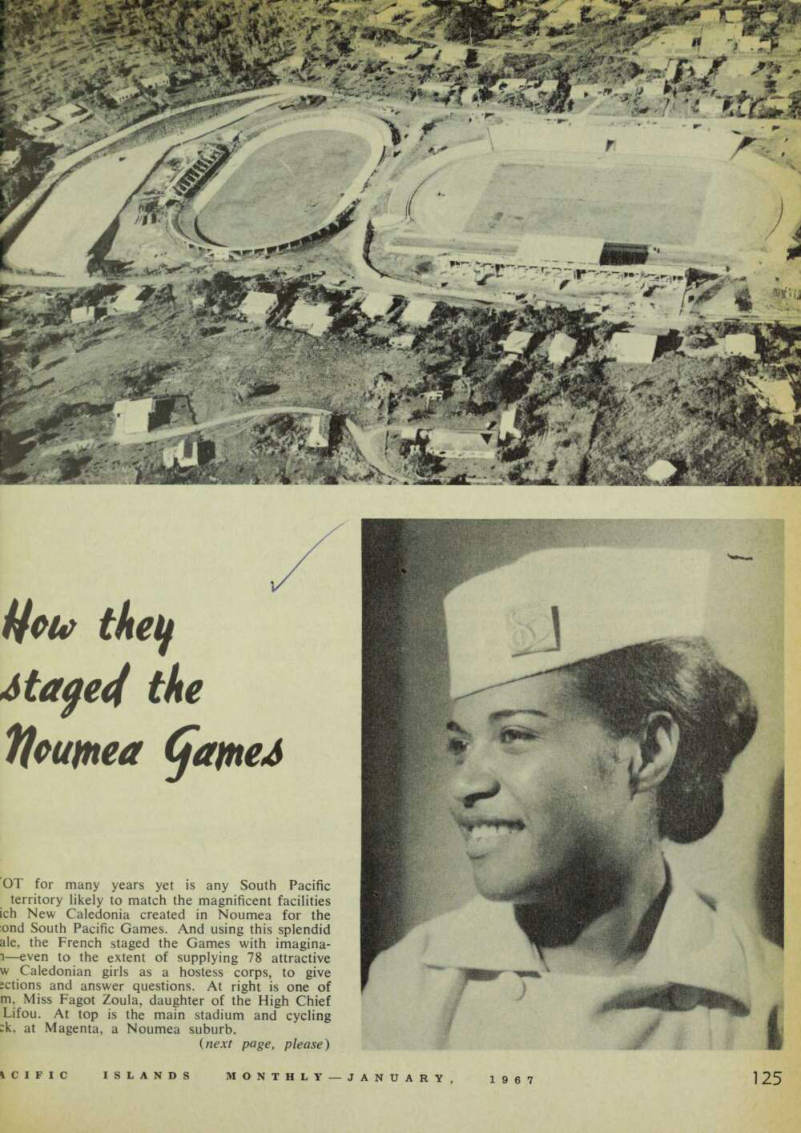
[?]OT for many years yet is any South Pacific territory likely to match the magnificent facilities [?]ich New Caledonia created in Noumea for the [?]ond South Pacific Games. And using this splendid ale, the French staged the Games with imagina [?]n—even to the extent of supplying 78 attractive [?]w Caledonian girls as a hostess corps, to give [?]sctions and answer questions. At right is one of m. Miss Fagot Zoula, daughter of the High Chief [?]Lifou. At top is the main stadium and cycling [/]ck at Magenta, a Noumea suburb. (next page, please )
The main stadium and cycling track were completed in 16 months from May, 1964. The stadium has an arena for soccer and rugby, a six-lane running track 400 metres long, and eight lanes in the 140-metre straight. There is also a steeplechase course and all facilities for field events. A control tower provides a comprehensive view of the field.
There is standing room for about 16,000 spectators.
The cycling arena, just behind the main stadium, has a concrete track 333.3 metres in circumference, a football field in the middle, and
accommodation for several thousand spectators.
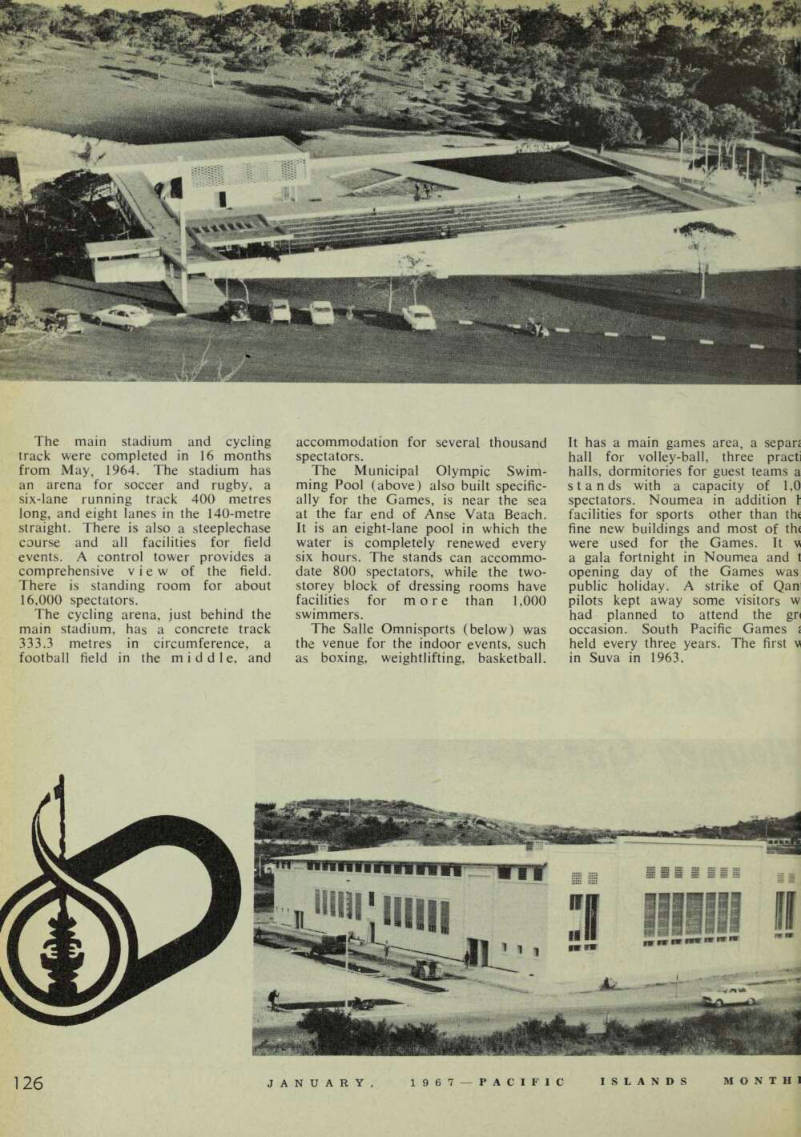
The Municipal Olympic Swim ming Pool (above) also built specific ally for the Games, is near the sea at the far end of Anse Vata Beach.
It is an eight-lane pool in which the water is completely renewed every six hours. The stands can accommo date 800 spectators, while the two storey block of dressing rooms have facilities for more than 1,000 swimmers.
The Salle Omnisports (below) was the venue for the indoor events, such as boxing, weightlifting, basketball.
It has a main games area, a sepan hall for volley-ball, three practi halls, dormitories for guest teams a stands with a capacity of 1,0 spectators. Noumea in addition Y facilities for sports other than the fine new buildings and most of the were used for the Games. It v, a gala fortnight in Noumea and t opening day of the Games was public holiday. A strike of Qan pilots kept away some visitors w had planned to attend the gr« occasion. South Pacific Games i held every three years. The first v in Suva in 1963.
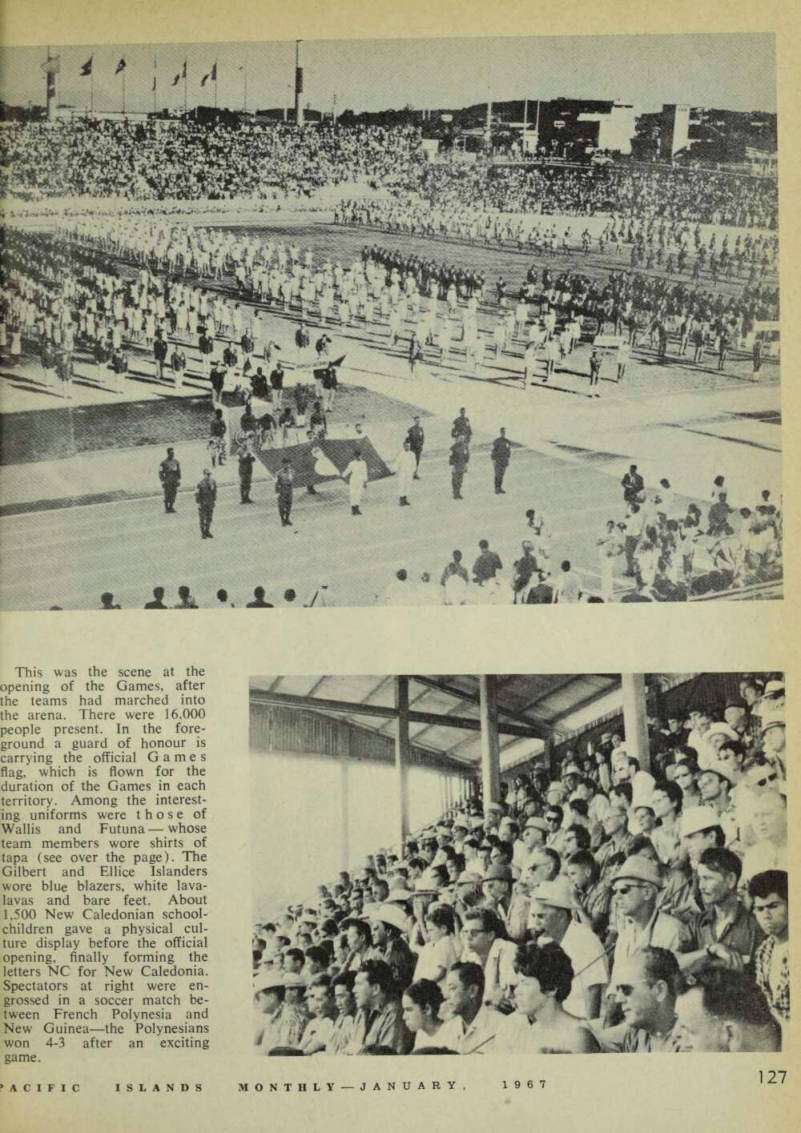
This was the scene at the opening of the Games, after the teams had marched into the arena. There were 16,000 people present. In the fore ground a guard of honour is carrying the official Games flag, which is flown for the duration of the Games in each territory. Among the interest ing uniforms were those of Wallis and Futuna—whose team members wore shirts of tapa (see over the page). The Gilbert and Ellice Islanders wore blue blazers, white lava lavas and bare feet. About 1,500 New Caledonian school children gave a physical cul ture display before the official opening, finally forming the letters NC for New Caledonia.
Spectators at right were en grossed in a soccer match be tween French Polynesia and New Guinea—the Polynesians won 4-3 after an exciting game.
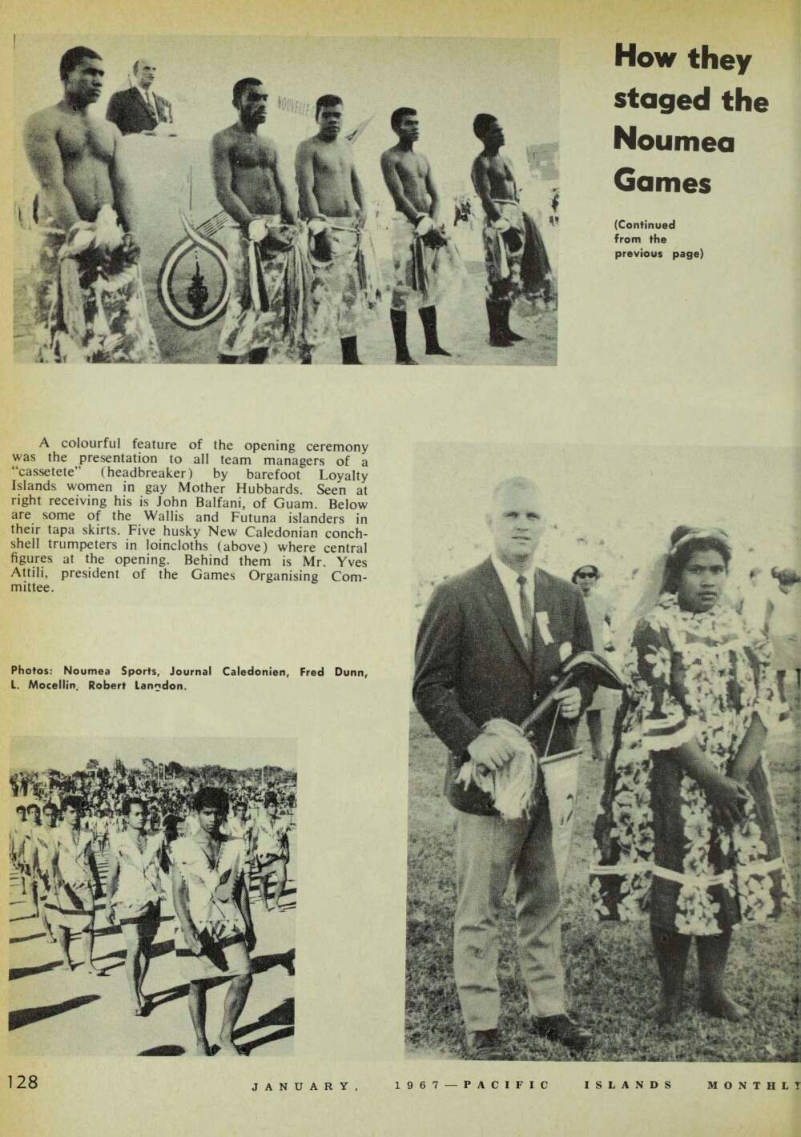
A colourful feature of the opening ceremony was the presentation to all team managers of a “cassetete” (headbreaker) by barefoot Loyalty Islands women in gay Mother Hubbards. Seen at right receiving his is John Balfani, of Guam. Below are some of the Wallis and Futuna islanders in their tapa skirts. Five husky New Caledonian conch shell trumpeters in loincloths (above) where central figures at the opening. Behind them is Mr. Yves Attili, president of the Games Organising Com mittee.
Photos: Noumea Sports, Journal Caledonien, Fred Dunn, L. Mocellin. Robert Langdon.