Group brought dynastic troubles
pp. 95-99 · Read in the full issue


When France's control of Wallis Group brought dynastic troubles
By H. E. L. Friday
In 1840, a few years before Rear-Admiral Dupetit- Thouars arrived in Tahiti to arrest British Consul Pritchard and “destroy the last semblance of Tahitian independence”, the French Marist missionaries established themselves in Wallis and Futuna, which rapidly became the most priest ridden isles in the Pacific.
4 WRITER in Stewart’s Handbook of the Pacific Islands (1922 dition), remarked that the native rould not do more than was bsolutely necessary for his own and to pay the calls made on im by the church, adding: “The 'hole island is under the sway of oman Catholicism, and the priests idirectly rule in all matters. The fench Resident, although the repre mtative of the ruling power, has no olice or any other force to main lin order, and all wrong-doing is idged by a council of chiefs who lete out punishment in the form of nes or labour for a given period, Kcept criminal cases, which are held ver until the arrival of a French anboat which transports the parties sncerned to New Caledonia, there ) undergo trial”.
Troublesome Islanders
In the last century the islanders ften proved troublesome. HMS awn, when she called at Noumea in 862, had just exacted payment of 0 tons of coconut oil from Wallis, alued at £6OO, this being a fine that [MS Elk had inflicted on the fallesians for having plundered a lipwrecked vessel and maltreated le crew. They found that Queen avalua had only a few fingers left, )r she followed the Tongan custom f cutting off a joint for every near dative who died, as a mark of ffection.
Wallis had become a sort of altural province of Tonga in the fteenth century, after being con uered by a fleet of Tongan war anoes. Futuna, a hundred miles way, whose fortifications were on igher ground, resisted the invader nd so retained a more primitive type f Western Polynesian culture.
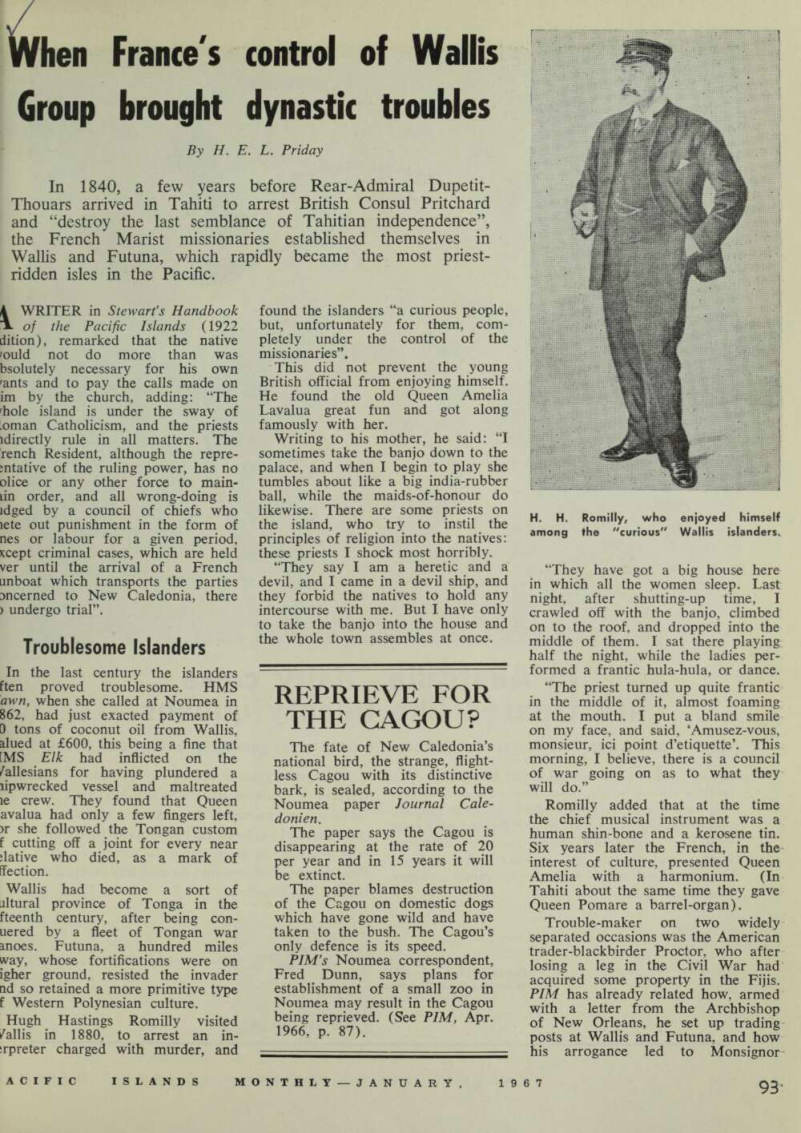
Hugh Hastings Romilly visited /allis in 1880, to arrest an in :rpreter charged with murder, and
found the islanders “a curious people, but, unfortunately for them, com pletely under the control of the missionaries”.
This did not prevent the young British official from enjoying himself.
He found the old Queen Amelia Lavalua great fun and got along famously with her.
Writing to his mother, he said: “I sometimes take the banjo down to the palace, and when I begin to play she tumbles about like a big india-rubber ball, while the maids-of-honour do likewise. There are some priests on the island, who try to instil the principles of religion into the natives; these priests I shock most horribly.
“They say I am a heretic and a devil, and I came in a devil ship, and they forbid the natives to hold any intercourse with me. But I have only to take the banjo into the house and the whole town assembles at once.
“They have got a big house here in which all the women sleep. Last night, after shutting-up time, I crawled off with the banjo, climbed on to the roof, and dropped into the middle of them. I sat there playing half the night, while the ladies per formed a frantic hula-hula, or dance.
“The priest turned up quite frantic in the middle of it, almost foaming at the mouth. I put a bland smile on my face, and said, ‘Amusez-vous, monsieur, ici point d’etiquette’. This morning, I believe, there is a council of war going on as to what they will do.”
Romilly added that at the time the chief musical instrument was a human shin-bone and a kerosene tin.
Six years later the French, in the interest of culture, presented Queen Amelia with a harmonium. (In Tahiti about the same time they gave Queen Pomare a barrel-organ).
Trouble-maker on two widely separated occasions was the American trader-blackbirder Proctor, who after losing a leg in the Civil War had acquired some property in the Fijis.
PIM has already related how, armed with a letter from the Archbishop of New Orleans, he set up trading posts at Wallis and Futuna, and how his arrogance led to Monsignor
H. H. Romilly, who enjoyed himself among the "curious" Wallis islanders.
itaillon and his congregation seizing s cork leg and holding him cummunicado until the French jam sloop Veri came to take him /ay. The Marists asserted that he id wanted to make himself king of e group.
But details have not been pub hed of how, years later, after he and made himself widely unpopular th the French in the New Hebrides, octor turned up on Futuna to set I a dynastic disturbance.
One day the French transport orff returned to Noumea from that e with a native named Stephano loufou, who had been exiled by i French Resident as a danger to blic security. He was held by the jw Caledonian Governor on the e of Pines, at the request, it was ited, of the two native kings of ituna.
Pretender to throne
The story is that Proctor and his ;rman backers in Samoa wanted win the Futuna copra trade by dermining French and Catholic in ence. Proctor set up Laoufou, a jmber of one of the royal families, pretender to the throne, and oufou did, in fact, attract to his use a large party of disgruntled anders who were already agin the vernment.
The coup misfired, the Laoufou rty was overcome, and once again j disgruntled American left for a al period of trouble-shooting in i New Hebrides, before eventually wing to Australia.
It was with Queen Amelia, the happy daughter of old kind Lavelua Wallis, that the French in 1886 ned anew treaty. The Governor ived from Noumea on the Dives declare a protectorate over the }up. France’s reply to British, :rman and American activities in : South Pacific,
King makers busy
Dynastic argument followed Queen nelia Lavelua’s death in 1895.
Powers of one Isaac, or Aisaaka velua, who regarded himself as her vful successor, staged a revolt and irched on the French residency.
Isaac had a genuine claim, his mdfather having ruled Wallis for ne years, following the assassina n of several of his brothers—the niliar story of wading through >od to a throne.
But the French Resident, Mr. de Keroman, was too clever for the revoltees. Taking his stand on what he termed democratic principles, he tried to persuade Isaac that he must not take over the kingship by force. but wait for election by a Council of Ministers.
While he was parleying with Isaac this council, which was under the thumb of the priests, chose as the Queen’s successor her own brother Vito. To celebrate this choice, the Marists staged a solemn Te Deum, and finally Isaac gave up his claim to the kingdom.
But king-makers were still busy on Wallis after Proctor quit the scene. Vito was not a great success and Aisaaka succeeded him, but he died in 1906, His cousin Sosefo Yantamakia, a man of about 50, then wore the crown as Sosefo Lavelua.
During a rebellion in 1910 many of his subjects, armed with guns and spears, surrounded his palace and fired several ill-directed shots, but the king was protected by his women folk and was not hit.
The French Resident sent for a
warship to restore order, and as the Kersaint happened to be in Noumea, the Governor sent off her commander with instructions to act firmly. But even before the warship arrived, the populace had deposed Sosefo and nominated his successor. It was with this successor, King Sevelona, that the French three years later arranged for out-and-out annexation.
There were more disturbances on Wallis two years after annexation.
The people attacked their new king, overturned his carriage, and left him for dead on a bush track. But he slowly returned to consciousness and crawled back home. The Resident had talks with the missionaries and other whites, after which a serious attempt was made to take away from the natives all firearms and even their native weapons. A huge pile was in fact collected, but a few weeks later the islanders were found to have fabricated for themselves a whole new armory.
There was then anew affray in which three Chinese barely escaped with their lives, and white store keepers were menaced. One of these, named Glenn, who managed the English store —much of the local trade passed through Fiji—com plained to the New Caledonian Governor, alleging that the natives had created the trouble to make the
1 'Threat l s Of Eternal unishment"
rice of copra more favourable to icm.
Glenn said that there was growing islike of the whites and that he had iffered a crack on the head.
It is worthy of note that at the me Monseigneur Blanc, Vicar postolic of Oceania, opposed raight-out annexation, fearing it light mean more power to the Resi gn! of the French Republic, Mr. r iotor Brochard. However, the lange in the status of the group as to make little real difference to
lissionary domination.
All the same, Monseigneur Blanc’s esitation is understandable. In Paris nnales Coloniales in 1913 pub shed an article by a “Rights of lan” Deputy named Maurice iolette which claimed that French •ceania had been turned into a nique seminary, and that one would ave to go back to the Middle Ages > find anything comparable with le methods of control that obtained iere.
He listed “threats of eternal pumsh lent, continual attacks on individual berty, a succession of work corvees :>r the natives, and incessant demands 3r money, and on occasion revolts taged with the issue of rifles and artridges” as some of the means mployed by the French missionaries.
The result, he said, was the com lete “abrutissement” of the popula ion, by the Society of Mary, whose ommercial transactions, he added, ontinued to prosper while the natives ast their “joie de vivre”.
Recent history
During World War II the Ameri an army which had a weather station in Wallis, brought some 200 Vallesians to Noumea. They em iloyed them mostly in timber milling it the Baie des Pirogues in the south, vhere they worked, I was informed, o the full satisfaction of their employers.
Since the war hundreds more Vallesians have followed to find work >r undergo military training in New Caledonia. Many worked on building he Yate dam. A few score did some brilliant sword and other Poly lesian dances at the New Caledonian :entenary celebrations in 1953, ;hough on that occasion the one or two women dancers present were, much to the chagrin of the crowd, prevented by an over-zealous gendarme from doing a Tahitian-type belly dance.