How To Keep Your Rain
p. 87 · Read in the full issue
Water Tank Clean
Household tank water can be kept clean and free of leaves and other rubbish with a cheap and easily constructed trap which will automatically divert the clean water into the tank when the dirty water from the roof has been collected.
THIS trap needs no attention or maintenance except for a simple emptying occasionally. The draining of the trap flushes out all of the collected rubbish, readying the trap for the next shower.
Materials required for the construehon of the trap are mainly scrap.
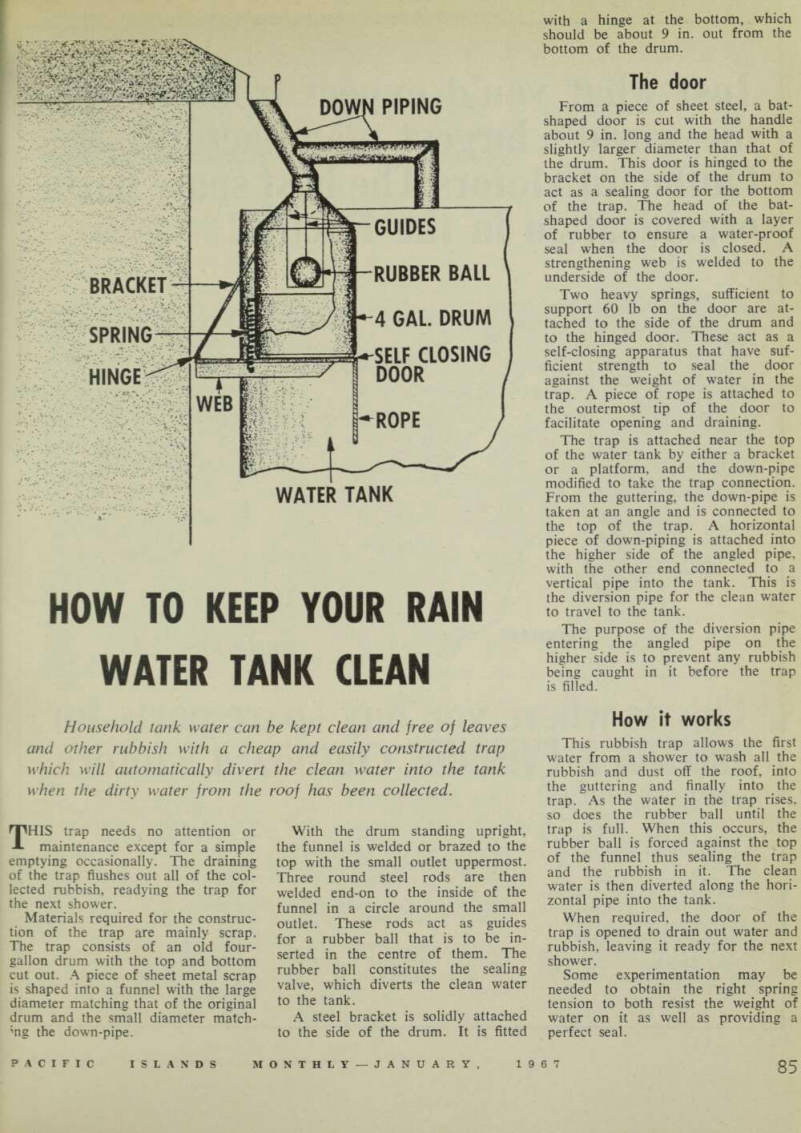
The trap consists of an old fourgallon drum with the top and bottom cut out. A piece of sheet metal scrap is shaped into a funnel with the large diameter matching that of the original drum and the small diameter matchmg the down-pipe.
With the drum standing upright, the funnel is welded or brazed to the top with the small outlet uppermost, Three round steel rods are then welded end-on to the inside of the funnel in a circle around the small outlet . These ro ds act as guides f a rubber ball that is t 0 be in . o , • .. r 56 "} J he c of ' hem ' Tj ru b b «r b? 1 ' constitutes the sealing valve, which diverts the clean water to I* l6 tank- A steel bracket is solidly attached to the side of the drum. It is fitted
with a hinge at the bottom, which should be about 9 in. out from the bottom of the drum.
The door
From a piece of sheet steel, a bat shaped door is cut with the handle about 9 in. long and the head with a slightly larger diameter than that of the drum. This door is hinged to the bracket on the side of the drum to act as a sealing door for the bottom of the trap. The head of the bat shaped door is covered with a layer of rubber to ensure a water-proof seal when the door is closed. A strengthening web is welded to the underside of the door.
Two heavy springs, sufficient to support 60 lb on the door are at tached to the side of the drum and to the hinged door. These act as a self-closing apparatus that have suf ficient strength to seal the door against the weight of water in the trap, A piece of rope is attached to the outermost tip of the door to facilitate opening and draining.
The trap is attached near the top of the water tank by either a bracket or a platform, and the down-pipe modified to take the trap connection.
From the guttering, the down-pipe is taken at an angle and is connected to the top of the trap. A horizontal piece of down-piping is attached into the higher side of the angled pipe, with the other end connected to a vertical pipe into the tank. This is the diversion pipe for the clean water to travel to the tank.
The purpose of the diversion pipe entering the angled pipe on the higher side is to prevent any rubbish being caught in it before the trap is filled.
How it works
This rubbish trap allows the first water from a shower to wash all the rubbish and dust off the roof, into the guttering and finally into the trap. As the water in the trap rises, so does the rubber ball until the trap is full. When this occurs, the rubber ball is forced against the top of the funnel thus sealing the trap and the rubbish in it. The clean water is then diverted along the hori zontal pipe into the tank.
When required, the door of the trap is opened to drain out water and rubbish, leaving it ready for the next shower.
Some experimentation may be needed to obtain the right spring tension to both resist the weight of water on it as well as providing a perfect seal.