Fiji can supply Santa Gertrudis
pp. 83-85 · Read in the full issue

to other Island territories
By Beryl Cates, in Suva
Introduced into Fiji by the Department of Agriculture in 1955, Santa Gertrudis cattle have proven themselves well suited for this particular tropical area. Since the Santa Gertrudis is highly tolerant of heat as well as drought, and already proven in 45 countries of the world, the breed should thrive in other tropical areas.
FOUR Santa Gertrudis bulls were first brought into Fiji from King Ranch in Australia. They were among the first Santa Gertrudis cattle born in Australia, and were the first ex ports from the Commonwealth. At this time no heifers were available in Australia and the bulls were used on Hereford, Shorthorn and grade Brahman cows at the Sigatoka Agri cultural Experiment Station and in two commercial herds.
After extensive inquiries in the USA, it proved possible, in April, 1958, to purchase 10 pure-bred heifers from the Armstrong Ranch in Texas. These cows were mated to one of the King Ranch (Australia) bulls, and the first pure-bred calves were born in early 1960.
Trial results
Unfortunately, all the original Aus tralian bulls were by the same sire, and it became evident that it would be difficult to do justice to the breed without a wider range of blood lines.
In 1963, two bulls and nine in-calf heifers were purchased from Texas.
The SPSM cattle estate at Yaqara acquired a Santa Gertrudis bull from Australia in 1963. This bull has been successfully crossed with the estate’s Herefords. Trials carried out under ranch conditions at Yaqara show the Hereford X Santa Gertrudis steers give a heavier and better quality carcase six months earlier than good, pure Herefords.
The Santa Gertrudis was developed on the King Ranch in South Texas to withstand semi-tropical and rugged range conditions, so its adapt ability to the Pacific areas is not altogether surprising.
To date, well over 100 pure-bred and grade Santa Gertrudis bulls have been sold to commercial beef pro ducers in all parts of Fiji, and the demand for bulls will probably ex ceed supply for a number of years.
By 1967 it is hoped the Sigatoka herd will be able to sell top quality Santa Gertrudis to other South Pacific territories, and orders for bulls have already been received from Western Samoa, the New Hebrides, New Caledonia, Niue Island, the Solomon Islands and Tonga.
The Sigatoka herd is a member of Santa Gertrudis Breeders’ International and only classified pure-bred bulls will be offered for sale outside Fiji.
Last August 35 animals were presented to visiting expert Robin Hart for classification with praiseworthy results. Santa Gertrudis Breeders’ International classifies animals when they are 18 months of age or older, and the owner can show proof that they are pure-bred, or have at least
• Beryl Cates, formerly on the land in New South Wales, is PI M’s agricultural correspondent in Fiji, where she now lives.
three top classes. This is one of the organisation’s major services.
The cattle are branded and recorded by the association if they meet the minimum requirements of the standard of excellence for the breed. This branding and recording ensures the recognition of superior animals and the elimination of in ferior ones.
Females are branded and recorded (S) if they meet maximum require ments of the type and accredited Santa Gertrudis, and (S) if they meet minimum requirements. For bulls there is only one category, that of being certified pure-bred. Animals not meeting minimum requirements are not branded.
Santa Gertrudis expert Robin Hart visited Fiji especially for classifica tion purposes. Of the 35 animals pre sented for classification 31 were branded S or S which is regarded considerably better than average.
Any cattleman who wishes to up grade his herd to pure-bred Santa Gertrudis status can without the initial purchase of pure-bred females.
Any base herd of females may be used; however, certified pure-bred (S) Santa Gertrudis bulls must be used. (Over)
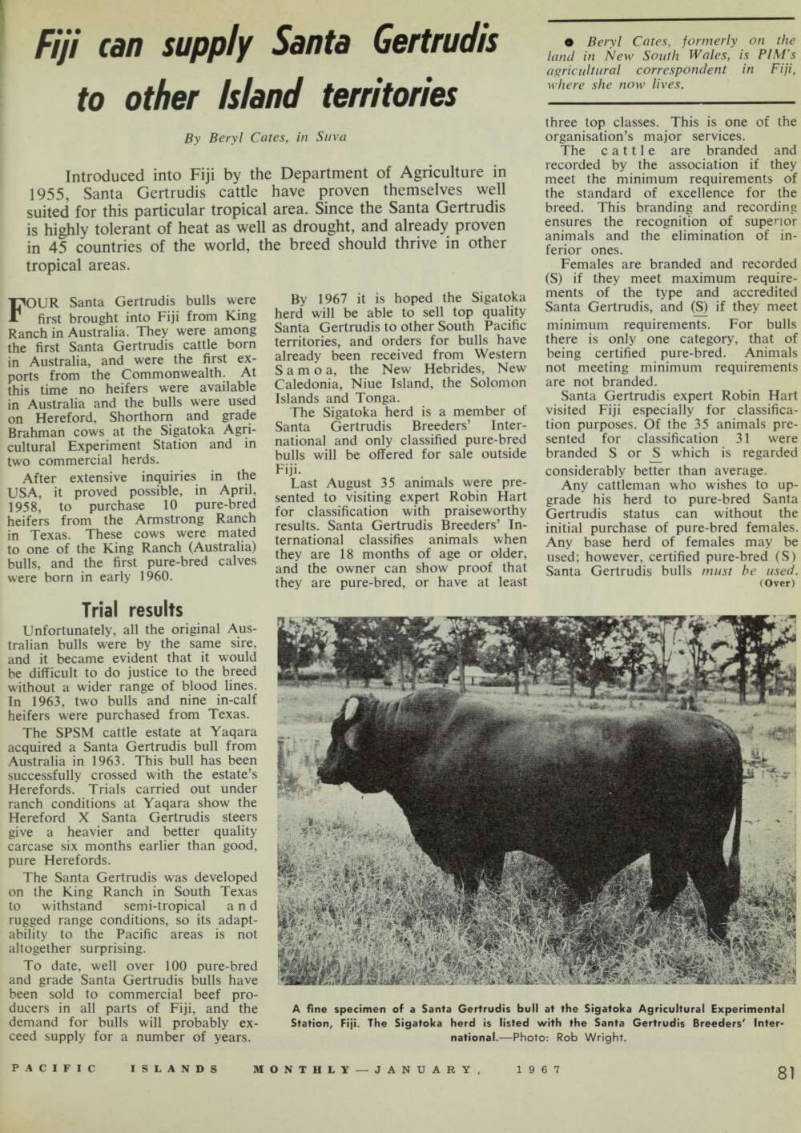
A fine specimen of a Santa Gertrudis bull at the Sigatoka Agricultural Experimental Station, Fiji. The Sigatoka herd is listed with the Santa Gertrudis Breeders' Inter national.—Photo: Rob Wright.
How to arrive at Four Top Classes S Bull 1 ] X - = i blood heifer —Ist Base Herd J S Bull 2 1 X \ = i blood heifer—2nd [ i blood heifer I S Bull 3 1 X j- = i blood heifer—3rd [ f blood heifer J S Bull 4 ] X J- = H blood heifer—4th i blood heifer J The Santa Gertrudis can make pro fitable gains of quality beef in hot climates and with sparse grazing.
Through the efficient utilisation of roughages it is unexcelled with regard weight for age.
Average weight for a bull is 1,700 lb and up in pasture conditions while cows weigh 1,200 lb and up at maturity.
Two to three per cent, more meat can be expected from animals with Santa Gertrudis breeding, and car cases with larger portions of the high priced cuts, and 55 per cent, plus dressing percentages are the rule, not the exception.
The breed can go long distances for food and water and has mag nificent stamina.
Santa Gertrudis cows produce an abundance of milk and have no trouble nursing calves to weaning.
The breed goes back to the early 1900’s when the King Ranch in Texas set out to produce cattle with good quality beef under adverse con ditions.
In 1910 greater hardiness was obtained by crossing the British breed with Brahman bulls, the Brahman having proved its hardiness on the range. The infusion of the rugged Brahman blood on a Shorthorn base gave noteworthy results.
Experiments went on for 10 years and then an outstanding bull calf was produced called “Monkey”. “Monkey” was a distinctive red colour, of good disposition and with deep and beefy heaviness for his age.
Born in 1920 and turned into a breeding herd of first cross red heifers in 1923, “Monkey’s” offspring were superior range and beef animals.
Before he died in 1932, “Monkey” had produced more than 150 useful sons that were used in select herds of Brahman infused Shorthorn cows.
By selective line breeding, occasional inbreeding and skilful mass selection the characteristics of the bull and his offspring were rapidly established in all descendants.
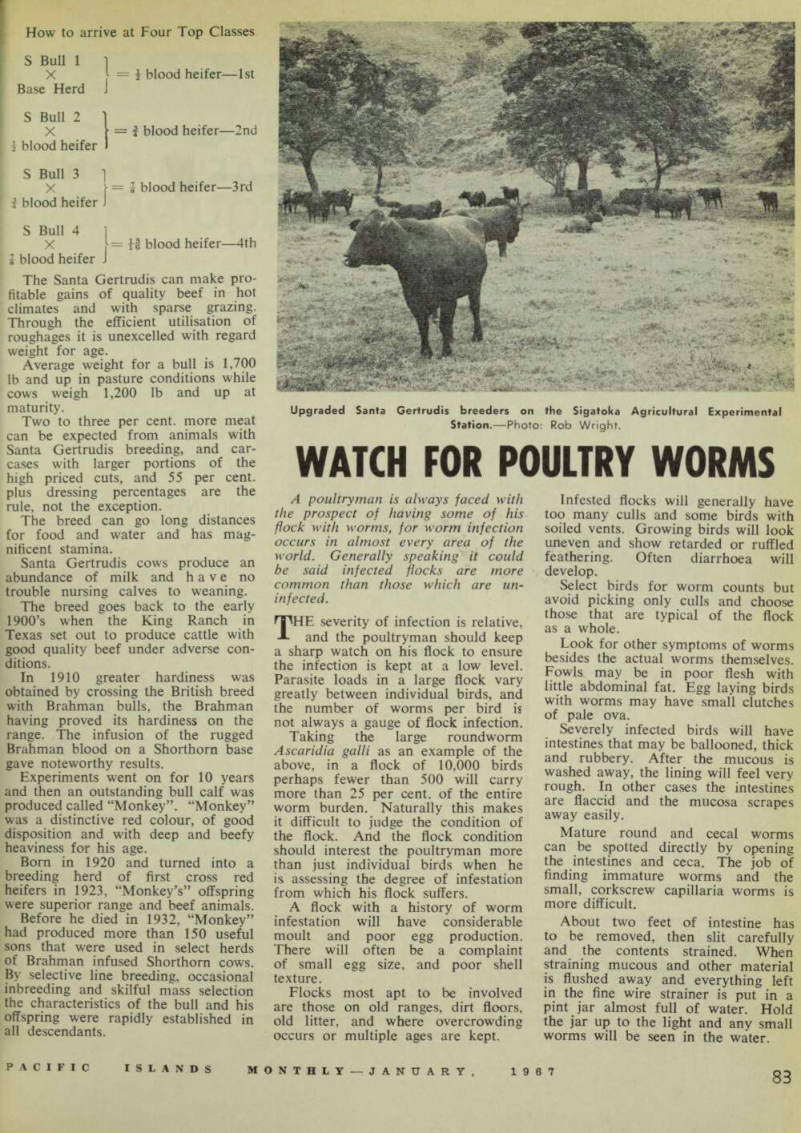
Upgraded Santa Gertrudis breeders on the Sigatoka Agricultural Experimental Station.—Photo: Rob Wright.