To The Point
pp. 43-46 · Read in the full issue
With
Percy
Chatterton
The eleventh meeting of the P-NG House of Assembly has come and gone. It has been notable for exhaustive debates on two major issues. The first of these was the renewed attempt by the member for Bougainville, Mr. Paul Lapun, to secure the amendment of the recently passed Min ing Ordinance, to provide that landowners under whose land minerals are found receive 5 per cent, of royalties paid to the Administration, in addition to rent and compensation for actual damage.
A LOT of controversy has gone on in the territory on this issue luring the last few months—con roversy notably enlivened by the >articipation in it of a colourful toman Catholic bishop; and the Administration, realising the im portance of getting the matter settled Mice and for all, not only did not esort to a procedural technicality o block the move, but also made no ittempt to shorten the discussion.
The result was a marathon debate, it the end of which Mr. Lapun ecured the passage of his bill by a omfortable majority.
It now remains to be seen whether he Commonwealth Government will iccept this verdict. It also remains o be seen whether this victory of dr. Lapun’s is going to solve all he problems which have been created >y inept handling of the situation n the past. But at least it should lelp.
"Most extraordinary"
The second debate, that on the treasurer's Income Tax Bill, was he most extraordinary which has fet taken place in the House, and lerhaps one of the most extra ordinary which has ever taken place n any legislature.
The aim of the bill was to spread he incidence of income tax down vards to lower income brackets, and ;o to spread the tax load, which has oreviously fallen on the expatriates md a few of the higher paid in ligenes, over a wider sector of the community.
A worthy aim, and one which has oeen repeatedly urged upon the Administration by elected members of the House.
But how to implement it? Our iccustomed panoply of tax returns, :oncessional deductions, group certi icates and refunds would be quite jnworkable in a sector where many
'We wanna be taxed!'
of the employees and some of the employers are illiterate.
Mr. Newman’s solution is sim plicity itself.
Leave the existing sophisticated system intact for the higher income groups, and for the lower ones charge a straight 2 per cent on the contents of the pay packet, euphe mistically described as “chargeable income”. This impost to start at a pay level of $8 a week, and to apply to all salaries up to $l,OOO a year.
At the intermediate level, from $l,OOO a year up to the point at which the taxpayer becomes liable to pay more than $2O under the Australian-type system, there will be a flat rate of $2O a year tax.
Simple indeed! But full of anomalies and inequities, particularly in the intermediate range.
And pretty brutal to the married man in a town job, with a family to feed on food bought in store or market out of a salary of $8 a week.
These points were made early in the debate, but they fell on deaf years. In fact, most of the indigenous members who took part in the debate didn’t actually talk about the con tents of the bill at all.
Their speeches were all variations on the theme, “We wanna be taxed”.
Everybody must pay tax. They must pay till it hurts. No nonsense about concessions. If people had children, that was their own business. Why should they expect to pay less tax?
Even the Treasurer, when the time came for him to reply to the debate, didn’t need to counter the criticisms which had been levelled at his bill. He clearly had it “in the bag”.
The bill passed its second reading on the voices, and pretty clamourous voices at that. At the committee stage Tony Voutas, the newly elected member for Kaindi, made a last minute bid to secure some easing of the burden on the family man with an amendment to make the starting point for taxpaying S 8 a week for a man with no dependents, $l2 a week for a man with up to three dependents, and $l6 a week for a man with more than three depen dents.
All he got for his trouble was some quite undeserved personal abuse, a thing we haven’t had much of in our legislature so far. It almost looks as if those “political education” visits to Canberra are bearing fruit!
The House would have none of it, and when it was pressed to a division, only 11 members were found to vote for it.
Theme for the Beatles!
“We wanna be taxed”. What a wonderful theme for a Beatles song!
But even if such a song had been written, and the Beatles had been there in person to sing it, the atmo sphere could hardly have been more emotional than it was.
How to explain this strange scene?
I think that there are at least three underlying factors.
First, it must be remembered that, while the apparatus of concessional deductions is so familiar to us that we take it as a matter of course, it is a completely new idea to all but a very few Papuans and New Guineans —those whose salaries have
brought them within the range of taxation on “taxable income”.
The only kinds of tax which the vast majority of Papuans and New Guineans have ever known are head tax, of late years euphemistically known as “personal tax”, and local government tax, which is also a head tax.
In the second place, most of the indigenous members of the House come from rural homes and their wives contribute to the sustenance of the family by making food gardens.
They find it difficult to visualise a town situation in which food for the whole family has to be bought out of wages in market or store; and consequently cannot see any reason why a married man should pay less tax than a single one.
Finally, and I think that this ex plains the emotional element in the debate, Papuans and New Guineans are becoming increasingly sensitive to reminders of the extent to which the territory is dependent financially on the beneficence of Australia.
These reminders have sometimes been rubbed in with barbed phrases like “a mendicant economy”.
Feelings of guilt
Australia’s generosity has evoked, and still does evoke, feelings of gratitude in the hearts of Papuans and New Guineans. It looks as if it is beginning to evoke also feelings of guilt, or at any rate of shame.
This may be no bad thing if it provokes to greater effort. But I think that we should be on our watch to sense the point at which gratitude may sour into resentment at being cast for the part of poor relation.
The stance of perpetual gratitude is a difficult one to sustain.
Whether the fruits of this new tax law are in fact going to make the territory substantially more self supporting is doubtful.
It is generally agreed that, while the educative and psychological effects may be considerable, the financial gains will not be great. In fact, they will be a mere drop in the bucket.
However, there it is. We march bravely into 1967, singing “We wanna be taxed”.
YOU will read these words early in the New Year—my 43rd New Year in Papua. In my early years at Hanuabada, the young people of what was then a typical Papuan village—differing only very slightly from those further away from the capital celebrated New Year’s morning in rather an odd fashion.
Bevies of village maidens swept through the village seizing on any young men they met, and carrying them struggling to the water’s edge, where they tossed them unceremon iously into the sea amidst loud cries of “Happy New Year”,
"Everybody in!"
After a while the young men began to retaliate, and, as the fun warmed up, the married folk joined in. The tempo of plops and “Happy New Year’s” accelerated until the supply of unimmersed bodies began to thin out and the din slowly sub sided as everyone went home to change their clothes—not very ex tensive or elaborate in those days.
Birth of a New Year custom
One year I yielded to the pleadings of a group of excited schoolgirls and allowed myself to be thrown in.
However, the “drink” on the shore side of a marine village in Papua is not too salubrious, and I did not encourage a repetition of the ritual on subsequent occasions.
Many years later I stumbled on what I think was a clue to this odd custom.
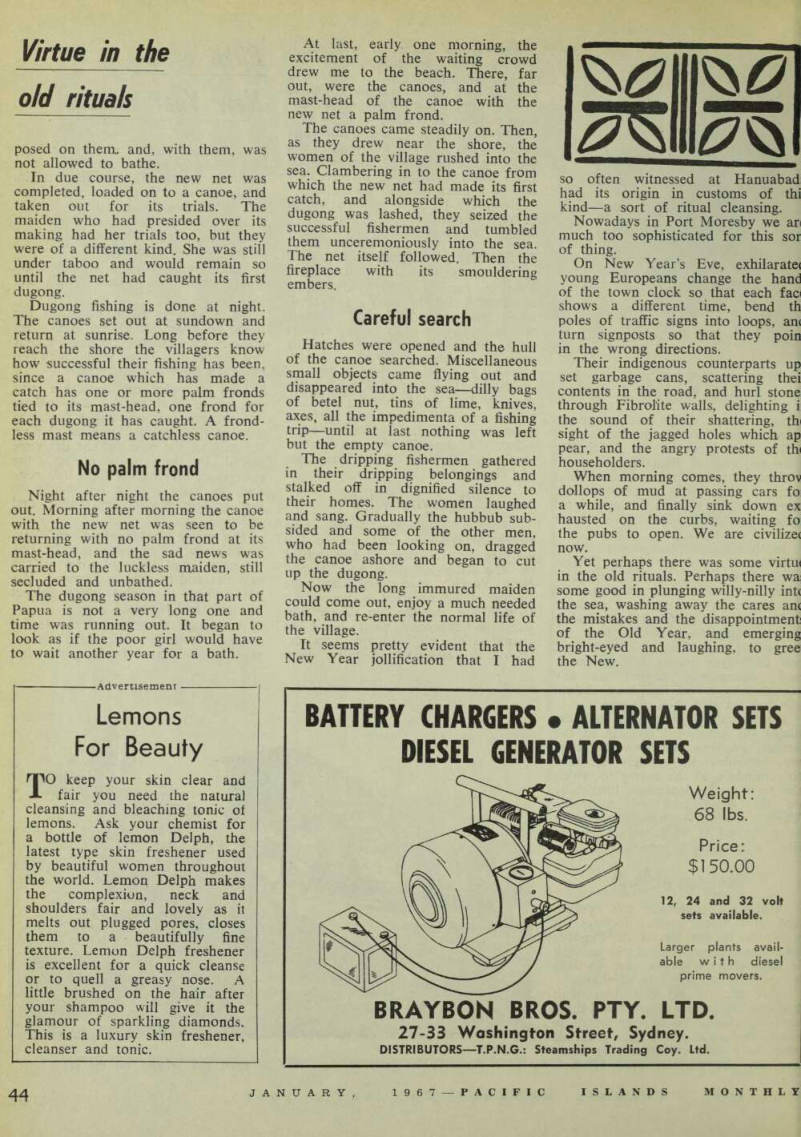
At a village many miles to the west of Port Moresby, and less affected by changing customs, a new dugong net was being made, with full observance of ancient ritual.
First a palm-leaf enclosure was erected to shut in the net makers and protect their operations from the gaze of the curious. Supplies of fibre for making the rope for the net were stored in the enclosure, and the process of making the fibre into rope and the rope into a net began to the accompaniment of ritual and taboo.
The spirits of the net-makers’ fore bears were called upon one by one by name, and their blessing on the new net and its makers invoked. The net makers themselves were subject to rigid food taboos.
A teenage daughter of the leader of the net makers became a sort of mascot. She shared in the taboos im-
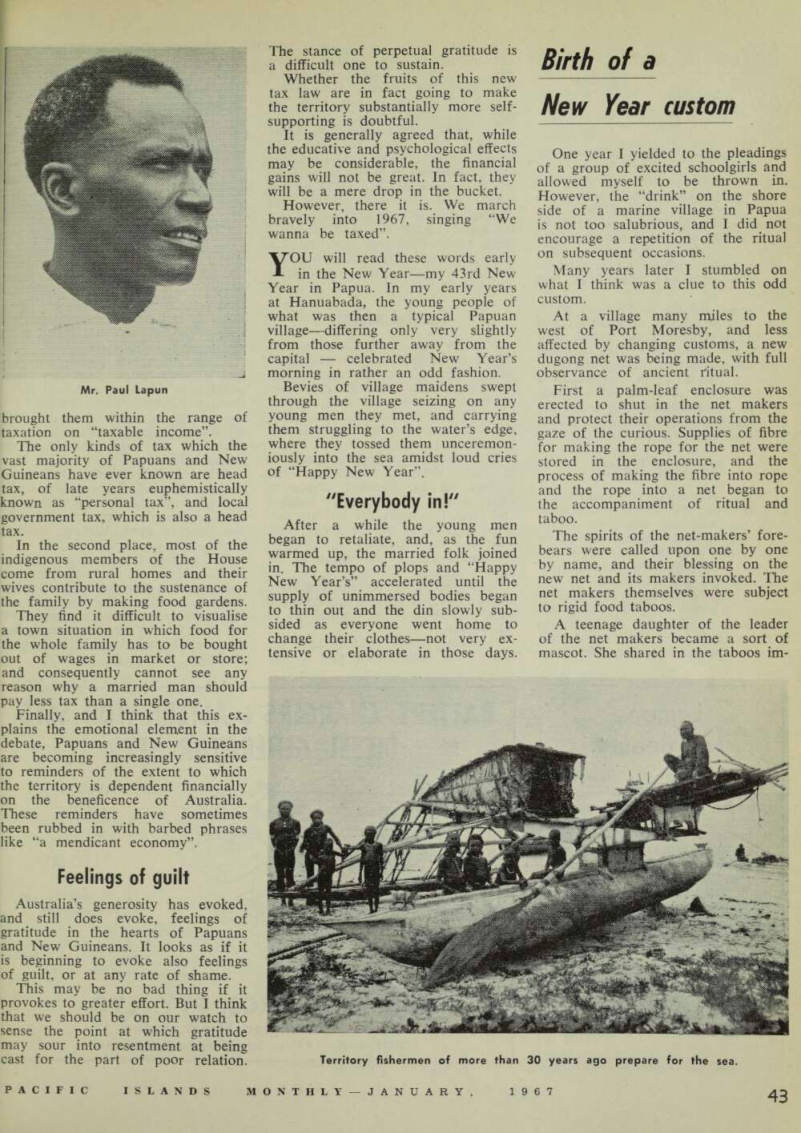
Mr. Paul Lapun
Territory fishermen of more than 30 years ago prepare for the sea.
Virtue in the old rituals
posed on them, and, with them, was not allowed to bathe.
In due course, the new net was completed, loaded on to a canoe, and taken out for its trials. The maiden who had presided over its making had her trials too, but they were of a different kind. She was still under taboo and would remain so until the net had caught its first dugong.
Dugong fishing is done at night.
The canoes set out at sundown and return at sunrise. Long before they reach the shore the villagers know how successful their fishing has been, since a canoe which has made a catch has one or more palm fronds tied to its mast-head, one frond for each dugong it has caught. A frond less mast means a catchless canoe.
No palm frond
Night after night the canoes put out. Morning after morning the canoe with the new net was seen to be returning with no palm frond at its mast-head, and the sad news was carried to the luckless maiden, still secluded and unbathed.
The dugong season in that part of Papua is not a very long one and time was running out. It began to look as if the poor girl would have to wait another year for a bath.
At last, early one morning, the excitement of the waiting crowd drew me to the beach. There, far out, were the canoes, and at the mast-head of the canoe with the new net a palm frond.
The canoes came steadily on. Then, as they drew near the shore, the women of the village rushed into the sea. Clambering in to the canoe from which the new net had made its first catch, and alongside which the dugong was lashed, they seized the successful fishermen and tumbled them unceremoniously into the sea.
The net itself followed. Then the fireplace with its smouldering embers.
Careful search
Hatches were opened and the hull of the canoe searched. Miscellaneous small objects came flying out and disappeared into the sea—dilly bags of betel nut, tins of lime, knives, axes, all the impedimenta of a fishing trip—until at last nothing was left but the empty canoe.
The dripping fishermen gathered in their dripping belongings and stalked off in dignified silence to their homes. The women laughed and sang. Gradually the hubbub sub sided and some of the other men, who had been looking on, dragged the canoe ashore and began to cut up the dugong.
Now the long immured maiden could come out, enjoy a much needed bath, and re-enter the normal life of the village.
It seems pretty evident that the New Year jollification that I had
so often witnessed at Hanuabad; had its origin in customs of thi kind—a sort of ritual cleansing.
Nowadays in Port Moresby we an much too sophisticated for this sor of thing.
On New Year’s Eve, exhilaratet young Europeans change the hand of the town clock so that each fac< shows a different time, bend th poles of traffic signs into loops, anc turn signposts so that they poin in the wrong directions.
Their indigenous counterparts up set garbage cans, scattering thei contents in the road, and hurl stone through Fibrol’ite walls, delighting i the sound of their shattering, tht sight of the jagged holes which ap pear, and the angry protests of th< householders.
When morning comes, they throv dollops of mud at passing cars fo a while, and finally sink down ex hausted on the curbs, waiting fo the pubs to open. We are civilize< now.
Yet perhaps there was some virtu< in the old rituals. Perhaps there wa some good in plunging willy-nilly intc the sea, washing away the cares am the mistakes and the disappointment! of the Old Year, and emerging bright-eyed and laughing, to gree the New.