[?]Second South Seas
pp. 7-8 · Read in the full issue
[?]Olympics" Went Off
With A Bang, Too
(and with a lot of unhappy background noises)
By Robert Langdon, who was in Noumea for the Games.
When the First South Pacific Games were iged in Suva in 1963, PlM’s report of that r ent was headed enthusiastically, “First South :as ‘Olympics’ Went Off With A Bang”. The port spoke of the friendly, carnival atmosphere Suva during the Games, and said that the ames, themselves, from both the sporting and cial viewpoints, were an undoubted success.
IHIS time, three years later, I feel that a similar heading to the e we had last time is again called r. But, although I would like to ; it otherwise, I think that almost ual billing must be given to the happy background noises (emanat \ from a large section of the visit ; athletes and officials) that accom nied the Games from beginning to d.
The fact is that although the unes were a brilliant success as a sctacle and from a sports point of ;w, they were a dismal failure
cially and diplomatically.
Some of the behind-the-scenes ar ngements left so much to be desired at many of the athletes and officials :nt home with most unpleasant jmories.
About 1,200 athletes from 14 cific territories took part in the ames. Their programme began on icember 8 with a display by local tioolchildren and a colourful parade all the teams in a magnificent idium. of Olympic standards, that d been especially built for the ames.
The stadium, an astonishing eye iener for many of the athletes, was ic of the main items on the credit le for the Games organisers.
Three other first class arenas—a lodrome, swimming pool and in ter sports hall (see p. 125) —had so been specially built. The total >st of the arenas was SA4 million.
The vast number of Games fixtures
that were staged in these and other arenas were run with efficency and precision that also did great credit to the Games organisers.
Although the standards of some of the teams and individual contestants were sometimes startlingly uneven, most sections of the programme pro vided close, interesting and often exciting contests, and many fine per formances were registered.
Good value
There is no doubt that the many local people who paid to see the various events were well satisfied with the value they got for their money.
New Caledonia, the host territory, with a massive contingent of 250 sportsmen and women, easily carried off the bulk of the medals—and deservedly, for they were clearly superior in many fields.
In the three years since the First Games in Suva, France had spared no expense or effort in training the territory’s most promising athletes for a big “kill” on their home ground.
Some athletes were sent to France for training and competition against France’s best. The others were licked into shape at home by top coaches
sent out from France, and in specially built facilities.
There was none of the Suva holi day spirit in the New Caledonians’ approach to the Games, They were out to win as often as they could; and the lesson is plain that the other territories must adopt the same rigorous training methods and same professional approach if they are to do as well next time.
In anticipation of a large number of New Caledonian victories, plus others by New Caledonia’s sister territory, French Polynesia, the French authorities imported a smart, well-drilled, 57-piece military brass band in two parts from Tahiti and France to play the Marseillaise each time the victors collected their medals.
The other territories had special, non-nationalist, tunes for when they won gold medals—and there was a general feeling among the visitors
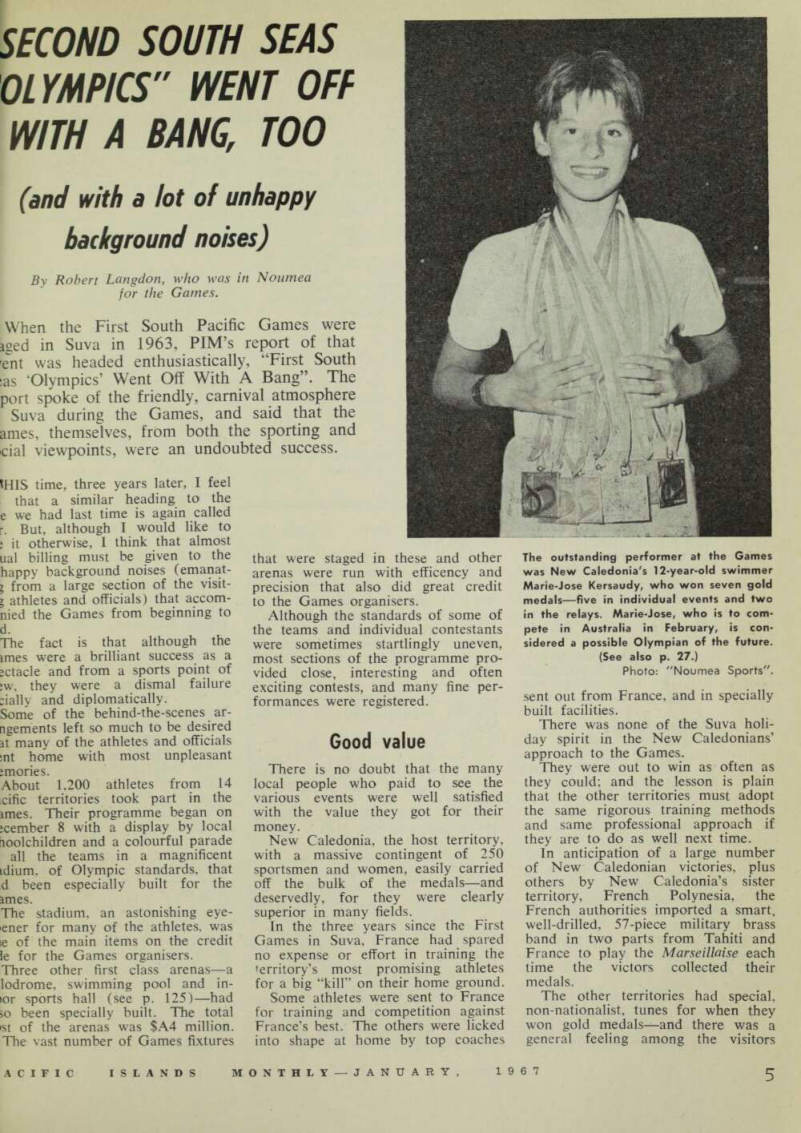
The outstanding performer at the Games was New Caledonia's 12-year-old swimmer Marie-Jose Kersaudy, who won seven gold medals —five in individual events and two in the relays. Marie-Jose, who is to com pete in Australia in February, is con sidered a possible Olympian of the future. (See also p. 27.) Photo: "Noumea Sports".
that the French, too, should have provided something similar.
Both the French view and the non- French view have something to be said for them—the first being so strongly held that the French are un likely to change their ways at future Games.
Bridging the gap in outlook be tween the French and non-French speakers will always be difficult, and it seems essential that more attention must be given in future to providing skilled interpreters to act as liaison officers.
In Noumea, this work was largely entrusted to a charming corps of 84 young, volunteer hostesses, who, al though they tried hard, were not always equal to the task allotted them because of their inadequate English.
Despite their shortcomings, the visiting athletes and officials were loud in their praises of the hostesses, as they were of many of the New Caledonian Games officials.
Roundly condemned
However, the same cannot be said about some of the key officials who were imported from France to organise the Games. These men were roundly condemned for; • Their high-handed, inconsiderate and uncompromising attitude over de tails of the Games programme, • The poor accommodation and facilities provided for a large section of the athletes, and the lack of thought and attention given to pro viding sufficient and suitable food for them.
The French officials appear to have made no effort to understand and accommodate the views of the non- French territories over the staging of Sunday sport and over details of the athletics programme.
They insisted on holding the athletics events over four consecutive days when it was widely felt that these events should be spread over the whole Games programme to en able the athletes to get maximum rest; and they insisted on holding events on Sunday, December 11, even though Fiji and Tonga had made it known many months earlier that it was against the religious convictions of their sportsmen (and even the law, in the case of Tonga) to play sport on the Sabbath.
When the Fiji officials found on arrival in Noumea that the French had completely ignored their view point and were unwilling to change anything, they asked their athletes to waive their objections to Sunday sport, if they could, rather than spoil the athletics programme or hand gold
medals on a platter to the New Caledonians.
The Tongans, however, are bound by their constitution not to work or play on the Sababth, and their small team of eight athletes was unable to compete in at least three events.
Far more regrettable, however, was the lamentable accommodation pro vided for a large section of the athletes.
The athletes were quartered in six schools—four for the men and two for the women—scattered all over Noumea.
The women appear to have been well fed, well housed and well looked after, as were the male athletes from the two Samoas (who were billeted together) as well as the French speaking New Caledonians, French Polynesians and New Hebrideans.
The remaining athletes—4oo of them from the Cook Islands, Fiji, GEIC, Guam, Nauru, P-NG.
Solomons, Tonga, and Wallis and Futuna—were herded together in the La Perouse High School in such cramped conditions that comparisons with the Black Hole of Calcutta were inevitable.
Twenty-eight Fijians, for example, were squeezed into one classroom about 27 ft long by 25 ft broad.
Their double-deck beds were iammed together without an inch of space between them so that the only way
of reaching some of them was? crawling over three or four oth There were no wardrobes, no min only one or two tables, and a mu shift rack for stowing suitcases. " was typical of all the other roo Originally, it had been inter] to quarter the French Polyne: team at the La Perouse School to put the Fijians in the same scK as the New Caledonians. Howe the Polynesian team happened arrive first, and after taking one I at the rooms that had been alia to them, they demanded sometl better and were transferred.
11 toilets for 400
A Papua-New Guinea official me that when his team arrived!
Tontouta Airport by special chai plane flight from Port More: there was no one at the airport meet them and no transport to t them the 30-odd miles into Noun “This was typical of the treatir we got throughout our stay,” he si “When we arrived at the Perouse High School, we found t there were only four showers for 400 athletes to be quartered tt and only 11 toilets.
“When we complained about number of showers, the authorii hastily put in 18 others, but unj there was full water pressure—i often there was not—they woulc work.
“Because of the lack of water, j the heavy demand on them, toilets got blocked up and the brigade had to be called in to cL them out.
“Meanwhile, we had very little; eat—only bread and tea for bre fast, and no greens at other me; It was not until we had been Noumea for four days that pro and adequate food was provided.
“This deficiency undoubtedly versely affected many performance The official added that there I been much ill-feeling because French-speaking athletes had I priority at meal times and in matt of transport.
In view of all this, and becai of the scattered nature of the Gar “villages”, it is not surprising t: there was little fraternisation friendship between members of French and English-speaking teai or between the men and women.
The Noumea Games are theref : likely to go down in South SI sporting history as the unhappy, t friendly Games—a great pity, as thu would not have been a single athll from any territory who wanted it tl way. • For further reports, see pp. 23-36