New Caledonia: An Island Gem, If
pp. 127-135 · Read in the full issue
You Forget The Traffic Hazards
By G. Douglass
New Caledonia, which is playing host to the Second South Pacific Games this December, is a South Pacific gem. Less glamourised, less sophisticated than the islands of Australia’s Barrier Reef, it is a fascinating island that can be reached just as easily from Australian cities as can the Barrier Reef.
IT’S a pleasant French community, not perhaps always easy-going if you take into account the wild traffic scramble of Noumea that is so reminiscent of the traffic of Paris.
The shops, too, convey that Parisian atmosphere—with all types of French wares—mostly very expen sive, for the French Government im poses heavy import duties—and the gendarmes have, surely, been brought direct from Paris!
Air travel from Sydney to Noumea is comfortable—it takes a short 2i hours, on the UTA (French Airlines) or Qantas plane. If you commence a meal immediately on leaving Sydney, the end of the meal finds you arriving in Noumea.
The airport is some 50 miles from the city, and transport costs about 200 French Pacific francs (SA2) by bus and about 1,500 francs by taxi.
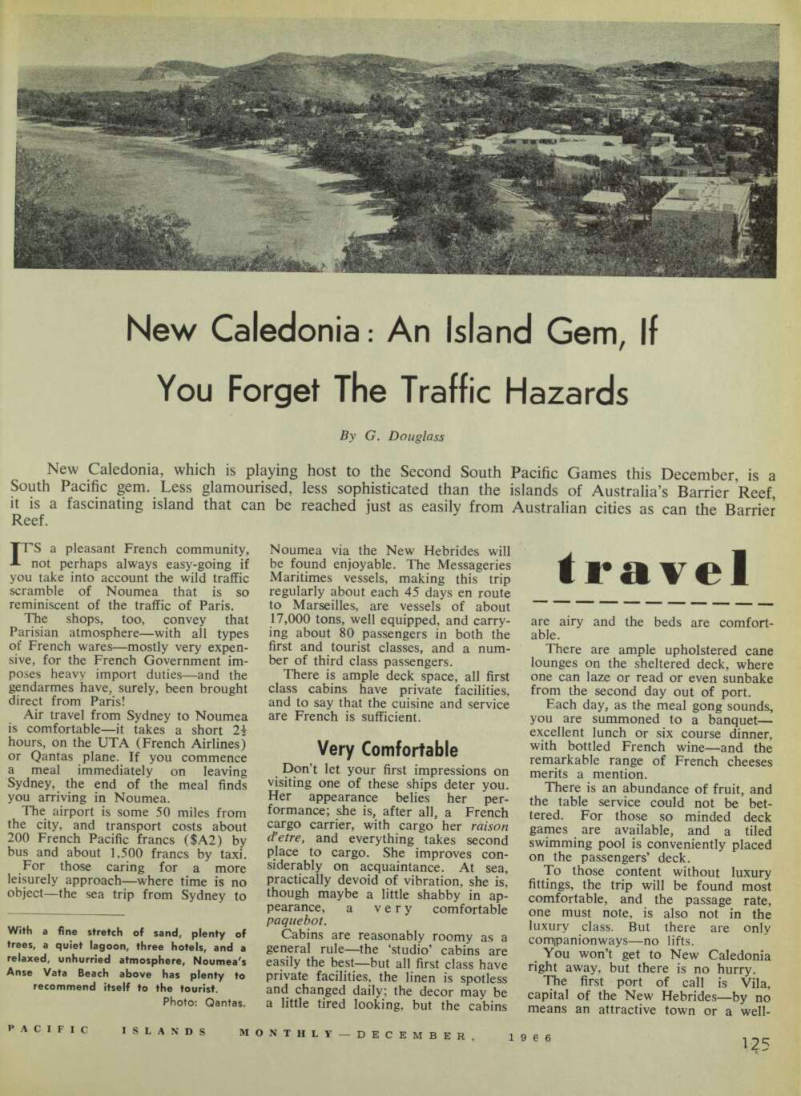
For those caring for a more leisurely approach—where time is no object—the sea trip from Sydney to With a fine stretch of sand, plenty of trees, a quiet lagoon, three hotels, and a relaxed, unhurried atmosphere, Noumea's Anse Vata Beach above has plenty to recommend itself to the tourist.
Photo: Qantas.
Noumea via the New Hebrides will be found enjoyable. The Messageries Maritimes vessels, making this trip regularly about each 45 days en route to Marseilles, are vessels of about 17,000 tons, well equipped, and carry ing about 80 passengers in both the first and tourist classes, and a num ber of third class passengers.
There is ample deck space, all first class cabins have private facilities, and to say that the cuisine and service are French is sufficient.
Very Comfortable
Don’t let your first impressions on visiting one of these ships deter you.
Her appearance belies her per formance; she is, after all, a French cargo carrier, with cargo her raison d’etre, and everything takes second place to cargo. She improves con siderably on acquaintance. At sea, practically devoid of vibration, she is, though maybe a little shabby in ap pearance, a very comfortable paquebot.
Cabins are reasonably roomy as a general rule—the ‘studio’ cabins are easily the best—but all first class have private facilities, the linen is spotless and changed daily; the decor may be a little tired looking, but the cabins
are airy and the beds are comfort able.
There are ample upholstered cane lounges on the sheltered deck, where one can laze or read or even sunbake from the second day out of port.
Each day, as the meal gong sounds, you are summoned to a banquet— excellent lunch or six course dinner, with bottled French wine—and the remarkable range of French cheeses merits a mention.
There is an abundance of fruit, and the table service could not be bet tered. For those so minded deck games are available, and a tiled swimming pool is conveniently placed on the passengers’ deck.
To those content without luxury fittings, the trip will be found most comfortable, and the passage rate, one must note, is also not in the luxury class. But there are only comjpanionways—no lifts.
You won’t get to New Caledonia right away, but there is no hurry.
The first port of call is Vila, capital of the New Hebrides—by no means an attractive town or a well
cared for waterfront, but set on a lovely bay edged around by tropical vegetation and by coconut groves.
The New Hebrides is a bonus voyage on your trip to New Caledonia by sea.
The boat anchors well out in the bay, and a free launch service is run by the company back and forth, hourly, to the town.
There are excursions which can be taken—even a flight over nearby vol canoes, and winter days will be found pleasantly warm.
The shore tour is not impressive— the native village disappointing, with grass huts patched here and there with scrap iron sheeting—the sur roundings unkempt.
Then the ship moves on to Santo —the town set upon a most pictur esque inlet, with an excellent wharf, and good roads radiating over the island—all of American wartime con struction.
Santo is a neater, cleaner looking town than Vila, and is surrounded by well maintained coconut planta tions. There are interesting shops, and the taxi service is good.
Australian currency mainly is employed—it is used interchangeably with French Pacific francs. The franc notes are issued in denomina tions of 1,000, 100, and 20. The 1,000 franc note is almost as large as a news sheet—a few thousand francs can make quite a sizeable roll.
One Bank
There is only one bank in the New Hebrides and Noumea—the Bank of Indo-Chine. Australian travellers’ cheques are changed at the rate of about 98 francs to the $, On reconversion, you get but A9sc to 100 francs.
The story that French wares are cheaper in Santo than in Noumea is fiction.
There are enjoyable trips which may be made around Santo. There are some beautiful beaches, and the water even in July will be found quite pleasantly warm for swimming.
These trips, also, can be made just as cheaply and much more con veniently by four in a taxi than by organised bus tour.
The boat arranges to supply 3icmc lunch—with wine—whenever required.
It is wise, in all these ports, to arrange cost and details of taxi services before starting on a trip
and some bargaining is usually advisable.
Leaving Santo, it is a pleasant 27 hours cruise to Noumea—passing along the beautiful coastline of New Caledonia, and inside the island of Lifou, along the barrier reef, with the glorious turquoise blue of the lagoon beyond, to the narrow entrance to Noumea lagoon at the Amadee Lighthouse.
To arrive at Noumea in the evening, when you will probably anchor in the “roads”, is to be greeted with a vista of fairy lights spreading up the various hills, and around the many bays—it is an entrancing and promising sight.
But at first sight in the morning, the place appears dingy, with many rusty roofs and faded cement build ings, rather remiscent of Algiers. In fact, Noumea has much that is very Algerian in character.
The city is built around a large central square or garden, which is beautifully maintained, with lovely trees—some colourful poincianas— good buffalo grass lawns (defense de marcher sur les pelouses) and many newly-painted garden seats.
To sit there and watch the passing types alone can be quite interesting— from the daintily dressed French girl to the Mother Hubbard-garbed Wallisian, with her baby carried on her back—and none appear to object to being photographed.
All work ceases, and shops close, from 11 a.m. to 1.30 p.m.—siesta time. Even the children appear to go home from school for this period.
The schoolchildren and the college
teenagers are invariably neatly dressed, and their deportment is some thing to be admired.
Most of the better shops and supermarkets are on the western side of the Central Gardens—beyond Rue Jean-Jaures—and interesting hours can be spent browsing through them.
That browsing can be an expensive experience also, for there is a tempting display of French wares, ranging from women’s dresses, shoes and handbags to shelves and shelves of French and Algerian wine, and cold cabinets of French cheeses of all types.
Everything in Noumea is costly, and items available in Australia are more cheaply bought in Australia, but temptation will come from many items which cannot be obtained in Australia.
Algerian Wines
French wines of good quality are almost twice the Australian price of similar types of Australian wine.
But if you can get some guidance, there are Algerian wines at reason able—even cheap—prices, which will be found very pleasant.
The cost of living in Noumea is high, but wages are high, and the minimum wage will be at least one third higher than in Australia.
But if there are few bargains to be found, you are certain, if you browse thoroughly, to come across some items which offer good value.
Perfumes, if you are conversant with them, will be found at reason able rates; also cosmetics, women’s
Amphicars—cars that you can drive on both sea and land—are among the novel ties for visitors to Noumea.
Photo: Qantas.
shoes, handbags, and clothing if a diligent search is made.
Taken all round, it is a fascinating shopping area.
Possibly, the bus services supply the best “buy” in Noumea. Small blue buses, with the name of the owner blazoned on the side, ply to all the outlying suburbs, and these buses are used by all—residents and tourists alike.
The fare of 15 francs appears to be the same on all the city and suburban bus services. It is 15 francs regardless of the length of the trip you make—be it 100 yards or five miles.
The buses run at frequent intervals on all routes. The Anse Vata route has a service at least every 10 minutes. The fare doubles after dark.
Given the time, the tourist can explore cheaply all the outer suburbs by the bus routes. There are beauti ful, even magnificent, homes around Noumea, and many of the hilltops have glorious panoramas beneath them.
The trip to Anse Vata beach is, of course, the choice run, for it meanders around the many bays— Baie de la Moselle, Baie de I’Orphe linat, Baie de Pecheurs, Baie des Citrons—to the end of Anse Vata beach and the new Chateau Royale
Hotel. Its return is usually by an inland route.
A varied assortment of hotels is to be found around Noumea, and, measuring by Australian standards, the rates for hotel accommodation are most reasonable.
One may choose the extremely luxurious, from about SA23 per day for two (without breakfast) to the small city hotel at about SAT per day for two, including breakfast.
Generally, each bedroom has private facilities, and the quality, and luxury, of the accommodation, varies with the price.
The Chateau Royal is most
luxuriously—some may think over ostentatiously—fitted. Architecturally, it is a gem, being built around and about beautiful trees which have been preserved.
Outstanding is a huge banyan tree in the central courtyard, with a root span extending well over 100 feet, with staghorns growing on its gnarled limbs, and well concealed lights illuminating, in muted fashion, the whole courtyard by night.
Nearby is the Nouvata—perhaps half a mile away, again facing a beautiful beach, with somewhat lower tariff, but well furnished and well managed—-a very comfortable hotel, again with swimming pool— in sheltered piazza in the rear, the area being made colourful with tables, chairs, and umbrellas, all beneath flowering poinciana trees.
Charming Beach
A little less expensive again is the Noumea Hotel, about a mile from the Nouvata, on Baie des Citrons, with a charming beach in front—a comfortable, well-furnished hotel, very well managed, with a good restaurant.
In the city, hotel rates are cheaper, and fittings rather less luxurious, but they are convenient for exploring the city, for one has a convenient retreat for rest during siesta time.
To those practising economy, too, they will be found good value, but if extreme economy is the aim, toilet soap and possibly towels may have to be provided personally.
There are many restaurants, both in the city and on the various bays; some are excellent, some are poor.
Quite a good meal for two, with
One of the most im portant centres on the east coast of New Caledonia is Hienghene, which is noted for coffee, other agricultural products and strik ing limestone rock formations such as this one. In the fore ground is a native hut. Photo: Qantas.
Amadee Lighthouse, on a small cay at the entrance to Noumea Harbour, 12 miles from the town, is one of New Caledonia's oldest and most interesting landmarks.
It was built on the heights of La Villette overlooking Paris, then dismantled and shipped piecemeal to Noumea just over a century ago. Photo: Qantas.
wine, can be obtained—say at the Esquinade for about 390 francs.
Indeed, if the advice of the waiter is heeded and un plat pour deux is tried, the cost may be considerably reduced, for one dish will be found to supply ample for two.
If one can obtain experienced guidance as to restaurants, the cook ing will be found to be outstanding, and the memory of dishes such as rognons roti and filet de poisson nantina will long remain.
There are numerous snack bars around the city. Outstanding is the Bettina in Avenue de la Victoire, where a grill, a salad, a sandwich, an ice, or even a cup of tea can be got at a reasonable rate.
Tours
There are various tours, also, whiclj should be investigated; the beautiful Isle of Pines, with its glorious beaches is easily reached by air—a mere 30 minutes flight from Magenta Air port, The return fare is 1,960 francs.
Accommodation can be obtained on the island at the Relais de Kanumera.
It is a lovely spot.
The East Coast tour is most com fortably made by air—the return air fare to Hienghene being 3,320 francs.
One can, of course, take a “drive yourself” hire car for a close vie.w of the excellent scenery along the mountain roads, or one can join an organised road tour. There is also a daily small blue bus to Poindimie, with great saving in cost.
The East Coast scenery is im pressive—narrow mountain roads, river crossings by punt, and tropical jungle make an interesting, but rather tiring, motor trip.
Tours can also be made by hire car, where the driver pays his own meal and accommodation accounts.
But it is well to have the total fee settled in advance.
Also, with a little barganing— with several drivers—a great reduc
tion in the rate can frequently be obtained.
The day launch trip from Noumea to Amadee lighthouse should be marked as a “must”. In a well-fitted catamaran launch, with an excellent host, the trip of about 20 miles across the lagoon can be very pleasant. It can also be very rough, though calm water is found in the shelter of the reef.
The view of the coral through the glass bottom tank on the launch cannot be bettered anywhere. Fish ing, both underwater and line, is an added attraction.
The island, with the lighthouse on which you land, has a glorious white
coral sand beach, and the lunch sup plied is superb. This day trip costs 850 francs each, and is well worth it.
Taken all in all, a holiday in New Caledonia is an interesting ex perience—a pleasant way to brush up one’s French, a warm winter climate, with hotels of reasonable cost, and with the overall cost (excluding expensive purchases) pos sibly below that of a holiday for a similar period on Queensland’s Barrier Reef.