New Stamps Commemorate
pp. 91-95 · Read in the full issue

Discovery Of The Four Pitcairn Islands
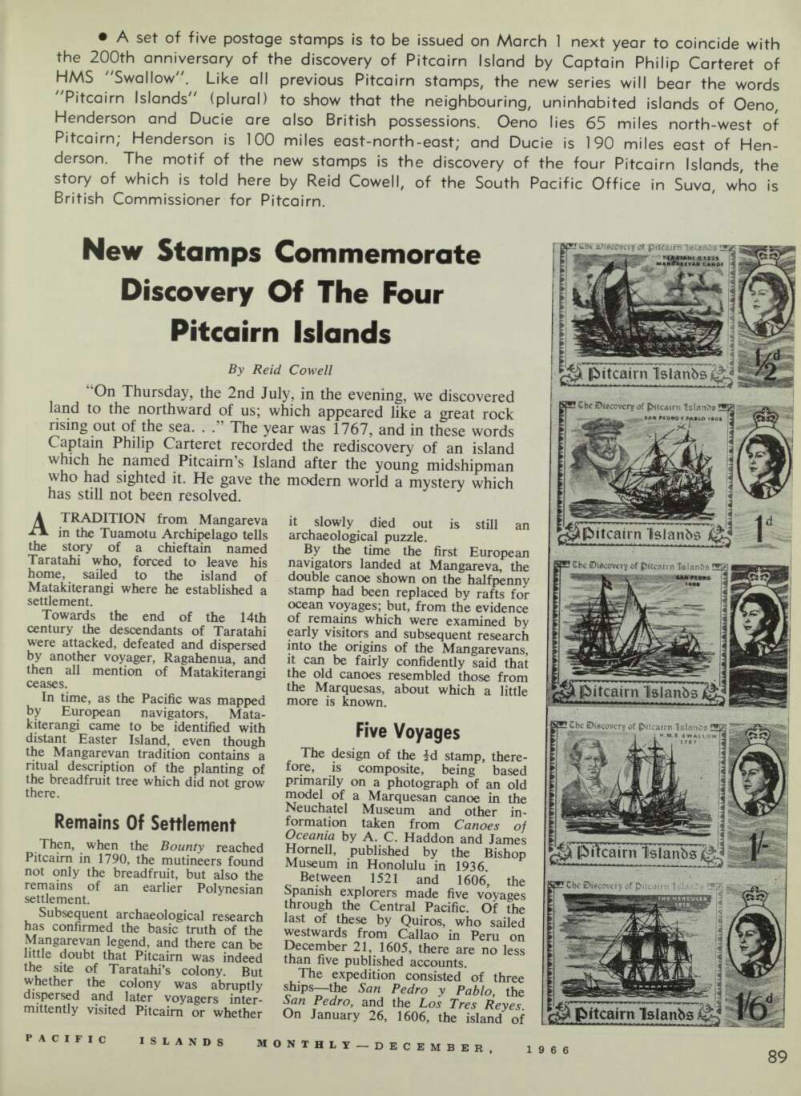
• A set of five postage stamps is to be issued on March 1 next year to coincide with the 200th anniversary of the discovery of Pitcairn Island by Captain Philip Carteret of HMS "Swallow". Like all previous Pitcairn stamps, the new series will bear the words Pitcairn Islands ' (plural) to show that the neighbouring, uninhabited islands of Oeno, Henderson and Ducie are also British possessions. Oeno lies 65 miles north-west of Pitcairn; Henderson is 100 miles east-north-east; and Ducie is 190 miles east of Hen derson. The motif of the new stamps is the discovery of the four Pitcairn Islands, the story of which is told here by Reid Cowell, of the South Pacific Office in Suva, who is British Commissioner for Pitcairn.
By Reid Cowell
On Thursday, the 2nd July, in the evening, we discovered land to the northward of us; which appeared like a great rock rising out of the sea. . . The year was 1767, and in these words Captain Philip Carteret recorded the rediscovery of an island which he named Pitcairn’s Island after the young midshipman who had sighted it. He gave the modern world a mystery which has still not been resolved.
A TRADITION from Mangareva in the Tuamotu Archipelago tells the story of a chieftain named Taratahi who, forced to leave his home, sailed to the island of Matakiterangi where he established a settlement.
Towards the end of the 14th century the descendants of Taratahi were attacked, defeated and dispersed by another voyager, Ragahenua, and then all mention of Matakiterangi ceases.
In time, as the Pacific was mapped by European navigators, Mata kiterangi came to be identified with distant Easter Island, even though the Mangarevan tradition contains a ritual description of the planting of the breadfruit tree which did not grow there.
Remains Of Settlement
Then, when the Bounty reached Pitcairn in 1790, the mutineers found not only the breadfruit, but also the remains of an earlier Polynesian settlement.
Subsequent archaeological research has confirmed the basic truth of the Mangarevan legend, and there can be little doubt that Pitcairn was indeed the site of Taratahi’s colony. But whether the colony was abruptly dispersed and later voyagers inter mittently visited Pitcairn or whether
it slowly died out is still an archaeological puzzle.
By the time the first European navigators landed at Mangareva, the double canoe shown on the halfpenny stamp had been replaced by rafts for ocean voyages; but, from the evidence of remains which were examined by early visitors and subsequent research into the origins of the Mangarevans, it can be fairly confidently said that the old canoes resembled those from the Marquesas, about which a little more is known.
Five Voyages
The design of the id stamp, there fore, is composite, being based primarily on a photograph of an old model of a Marquesan canoe in the Neuchatel Museum and other in formation taken from Canoes of Oceania by A. C. Haddon and James Hornell, published by the Bishop Museum in Honolulu in 1936 Between 1521 and 1606, the Spanish explorers made five voyages through the Central Pacific. Of the last of these by Quiros, who sailed westwards from Callao in Peru on December 21, 1605, there are no less than five published accounts.
The expedition consisted of three San Pedro y Pablo, the San Pedro, and the Los Tres Reyes On January 26, 1606, the island of
La Encarnacion was discovered and, three days later, a second island, “massive, moderately high, open, having groves and plains”, which was named San Juan Bautista.
The descriptions, courses and latitudes recorded in the accounts leave no doubt that the two islands are those now known as Ducie and Henderson which were rediscovered and so renamed three centuries later.
With the help of Father Celsus Kelly, of the Franciscan Friary, Ascot, England, a portrait of Pedro Fernandez de Quiros and repro ductions of a typical galleon and bergantine of the period were obtained from Spain and used in the designing of the penny and 8d stamps.
Tale Of Misadventure
The rediscovery of Pitcairn by the Swallow in 1767 was a tale of mis adventure. On August 22, 1766, Carteret sailed from Plymouth in company with Captain Samuel Wallis in the Dolphin to search for Davis’
Land—the southern continent.
After four months together, the two ships separated in the western opening of the Straits of Magellan and Wallis, believing the misnamed Swallow had foundered, sailed on alone.
But Carteret limped on, and, having searched fruitlessly for Davis’ Land in the region of Juan Fernandez, he turned westwards on Quiros’ track, rediscovered Pitcairn’s Island, and, then, to complete a voyage round the world.
Curiously, on his way home through the Atlantic 18 months later, he was overhauled and hailed by the Boudeuse commanded by the French explorer Bougainville who, a few months behind, had picked up Carteret’s trail through the Solomons and New Britain.
And what became of Midshipman Pitcairn from whom the island now takes its name? It is recorded that he “was afterwards lost in the Aurora, in her passage to the East Indies; and his father, major of the marines, fell in the action of Bunker’s Hill, and died in the arms of another of his sons”.
Between 1767 and 1790 when Fletcher Christian, the mutineer, beached and burned the Bounty, there is no record of Pitcairn’s again being sighted, though it is known that Cook, looking for it, was only a few miles off when an outbreak of scurvy
compelled him to turn away to the north.
In 1791, Captain Edward Edwards m the Pandora, searching for the Bounty, sighted and renamed Quiros’
La Encarnacion, Ducie Island; but it was not until 1808 that Mayhew Folger, an American sealer, found the new community.
We have the later and authentic authority of John Adams, the last of the mutineers and patriarch of Pitcairn, that it was Carteret’s journal 1C j fi. nal ly guided Christian to the island, in spite of a printing error which placed it five degrees to the north of its true position.
Report Unnoticed
The Swa U° w i s reproduced on the shilling stamp together with a portrait of Carteret kindly made available by the Museum of the Societe Jersiaise.
Folger’s report went unnoticed in a Europe at war with Napoleon and Pitcairn was lost again until 1814 when the British warships Briton and Tagus revealed the story of the Bounty mutineers’ settlement to an astonished world.
This resulted in the Calcutta com mittee of the Society for Promoting Christian Knowledge sending a supply of Bibles and prayer books to the island, and the Calcutta Journal
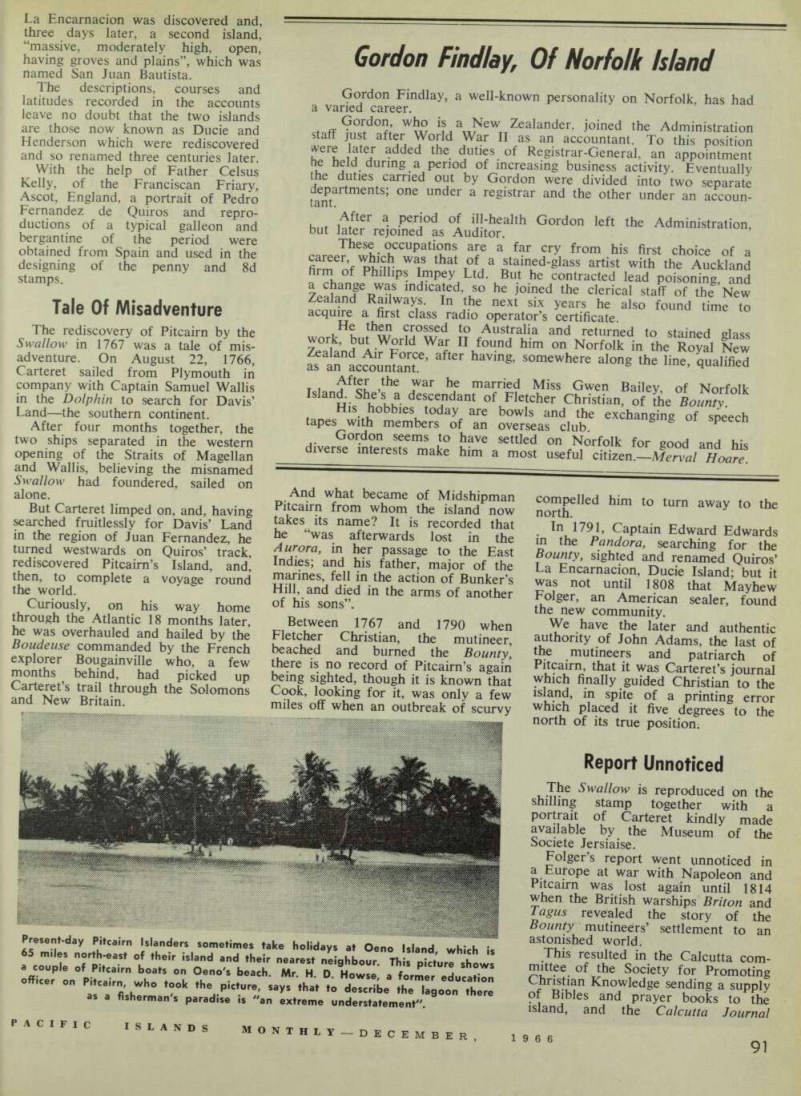
Present-day Pitcairn Islanders sometimes take holidays at Oeno Island which is 65 miles norht-east of their island and their nearest neghbour. This picture shows a couple of Pitcairn boats in Oeno's beach. Mr. H. D. Howse, a former education officer on Pitcairn, who took the picture, says that to descrbe the lagoon there as a fishermans paradise is "an extreme understatement".
raised a subscription for material aid, including a 22 ft cutter. These gifts, with a letter to John Adams from his brother Jonathan, a Thames waterman, were carried by Captain James Henderson of the merchant ship Hercules on the way to Valparaiso.
Henderson, having put into Pitcairn again on the return voyage, dis covered the fourth island of the group on January 19, 1819—the coral atoll now known as Oeno Island, The name Oeno is that of an American whaler which sighted the island again in 1824. Henderson’s connection with Pitcairn is perpetua ted in the renamed San Juan Bautista of Quiros which he also sighted on this voyage.
The Hercules on the 1/6 stamp has been reproduced with the co operation of the National Maritime Museum at Greenwich.
Polynesian Knowledge
Did the early Polynesians also know of Henderson, Ducie and Oeno Islands? Almost certainly, I think.
But whereas Pitcairn had timber and flints to offer as proof, the other three had little or nothing.
Possibly Henderson, which still has small stands of timber left, may have been intermittently visited; and perhaps its caves may yet reveal archaeological evidence of occupa tion. But the atolls of Oeno and Ducie will probably remain silent.
The bi-centenary of Pitcairn’s re discovery by Carteret is a fitting moment to recall the story of these four, isolated islands.
The double canoes of the early Polynesian navigators, the galleon and bergantine of Quiros, the sloop of Carteret, the armed-vessel Bounty, Henderson’s Indiaman and the men who manned them are part of the saga of the South Seas.
Perennial Interest
Of the four islands, only Pitcairn is permanently occupied. But its story of mystery, mutiny and renaissance alone is sufficient to guarantee a perennial interest in them.
The main sources of reference for the information in this article are two papers by H. E. Maude on Spanish and post-Spanish discoveries in the Pacific published in the Journal of the Polynesian Society for December, 1959, and March, 1961, and J. C. Beaglehole’s book The Exploration of the Pacific, London, 1934.