Tahiti's School
p. 82 · Read in the full issue
Centenary Was 50
Years Too Late
By Robert Langdon
Celebrating the centenary of some thing half a century after the event probably doesn’t happen anywhere more than once in a century or so.
But it happened in Tahiti in Sep tember.
ON Saturday, September 17, thousands of Tahitian school children, their parents and ex-students turned out to celebrate what was supposed to be the centenary of Protestant schools in the territory.
Speeches were made by the Governor, Mr. Jean Sicurani, the then Mayor of Papeete, Senator Poroi, and the Inspector-General of Secondary Education, Mr. Joubert.
Trees were planted. Flags were waved. Food was eaten. And the Rue Perotte in Papeete was renamed the Rue Charles Vienot.
Charles Vienot was the man, who —according to the speeches and the Papeete Press—founded the first Protestant school in Tahiti a hundred years ago.
He was, no doubt, a most worthy Frenchman, fully deserving of having a street in Papeete named after him.
But the unGallic truth is that he was by no means the first person to establish a Protestant school in Tahiti.
Welshman
That distinction belongs to a Welshman, John Davies, who arrived in Tahiti in the ship Royal Admiral in 1801 to join other missionaries of the London Missionary Society, who had reached the island four years earlier.
Davies, who proved more pro ficient in learning Tahitian than many of his colleagues, opened an evening school for “the boys and young men that attend about the missionaries’ dwellings as servants, etc” in October, 1806.
Six months later, the missionaries sent manuscripts of a Tahitian spel ling book and some Tahitian catechisms to England to be printed for use in their school. But before the printed versions could be sent back to Tahiti, political events in the
island forced the missionaries to flee to Sydney. This was in 1809.
The missionaries began drifting back to Tahiti in 1811, but as con ditions there were still unsettled, they re-established themselves on the neighbouring island of Moorea.
On September 21, 1812, Davies opened a school on Moorea with 18 scholars—most of them being boys who worked at the mission as servants.
Three years later, enrolment at the school had “increased beyond all expectations” to 660—many of the scholars being adults from Tahiti.
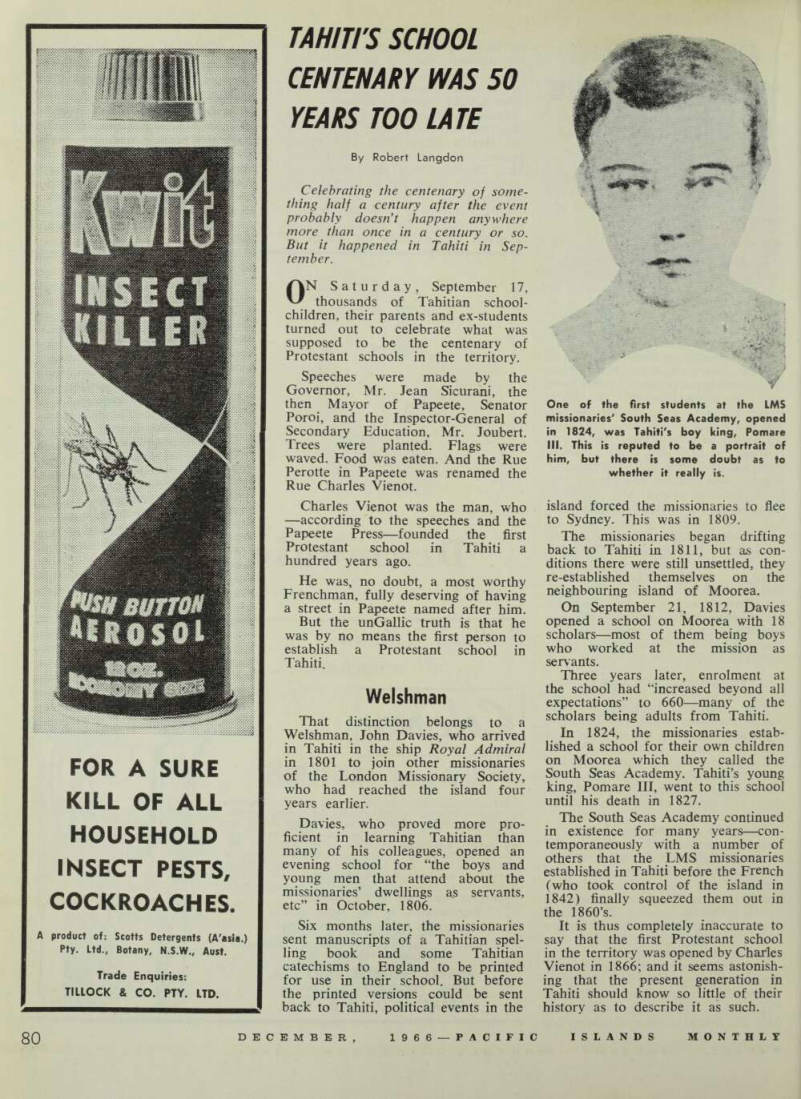
In 1824, the missionaries estab lished a school for their own children on Moorea which they called the South Seas Academy. Tahiti’s young king, Pomare 111, went to this school until his death in 1827.
The South Seas Academy continued in existence for many years—con temporaneously with a number of others that the LMS missionaries established in Tahiti before the French (who took control of the island in 1842) finally squeezed them out in the 1860’s.
It is thus completely inaccurate to say that the first Protestant school in the territory was opened by Charles Vienot in 1866; and it seems astonish ing that the present generation in Tahiti should know so little of their history as to describe it as such.
One of the first students at the LMS missionaries' South Seas Academy, opened in 1824, was Tahiti's boy king, Pomare III. This is reputed to be a portrait of him, but there is some doubt as to whether it really is.