Cruising Yachts
pp. 103-119 · Read in the full issue
Pacific Shipping And Cruising Yachts
More Asian Fishing Boats To Work Out Of Levuka
Korean and Formosan fishing boats are to join Japanese boats operating out of Levuka, on the Fijian island of Ovalau.
THEY will supply fish for a canning factory to be built at Levuka, which will can fish for export as pet food to the United States.
The factory will be built by the Japanese-controlled Pacific Fishing Company, which expects production to start about next March.
A company spokesman said recently that the Korean and Formosan crews were inexperienced in freezing fish at sea, so some of their catches reached port in sub-standard con dition.
Sub-standard flesh from these fish would be canned as pet food at Levuka, while the choice flesh would be sent to the US for canning.
Bones, tails and heads would be treated in a fish meal plant which the company recently opened in Levuka.
Served by a fleet of 25 to 30 ships, the Japanese company has been freez ing fish at Levuka for export since mid-1964. A couple of dozen Japanese technicians live ashore.
Japanese, Korean and Formosan
ships also supply two American can neries at Pago Pago with fish for canning. They use the long-line fish ing method.
Japanese Fishing Boat
In Tonga Incident
Captain Tevita Fifita, Tongan Government pilot for Ha’apai and Vavau, intercepted a Japanese fishing boat off Ha’ano, the northermost island of the Ha’apai Group in late September for illegally entering Tongan waters.
Captain Fifita (hero of the Minerva Reef drama several years ago) was sailing to Vavau in the Fonualei when he saw the Japanese fishing ship Kaiho Maru No. 18 anchored close by the island of Ha’ano.
When the Fonualei headed for the Japanese ship, the Japanese hoisted anchor and headed out to sea.
Captain Fifita then changed course again, but the Japanese did likewise in an apparent effort to get away.
Finally, the Japanese hove to when the pilot flag was hoisted on the Fonualei.
Captain Fifita boarded the Japanese vessel, and asked the captain, through the English-speaking radio operator, whether his ship was in difficulties.
The Japanese captain replied that she was not, and that the crew had been gathering coconuts.
When Captain Fifita ordered the Japanese to leave the area, he was told that some of the crew were still ashore at Ha’ano. He then escorted the Japanese ship to the island while
the stranded crewmen were picked up, and directed the ship to sea.
Reporting the incident, Tonga’s Chronicle says Captain Fifita has handed a full report to the Govern ment for further action.
Plan For New Ship
For G.E.I.C.
The British Colonial Secretary has agreed that the Gilbert and Ellice Islands Colony should submit a Colonial Development and Welfare Scheme for finance to purchase a high-density passenger vessel capable of transporting up to 200 people.
With this vessel in the colony, it is hoped that future recruiting and repatriation of labour for the British Phosphate Commissioners can be undertaken by the Government on a charter basis, thus saving large sums of money from going out of the colony.
Promotion For
French Admiral
Rear-Admiral Francois Picard- Destelan, commander of French naval forces in the Pacific, was promoted to vice-admiral recently.
Admiral Picard-Destelan has been in his present post for more than two years. He is an extremely popular officer, not only in French circles but among US and Australian naval men. He is a very good friend of the US Ambassador to Australia, Mr.
Ed. Clarke.
Admiral Picard-Destelan saw war service in the Algerian forces from
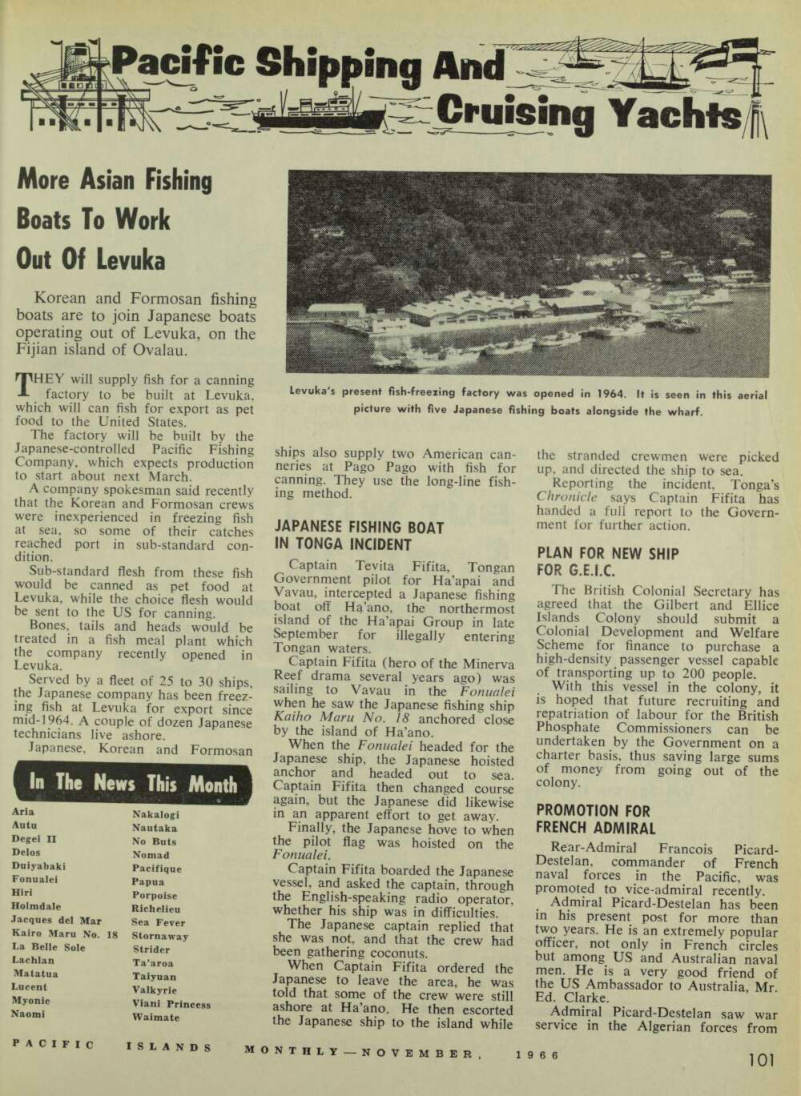
Levuka's present fish-freezing factory was opened in 1964. It is seen in this aerial picture with five Japanese fishing boats alongside the wharf.
1939 to 1941, and from that year to 1944 was aboard the French battle ship Richelieu. He also saw service with the Home Fleet in the North Sea. In the last year of the war he commanded an escort vessel in convoy work.
After the war, he saw service in SHAPE and other organisations, and spent some time at the Pentagon.
Following active command aboard various vessels, he was named rear admiral in 1961 and was posted to various executive positions in the French Admiralty.
In April, 1964, he was posted to the Pacific command.
A widower—his wife lost her life in tragic circumstances some years ago in Tahiti—the new vice-admiral has five children.
Admiral Picard-Destelan arrived in Canberra in late October to begin a round of farewells to Australian Government officials and service chiefs.
He will end his tour of duty in the Pacific in November and return to France.
New Ship For New
Hebrides Mission
Five New Hebrideans arrived in Brisbane in early October to take their first look at a newly-acquired 45 ft mission vessel which they will sail home across 1,000 miles of open ocean to the Seventh-day Adventist Mission at Aore, near Santo.
The New Hebrideans will have an Australian pastor for their captain on the return journey.
He is Pastor Walter G. Ferris, a
master mariner, at present director of the Seventh-day Adventist Welfare Centre for Aborigines, at Kuranda, near Cairns.
Pastor Ferris has had 34 years of experience in sailing medical mission ships in the South West Pacific.
The newly-acquired vessel, MV Pacifique, was formerly a pleasure cabin cruiser which was originally based at Brisbane, but more recently at Yeppoon.
Travelling to Brisbane has been the crew’s most thrilling assignment to date, in that for all of them it meant taking their first plane and train rides.
Their reaction? Planes and trains are not for them!
“We couldn’t get a wink of sleep,” one said.
All five New Hebrideans are ex perienced sailors. The eldest, “Cap tain” Daniel Mial, is more than 60 years old and has sailed the mission’s boats for more than 30 years.
The MV Pacifique has been purchased in Brisbane to replace the MV Nakalagi which was wrecked in a storm some time ago.
She was dedicated on October 9 at Griffith’s Private Jetty, Corona tion Drive, Brisbane, under the direction of Pastor K. S. Parmenter, president of the Seventh-day
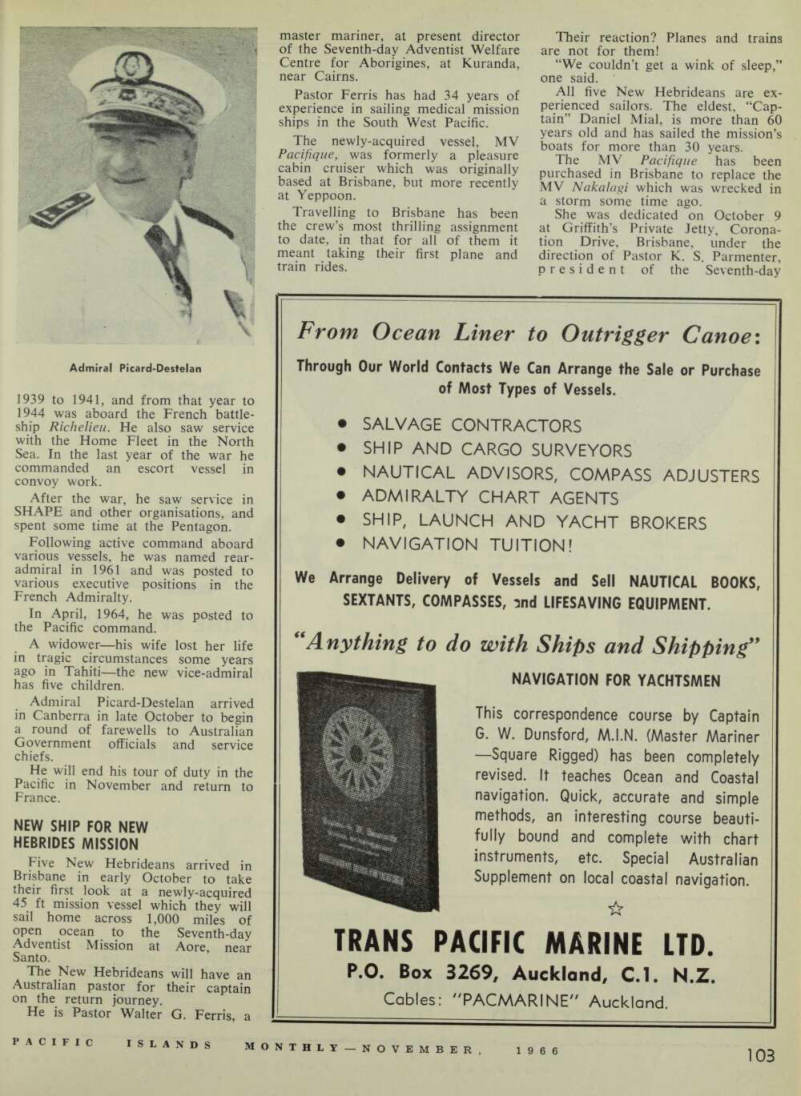
Admiral Picard-Destelan
Adventist Church in Queensland, and Mr. J. K. Irvine, assistant secretary of the Australasian division of the Seventh-day Adventist Church.
The Pacifique’s anchorage will be off the Adventists’ slipway at Acre.
This is extensively used by boats of other missions and traders. The slip way is run in conjunction with the church’s large missionary training school, and is under the control of missionary and marine engineer, Arnold Paget.
Sailing Of
"Waimate" Delayed
The Union Steam Ship’s inter island freighter, Waimate, has had her November sailing delayed by at least three weeks through bad weather on the New Zealand coast, industrial trouble in New Zealand and con gestion at Auckland.
While at Auckland on her last trip she underwent a survey.
Her next trip out of Sydney for Fiji, Samoa, Tonga and New Zealand is tentatively scheduled for November 29.
Mv "Papua" Goes
Into Service
A new motor vessel, the Papua, built at the Ballina ship yards in northern New South Wales, arrived in Port Moresby in October to go into service for the Federation of Native Associations Ltd.
The Papua is 70 ft long. She can carry 100 tons of general merchan dise and 65 deck passengers.
She will operate from Abau in the Central District to Dam in the Western District. This service was previously operated by the Hiri, which has been sailing on the Papuan coast since 1962.
The Hiri will be based at Samarai from now on.
Trial Voyage
To Fiji
A second experimental voyage from Lyttelton to Suva and Lautoka, Fiji, was made by the Holm Shipping Company’s motor-vessel Holmdale in late September.
The voyage was the result of a request by Christchurch exporters of meat, poultry by-products and potatoes for more regular shipping facilities to the Pacific Islands.
The bulk of New Zealand’s Pacific trade is usually handled through Auckland.
The 911-ton Holmdale, under Captain G. Patrick, is one of the fastest small vessels on the New Zealand coast.
Apart from the Fiji venture, the Holm company has established a link between Lyttelton and New Caledonia.
Biggest Locally-Built
Ship Launched In Fiji
The Fiji Public Works Department is building a steel landing barge, which will be used to carry con struction units for building airstrips in the smaller islands of the group.
It will be the largest steel vessel ever built in Fiji.
The barge, the Duiyabaki, was launched on September 17 by Mrs.
J. N. Falvey, wife of the Member for Works and Communications. The vessel is named after one of the big canoes said to have brought the first Fijians to Viti Levu.
The Duiyabaki will be finished in December and is expected to go into service in January.
The barge is 110 ft long and has a beam of 26 ft. She will be powered by two Rolls Royce supercharged 240 hp diesel engines, which will give her a speed of about eight knots.
The craft has a displacement of 200 tons. She will be used for carry ing construction equipment for the PWD and other Government cargo to outlying islands, especially to islands where other ships can’t go.
She will be able to run up on the beach.
Ship Launched For
P-Ng Administration
The Aria, the last of five ships built for the Papua-New Guinea Administration for general purposes, was launched at Rabaul in Sep tember.
She is a 70 ft, 50-ton ship, built by the Toboi Shipbuilding Co. Ltd. in about eight months.
The name Aria is a Kuanua word meaning “something different”.
Cook Islands
Harbour Survey
The New Zealand survey ship Lachlan was due to sail from Auck land for Rarotonga in late September to survey port facilities for the NZ Department of Island Territories.
The Lachlan was to spend a fort night working off Avarua and Avatiu.
The results of her survey will be available for possible port develop ment.
Japanese Fishing
Vessel Wrecked
A Japanese fishing vessel piled up on a reef to the north of New Caledonia in late September.
The site of the wreck is the “Recif des Francais”, some miles north of Pott Island, at the etxreme north
The landing barge "Duiyabaki" under tow after being launched in Sep tember.
of New Caledonia’s barrier reef. No accident to the crew was reported, but the vessel was abandoned. The crew was taken off by a second vessel sent down from Santo, New Hebrides.
Fiji Cutter Goes
Aground
The Viani Princess, a Fiji auxiliary cutter, went aground on a reef of Lekubi, Bua Bay, Vanua Levu, on September 14, but was subsequently towed off by the Government ship, Degei 11.
The Viani Princess arrived back at Suva under her own power a week later, and went on to the slip for an inspection of damage to her hull.
Complaints Over Lae
Wharf Congestion
The Lae Chamber of Commerce decided at a recent meeting to write to the Assistant Administrator, Services, Mr. L. W. Johnson, ex pressing concern at the shortage of storage space and berthing facilities at the Lae wharf.
Figures presented to the chamber showed a big increase in the amount of cargo passing through Lae. • In December-March, 1965-66, there were 108,000 tons, against 75,000 tons in December-March, 1964-65; • In June-August, 1966, there were 23,400 tons. A big increase was expected for September. • In August, 22 ships entered and left Lae, and 26 were expected in September.
Mr. Ralph Phillips said port facilities would have to be extended, as the amount of cargo would increase. The peak had not been reached.
A few days after the Chamber of Commerce meeting, Captain John Olsson, master of the Delos, said that overcrowding at Lae (and Port
Moresby) was costing his company thousands of dollars.
On the most recent trip the loss was $4,000, Delays in unloading cost the ship two running days, and it cost $2,000 to run the Delos each day.
Some days later there was a meet ing at Lae wharf to study the problem at first hand.
Officials of the New Guinea Co., the Chamber of Commerce and the Customs Department attended.
Mr. Stedman said after the meet ing that all agreed the situation was “drastic”.
Mr. Roy Oslington, manager of A. H. Bunting Stevedores, said that a shortage of storage space at Lae had cost his company thousands of dollars. It had paid $3,200 for tarpaulins to cover cargo at the wharf.
Flags For Their
Funnels
All China Navigation Co. ships are to have the company’s flag painted on the funnel. The company operates 16 ships to various ports in the Pacific Islands.
The flag is made up of two red and two white triangles with a blue line running down the middle.
The Taiyuan already has the flag painted on the funnel, and other ships will be attended to as they pass through Hong Kong.
New Assistant Harbour
Master For Moresby
Captain Richard Harold Davis has taken up duties as Port Moresby’s new assistant harbour master and shipping inspector.
For the previous four years, Captain Davis was employed by the Burns Philp (New Guinea) Ltd.
"Viani Princess"
shipping line, travelling between Aus tralia and Papua-New Guinea.
He is a former master of the CSIRO fisheries research vessel, the Derwent Hunter.
An Englishman, Captain Davis served 19 years with the Royal Navy in which he held a submarine com mand.
Solomons Mail Arrives
By Bottle
A bottle containing a letter, which was thrown into the sea about 1,000 miles north of the Solomon Islands, has been recovered from a beach near Amsor village in the Aitape sub- District of Papua-New Guinea by three New Guinea boys.
Bearing the name of Mr. Liasson, of Sweden, the letter described where the bottle had been thrown into the sea from a ship and requested that the finder reply to an address en closed.
The letter has been handed to the Assistant District Commissioner at Aitape, Mr. H. Roach.
Thoughts On Shipping
Bananas
NEW Zealander Jim Shortall, whose perennial interest in ships and the things carried in them is well-known to PIM readers has sent PIM a few notes on the world banana market, as he sees it.
He was writing from Guayaquil,
Ecuador, where his ship was then loading for Japan.
He says: “It may be of interest to Islands growers that the trend these days is for all bananas to be shipped in cartons instead of the former method of shipping in stems (I think only NZ and Australia use crates).
“The cargoes for Japan go in cartons containing 12 kilos approxi mately, in ‘hands’—not stripped down to single bananas as is done in the South Pacific.
“That size, and a carton twice that size, are being shipped to France.
To the US we have taken only the larger-sized cartons.
“We did take a part-cargo of stems to Hamburg last year, but I think it will be all cartons soon. The cartons used in the French Caribbean islands are shipped in folded form from France, and quickly ‘unfolded’ on arrival. In Guayaquil, the cartons are made locally.
“Taiwan (Formosa) bananas— Japan’s normal main supply—are favoured over Ecuador bananas by the Japanese consumers. But the Ecuador bananas sell at a lower price, and the handy-sized cartons are preferred by the small retailers.
“The Taiwan bananas are shipped in big cane baskets, in hands.
“So long as there is a good supply of Taiwan bananas, it’s hard to sell
Ecuador bananas in Japan. But Taiwan is right in the track of the typhoons which play havoc with the crop. That is when Ecuador—and Tonga—get a chance.
“However, Ecuador, the largest banana-exporting country in the world, with about 35 million stems worth SUS7O million, has no trouble selling to Europe.
“Almost all the loading at Guayaquil is done in mid-stream in the river, with lighters on either side, the cartons carried aboard two at a time up gangplanks through doors in the ship’s side.”
Commenting on the idea of ship
ping bananas from the Islands in cartons, PlM’s Suva correspondent says: “There is no chance of doing this at the moment. The reason is that the Union Steam Ship Co., which does all the shipping of bananas from the Islands to New Zealand does not have holds equipped for handling cartoned cargo, because of the height between decks.
“Only so many cartons can be stacked on top on each other. Other wise, they collapse.
“It is believed, however, that the Union Steam Ship Co.’s new ship, to replace the Matua, will have stowage facilities for cartoned cargo.”
9 LA BELLE SOLE, 64 ft yacht, arrived at Suva early in October from Rarotonga (P/M, Oct., p. 115). Mr.
R. W. Franson, son of the owner, Mr. Roger Franson, of Los Angeles, was treated at the CWM Hospital in Suva for a suspected heart attack, and was then allowed to rejoin the yacht.
Mr. Franson, Sr., and his wife, who joined La Belle Sole in Tahiti, expected to fly back to the United States from Fiji.
La Belle Sole was to leave Suva after a few days for the New Hebrides, New Caledonia, New Zealand and Sydney. • RONGOMAU, one of the mother ships in the Auckland-Suva yacht race earlier this year, left Suva on September 20 for Auckland.
She had been cruising in the Fiji Group since her arrival in May.
On board were the owner-skipper, H. I. Dimock, his 17-years-old niece, Rosaline Chadwick, Semesa Vasu, Nemani Sarasau and Flying-Officer M. Tiller. • LUCENT, 70-year-old gaff ketch, was due to leave Noumea on October 3 for Sydney with Bernard Katchon, his wife Yvonne, and a Swiss entertainer, Roland Ernst.
Lucent, which was built at St. Ives, Cornwall, in 1896 of pitch pine on Cornish oak, is 34 ft overall, with a 11 ft 6 in. beam and 5 ft draught.
She began her career as a Cornish mackerel boat and is still in excellent condition.
Sailed by Roger Jameson, Lucent left England seven years ago for the West Indies, Panama and Galapagos.
She spent a year in the Galapagos, where Jameson worked with a team of UNESCO experts. From there, she sailed to the Tuamotus, Societies, Australs, Cooks, Samoas and Fiji.
The Katchons, who are Australians, and Ernst, took over in February to sail the yacht to Australia. They sailed from Suva to the Lau Group, then to the New Hebrides and Loyalties.
Mr. Katchon tells us in a note from New Caledonia that he had spent four weeks in the beautiful atolls of Uvea and Beautemps-Beaupre, which were “trulv a yachtsman’s paradise”.
“We reached the east coast of New Caledonia at the beginning of Sep tember,” he said, “and intend to leave
from Noumea for Sydney on October 3.
“It is our intention to sell Lucent lock, stock and barrel in Australia.” • AUTU, 35 ft New Zealand trimaran, arrived in Nukualofa on September 26 from Raratonga. On board were owner D. Morgan, skipper P. J. Duggan, and one crew member.
After a paint job on the beach, Autu was due to leave for New Zealand on October 6, ending her six months’ trip round the Pacific. • STORNOWAY, a big motor yacht registered in New York, arrived in Vila, New Hebrides, on September 28 with a Mr. and Mrs. Petersen.
The Petersens left San Francisco in mid-March and have visited the Marquesas, Society Islands, Solomons, Samoas and Fiji.
They plan to return to the United States after visiting New Caledonia, New Zealand, Australia, the Philip pines and Japan. • PORPOISE, 38 ft American ketch, left Pago Pago in late Septem ber for Vavau and Nukualofa. She went on to Auckland on October 5.
Porpoise is skippered by Mrs.
Louise Meyer. Crew members are Tom Thurston, Gordon Hooper and Peter Quackenbush. • NO BUTS, 28 ft yawl, arrived unexpectedly in Fiji waters in late September after a series of mishaps which started when she broke her anchor chain off Late Island. Tonga.
Owner-skipper. Charles Carr, of Honolulu, had taken a three-man
"Lucent" under sail. The large yard arms are part of an efficient self-steering system, which operates with winds from any quarter.
seismological survey party to Late from Vavau; and while the yawl was anchored off the island, the anchor chain broke in heavy seas and high winds. Carr then found the clutch would not engage.
When he managed to get the engine going, he found the yawl was taking water.
Bailing was of no avail, but just when he was about to abandon ship, he found the leak.
Having made temporary repairs, he tried to sail back to Late. But the current was too strong.
Vavau also seemed out of the question, even though it was only 35 miles away. So Carr made for Fiji, 450 miles away.
He called at Lakeba to radio to Suva about the three men marooned on Late, and then sailed to Suva, via Lautoka.
After No Buts was overhauled at Suva, Carr planned to sail for Auck land. © SEA FEVER, 42 ft ketch, which Larry and Margaret Alexander, their young son John and nephew Richard Lewis, sailed round the world, was sold recently in Los Angeles to Mr. Ronald Cox.
Sea Fever completed her cir cumnavigation on July 31 last year when she reached Honolulu after a 4i-year cruise {PIM, Sept., p. 109).
The Alexanders eventually found it too expensive to live aboard their ketch, and decided to try to sell her in Honolulu. When this idea failed, they sailed her over to Los Angeles, taking 23 days for the trip.
The Alexanders, who are now living in Hilo, Hawaii, built Sea Fever themselves. They hope to build another boat later on. • MY ON lE, 36 ft ketch, will leave her home port of Miami, Florida, in early November, with owner-skipper A 1 Gehrman and his wife “Mike”.
The Gehrmans plan a second cir cumnavigation.
Myonie completed her first cir cumnavigation in June, 1964. She had figured in PIM many times before that.
On their new voyage, the Gehrmans hope to visit many South Pacific islands, plus New Zealand, Australia and Japan. • STRIDER, Los Angeles yacht, with Bob and Charlene Heacock, has tied up in Suva to wait out the hurri cane season.
Strider, a reverse-sheer sloop, left Los Angeles in July, 1965, for Hono lulu; cruised the Hawaiian Islands
until March this year; then went on to the Tuamotus, Tahiti, the Societies, Rarotonga ( PIM, Oct., p. 115), Tonga and Fiji.
Bob is now working for a Suva engineering firm; and the Heacocks plan to haul their boat and do some painting and repairs.
“We are living aboard at the Royal Suva Yacht Club, where we receive our mail,” Mrs. Heacock tells us in a note. “We have had a very good cruise thus far—fortunately no bad weather, and nothing serious going wrong with the boat.
“We thoroughly enjoy reading your magazine, and think you are per forming a real service to the people in these islands.” & VALKYRIE, 31 ft ketch, with 72-year-old John Goetzcke, sailed into Durban after a 34-day trip from the Seychelles on September 26.
Mr. Goetzche, an American, spent about a year in the Pacific Islands in 1963-64. He is on a voyage round the world which began in Charlotte Amalie, Virgin Islands. • NOMAD, 49 ft yacht from Auckland passed through Vila, New Hebrides, in October en route to Brisbane. On board were the owner builder, Bryan Williams, his wife Pauline, and three children, Mark, 12, Suzanne, 11, and Jannice, nine.
The Williams family are on a world cruise. They left NZ on April 4 and have since visited Rarotonga, Aitutaki, French Polynesia, Samoa and Fiji.
• MATATUA, 36 ft cutter, from Auckland, which has been cruising French Polynesia, the Samoas and Fiji, visited Vila in October. • TA’AROA, 49 ft ketch, arrived in Pago Pago from the Cook Islands on September 28 for a five-day stay.
The owner is Jack H. Sederlund, of Corono del Mar, California.
He has a crew of four consisting of Barbara Zimmer. Chris Dalby, Allen Hessamer and Nancy Spencer, all from Newport Beach, California. • NAOMI, 46 ft steel yawl, arrived in Pago Pago from Niue on September 30 for a four-day visit.
"Valkyrie"
travel
A Regular Rim Department
Reporting News Of South
Seas Tourism And Travel
From The Inside
One of the most fertile and attractive islands in the South Pacific is the island of Tanna in the New Hebrides. But you would never guess it from this photograph of Tanna's constantly active volcano, Mt. Yasur, and the surrounding area.
Yasur is one of the many points of interest for the increasing flow of tourists to the New Hebrides. (See next page.)