A G-G Writes
p. 101 · Read in the full issue
Of His Pa
And Grandpa
The history of a country is the history of its people, and
although Lord Casey’s Austra
lian Father and Son (his grand father and father respectively) were neither typical nor average Australians, their combined lives spanned a century of Australia in its most formative years. grandfather. Dr. C. G. Casey, A was born in Liverpool in 1811 of Irish parents. At 22 he went to Australia as a ship’s doctor, and re mained on in Tasmania as a medical officer. He never returned to England, and died in Victoria at the age of 85.
His eldest son, Richard Gardiner Casey, was born in northern Tas mania in 1846 and died in Honolulu in 1919, aged 73, on the way back to Australia from London. From the age of 17 to 47 he was a pastoralist —first a jackeroo then manager and owner.
During the rest of his life he was engaged in commerce and industry, in mining particularly, but was for a period of five years Member for Warrego in the Queensland Legisla tive Assembly.
RGC was not born with a silver spoon in his mouth but he was a man of his time in Australia, with initiative, drive and the necessary qualifications for emerging in the upper crust of Australian squatocracy and grasping the industrial oppor tunities that emerged therefrom.
As such his ideals remained firmly rooted in England and in the period of his affluence he became as familiar with that country as with his own.
He married late, at 42, the 23-year old daughter of a leading Brisbane merchant, shipowner and MLC; and in his mature years he had a cultiva ted taste for racehorses, old wine and Savile Row clothes.
If you take the shearer or the drover as the typical Australian of the 19th century, the Caseys were as untypical as they come.
They were nonetheless not rarities in the stratum of society to which they belonged. It was men like these who dragged Australia out of its convict settlement beginnings and set it on a new course.
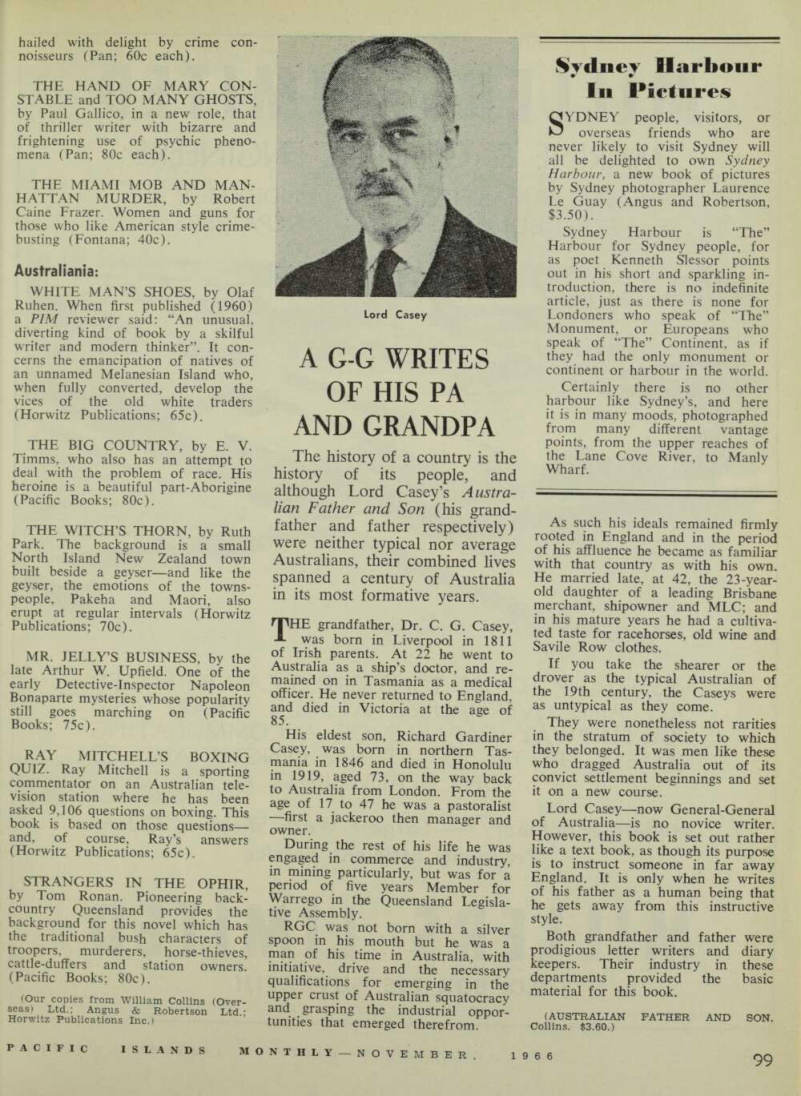
Lord Casey—now General-General of Australia—is no novice writer.
However, this book is set out rather like a text book, as though its purpose is to instruct someone in far away England. It is only when he writes of his father as a human being that he gets away from this instructive style.
Both grandfather and father were prodigious letter writers and diary keepers. Their industry in these departments provided the basic material for this book.
(Australian Father And Son.
Collins. $3.60.)
Lord Casey