Convict Escapist
pp. 87-91 · Read in the full issue
Henri T Artas,
Extra Ordinary
By Lew Priday
During World War 11, when I was staying at the Hotel Cosmopolitan in Noumea, I was visited by an old man rather under average height, with a live eye and an intelligent expression, who spoke ungrammatical but understandable English.
HE was Henri Tartas, the most notable of the small remaining ex-convict group of the New Cale donian population. He put into my hand an old exercise book in which he had written out for me, in pencil but in quite legible French, an ac count of his three escapes.
The first was from Bourail to Queensland in an open boat; the second was on a raft from He Nou to the New Caledonian mainland, and thence across the roughest sort of country to near the mouth of the Pourina River on the East coast; and the third escape, in a boat that he and his mates took months to build, was to German New Guinea.
Shoe Repairer
Thereafter, until his death a year or two later, I saw a good deal of the old man, who was fond of basking in the sun under the flamboyant trees on the Place des Cocotiers, when he was not working to keep himself alive by repairing shoes for his fellow citizens.
The most interesting of his adventures was his escape to Queens-
land, which I am outlining in this account.
I found Tartas to be a man of courage and independence, and well believed him capable of leading and inspiring his mates in the desperate adventures he related in his exercise book.
One day I asked him why he preferred to end his days on a lonely bunk in an old tin shed to living in the old men’s home on the heights run devotedly by French, Australian and New Zealand Little Sisters of the Poor, whom I shall never cease to admire.
“Well, Monsieur Friday, you see it s like this,” he said, “freedom comes first with me, and I strongly object
to being asked to mumble a prayer to le bon Dieu before I am given a meal. For le bon Dieu was never very good to me.
“Certainly I was sent here, long ago when I was still a youth, for taking a small sum of money that didn’t belong to me. It was in the region of Bordeaux, and if it hadn’t been a church I took it from, I don’t think Fd have been sent here at all.
I expect these days they’d have let me off with a caution as it was a first offence.”
Below I have translated and slightly abbreviated Tartas’ story of his escape from Bourail to Bowen in an open boat.
It is my intention to hand the original manuscript to either the public library in Bowen, where the escape is still remembered—or was some years ago; or to the Mitchell Library in Sydney.
Bourail To Bowen
In An Open Boat
TN the colony of New Caledonia, A I, Henri Tartas, was taught the trade of shoemaker, and spent much time on the main penitentiary depot at He Nou, the island which protects Noumea harbour.
But about 1892, when transportation ceased and the penitentiary was re organised, the boot factory was closed
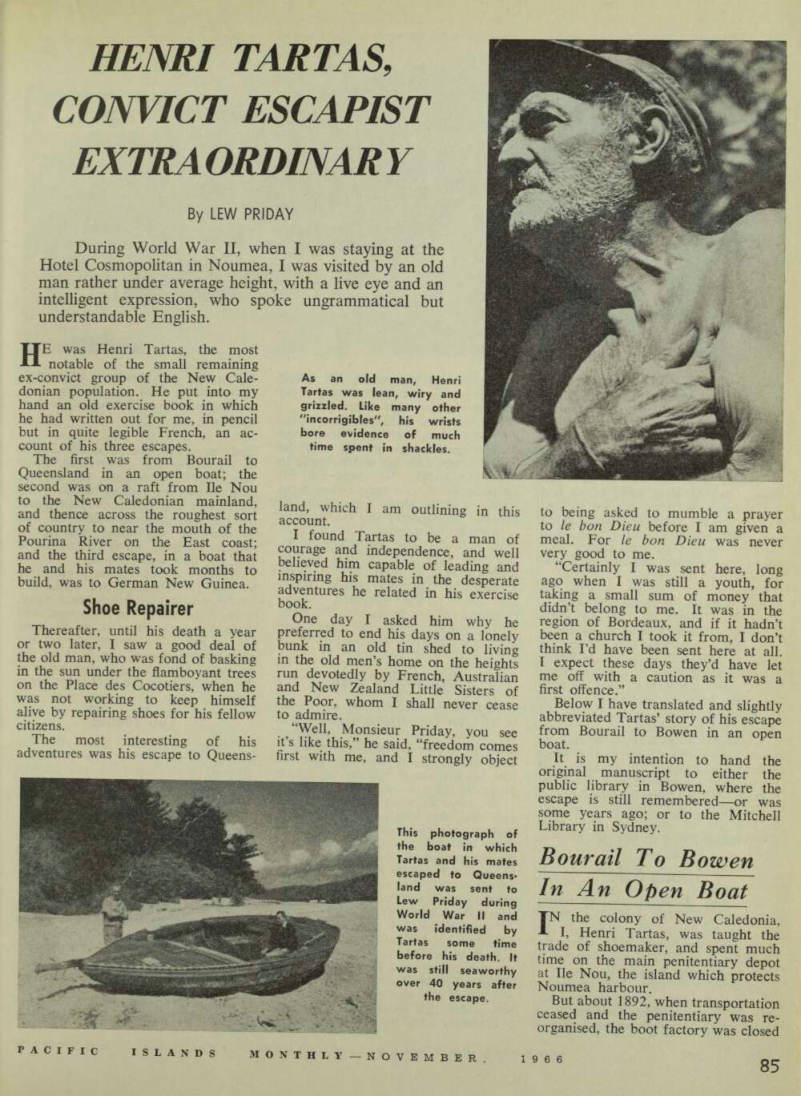
As an old man, Henri Tartas was lean, wiry and grizzled. Like many other "incorrigibles", his wrists bore evidence of much time spent in shackles.
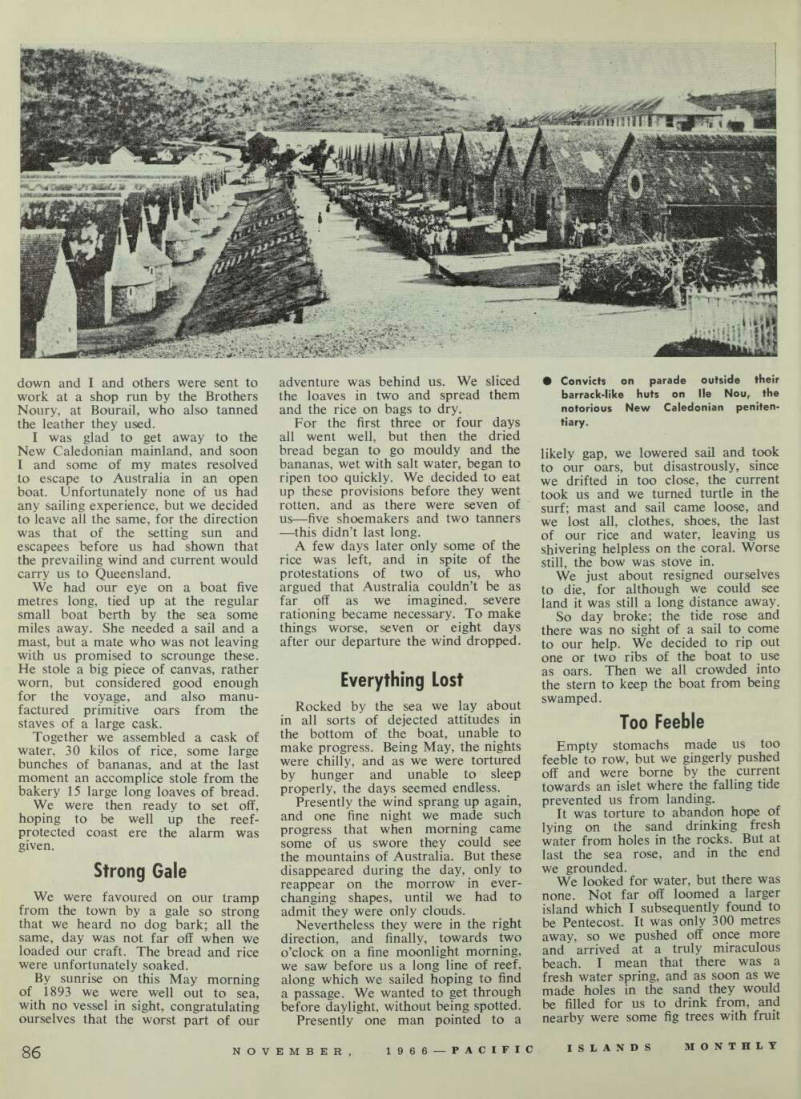
This photograph of the boat in which Tartas and his mates escaped to Queens land was sent to
Lew Friday during
World War II and was identified by Tartas some time before his death. It was still seaworthy over 40 years after the escape.
down and I and others were sent to work at a shop run by the Brothers Noury, at Bourail, who also tanned the leather they used.
I was glad to get away to the New Caledonian mainland, and soon I and some of my mates resolved to escape to Australia in an open boat. Unfortunately none of us had any sailing experience, but we decided to leave all the same, for the direction was that of the setting sun and escapees before us had shown that the prevailing wind and current would carry us to Queensland.
We had our eye on a boat five metres long, tied up at the regular small boat berth by the sea some miles away. She needed a sail and a mast, but a mate who was not leaving with us promised to scrounge these.
He stole a big piece of canvas, rather worn, but considered good enough for the voyage, and also manu factured primitive oars from the staves of a large cask.
Together we assembled a cask of water, 30 kilos of rice, some large bunches of bananas, and at the last moment an accomplice stole from the bakery 15 large long loaves of bread.
We were then ready to set off, hoping to be well up the reef protected coast ere the alarm was given.
Strong Gale
We were favoured on our tramp from the town by a gale so strong that we heard no dog bark; all the same, day was not far off when we loaded our craft. The bread and rice were unfortunately soaked.
By sunrise on this May morning of 1893 we were well out to sea, with no vessel in sight, congratulating ourselves that the worst part of our
adventure was behind us. We sliced the loaves in two and spread them and the rice on bags to dry.
For the first three or four days all went well, but then the dried bread began to go mouldy and the bananas, wet with salt water, began to ripen too quickly. We decided to eat up these provisions before they went rotten, and as there were seven of us—five shoemakers and two tanners —this didn’t last long.
A few days later only some of the rice was left, and in spite of the protestations of two of us, who argued that Australia couldn’t be as far off as we imagined, severe rationing became necessary. To make things worse, seven or eight days after our departure the wind dropped.
Everything Lost
Rocked by the sea we lay about in all sorts of dejected attitudes in the bottom of the boat, unable to make progress. Being May, the nights were chilly, and as we were tortured by hunger and unable to sleep properly, the days seemed endless.
Presently the wind sprang up again, and one fine night we made such progress that when morning came some of us swore they could see the mountains of Australia. But these disappeared during the day, only to reappear on the morrow in ever changing shapes, until we had to admit they were only clouds.
Nevertheless they were in the right direction, and finally, towards two o’clock on a fine moonlight morning, we saw before us a long line of reef, along which we sailed hoping to find a passage. We wanted to get through before daylight, without being spotted.
Presently one man pointed to a
likely gap, we lowered sail and took to our oars, but disastrously, since we drifted in too close, the current took us and we turned turtle in the surf; mast and sail came loose, and we lost all, clothes, shoes, the last of our rice and water, leaving us shivering helpless on the coral. Worse still, the bow was stove in.
We just about resigned ourselves to die, for although we could see land it was still a long distance away.
So day broke; the tide rose and there was no sight of a sail to come to our help. We decided to rip out one or two ribs of the boat to use as oars. Then we all crowded into the stern to keep the boat from being swamped.
Too Feeble
Empty stomachs made us too feeble to row, but we gingerly pushed off and were borne by the current towards an islet where the falling tide prevented us from landing.
It was torture to abandon hope of lying on the sand drinking fresh water from holes in the rocks. But at last the sea rose, and in the end we grounded.
We looked for water, but there was none. Not far off loomed a larger island which I subsequently found to be Pentecost. It was only 300 metres away, so we pushed off once more and arrived at a truly miraculous beach. I mean that there was a fresh water spring, and as soon as we made holes in the sand they would be filled for us to drink from, and nearby were some fig trees with fruit
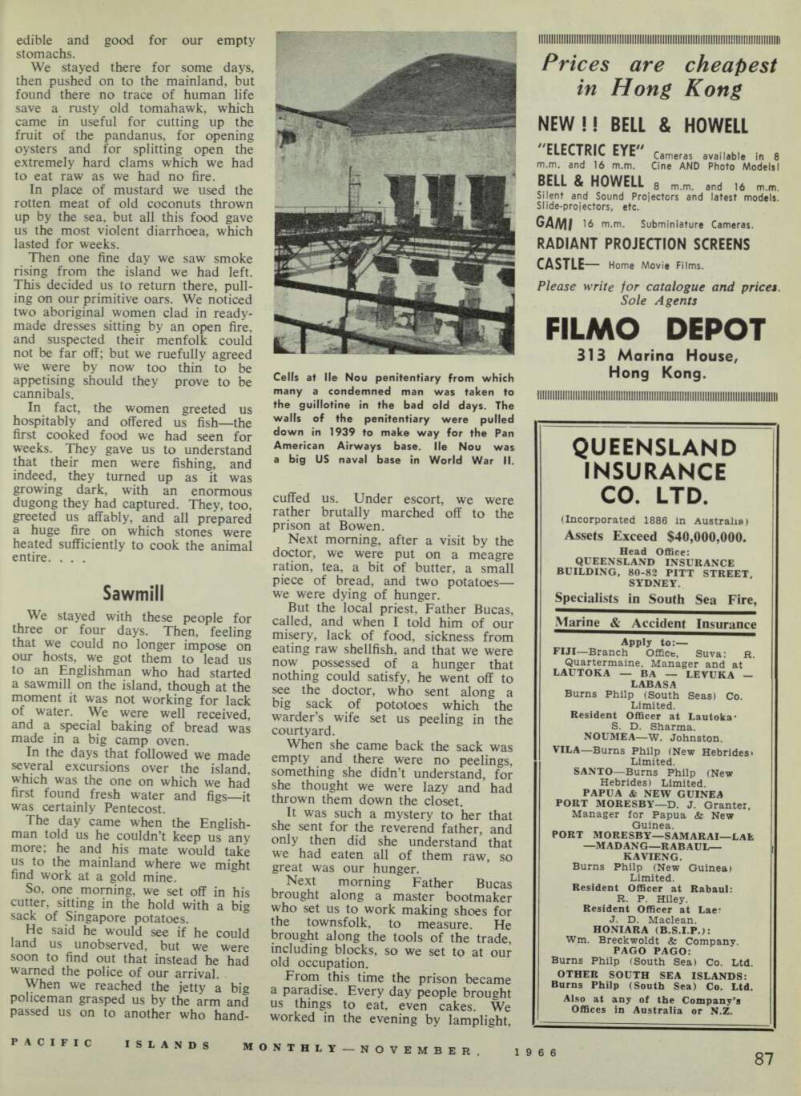
Convicts on parade outside their barrack-like huts on Ile Nou, the notorious New Caledonian peniten tiary.
edible and good for our empty stomachs.
We stayed there for some days, then pushed on to the mainland, but found there no trace of human life save a rusty old tomahawk, which came in useful for cutting up the fruit of the pandanus, for opening oysters and for splitting open the extremely hard clams which we had to eat raw as we had no fire.
In place of mustard we used the rotten meat of old coconuts thrown up by the sea, but all this food gave us the most violent diarrhoea, which lasted for weeks.
Then one fine day we saw smoke rising from the island we had left.
This decided us to return there, pull ing on our primitive oars. We noticed two aboriginal women clad in ready made dresses sitting by an open fire, and suspected their menfolk could not be far off; but we ruefully agreed we were by now too thin to be appetising should they prove to be cannibals.
In fact, the women greeted us hospitably and offered us fish—the first cooked food we had seen for weeks. They gave us to understand that their men were fishing, and indeed, they turned up as it was growing dark, with an enormous dugong they had captured. They, too, greeted us affably, and all prepared a huge fire on which stones were heated sufficiently to cook the animal entire. . . .
Sawmill
We stayed with these people for three or four days. Then, feeling that we could no longer impose on our hosts, we got them to lead us to an Englishman who had started a sawmill on the island, though at the moment it was not working for lack of water. We were well received, and a special baking of bread was made in a big camp oven.
In the days that followed we made several excursions over the island, which was the one on which we had first found fresh water and figs—it was certainly Pentecost.
The day came when the English man told us he couldn’t keep us any more; he and his mate would take us to the mainland where we might find work at a gold mine.
So, one morning, we set off in his cutter, sitting in the hold with a big sack of Singapore potatoes.
He said he would see if he could land us unobserved, but we were soon to find out that instead he had warned the police of our arrival.
When we reached the jetty a big policeman grasped us by the arm and passed us on to another who hand-
cuffed us. Under escort, we were rather brutally marched off to the prison at Bowen.
Next morning, after a visit by the doctor, we were put on a meagre ration, tea, a bit of butter, a small piece of bread, and two potatoes— we were dying of hunger.
But the local priest, Father Bucas, called, and when I told him of our misery, lack of food, sickness from eating raw shellfish, and that we were now possessed of a hunger that nothing could satisfy, he went off to see the doctor, who sent along a big sack of pototoes which the warder’s wife set us peeling in the courtyard.
When she came back the sack was empty and there were no peelings, something she didn’t understand, for she thought we were lazy and had thrown them down the closet.
It was such a mystery to her that she sent for the reverend father, and only then did she understand that we had eaten all of them raw, so great was our hunger.
Next morning Father Bucas brought along a master bootmaker who set us to work making shoes for the townsfolk, to measure. He brought along the tools of the trade, including blocks, so we set to at our old occupation.
From this time the prison became a paradise. Every day people brought us things to eat, even cakes. We worked in the evening by lamplight,
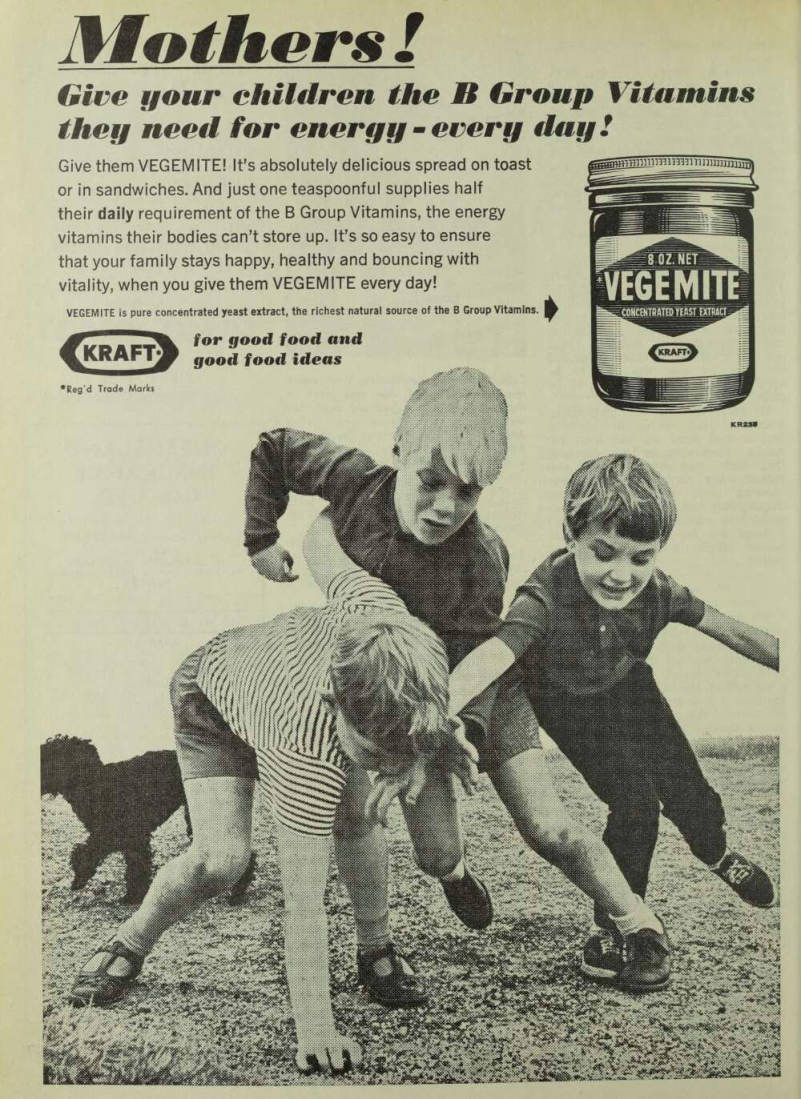
Cells at Ile Nou penitentiary from which many a condemned man was taken to the guillotine in the bad old days. The walls of the penitentiary were pulled down in 1939 to make way for the Pan American Airways base. Ile Nou was a big US naval base in World War II.
and our visitors brought bottles of drink, which we shared with our kindly gaoler, the master shoemaker, and others.
Unfortunately, this didn’t last long.
The order arrived for us to be sent to Brisbane.
There, although we weren’t treated too badly, we had to say goodbye to high living, to beer.
Back To New Caledonia
Once a week we had to appear at the police court, to be remanded until a warder from New Caledonia arrived to take us back.
Even though we had not admitted our identity, we could have been recognised from the penitentiary photographs which had been sent over.
By an extradition law passed some years earlier, we were condemned to be returned to He Nou.
Two months after our return, we appeared before a special tribunal, which gave us terms of solitary con finment.
I, being regarded as the leader, received the maximum sentence for an escapist—five years. I nearly went mad.
All they gave us to read was religious pamphlets and books of no live interest whatsoever.
When my five years were up, I was set to work again at my old employment, in a shop making foot wear for the warders.
But once again my thoughts were
all of escaping, . . ,