Rock-Hewn Plumbing
p. 75 · Read in the full issue
On Norfolk Island
By Anne Kent Stidolph
Plumbing has come a long way in the last 100 years , even in the last 20. New ideas and new materials have stream lined a trade that was once considered unnecessary.
TODAY it is one of the first and most important considerations in the building of castle or cottage for human occupation.
On a recent trip to Norfolk Island, about 1,000 miles east of Australia, I was intrigued by the plumbing system of the one-time gaol, which was built about 1826 during the penal settle ment days of the island.
The main gaol was constructed from hand-hewn stone, quarried from the off-shore island of Nepean.
One Soldier
It was built in the shape of a pentagon with the cells in double rows radiating from the centre to the points of the angles.
The space in between the double rows of cells was divided down the centre to form exercise yards—one for each row of cells. This meant that the whole gaol could be super vised by one soldier stationed in the centre.
At the end of each row of cells was a toilet. This, like the building, was made from hand-hewn stone, even to the seats which consisted of one large slab approximately four
feet square, and one foot thick with a hole in the middle.
All the waste matter was carried off to the sea some 400 or 500 yards away through a system of drains underneath the gaol and also built of stone slabs.
It was an ingenious construction, especially in a time when plumbing was in its infancy, and it served the gaol well.
Although it is over 100 years since the prisoners were withdrawn from the island, and the buildings have become crumbling ruins, the stone drains can still be traced and at least one toilet seat is intact for all to see.
Officers' Bath
All the construction work was done by the prisoners under the supervision of the prison authorities.
Today, many homes on the island have septic tanks, for there is still no public sewerage system.
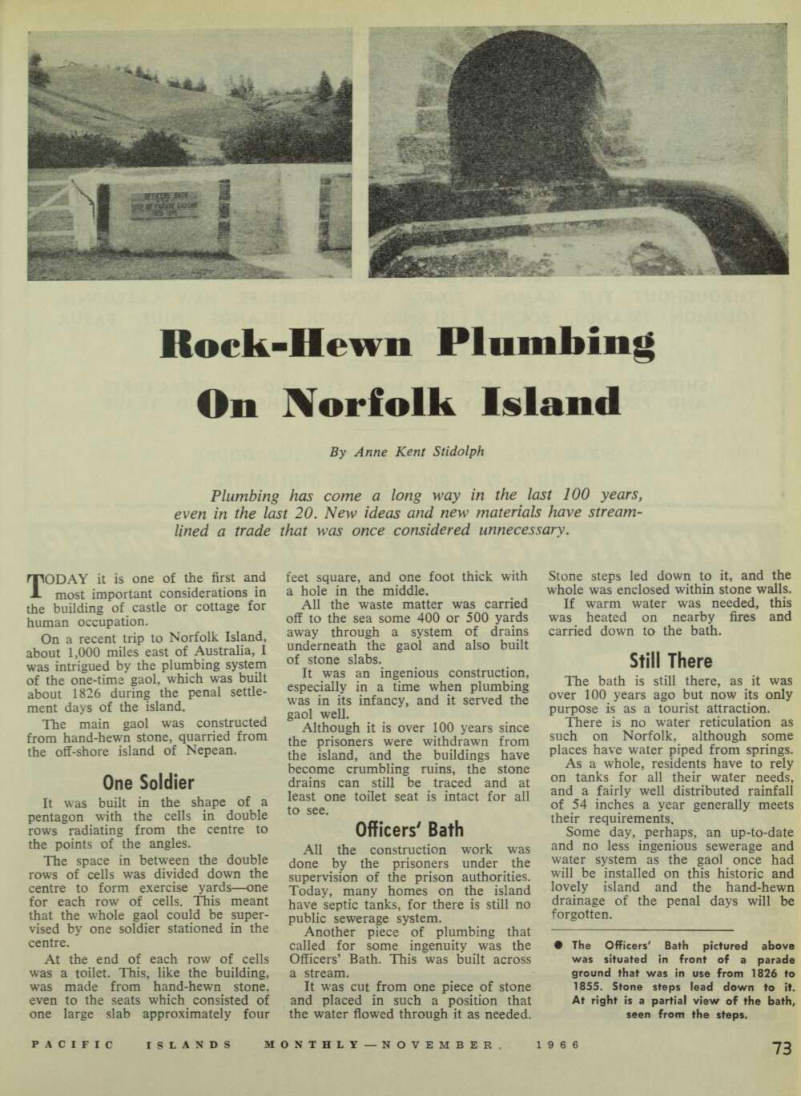
Another piece of plumbing that called for some ingenuity was the Officers’ Bath. This was built across a stream.
It was cut from one piece of stone and placed in such a position that the water flowed through it as needed.
Stone steps led down to it, and the whole was enclosed within stone walls.
If warm water was needed, this was heated on nearby fires and carried down to the bath.
Still There
The bath is still there, as it was over 100 years ago but now its only purpose is as a tourist attraction.
There is no water reticulation as such on Norfolk, although some places have water piped from springs.
As a whole, residents have to rely on tanks for all their water needs, and a fairly well distributed rainfall of 54 inches a year generally meets their requirements.
Some day, perhaps, an up-to-date and no less ingenious sewerage and water system as the gaol once had will be installed on this historic and lovely island and the hand-hewn drainage of the penal days will be forgotten.
The Officers' Bath pictured above was situated in front of a parade ground that was in use from 1826 to 1855. Stone steps lead down to it.
At right is a partial view of the bath, seen from the steps.