The Editors' Mailbag
pp. 36-39 · Read in the full issue


Wallis Island Flag
Sir, —In the very interesting article by the Rev. John J. Hurley on “Vexil lology in the the South Seas” (PIM, Sept., p. 81), it is stated that “the French territories fly only the famous Tricolor. . .
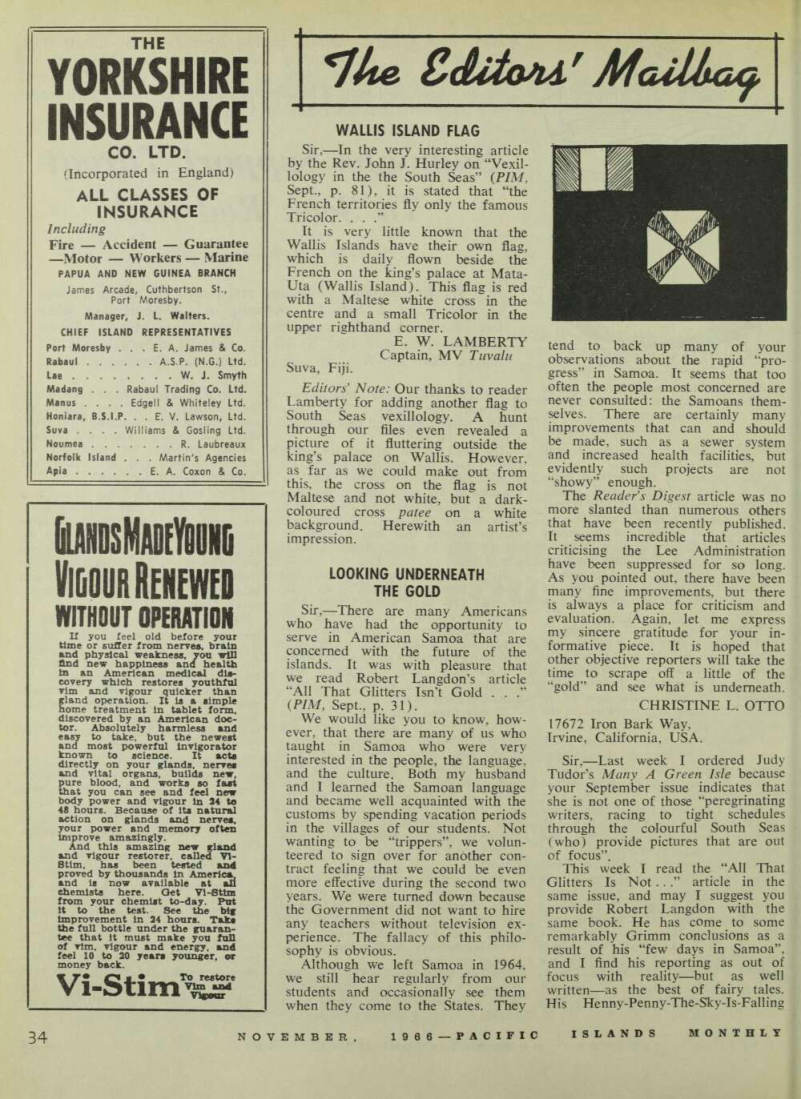
It is very little known that the Wallis Islands have their own flag, which is daily flown beside the French on the king’s palace at Mata- Uta (Wallis Island). This flag is red with a Maltese white cross in the centre and a small Tricolor in the upper righthand corner.
E. W. Lamberty
Captain, MV Tuvalu Suva, Fiji.
Editors’ Note: Our thanks to reader Lamberty for adding another flag to South Seas vexillology. A hunt through our files even revealed a picture of it fluttering outside the king’s palace on Wallis. However, as far as we could make out from this, the cross on the flag is not Maltese and not white, but a dark coloured cross patee on a white background. Herewith an artist’s impression.
Looking Underneath
The Gold
Sir, —There are many Americans who have had the opportunity to serve in American Samoa that are concerned with the future of the islands. It was with pleasure that we read Robert Langdon’s article “All That Glitters Isn’t Gold . . ( PIM , Sept., p, 31).
We would like you to know, how ever, that there are many of us who taught in Samoa who were very interested in the people, the language, and the culture. Both my husband and I learned the Samoan language and became well acquainted with the customs by spending vacation periods in the villages of our students. Not wanting to be “trippers”, we volun teered to sign over for another con tract feeling that we could be even more effective during the second two years. We were turned down because the Government did not want to hire any teachers without television ex perience. The fallacy of this philo sophy is obvious.
Although we left Samoa in 1964. we still hear regularly from our students and occasionally see them when they come to the States. They
tend to back up many of your observations about the rapid “pro gress” in Samoa. It seems that too often the people most concerned are never consulted: the Samoans them selves. There are certainly many improvements that can and should be made, such as a sewer system and increased health facilities, but evidently such projects are not “showy” enough.
The Reader’s Digest article was no more slanted than numerous others that have been recently published.
It seems incredible that articles criticising the Lee Administration have been suppressed for so long.
As you pointed out, there have been many fine improvements, but there is always a place for criticism and evaluation. Again, let me express my sincere gratitude for your in formative piece. It is hoped that other objective reporters will take the time to scrape off a little of the “gold” and see what is underneath.
Christine L. Otto
17672 Iron Bark Way, Irvine, California, USA.
Sir, —Last week I ordered Judy Tudor’s Many A Green Isle because your September issue indicates that she is not one of those “peregrinating writers, racing to tight schedules through the colourful South Seas (who) provide pictures that are out of focus”.
This week I read the “All That Glitters Is N0t...” article in the same issue, and may I suggest you provide Robert Langdon with the same book. He has come to some remarkably Grimm conclusions as a result of his “few days in Samoa”, and I find his reporting as out of focus with reality—but as well written—as the best of fairy tales.
His Henny-Penny-The-Sky-Is-Falling
style makes exciting reading, although, unfortunately, his verbal rock tossing does far more damage than those stones he claims were thrown at him by Samoan boys.
In my three months in Samoa, I have not been able to draw con clusions of cultural downfall from stones, skirts and smiles as did Mr.
Langdon, but I do recognize that of such trivia news is made. Neither can I believe that Governor Lee intended to create “Paradise”—that would have been most presumptive of him. And, I know, he hasn’t fashioned hell, so perhaps the truth lies somewhere between Reader’s Digest and PIM.
My guess is that he was merely trying to improve the lot of a proud and wonderful people. In doing so he stepped on some toes. It wouldn’t surprize me if those who cried “ouch!” the loudest may have had their toes in the wrong places to begin with.
As for the angry part-Samoan, visiting his homeland for the first time in 20 years and indignant over the changes here, I wonder where he spent those 20 years, what salary he was making, and what his standard of living was. I wonder, too, why the editor of PIM in “What the Samoans Say About Progress” (state ments supposedly supporting Lang don’s viewpoint) did not question the validity, or at least the timeliness of the eight quotations when seven of them were more than a year old.
As one of those Stateside “trip pers” Mr. Langdon seems to abhor, 1 hope that in the two years I’ll be iere that I will be able to accomplish something constructive. I’ll certainly lave more time for it than those let-Age-Jaunters who visit Samoa ictween planes and then publish itartling conclusions based on original ihotography of ladies’ posteriors!
Jack H. Stoltz,
Principal Leone High School. s ago Pago, American Samoa.
/Oyages Without Instruments
Sir, —Now that we have left Torres >trait 2,000 miles astern and have the ndian Ocean South-East Trades mder our tail, we have been forced o realise regrettably that we have aid goodbye to the Pacific for the noment.
This letter is partly to say how nuch we have appreciated reading the iccounts of yachts’ progress, includ ing our own, in the PIM. We will till be keeping in touch, and the ise of swell lines south of Bougain ille.
As we will be returning to the
last thing we did before leaving Darwin was to take out a subscrip tion.
The second purpose of this letter is to make a request to your readers.
I am particularly interested in in digenous methods of navigation by the stars, swell, etc., because a study of their potentialities may contribute towards elucidating the settlement and subsequent inter-island contact in the Pacific.
We made a test voyage without instruments last year between Tahiti and New Zealand. (The story is told in Daughters of the Wind, which
Reeds of Wellington are bringing out about Christmas.) More recently we have been col lecting data from islanders who have made non-instrumental trips, and I have been amazed to find what a considerable amount of this lore re mains and that a number of tech niques used have no equivalent in Western navigation.
Examples are the methods of the captains of the lakatoi that used to undertake the hiri trading voyage across the Gulf of Papua, star and wave refraction techniques still in use by a Tongan cutter skipper, and the
Pacific within the next two years to make a more systematic study, I would be most grateful if any of your readers could let me know about inter-island canoe or cutter voyages without instruments over distances of, say, more than 100 miles that are still being made or have been made recently.
If possible I would like the names of individual islanders or at least of the islands concerned so that we can visit them.
Our address from November to January is: c/o Sunderland, 9 Anerley Road, Parktown, Johannes burg, South Africa.
Our permanent forwarding address is: c/o Naydler, 1 Paper Buildings, Temple, London, EC4, England.
David Lewis, Mb, Chb.
Catamaran Rehu Moana, Towards Durban, via Cocos.
New Columnist
Sir, —I was depressed to find your new columnist Percy Chatterton opening his score with the ritual New Guinea blast at other writers.
It was a graceless preliminary to the book which he himself will in evitably produce before too long.
I wrote my own Assignment New Guinea after about 12 months in the territory. I feel no need to apologise for this.
No doubt a residence of 30 years might have improved my background knowledge. Unfortunately I did not have 30 years to spare—a complaint shared by most other professional writers.
I remember Percy Chatterton as one of the most honest—and, cer tainly, most entertaining, members of the House of Assembly.
I hope more of the humour will shine through in his future columns, and I look forward to reading them.
Keith Willey.
Manly, NSW.
"Better Off French"
Sir, —I read with interest the com ments on the recent spate of rumours on Britain’s future in the New Hebrides. Having lived here for many years, and through hard work established myself with a large stake in the country, I view with dismay the extraordinary attitude the British have to their own countrymen; and, despite Mr. Lee’s assurances, I have every reason to be apprehensive about my future here.
British officials gave no help when a planter appealed for their assistance because his property was being used by natives, who, apart from squatting, were intimidating his wife by terrify ing her. Finally, the French stepped in and a land commission was
appointed to investigate. This should have been done by the British Dis trict Agent, but no one was prepared to rock the boat.
The French assisted their internal airline both in financing and subsidis ing it after it came in on ground pioneered by New Hebrides Airways.
The British contribution to British aviation in six years of operations has been one wheelbarrow.
To be in business here and be British is to be constantly accused of exploitation. It has caused the British people to slowly pull out of
business; and the British Administra tion will not rest until the few re maining are driven out.
Perhaps the remark of a well known planter (British) sums it up.
When told of the rumours that the British were leaving, he paled and said: ”My God! For a moment I thought you said the French were leaving.”
Personally, I think we would be better off being French.
Alan Breck.
Vila, Hebrides.