Tropicalities
pp. 19-22 · Read in the full issue
What will happen to New Hebrides aviation now that Air Melanesia has lost one of its two Drover aircraft in the tragic crash on Tanna in October?
WILL Bob Paul, whose vision, energy and drive got commercial aviation going in the New Hebrides in the face of almost unbelievable official indifference and hostility, be able to find another dedicated, dare devil pilot to replace his ill-fated friend and partner, Paul Burton?
Will Paul Burton’s loss increase the possibility of Bob Paul’s airline falling further, if not completely, into French hands?
Would a subsidy from the Con dominium Government be of any real help in the financial difficulties the airline is now bound to face?
Or has civil aviation in the New Hebrides now reached the stage that the only hope for its safe continu ance is a Government shareholding
Where Does New Hebrides Aviation Go From Here?
through one or more of the major airlines serving the Pacific?
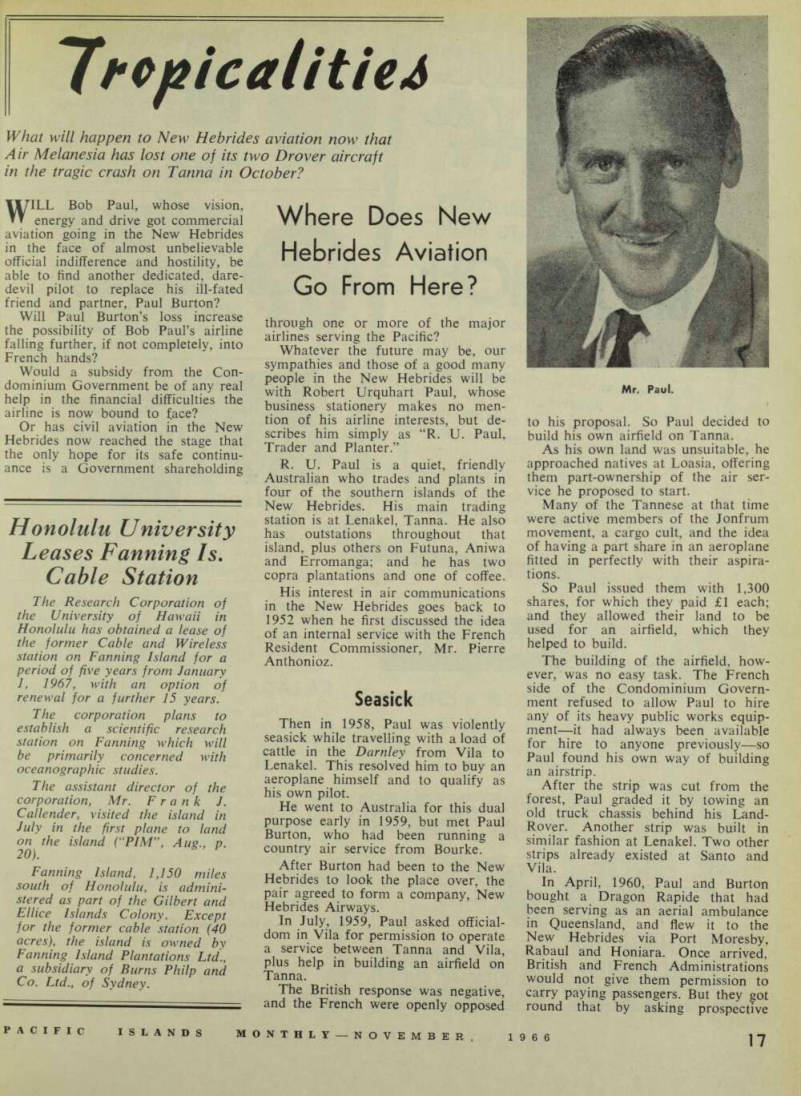
Whatever the future may be, our sympathies and those of a good many people in the New Hebrides will be with Robert Urquhart Paul, whose business stationery makes no men tion of his airline interests, but de scribes him simply as “R. U. Paul, Trader and Planter.”
R. U. Paul is a quiet, friendly Australian who trades and plants in four of the southern islands of the New Hebrides. His main trading station is at Lenakel, Tanna. He also has outstations throughout that island, plus others on Futuna, Aniwa and Erromanga; and he has two copra plantations and one of coffee.
His interest in air communications in the New Hebrides goes back to 1952 when he first discussed the idea of an internal service with the French Resident Commissioner, Mr. Pierre Anthonioz.
Seasick
Then in 1958, Paul was violently seasick while travelling with a load of cattle in the Darnley from Vila to Lenakel. This resolved him to buy an aeroplane himself and to qualify as his own pilot.
He went to Australia for this dual purpose early in 1959, but met Paul Burton, who had been running a country air service from Bourke.
After Burton had been to the New Hebrides to look the place over, the pair agreed to form a company, New Hebrides Airways.
In July, 1959, Paul asked official dom in Vila for permission to operate a service between Tanna and Vila, plus help in building an airfield on Tanna.
The British response was negative, and the French were openly opposed
to his proposal. So Paul decided to build his own airfield on Tanna.
As his own land was unsuitable, he approached natives at Loasia, offering them part-ownership of the air ser vice he proposed to start.
Many of the Tannese at that time were active members of the Jonfrum movement, a cargo cult, and the idea of having a part share in an aeroplane fitted in perfectly with their aspira tions.
So Paul issued them with 1,300 shares, for which they paid £1 each; and they allowed their land to be used for an airfield, which they helped to build.
The building of the airfield, how ever, was no easy task. The French side of the Condominium Govern ment refused to allow Paul to hire any of its heavy public works equip ment—it had always been available for hire to anyone previously—so Paul found his own way of building an airstrip.
After the strip was cut from the forest, Paul graded it by towing an old truck chassis behind his Land- Rover. Another strip was built in similar fashion at Lenakel. Two other strips already existed at Santo and Vila.
In April, 1960, Paul and Burton bought a Dragon Rapide that had been serving as an aerial ambulance in Queensland, and flew it to the New Hebrides via Port Moresby, Rabaul and Honiara. Once arrived, British and French Administrations would not give them permission to carry paying passengers. But they got round that by asking prospective
Mr. Paul.
passengers to pay £5 for a packet of cigarettes in Paul’s stores, then giv ing “free” rides on New Hebrides Airways.
Passenger traffic grew rapidly, but the comic opera fare arrangement continued until Mr. Julian Amery, the British Under-Secretary of State for the Colonies intervened.
The Dragon Rapide remained in service until well into 1961, when it was condemned as no longer air worthy. Fiji Airways then came to the rescue by chartering Paul a de Havilland Dover, which it later sold to him.
Meanwhile, the New Caledonian airline Transpac, which had shown an interest in the possibilities of New Hebridean services from the begin ning, formed a new company, Hebridair, with which to enter the field.
However, it was not until February, 1964, that Hebridair got going with a German two-engine Dornier air craft. It was not exactly received with open arms.
Petrol Drums
In fact, when it tried to gain access to NHA’s strips, the natives rolled empty petrol drums across them to prevent the Dornier using them.
Hebridair’s Dornier also suffered a series of landing accidents which put it in Noumea for long periods of repair.
But it managed to establish itself and to keep going with the help of a “few questions asked” subsidy of £5,000 a year from the French Gov ernment.
New Hebrides Airways always kept ahead of Hebridair, but several factors have combined to loosen the strong grip that Bob Paul and Paul Burton once had on the New Hebrides aviation situation:— • NHA made a deal with a French building contractor, Ardimani, to build more airfields for it, in return for which Ardimani acquired the largest single block of shares in
Nha.
• The petrol drum incidents caused the Condominium Govern ment to decide to take over all air fields from NHA, and it is now buy ing them up. • NHA was persuaded to pool its resources with Hebridair for a trial period of six months from last June.
The government decision to take over NHA’s airfields was, in the be ginning, advantageous to NHA in that, with the proceeds it received from the sale of its first field, it was able to buy another Drover.
However, the loss of one of the company’s two Drover’s in October
has now offset this advantage in that the insurance on it is unlikely, by any means, to cover the cost of a new plane. Even the prospect of a subsidy from the Condominium Gov ernment does not seem likely to solve the financial problems.
The loss of Burton in the crash has created further difficulties for Paul in that Burton held about 20 per cent, of the issued capital.
We can only guess at what will happen to Burton’s shares now. But we do know that it won’t be easy for Paul to find another British pilot of the same calibre, as British pilots are pretty scarce even in comfortable countries, and there’s not much to attract them in the rugged New Hebrides.
It could be that a Government shareholding through one of the Commonwealth airlines is about the only hope for continued, reliable, British-flavoured airline services with in the Condominium.
Certainly, it looks as if Bob Paul’s biggest challenge now is to stop the French getting an even bigger share in his business than is the case now.
They Want Some
Aerial Ropeways
GUINEAN farmers in two districts are asking the Admin istration to look into the chances of constructing aerial ropeways to help move produce to markets.
First query came from the Pindiu area, in the mountain ranges behind Finschhafen, where much coffee is grown. Then a similar request came from Bougainville.
There is a growing awakening to the advantages of cash-cropping among New Guineans. There is an
abundance of fertile soil. The big problem in many places is getting the produce to market.
The P-NG Director of Public Works, Mr. Jim Burns, has not scoffed at the idea of aerial rope ways. He admits their use in such places as Hunza and Nepal—places that are known to New Guineans in these days of radio. He has pro mised to investigate the practicability of constructing ropeways, but it seems certain that a good deal will depend on initial cost and the volume of traffic that could be expected.
Meanwhile through local government councils and members of the House of Assembly the pressure is being kept up.
Anniversary
For NG Women
THE New Guinea Women’s Asso ciation of Victoria, which is celebrating its 25th anniversary in November, was born of grim events.
It was formed in November, 1941, a month before Pearl Harbour, when a band of women evacuees from New Guinea joined together to help one another and to raise money for comforts for their men in the terri tory. The small band soon swelled when news of Pearl Harbour resulted in all the women and children being sent south.
With most of New Guinea over run by the Japanese, there was no news of most of the men for the next few years; most were believed prisoner in Japan.
With the end of the war it was learned that almost the whole civilian population left behind in New Guinea had been wiped out—most of them aboard the ill-fated prison ship.
Montevideo Maru.
So these courageous women who now found they were widows decided to raise money enough to found a permanent memorial scholarship to these men who died, and a number of children living in the territory have benefited from this scholarship.
The Melbourne association also played a major part in erecting the memorial gates to the entrance of Rabaul’s Queen Elizabeth Park. And after 25 years, members of the Mel bourne association still meet each month at various homes, and contri bute to both local and territory charities.
President is Mrs, Catherene Lewis; vice-presidents Mrs. Olga Bliss and Mrs. W. Holland; hon. secretary Mrs, Donella Walker and hon. treasurer Mrs. Margaret Farnsworth.
The 25th anniversary will be celebrated at the home of Mr. and
Mrs. W. C. Groves, of Camberwell —which is fitting, as Mrs. Groves was one of the founders in Mel bourne, and she also played a major part in founding last year a New Guinea Women’s Club in Canberra.
Meanwhile at the New Guinea Women’s Club in Sydney Mrs. A.
Green has taken over as president from Mrs. N. Foxcroft, who held that post for a record 20 years.
New Guinean
Customs Men?
THERE has been a good deal of criticism in Papua-New Guinea at the Administration’s apparent
failure to train young New Guineans as Customs officers. Questions have been asked in the House of As sembly—the answer usually being that it is hard to attract the right kind of trainee.
Now a belated beginning has been made with the appointment of a special training officer to the Customs Branch of the Department of Trade.
He has had experience in this type of work in Australia and he seems to have made a very good start — young trainees appear happy and are responding to tuition.
We hope these youngsters are allowed to complete a full course of training before they are asked to accept responsibility.
His Renunciation
Made History
A LONGSTANDING and appar ently serious dispute over the high Tuiaana title of Western Samoa was settled peacefully at the Lands and Titles Court in Apia in October.
Tufuga Efi, son of former Head of State Tupua Ramasese and budding politician, made a surprise announce ment in court renouncing the title and all the honours attached, “if it meant a peaceful settlement to the dispute.”
The dispute started when the dis trict of Leulumoega conferred the Tuiaana honours on Tufuga Efi at a ceremony in May last year.
Objections were lodged immediately in court by a number of grouns connected with the title. The hear
ing was scheduled to take place last November but was postponed in an effort to reach agreement outside court.
Chief Judge P. L. Molineaux earlier expressed grave concern about the dispute and made some pointed remarks about the relevance of tradition to the modern world.
After the action by Tufuga Efi in renouncing the title the Judge said he had nothing but praise for the wisdom of the leaders of the parties.
He said that never in the history of Samoa had anyone renounced such a high title and the relinquishing by Tufuga Efi of the Tuiaana title was historic. He should be commended for an unselfish stand.
Little Chimbu Was
For The Twins
JJTTLE CHIMBU, the first book for children written about New Guinea, in New Guinea, by a terri torian, has had an immediate success, but this has not affected its author illustrator, Nancy Curtis, one wit.
An educational firm has selected Little Chimbu and his quaint adven tures with the Kokomo bird as its children’s book of the year for Christmas, and a company producing souvenirs wants to use Little Chimbu’s appealing features on chinaware.
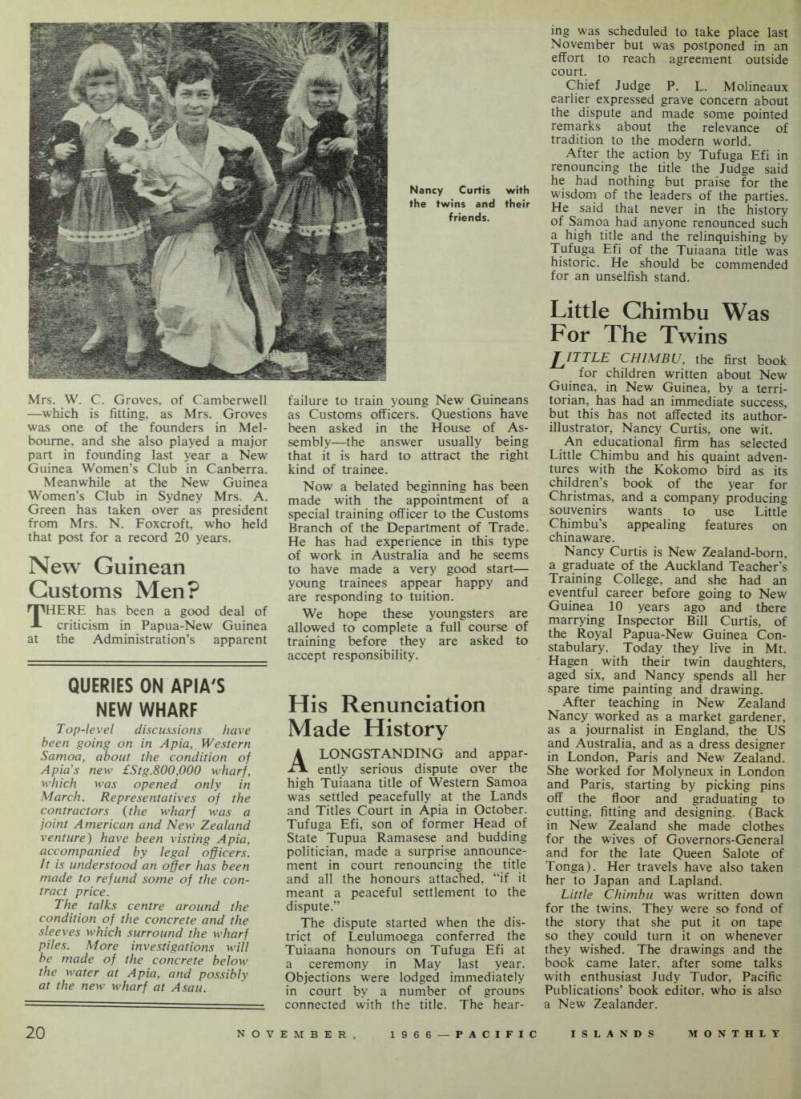
Nancy Curtis is New Zealand-born, a graduate of the Auckland Teacher’s Training College, and she had an eventful career before going to New Guinea 10 years ago and there marrying Inspector Bill Curtis, of the Royal Papua-New Guinea Con stabulary. Today they live in Mt.
Hagen with their twin daughters, aged six, and Nancy spends all her spare time painting and drawing.
After teaching in New Zealand Nancy worked as a market gardener, as a journalist in England, the US and Australia, and as a dress designer in London, Paris and New Zealand.
She worked for Molyneux in London and Paris, starting by picking pins off the floor and graduating to cutting, fitting and designing, (Back in New Zealand she made clothes for the wives of Governors-General and for the late Queen Salote of Tonga). Her travels have also taken her to Japan and Lapland.
Little Chimbu was written down for the twins. They were so fond of the story that she put it on tape so they could turn it on whenever they wished. The drawings and the book came later, after some talks with enthusiast Judy Tudor, Pacific Publications’ book editor, who is also a New Zealander,
Nancy Curtis with the twins and their friends.