Battle For Bougainville
p. 15 · Read in the full issue
Is Coming To A Head
From a Rabaul Correspondent The Battle of Bougainville appears to be coming to a head. The battle centres around the demands of New Guineans in the Kieta area for royalties from land which is currently being tested by Conzinc Riotinto for copper.
r seems that the copper is there, but under present territory laws, land owners are not entitled to royalties from mining activities, be cause minerals beneath the earth are the property of the Crown.
Basically the situation is the same as reported in PIM in March (p. 19), except that now both sides—Admin istration and New Guinean land owners—are more determined to stay put on their views.
Meat in the sandwich is still CRA, which has been embarrassed over the Government’s stand because it knows that it will need the goodwill of the locals to develop the area when the time comes. CRA would be willing to adopt some kind of share-out system.
Pickets, Police
Already the local situation has be come rather ugly, with the New Guineans virtually picketing CRA activities, and preventing them from getting on with their work. The police detachment at Kieta has been strengthened.
Now the Catholic Mission in Bougainville has come out in strong support of the native objections and is against the new mining ordinance passed by the Assembly at its June meeting. This ordinance provides for a system of compensation and land rents for mining lands (PIM, July, p.
The priests on Bougainville say this ordinance should be repealed and property owners be given royalties.
Fhe priests say the ordinance was passed by the House in “unseemly haste”.
Bishop L. L. Lemay, of Bougain ville, said in October that because >f the Australian Government’s de ;ermination to enforce its views on he people, Kieta was being ‘turned nto a battle ground”.
He said the owners of the mineral idds were angry because they had lever been asked if they were willing o have their grounds occupied. The ocal people were merely trying to lold on to their land.
The basic question was whether the Australian way of life should be forced upon the people of the territory through Australian ordinances, even though these could cause disur^f nces peace.
The Catholic stand might well harden the view of the House of Assembly when it meets in November.
At this meeting the member for Bougainville, Mr. Paul Lapun, will introduce amending bills designed to give a five per cent, royalty to land owners.
The Administration has already made it clear that it will not reverse its stand, and this attitude was confirmed by the Minister for Territones, Mr. Barnes, at a news confcrence in Port Moresby in October.
Mr. Lapun may not have a chance ot getting his amendment passed, because many members resent the missions suggestion that the June ordinance was passed with unseemly naste. and because some elected members resent moves by any mission to openly intrude into territory pomics. m The unseemly haste allegation certainly won t stick.
The new ordinance was introduced into the House on June 8 by the Secretary for Lands, Mr. Don Grove, who gave a most detailed explana tion of it. The debate was resumed on June 10 when Mr. lan Downs, speaking in pidgin, gave a clear out line of the purposes of the bill.
The main debate took place on June 14, but meanwhile there had been considerable discussion outside the House among elected members, and there was much lobbying over Mr. Lapun’s announced intention to seek amendments Of 21 speakers in the June 14 de bate, 12 were New Guineans, six were European elected members and six official members, Mr. Lapun’s amendment was moved in the committee stages, during which there was further debate. The subsequent voting on Mr. Lapun’s amendment to seek a five per cent royalty for land owners indicated that members were well aware of the principles involved. The amend ment was defeated 30 votes to 22.
It will be interesting now to see how the November meeting deals with the same problem.
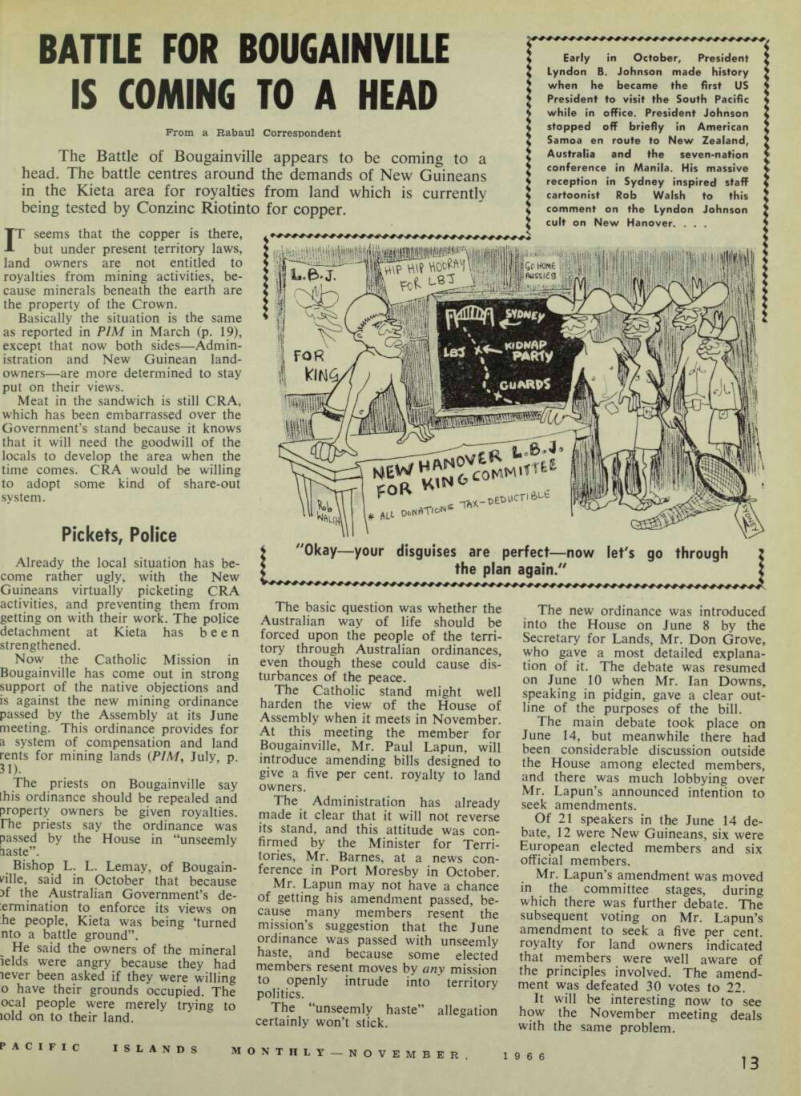
Early in October, President Lyndon B. Johnson made history when he became the first US President to visit the South Pacific while in office. President Johnson stopped off briefly in American Samoa en route to New Zealand, Australia and the seven-nation conference in Manila. His massive reception in Sydney inspired staff cartoonist Rob Walsh to this comment on the Lyndon Johnson cult on New Hanover. . . .
"Okay—your disguises are perfect—now let's go through the plan again."