The Sugar Economy: How Fiji's
pp. 143-155 · Read in the full issue


Business and Development
The Sugar Economy: How Fiji's Major Industry Survives
From a Suva Correspondent Being a British colony under British protection, Fiji enjoys many privileges that it certainly would not have if it were the “free and independent nation” envisaged recently by the United Nations’ Committee of Twenty-Four. Nothing shows this more clearly than the conditions under which Fiji sells the product of its chief industry, sugar-growing.
INHERE is enormous world over- L production of sugar, and the irrent quotation for sugar, an >unced daily in London, is around >tg.ls per ton. That is much less an the cost of production in any mntry. Then how do the economics ; the industry work?
British sugar-growers survive be luse, to protect their sugar-produc g industries, the Commonwealth »untries maintain a form of control rer imports and distribution.
Fiji gets a guaranteed £F47/10/- ;r ton for about one half of its mual exportable production of ound 280,000 tons. For the other ilf, the price is very much catch -catch-can—being the daily world arket quotation, plus whatever else ,n be gained by keen selling. The ice varies with market fluctuations.
Main Sources
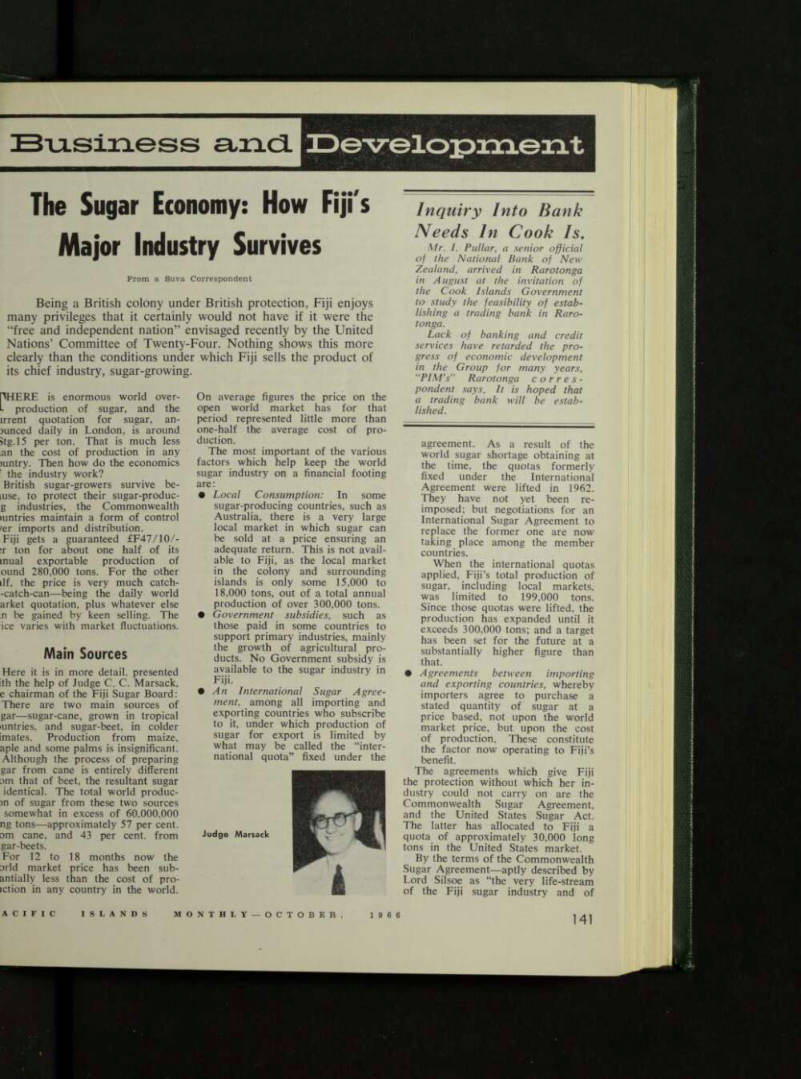
Here it is in more detail, presented ith the help of Judge C. C. Marsack, e chairman of the Fiji Sugar Board: There are two main sources of gar—sugar-cane, grown in tropical iuntries, and sugar-beet, in colder imates. Production from maize, aple and some palms is insignificant.
Although the process of preparing gar from cane is entirely different 3m that of beet, the resultant sugar identical. The total world produc >n of sugar from these two sources somewhat in excess of 60,000,000 ng tons —approximately 57 per cent.
Dm cane, and 43 per cent, from gar-beets.
For 12 to 18 months now the arid market price has been sub antially less than the cost of pro iction in any country in the world.
On average figures the price on the open world market has for that period represented little more than one-half the average cost of pro duction.
The most important of the various factors which help keep the world sugar industry on a financial footing are: • Local Consumption: In some sugar-producing countries, such as Australia, there is a very large local market in which sugar can be sold at a price ensuring an adequate return. This is not avail able to Fiji, as the local market in the colony and surrounding islands is only some 15,000 to 18,000 tons, out of a total annual production of over 300,000 tons. • Government subsidies, such as those paid in some countries to support primary industries, mainly the growth of agricultural pro ducts. No Government subsidy is available to the sugar industry in Fiji. • An International Sugar Agree ment, among all importing and exporting countries who subscribe to it, under which production of sugar for export is limited by what may be called the “inter national quota” fixed under the
agreement. As a result of the world sugar shortage obtaining at the time, the quotas formerly fixed under the International Agreement were lifted in 1962.
They have not yet been re imposed; but negotiations for an International Sugar Agreement to replace the former one are now taking place among the member countries.
When the international quotas applied, Fiji’s total production of sugar, including local markets, was limited to 199,000 tons.
Since those quotas were lifted, the production has expanded until it exceeds 300,000 tons; and a target has been set for the future at a substantially higher figure than that. • Agreements between importing and exporting countries, whereby importers agree to purchase a stated quantity of sugar at a price based, not upon the world market price, but upon the cost of production. These constitute the factor now operating to Fiji’s benefit.
The agreements which give Fiji the protection without which her in dustry could not carry on are the Commonwealth Sugar Agreement, and the United States Sugar Act.
The latter has allocated to Fiji a quota of approximately 30,000 long tons in the United States market.
By the terms of the Commonwealth Sugar Agreement—aptly described by Lord Silsoe as “the very life-stream of the Fiji sugar industry and of
Judge Marsack
the country”—Fiji has what is known as an “overall quota” of 225,000 tons. Under that quota Fiji is entitled to export to preferential markets within the Commonwealth 225,000 tons of sugar annually.
Of this total of 225,000 tons, 140.000 tons represent what is known as the negotiated price quota; the price being fixed by negotiation in London between the Ministry and delegates from the exporting countries. It is assessed on a basis which will render a reasonable return to the efficient producer.
The present negotiated price is £Stg.43/10/- per long ton, f.o.b. stowed bulk. To this is added further sums for the benefit of less developed countries such as Fiji; with the final result that for the present 1966 season the negotiated price to be paid for 140,000 tons of Fiji sugar exported to the United Kingdom will be £Stg.47/10/- per ton.
The price paid for the balance of the overall quota (225,000 tons less 140.000 tons) represents an increase over the price paid for sugar sold on the open world market and reflected in the London daily price, though this latter is the basis upon which the Commonwealth preference price is calculated.
For the United States quota the price paid is also one which can be said to render a reasonable return to the efficient producer. This price has not been made public.
Market Prospects
With the balance of Fiji’s produc tion, to be sold in markets not covered by the Commonwealth Sugar Agreement or the United States Sugar Act, the price received is based on the world market price. On that market, supply has for a long period greatly exceeded demand; with the inevitable result that prices have crashed.
There has been no price improve ment, because a number of countries have preferred to sell their exportable sugar surplus at substantially less than the cost of production merely for the sake of foreign exchange.
While world production of sugar remains greatly in excess of world consumption these surpluses will con tinue to exist. While the countries concerned are prepared to sell at a loss, there is little likelihood of any material improvement in the world market price, unless a new Inter national Sugar Agreement operates.
The Commonwealth Sugar Agree ment is meanwhile Fiji’s protection —the one factor which makes it worthwhile growing sugar in the colony.
Last Shipment Of
Makatea Phosphate
THE last shipload of phosphate from Makatea, French Poly nesia, was due to leave that island for New Plymouth, NZ, about September 17 in the 7,798-ton Norwegian phosphate carrier Utsira.
Makatea has been one of three important sources of phosphate in the Pacific in the 20th century. The others are Ocean Island and Nauru.
For the past 53 years, Makatea’s phosphate has been mined by a French company, Compagnie Francaise des Phosphates de I’Oceanie, and shipped out at the rate of about 300,000 tons a year.
About 2,000 people on Makatea will be returned to their home islands, mainly Tahiti; but most of the build ings will be left there, as it would be too expensive to dismantle and take them away.
There will still be a small amount of phosphate on the island, but in sufficient to be commercially work able.
New Idea For
Copra Industry
THE Philippines, the world’s largest producer of copra, expects to increase its annual income from this product by more than 10 per cent, soon by the adoption of a dip treat ment to cut down spoilage and losses caused by mould.
The dip treatment is simple and inexpensive. Fresh kernels are loaded into baskets and dipped into metal drums filled with a chemical solu tion.
The solution protects the coconut flesh from moulds, which cause up to 15 per cent, losses in the wet season.
The dip treatment has been worked out by several Filipino scientists in association with Dr, V. Subrahmanya, an FAO food technologist.
Reporting this recently, the Manila Bulletin quoted Godofredo Reyes, chairman-general manager of the Philippine Coconut Administration, as saying that the dip treatment in creased the oil yields of copra and improved its quality.
Field studies showed that a pro ducer normally making 18 tons of oil a month increased his production to 21 tons from the same number of coconuts, while another increased his production from 15 tons to 17 tons a month.
Manila oil milling firms reported that treated copra yielded oil of the best edible quality, with practically no colour and a low free fatty acic content.
A trial shipment of treated copra to San Francisco recorded a free fatty acid content of only 0.1 per cent The shipment earned more dollar: because copra with less than three per cent, free fatty acid content wa: entitled to a two per cent, premium The Manila Bulletin said severa solutions had been developed by the scientists to treat coconuts. Soda ash solution was extensively used foi copra products.
A mixture of dilute acetic anc sulfuric acids treated kernels to b< manufactured into flour and protein
Rice Factory In
The Solomons
A RICE-HULLING and polishin] factory is being established ii Honiara, British Solomon Island Protectorate, which will process th 200 tons of rice being harvested a Metapona on the island of Guadal canal.
The entire crop will be sold oi the local market at a price estimate* to be SA2O to SA24 per ton cheape than imported rice. The new cro] to be planted later this year will hav double the present acreage. Austra lian irrigation experts will survey th land for the possible development o an irrigated rice scheme.
It is hoped to export rice withii five years.
The Solomons have been describe* as the “potential rice-bowl of th South-West Pacific”.
Plantation With
A Difference
NEW GUINEA’S “plantation will a difference”, Aropa, near Kiet; on Bougainville, earned $39,000 net profit for its new owners in th financial year just ended, despite th low price for cocoa, its main crop The owners, the New Guine: Biological Foundation, in their lates annual report, say they are prepare* to offer this year a special sum o $20,000 which will be used as i grant to promote “some idea o useful and practical purpose” o benefit to the territory.
The New Guinea Biologica Foundation is a limited compan; registered in P-NG in January, 1964 A group of nine people subscribe* a total of $484,904 for the founda tion, which then bought Aropa fron Mr. Robin McKay. Aropa was i
German experimental plantation prior to 1914.
The foundation was created through the belief that the world’s equatorial zone holds latent and unexploited potential, capable of improving the welfare of mankind at large.
The board operates Aropa for profit and uses the profit for research ‘in the interests of human welfare”.
On the plantation profits side, the mnual report says that since the igures were taken out cocoa produc ion is now attractively profitable.
The gross profit from sale of 157 ;ons of cocoa was $30,000.
Copra earned $28,000 gross from 104 tons, which was 30 tons lower han the previous year.
There was $lO,OOO gross profit from sale of 841 bales of smoked ■ubber, an increase of 41 bales over he previous year. Rubber was not particularly profitable because of severe competition with synthetics, [lubber under cultivation would not pe increased, but new varieties with greater yield would be examined.
The report says there is “intense puilding activity” during the year, with new native quarters and staff lousing and a visitors’ house for esearch scientists and others.
A native welfare officer would probably be appointed. Of him, the ■eport says:
Welfare Officer
“The man chosen to be a Papuan pr New Guinean, will control lygiene, sporting activity and other ispects of our native employees’ lives issociated with their health and elaxation. A simple educational programme is envisaged to help lative employees better able to read, vrite and enjoy their surroundings, poth aesthetically and socially.
“We desire to set an example of luman understanding of our em ployees, and to use our labour dficiently and wisely; in addition, o improve things which they enjoy ind to introduce them to concepts vhich will enlarge their interests and lappiness.
“An area planted to coconuts near he dormitories and mess hall has peen cleared, and will be converted o a playing field. Soccer and basket pall fields are planned, and the lative welfare officer will help prganise sporting activities which we lope will bring into increasing parmony with local surroundings he 260 men from the Sepik area vorking under a two-year agreement vith us, who are a group of New Tuineans far away from their native /illages.
(Continued on p. 153)
“It is hoped through sport, enter tainment, etc., to open the minds of Dur indentured set to enjoying life ogether with local Bougainville latives. This has been anything but he case up to the present, as neither jroup likes or trusts the other, and he hope is easier to express than to iccomplish.
“The native welfare officer will je chosen as a man of strong character, a keen sportsman and of jood intelligence.”
On the matter of the $20,000 grant 'or an idea, the report says sug gestions will go before a committee leaded by Dr. John Gunther, vice ;hancellor of the P-NG University, br selection. The money would be ised for some scheme not likely to ittract a normal grant.
Proposals must be in writing and :an be in English, Pidgin or Motu. fhe ideas may come from inside or mtside the territorv but thev should >e for the benefit of the wider welfare of the people of the territory.