New Guinea's Stone Age World
pp. 123-131 · Read in the full issue
From a Mi. Hagen Correspondent ■ . Il f IS h . ardly sur P ri sing that the tourist industry is booming in New Guinea’s Western High- P 3068 “ 1116 WOrld where a tourist can come into intimate contact
F countr y / istr ibuted 1 000 f [u m be l ow 1,000 to over 12,000 ft, the visitor accustomed to driving on nothing
hiaW^ Bged
roads. But even the most timhTwould breathtaking lll ? ' lt 18 v U h lly mo - st th^ a m ta f kl vl g i ri A WhlCh res . u , ts “} worth the reatbtak - ng y ieWS> 11 • well
“wl-TT TT'
J!a y u ca r se ’ l^ ey usually end acceptmg the fact that you can t expect tarmac bordered at regular intervals by flush toilets in KfLf „° n .t ° f “15 m ° St primi,ive regions in the world.
Twice As Many
„ * 7 •
r-°r, for that's Oufaffi
Jact diat^^ $ territory 11 norfed L „m w y . newspap fr r !‘ woman as fL
roadside “itii
oadside Devonshire teas , they
were not designed to attract the tourist trade, being plain flour cakes and cups of tea or coffee for sale to passing natives!) Those tourists looking for neon signs and Devonshire teas go either to Surfers Paradise or to Devon.
The others come to the Western Highlands.
And they are coming in larger numbers. Last year something like 300 tourists visited this district, but in the first half of 1966 this figure was more than doubled. This increase is in a large part due to a growing belief in the value of the tourist industry to Papua-New Guinea’s economy, with a consequent stepping up of publicity, and the Western Highlands is not the only area to find that the number of tourists is on the increase.
Easy To Reach
Nevertheless, today the Western Highlands has the largest turnover of tourists in the territory; and part of the Eastern Highlands’ tourist trade has gone over to the Western Highlands.
One of the reasons for the High land’s growing attraction is that it is easy to get there! Both of the territory’s main airlines provide frequent passenger flights to and from
Mount Hagen airport which is the seventh busiest in the Southern Hemisphere In the past two vears the number of scheduled services operated
fisssr %&£
d be S nex^sk months include Fokker Friendships Short Skyvans (15 passenger) and a new light twin aircraft (7-8 messenger) ,he A - c
Air Services
At present MAL operates flights Hagen/Lae and return on Mondays, Tuesdays, Wednesdays, Fridays and Saturdays, connecting with the Electra service to and from the Australian mainland. Three flights a week
sssMJsfg
service to Brisbane, Sydney, etc., and the Friday service with the Fokker easy to Friendship service to Cairns and Townsville.
TAA also provides regular service
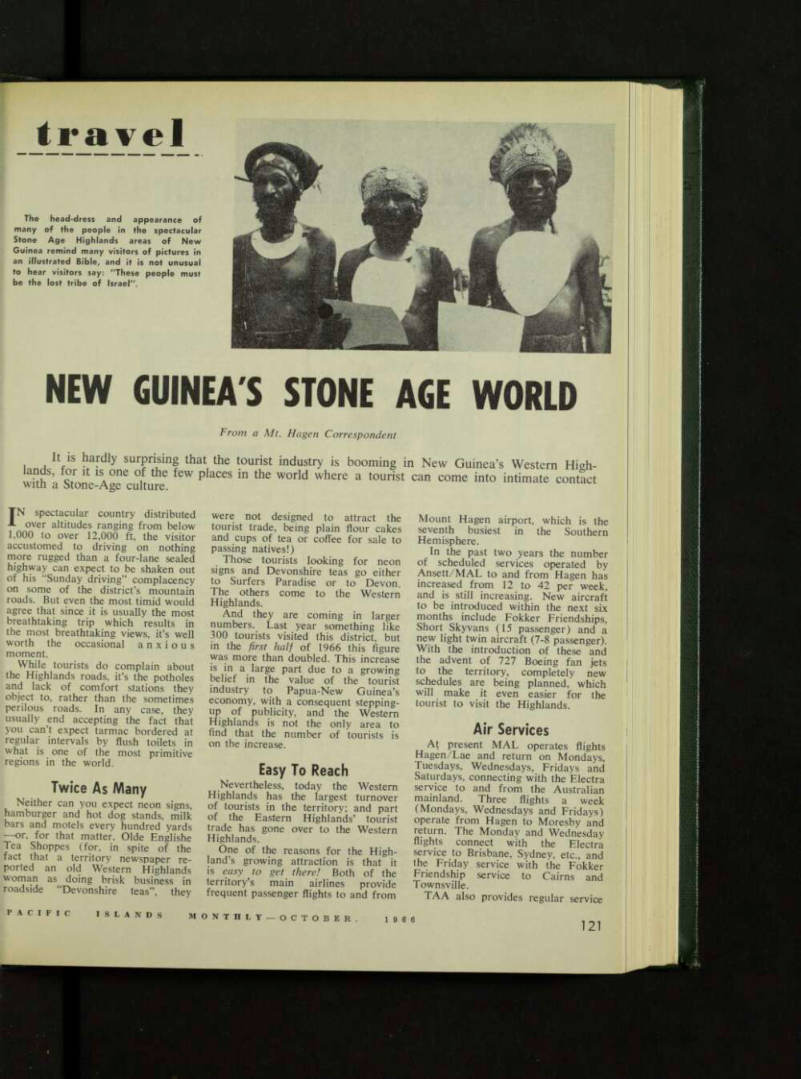
The head-dress and appearance of many of the people in the spectacular Stone Age Highlands areas of New Guinea remind many visitors of pictures in an illustrated Bible, and it is not unusual to hear visitors say: "These people must be the lost tribe of Israel".
flights to and from Hagen, connect ing with the Electra Bird of Paradise services to and from Australia.
If a tour party is too large to be accommodated on a scheduled flight, an additional aircraft uplifts the party. Depending on the number of passengers, the party may choose either to charter an aircraft or to travel on the special flight.
It is also fairly easy to get to Hagen by road from Lae, but the condition of this road depends on the weather, and 340 miles of rugged driving doesn’t appeal to every tourist. For those prepared to put up with a bit of discomfort, there are firms who will arrange hire cars or buses for this trip.
What about transport within the district, accommodation, conducted tours, etcetera? Some tourists like to take pot-luck, but most prefer to make some kind of advance arrangements, and this latter group should leave it all to the experts.
TAA, for instance, will arrange all aspects of a tour, including accom modation, road tours, charter flights and even native “sing-sings”. A tour can be arranged for an individual or for a group, by any TAA agent in Australia. TAA are well-known for their “Ann Travaire” tours, con ducted by specially-trained girls, generally ex-hostesses, who are familiar with the area. Each tour comprises about 16 people and lasts for two weeks, concentrating mainly on the Western Highlands.
Ansett will also arrange tours— either 5,7, 10 or 14-day “package deals”, or tours tailored for in dividuals, and any Ansett/ANA agent in Australia can make the arrange ments.
Recently Ansett organised for
visitors to the Western Highlands such diversions as a boat trip down the Sepik River and a mountain climb —and came to the rescue with an interpreter for a party of Italians who could not speak any English.
In arranging their Western High lands tours both Ansett and TAA make use of the services of a young and enterprising Mount Hagen Company, Central New Guinea Tours, Pty., Ltd. This organisation has proved its worth to the tourist industry and deserves the pioneer’s certificate for tourism it is hoping for. As well as working with the air lines, Central New Guinea Tours will also deal directly with the prospective tourist, who has only to write to manager Steve Brady to be sure of a trouble-free holiday.
Police Escort
Mr. Brady will arrange transport for those wishing to make the road trip from Lae to Hagen, and within the Western Highlands the tourist has a‘ choice of various day trips, by plane, bus or car—or even on foot. (Incidentally, all walking tours are accompanied by a police escort).
Central New Guinea Tours has a fleet of buses and cars, and employs only experienced driver-guides, in cluding a number of very attractive girls. There are self-drive cars avail able.
This organisation aims at showing the tourist as much as possible of the native way of life, and sing-sings are arranged on request.
Mr. Brady stresses that because of heavy demand on accommodation he needs at least two months’ notice of large tours, and it is advisable for all tourists to make arrangements as far ahead as possible.
Some tourists blanch at the idea
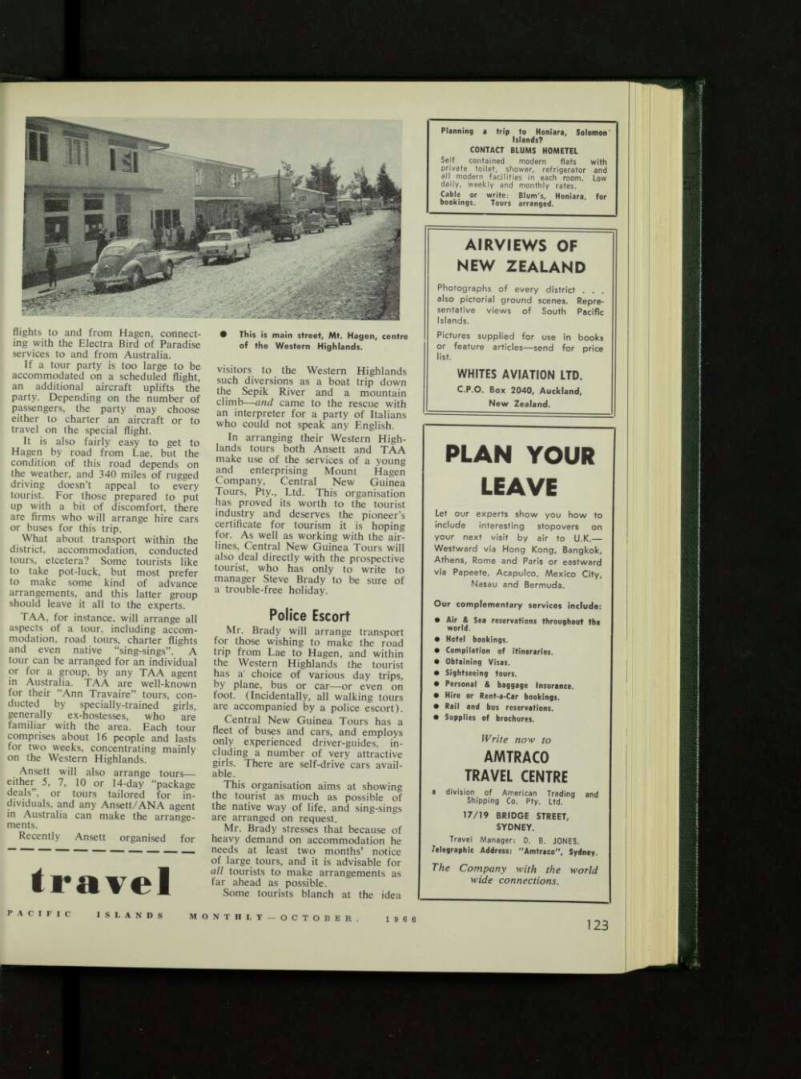
This is main street, Mt. Hagen, centre of the Western Highlands.
of having everything cut and dried, and Central New Guinea Tours is also at the service of those who prefer to arrive in an area before deciding what they want to see.
This “pot-luck” approach is not, however, recommended for large parties, and every tourist (even if travelling solo) would be wise to at least make advance bookings for accommodation.
Regular PIM readers may have gathered that some territory lodging houses leave a lot to be desired.
However, tourist accommodation in the Western Highlands is of a high standard, and these days the visitor to Mount Hagen has at least some choice.
The Mount Hagen Hotel, built in 1961, has recently been extended and renovated, and is to be extended even further. Although some people preferred the place when it was true to a travel writer’s description of “the rustic Mount Hagen Hotel”— that is, before they replaced the log tables and cowhide chairs by con temporary furniture, and the LADIES and GENTS by “Guys” and “Dolls” —there is no doubt that in its modernised state it has more to offer the tourist, A new accommodation block of 16 double rooms, each with private toilet, adjoins the original accom modation of eight double rooms fitted with hand basins. There are, of course, ample common toilet facilities serving these rooms.
All bedrooms are well-furnished.
The tourist should perhaps be warned at this point that he may have to share a room with a complete stranger—a practice which is not peculiar to this hotel, but is fairly common throughout the territory.
An Australian actor who recently visited this country complained about having to share a room with a young man who, in his somewhat inebriated slumber, “emitted every conceivable
noise from every part of his body except his navel”. However, this was in a Lae hotel. The worst that has happened to a tourist at the Hagen Hotel is to be sprayed with fire extinguisher foam by an exurberant party paying a midnight call on his room-mate.
Food at the Hagen Hotel may not be a gourmet’s delight, but it is good, and while several young Administra tion officers have been heard to say, “God help you if you ask for seconds!”, these fellows probably make a habit of asking for seconds of everything, and the tourist with a reasonably normal appetite will get a better deal! Prices here are as reasonable as you can expect in the territory.
The Hagen Park Motel, owned and managed by Mr. and Mrs. Bob Wilson, and licensed to sell liquor, is in pleasant pine-wood surroundings.
Not yet completed, this motel has present accommodation of 16 double rooms, each with its own private toilet, comfortable furnishings and wall-to-wall carpets. Tourists ought not to be blase about those carpets, for only a few years ago in the High lands the traveller would be lucky to see wall-to-wall floors.
Reasonable Tariff
The completed motel will consist of at least 30 double rooms, with a central administration block in cluding public and private dining rooms, lounge and artifacts shop.
Again, the tariff is reasonable.
Since Hagen’s second motel —out at Kagamuga, three minutes drive from the airstrip and nine minutes from town—is only in its early stages of construction, very limited accom modation is now available. But the restaurant side of the business is well under way, and superb food can be had there for a moderate cost.
The meals are personally cooked by Frank Mollinger and his wife. Frank is one of the directors of the com pany owning the motel; the other is John Colman, a young Hagen busi nessman.
An attractive feature of the com pleted motel will be its native round house styling. The fact that each unit will have modern furnishings and private toilets will appeal to the tourist looking for “native” atmosphere without the accompany ing discomforts.
The one complaint about the food is that there is too much of it. The
cook frequently offers seconds of all four courses. You may order your meal, and your wine, in nine languages, as the Mollingers between them have a command of that many.
The restaurant has become by far the most popular place in Hagen for a meal, so it is advisable to book in advance, at least for dinner.
Kimininga Hostel, about half a mile outside Mount Hagen, is owned by the Hagen Local Government Council, and efficiently run by a European manageress. While not for the tourist looking for luxury accom modation, the hostel is ideal for those with a limited budget, the maxi mum tariff being $4.75 per day, inclusive of three good meals.
Rooms have either two or three beds; the rate for a room shared with two others is $4.25. Bookings can be made either by phone (165) or through the council offices in Hagen.
Trips Restricted
At present the only facilities for tourists wishing to stay elsewhere in the Western Highlands are at Minj, 57 miles from Hagen, The Minj Hotel, which has eight twin and five single units, provides very good accommodation these days, and there is some talk of erecting a second hotel or motel at Minj, and a motel at nearby Banz.
However, since there are no facilities at all on any of the out stations, all tours within the Western Highlands at present are restricted to day trips. For those tours cross ing over the border into the Southern or the Eastern Highlands excellent accommodation is provided at the Mendi Guesthouse and the Kundiawa Hotel.
But even if the tourist must return to base at Mount Hagen each night, he still manages to take in a great deal on these trips. And he doesn’t really need to move out of the town area to see “native life”.
The twice-weekly market (Wednes days and Saturdays) provides heaps of local colour, and visitors have only to walk through Hagen’s main shop ping centre on a Saturday morning to rub shoulders with any number of fierce-looking warriors clad in little more than a layer of grease and a few leaves and feathers.
As Mr. David Newman said re cently, this is the unique attraction of Mount Hagen. Here the tourist is able to see people directly out of
the Stone Age mingling with those of the 20th century. Mr. Newman, of Vancouver, who is making an extensive study of tourism for the Uni-
hTLTI™ ,£ e
com ( . n H t (.ottt n ,^vLw raCt l° n t 0 h same degree anywhere else m the rr ’ koionm „ or j an[ ,
d-h|? r d a« Z
club welcomes visitors. The town also boasts some good tennis courts, and the bowling green is expected to be completed shortly.
Mount Hagen also possesses Australasia’s only pyrethrum extraction plant. While, of course, the manager does not make it a general practice to run conducted tours of the factory, he will always welcome those visitors having an introduction.
The same applies to the district’s first commercial tea factory at Kurumul, and to its numerous tea and coffee plantations.
No tourist wo « h his fare leaws the Western Highlands without several pounds excess luggage in the form of artifacts, and it is not even neces- S'”-- — " 5 “ Wally Smith s artifacts shop in Mount Hagen stocks—in addition to ? selection of local artifacts includ *nS f am °us Hagen axe—a large ran 8 e of weapons, carvings, pottery a^ d basket-work from the islands, and other areas, Prices range from 13 cents and upwards for arrows, to S 3 and upwards for Hagen axes and $6 and
upwards for the grotesque Sepik masks.
Incidentally, it is no longer neces f sary for the tourist to have artifacts f sprayed by the Department of Agri , culture before taking them out of the territory.
Mr. Smith’s artifacts business shares the same premises as Central New Guinea Tours. This building, known as the Mount Hagen Tourist Bureau, also includes an art gallery and a camera shop. While this build ing aims at providing a comprehensive service for visitors to the area, the tourist should not expect the whole of the town to be similarly geared to his requirements.
Hagen gets on with its normal business. There are a few postcards and souvenirs on sale in some of the stores, but Hagen is far from be ing tourist-conscious to the extent of over-commercialisation. Which is a fact appreciated by those visitors who come to see the natural attractions of the area rather than to purchase articles emblazoned with the legend, “A Gift from Mount Hagen”.
What does need to be done is to extend the accommodation at present available. There must be more of it, and there is a real need for tourist facilities to be extended to other parts of the Western Highlands district.
There has for some time been talk of building “safari villages” through out the Highlands, and the sooner this is done the better.
Visitors planning to see the Western Highlands in the next 12 months might like to have then visit coincide with the next Hagen Show, August 19-20, 1967. It will be well worth it.
Some details of transport costs in the Western Highlands are:
Aircraft Charters
Territory Airlines and Ansett-MAL have light aircraft available for charter at Mount Hagen, and the local mission sometimes has a light aircraft at limited periods. DC3 air craft can be chartered through TAA and Ansett-MAL. Travellers can arrange payment through the Admini stration Treasury for a seat on the regular Administration and charter and freezer runs to outstations not served by regular transport. The Hagen Park Motel operates the Mount Hagen taxi services.
Charter rates for aircraft are: Three-passenger Cessnas, 544 per
flying hour; four/five passengers, $53; five-passenger twin Cessnas, $65; nine-passenger twin Piaggios, $110; 24-30 passenger DC3’s, $l6O.
Road Tours
Following are the schedules and prices of coach and car tours of the area, arranged by Central New Guinea Tours, Mount Hagen. Coach trips are based on $95 a day, excluding driver’s accommodation. Coaches take 17 passengers with luggage, and 21 on day tours without luggage.
A nine-seater Toyota bus is available for day tours at $65.
Organised coach tours are: Hagen- Minj, one day, $95; Hagen-Kundiawa-
Goroka, two days, $305; Hagen- Kundiawa - Goroka - Kainantu, three days, $505; Hagen-Kundiawa-Goroka- Kainantu-Lae, four days, $620.
Car trips are based on $5O a day, excluding the driver’s accommoda tion. The details of these are: Hagen-Minj, one day, $5O; Hagen- Kundiawa-Goroka, two days, $170; Hagen - Kundiawa - Goroka - Kainantu, three days, $230; Hagen- Kundiawa - Goroka - Kainantu - Lae, four days, $350.
Hire of a car with a European driver, for the Hagen area, costs $4O a day and $2O a half-day. Self drive cars are $l5 a day, with the client providing the petrol.