Cruising Yachts
pp. 103-111 · Read in the full issue
Pacific Shipping And Cruising Yachts
Tongan Robinson Crusoes Gaoled After 15 Months On Lonely Isle
From Dorothy Lavin in Nukualofa.
Echoes of Minerva Reef reverberated around the King dom of Tonga in September when six Tongan youths were rescued from the isolated, usually uninhabited island of ’Ata after being marooned there for 15 months.
THE youths, whose ages range from 16 to 18, drifted to ’Ata from Nukualofa after “borrowing” a 24 ft whale boat for a night’s fishing and being caught in a storm.
They were found on ’Ata by the crew of the 46 ft Australian fishing boat Just David, which brought them to Nukualofa on September 13.
The reunion on the wharf with their families, who had long ago given them up for lost, was a moving experience for all, including those who saw it. But there was some bitter irony afterwards when the youths, who had suffered many priations, were arrested by the police and remanded in custody on a charge of having stolen the whale boat.
The youths are: Sione Fataua, 17, Sione Filipe Totau, 17, Luke Veikoso, 18. Tevita Fefita Siola’a, 16, who claims relationship with Tevita Fefita of Minerva Reef fame, and Tevita Fatai, 18.
The youths were attending school in Nukualofa last year when they
took the whaler for a night’s fishing.
They dropped anchor five miles north of Tongatapu, fished for a while, and dropped off to sleep.
A sudden squall broke their anchor rope, and as the boat drifted out to sea, they awoke to gale force winds and wild seas. Land was visible no where, and the boat was taking in water at an alarming rate.
Boat Breaks Up
For eight days, despite constant bailing, the boat just barely kept afloat. During this time, the youths kept up their strength by eating the fish, raw, they had caught on the first night.
Their boat was beginning to break up when the island of ’Ata was sighted, although the boys had no idea what island it was. ’Ata is the southernmost island in the Tongan group—a volcanic cone about 1,200 ft high, with bush covered slopes that reach down to
rocky cliffs plunging sheer into the Pacific. It is about 85 miles south west of Nukualofa, and has had no permanent inhabitants since a Peruvian slave raider carried off many of its 200 people about 1862, and King George Tupou I ordered the survivors to move to ’Eua.
With the aid of planks, the boys took to the water and reached the island after swimming all day and half the next night. They were washed up on a rocky ledge, exhausted and battered.
At first, the youths were too ex hausted to attempt the climb up the
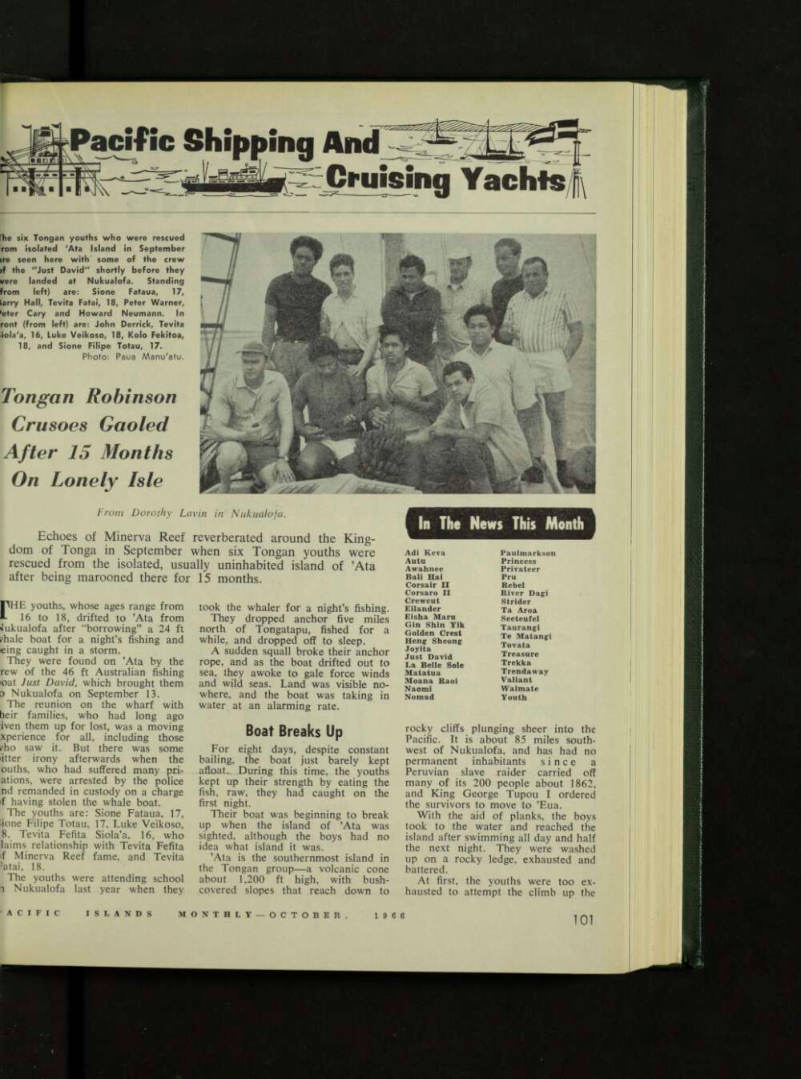
The six Tongan youths who were rescued from isolated 'Ata Island in September are seen here with some of the crew of the "Just David" shortly before they were landed at Nukualofa. Standing (from left) are: Sione Fataua, 17, Barry Hall, Tevita Fatal, 18, Peter Warner, Peter Cary and Howard Neumann. In front (from left) are: John Derrick, Tevita Siola'a, 16, Luke Veikoso, 18, Kolo Fekitoa, 18, and Sione Filipe Totau, 17.
Photo: Paua Manu'atu.
cliff face to shelter, so they burrowed out a small cave with their hands.
It was a month before they had gathered strength to claw their way to higher levels.
During this time they caught sea birds with their hands, drinking the blood and eating the raw flesh. They also ate young coconut shoots growing from the cliff face.
After having found and negotiated the only possible route to the crater, the boys built a Tongan-style shelter of woven coconut leaves.
Each day was carefully planned in a routine aimed at improving their conditions and providing food.
After morning prayers, the boys planted out young banana shoots, as the existing trees were bearing little fruit.
Fishing lines were fashioned from vines, and fire was produced by rubbing two sticks together.
Food was never a major problem as coconuts, bananas, chickens, fish and papaws were plentiful, but water was. Little rain fell during the 15 months they were marooned.
Until they were able to climb for drinking nuts, the boys tapped the trees for water and found a few pools of stagnant water to eke out their supply.
Until they found two old rusty knives, their only tool was a piece of iron sharpened by a stone.
Guitar
With this they fashioned a guitar, using two halves of coconuts as sound boxes and wire salvaged from the planks they brought ashore, as strings.
This gave them the incentive to compose five songs, and their evenings were spent in the traditional Tongan style.
They kept a daily log which proved to be only two days out when they were rescued.
Escape from their island was never far from their minds, and to effect this, they built a log raft with a ough cabin on top. They stocked it with what food they could carry and set off in high hopes for home.
However, about a mile from shore, the raft broke up and they were forced to swim back to their Robinson Crusoe existence.
Although the boys lit signal fires whenever they saw a ship, four vessels passed by before the Just David rescued them.
Just David, with John Derrick skipper), Peter Warner (owner), Peter Currie, of Sydney, and Ralph Johnson, Harold Neumann and Barry Hall, all of Tasmania, was looking into the possibility of commercial
crayfishing in Tongan waters when ’Ata was sighted. (Mr. Warner, son of the late Sir Arthur Warner, had visited Tonga last year in the luxury yacht Bali Hai.) Just David’s crew knew that ’Ata was usually uninhabited, and when they saw that a patch of bush had been burnt, they decided to investigate.
As they moved in to the island, they saw smoke rising, and next a naked figure waving frantically.
Pulling in as close as possible to the rocky shoreline, they hove to while the figure swam out to them.
On being told that five other youths
were ashore, Barry Hall swam back to the island, and returned with six wild-looking, long-haired, exuberant Tongans.
After the boys were brought back to Nukualofa, they were medically examined and were found to be re markably fit.
There was more than a little criticism when they were taken into custody pending court proceedings for stealing the whale boat.
But on September 20 they were released so that they could return to ’Ata to take part in a TV documentary to be filmed by an Australian crew, which arrived in Nukualofa on that day.
Iadang's New Wharf
Eady Soon
jMadang’s new $1 million wharf is [pected to be completed on schedule {December, according to a spokes lan for the contractors, Delta Con ructions Ltd., in late August.
IThe wharf will be capable of pro iding berthing facilities for the rgest vessels which enter Papua few Guinea waters. Work on the roject began in May, 1965, The new wharf, located on the innen Harbour approach, will be 50 ft long with a 44 ft wide con rete deck which will involve far iss maintenance than the existing 30 ft long all-timber wharf.
The new wharf scheme .will in ude a main 300 ft x 80 ft storage led, a block of four offices, a bond ore, modern toilet facilities, a quor store, a broken cargo shed, a ;rtiliser store, an open 240 ft x 30 ft storage area surrounded by sealed road, security fence and oodlights, a 150,000-gallon water ink to serve vessels, and a Customs ispector’s office on the wharf en ance approach.
The District Commissioner, Mr.
I Clifton-Bassett, said in August lat the additional wharf facilities ere being eagerly awaited, not only y Madang District people, but by lousands of Highlands people who t present relied heavily on cargo ir-freighted from Madang after harf clearance.
00D Was Not To
Oachers' Liking
Several Formosan fishermen, rrested in August for entering apua-New Guinea waters illegally, amplained about the food given to lem while awaiting trial in Rabaul rison.
The fishermen said they did not ke European or native foods, so the blice Department arranged for Chinese meals to be prepared for lem.
The men were from the Heng heong.
The prosecution alleged in New iritain District Court that the ship fas engaged in pirate activities in the 'ead Islands.
The Magistrate, Mr. A. Germaine, ealing with 12 men, including the laster, said the ship was on a eliberate expedition to poach or •irate clams from territory waters, liregarding the rights of the tern ary or individuals.
He described evidence given by he captain as an “ingenious concoc ions of part-truth and fiction”.
The captain, Tan Chin Cheng,
claimed the engine of his ship had broken down.
He said he was unable to return to Formosa because of a typhoon, and currents had carried the ship into a bay in the Fead Islands.
His crew had left the ship to check the hull from a reef and had resisted arrest because they thought the inhabitants of the islands were cannibals.
Fines totalling 5A2,130, were guaranteed by the Formosan Embassy in Canberra.
Twelve seamen from another Formosan ship, the Gin Shin Yik, were deported from the territory in August by special order of the Ad ministrator, Sir Donald Cleland.
The master, Shar Tsu, was fined Si 00 on each of 11 charges of permitting the crew to land in the Fead Islands, and each of the 11
members of the crew was sentenced to three weeks’ imprisonment with hard labour.
The fines and the costs of pro visioning were paid by the Formosan Embassy in Canberra.
"Joyita" To Become
A Museum
The world-famous Islands trading vessel Joyita, which was found abandoned, waterlogged and partly submerged off the coast of Fiji in November, 1955, is to be renovated and turned into a museum.
The ship has been lying on the beach at Levuka, Fiji, for several years.
She was bought by Viscount Maugham when he visited Fiji four years ago; and was recently acquired by Major Casling-Cottle, who, with
his wife and daughter, has established a tourist and publicity bureau at Levuka.
The major, who was badly wounded during World War 11, in tends to preserve the vessel as a historic relic.
The Joyita, of 70 tons, left Apia, Western Samoa, on October 3, 1955, for the Tokelaus, but failed to reach her destination. Five weeks later she was found 90 miles from Fiji, but there was no trace of her 25 passen gers and crew.
Replacement Sought
For "Moana Raoi /#
The Moana Raoi, which belongs to the GEIC Wholesale Society, will be replaced when her owners find a siutable replacement.
The society has found that the Moana Raoi is inadequate for the increasing work she is required to do because she is getting old and lacks speed.
Tenders for a new ship have been invited. The society is also looking at second-hand ships.
Fiji Joins Ships
Reporting System
Fiji has joined AMVER (Auto mated Merchant Vessel Reporting System), an international communi cations system with headquarters in New York, designed to give a com plete picture of movements of merchant ships throughout the world.
AMVER is an international mari
time mutual assistance programme which had its origins in the United States Coast Guard.
New Zealand has agreed to join AMVER, Australia is expected to join some time this year when final details have been worked out, and Japan is also expected to join.
Information collected about move ments of ships is fed into a com puter which can give the position, speed and course of merchant ships at sea in any part of the world within a matter of minutes.
Regular reports of shipping move ments are fed to the headquarters of AMVER in New York.
Other information includes what
facilities a ship may have for search rescue work, and whether there is a doctor on board.
In the case of Fiji, Radio Suva, VRO, reports movements.
Information from Australia will be collected from ships at sea by the Overseas Telecommunications Com mission, and passed to the Depart ment of Civil Aviation at Mascot.
This information will then be re layed to Honolulu for transmission to New York, The present system stems from a manual plot, maintained by the US Coast Guard, which included ships in American coastal waters.
In 1958, when the first electronic
The "Joyita" photographed at Levuka by Stan Whippy in 1962.
computer was installed in the AMVER centre, the area of the plot was expanded to mid-Atlantic.
I As the participation and communi cation capability increased, it became feasible to expand the area again, until now it embraces the entire world for countries which wish to join.
The New York computers give out information in 13 languages—Danish, Dutch, English, French, German, Greek, Italian, Japanese, Norwegian, Portuguese, Russian, Spanish and Swedish. r The objective of AMVER is to facilitate maximum efficiency in co ordinating assistance offered by mer chant ships to save life and property at sea.
The information available from the computer gives an immediate picture of the most appropriate, nearby and early assistance.
Ships which respond to emergency calls are able to continue their voyages with a minimum of delay.
It is not compulsory to join AMVER. Voluntary reporting of positions by ships does not infer any special obligation.
Participation in the programme is not a prerequisite for a ship requiring help.
Benefits
The AMVER organisation claims benefits to shipping include: • Improved chances of aid in emergencies; • Reduced number of calls for assistance to ships not favourably located; • Reduced time lost for ships re sponding to calls for help.
An AMVER participant is under no greater obligation to render assistance luring an emergency than a ship not participating.
One example of how AMVER fitted nto a search-rescue operation was in Vl ay, when a Greek cargo ship, the Aurora, started to take in water in the Atlantic.
At 12.5 p.m. (GMT) on May 18, :he Halifax rescue co-ordination :entre advised the New York Coast Guard of the plight of the Aurora.
Fifteen minutes later an AMVER surface picture containing the names md positions of 12 ships within a 200-mile radius was passed on to Halifax.
Additional information, as it be :ame available, was passed on to ;he ships, and to aircraft taking part n the operation.
The Aurora was abandoned at 10 p.m. (GMT) and the master and 26 of the crew were picked up by two ships which had reached the Aurora and were standing by.
"Adi Keva" To Become
"Tovata"
Island Transport Ltd., of Fiji, a Carpenter subsidiary, plans to per petuate the name of Tovata in its fleet.
The managing director, Mr. W. G.
Johnson, has applied to the board of trade for permission to change the name of the Adi Keva to Tovata.
The Adi Keva, previously operated by Morris Hedstrom, a Carpenter subsidiary, now sails under the Island Transport flag.
The earlier Tovata was condemned several years ago and Mr. Walter Whippy, of Charles Whippy and Co., Suva boatbuilders, bought the hull.
Tovata is the name of the con federacy of the Fijian provinces of Macuata, Bua, Cakaudrove and Lau, an area in which the Island Trans port ships operate.
New Kieta Wharf
Ready In January
A $250,000 steel and concrete wharf being constructed at Kieta, Bougainville, is expected to be com pleted by January. The wharf is being built by Delta Construction Limited. Work began eight months ago.
The wharf is 200 ft long, and when completed it will be capable of ac commodating ocean-going vessels.
Annual Survey For
"Waimate"
The USS Co.’s Waimate was scheduled to go into dock at the end of the September-October
Sydney-Pacific Islands trip, for annual survey.
Her next trip out of Sydney for Suva, Lautoka, Apia, Nukualofa and Auckland has tentatively been fixed for November 4.
Japanese Ship For
Logging Trade
A former Japanese ship, the Eisha Maru, was undergoing refit at Rabaul recently for carrying timber from the Cape Hoskins logging area to other centres. The ship is to be renamed River Dagi.
She is capable of carrying 180,000 super ft of timber, and will be operated by South Pacific Lines, an amalgamation of three Rabaul com panies.
Causeways System In
North Tarawa Completed
A causeway and bridge south of Abaokoro in North Tarawa was opened for motor traffic on Septem ber 1, and it is now possible to travel from Tabonibara to Buariki without getting wet.
Seven causeways have been built in North Tarawa since early 1965.
The system of causeways has now been completed.
Villagers Build Wharf
A native society in the Milne Bay District of Papua-New Guinea has built a 225 ft stone jetty and timber wharf facilities on Ware Island at a cost of $1,007 and by the use of voluntary labour.
All the stone, 400 cubic yards of it, was carried by hand and canoe for more than a mile.
FOR NEW HEBRIDES TRADE: Captain Athol Rusden, of Vila, now has a fleet of six ships engaged in the New Hebrides trade following the recent acquisition of the 500ton motor vessel "Holmbrae", formerly "Rivercity", from the Holm Shipping Co. Ltd., of Wellington. Captain Rusden has renamed his new purchase "Paulmarkson" (PIM, Sept., p. 105). She is 150 ft long and has a speed of 9½ knots. The other ships in Captain Rusden's fleet are the motor vessels, "Altaic", "Darnley", "Tuvalu", "Tui Cakau" and "Darega".