A Trip To The Gilbert
pp. 87-91 · Read in the full issue
Islands At The Turn
Of The Century
By Neville Chatfield
In 1901, when I was 16 years old, I started work as a junior clerk in the Islands Department of Bums Philp and Com pany in Sydney, at a salary of £24 a year, less 10 per cent, for superannuation.
A YEAR or so later, I was “shanghaied” out of that departnent and made assistant supercargo ■f BP's steamer Ysabel (524 tons H-oss), which, in March, 1902, had •egun a service between Sydney and he Gilbert and Ellice Islands Proectorate On mv first trin Vcnh*i coMori rom Sydney on December 1 1902 Tie passengers included Mr ’ Teller 'ampbell the British Resident Com
lissioner *in the wife*
Miss Jeffries,who was a* comanion to Mrs. Campbell and nurselaid to baby William Camobelliree fathers of the Sacred Heart lission; and Robert Candle a •ader on the island of Little Makin We arrived at Betio, Tarawa, on )ecember 19, having spent a couple f days on the way at Vila New
lebrides. ’
The Resident a
entered Tarawa lagoon and was lowered when the Commissioner and his family boarded the Government boat, which came off from the Residency, manned by Fijian police, and took them ashore in formal style. c , TT , , , , T* l6 . a cred Heart fathers left m p l - ™. lss * on boat f° r tbe i r station at 5? and after we - had ? u PP lied G °yernment station with the StOl ?u re£ * mred ’ we Proceeded T™' „ ° ur 11 , first „ call was at Captain KusteP B —a fine old American sea cap i am who had lost one hand in a dynamiting accident some years earl,er We next proceeded to Peter Grant’s station—Peter being an Irishman Wlth two small daughters. .. u „ When the tide was high, we moved
lander, and Russian Tom traded— in bitter opposition.
Russian Tom had a hole in his side, which he said was caused by a copper bullet fired by the English at Balaclava, when he was a young Russian soldier.
Two Chinese
There were also two Chinamen trading on this island. One was Ah Chew; the other name I have forgot ten, Both of them traded on stations owned by On Chong and Co., of Sydney.
On Chong had shops all over NSW, and those who fell by the wayside and could not pay their accounts were shipped off to the Gilberts to work “off the dead horse”.
Later on we used to get quite a lot of copra from different Chinese in the group, but always on the night tide.
We paid them in sovereigns and got them to buy as much as they could from our traderoom. When they went ashore, they used to put their money in pickle bottles.
Some of them used to say, “One sovereign belong me, and one belong On Chong”.
Having finished trading in Tarawa Lagoon we hove up and proceeded to Abaiang, anchoring at Koinawa off Arthur Hitchfield’s station, which Hitchfield had leased to Frank High land while he was in the Carolines.
Also on Abaiang were Peter Garrick; George Hugill, a Yorkshire man; Albert Thomas a fine old
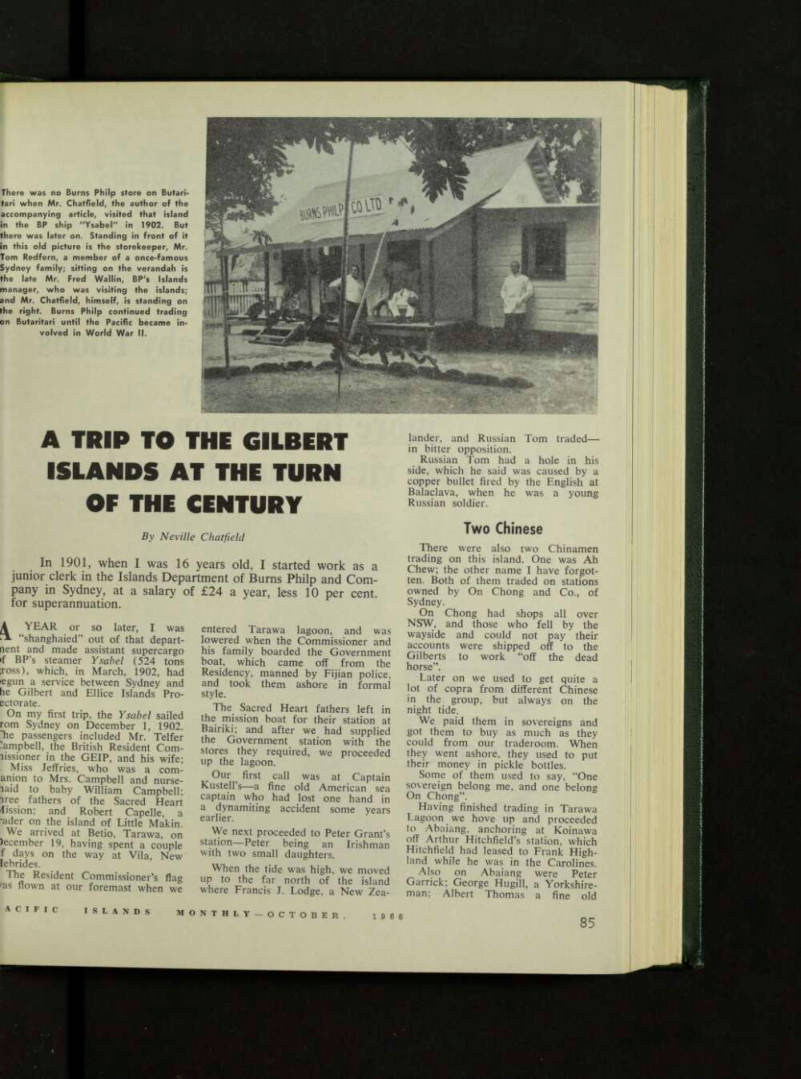
There was no Burns Philp store on Butari tari when Mr. Chatfield, the author of the accompanying article, visited that island in the BP ship "Ysabel" in 1902, But there was later on. Standing in front of it in this old picture is the storekeeper, Mr.
Tom Redfern, a member of a once-famous Sydney family; sitting on the verandah is the late Mr. Fred Wallin, BP's Islands manager, who was visiting the islands; and Mr. Chatfield, himself, is standing on the right. Burns Philp continued trading on Butaritari until the Pacific became in volved in World War II.
Norwegian whose correct name I never knew; and Peter Nakoko, a Hawaiian.
Peter was a character who. like a ot of other traders, loved his gin, vhich we used to sell at 2/- per arge squarefaced bottle, Peter Garrick was a fine boat milder, who, with George Murdoch, lad taken Gilbertese labour to the :offee plantations in Guatamala in he 1890’s.
Peter Garrick had a native wife, ind a daughter, Katie, who married Geisig, engineer on the German chooner Hercules.
George Hugill was a long, thin forkshireman with a straggly beard, /hose one son was also called jeorge.
Knowledge Of Astronomy
At Abaiang, there were also two toman Catholic priests and a brother /hose company I enjoyed. They were r ather Lebeau, of Liege, Belgium, /ho was Father Superior of the Jilbert and Ellice mission; Father 'ochet a lovable, cultured French man, who would go a mile out of is road to help anybody; and Brother mzoller who was a well-educated arpenter and builder, whose hobby /as astronomy.
Brother Fuzoller’s astronomical nowledge paid a big dividend everal years later when Father -ebeau had to go to France and telgium on mission work.
Before leaving Abaiang, Father -ebeau laid the foundations of a new hurch, which was to be built out of me made from coral.
Little progress was made on this hurch during Father Lebeau’s bsence until Brother Fuzoller told le natives that, if they did not nish the church quickly, God would ut out the sun and cover the island dth water.
Not much notice was taken at rst of this threat. But towards a.m. on January 3, 1908, towards ic top of a spring tide, the sun ■arted to “black out” and the tide ept rising.
From that day onwards, the natives ied with one another to see who puld bring the most lime, and the [lurch was finished before Father ebeau returned.
But to get back to our trading oyage. . . .
On the afternoon of December 24, 1902, we saw a boat coming up the lagoon. It turned out to be a police boat with an invitation from the Resident Commissioner to the captain, engineer, supercargo and assistant supercargo to have Christmas dinner with him and his family at the Residency the following day.
The invitation was, of course, ac cepted, and we sailed for Tarawa next morning, taking the police boat with us.
It is only some 40 miles from Koinawa to Betio, so even at six
knots an hour we made it in good time for dinner.
In those days there was a wall built out about 100 yards from the beach to a landing spot in the Residency ground; but there was no gutter, so that one came ashore clean at high water and told the launch boy—we had a 26 ft launch with a 21 h.p. Union engine— to go and anchor below high water mark and to expect to hear us call out to him at midnight.
When midnight came the four of us walked along the top of the rough coral wall and hollered to the boy in the launch. There was no answer.
We could see the launch in the distance and the tide was beginning to rise again.
Being the youngest I was told to strip, swim out to the launch and wake the boy—which I did; but I don’t mind admitting that I was mighty scared of sharks.
Fortunately, Sir Arthur Grimble’s Pattern of Islands, with its stories of sharks and their habits in Tarawa lagoon had not then been written, or I miglit have refused duty.
From Tarawa, we proceeded to Marakei where Harry Halderson, a Scandinavian, was the trader at the north end, and one Schumacher traded at the south end. Father Hoogstraaten was the Roman Catholic priest-in-charge.
Our next call was at Butaritari, where On Chong had their head station. A Chinaman known as Louie was in charge.
On Chong’s inter-island steamer was the Fernmount, skippered by Captain Menmuir (afterwards in
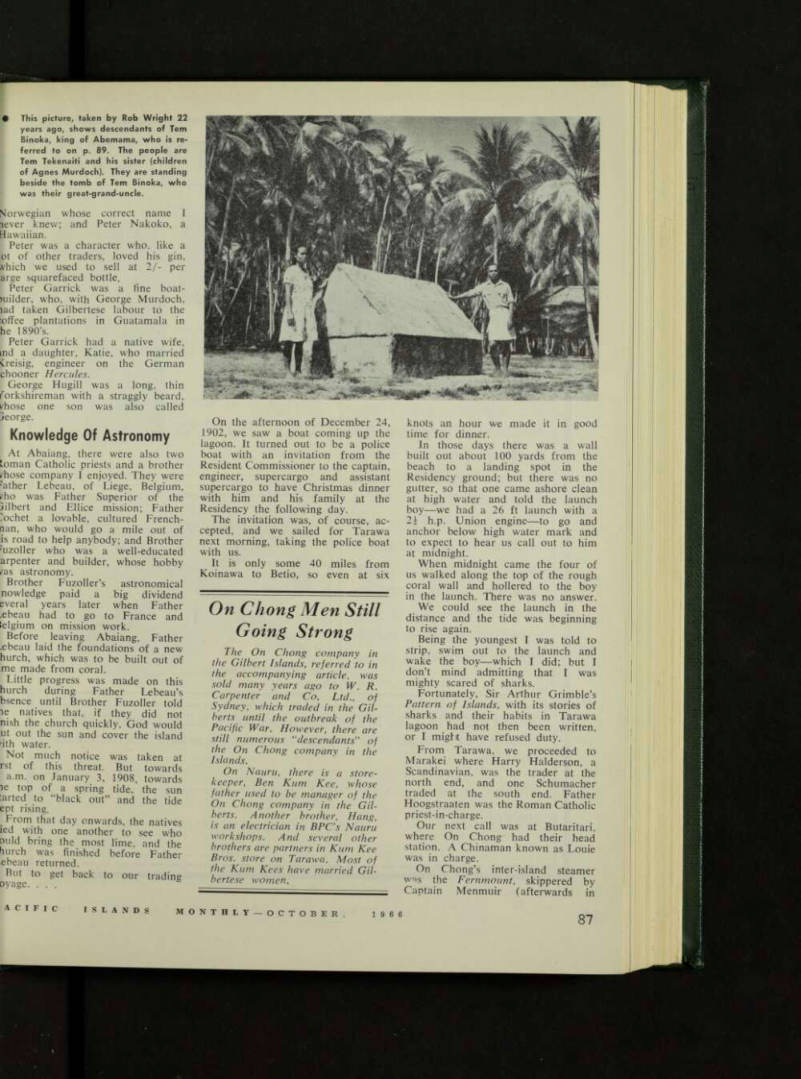
This picture, taken by Rob Wright 22 years ago, shows descendants of Tem Binoka, king of Abemama, who is re ferred to on p. 89. The people are Tem Tekenaiti and his sister (children of Agnes Murdoch). They are standing beside the tomb of Tem Binoka, who was their great-grand-uncle.
[charge of the Kulambangra for Levers), (The Fernmount, by the way, sank at its moorings in the inner lagoon in front of On Chong’s during the night of Christmas Eve, 1904).
Fritz Muller had the biggest privately-owned station on the island.
After his death, this was taken over by Burns Philp and Co. and leased to D.O’N. Flood. After Flood’s death BP used it as their own station and a depot. It was a nice store, near the Roman Catholic Cathedral and convent, where a fine Belgian woman, Mother Isabel, was in charge. Bishop Leray had his headquarters there.
So did the Jaluit Gesellschaft, which was headed by Captain Janke.
Whistling Of Porpoises
From Butaritari, we sailed to Little Makin where we landed Robert Capelle. A few miles to the south of Little Makin, but on the same reef is the Islet of Kuup.
Ah Moon was the trader there; and it was at Kuup that I heard about the alleged power of certain natives to whistle the porpoises to come ashore. (Grimble wrote about this many years later, but I, person ally, never saw it happen).
From Little Makin we went direct to Abemama, arriving there on the morning of New Year’s Day, 1903.
A westerly gale started that day and we lay there for six days with two anchors down and unable to work copra.
The Government officer in charge was George McGee Murdoch, about whom much has already been written.
He probably understood the native mind better than any other white man.
This was the home of Tern Baul who succeeded his father Tern Binoka as king of the Island.
It was Tern Binoka who, in 1892, negotiated with Captain Davis of HMS Royalist for his island to come under the protection of Great Britain.
The chief magistrate was Ten Teinoa, one of the most lovable natives I have ever met. Next to him was Benuakai. They were fine men who controlled their people well and were respected by both natives and whites.
On Abemama, I saw the remains of an old Gilbertese war canoe. It was the only one I ever saw.
As may be gathered from the fore going, the Gilberts had had plenty of contact with the Western world by the time I knew them, and many of the old Gilbertese customs and ways of doing things were already dead.