Vanua Lava's Sulphur Deposits
pp. 74-77 · Read in the full issue

With the price of sulphur soaring . . .
Vanua Lava's Sulphur Deposits Should Be Worth A New Look
By a Staff Writer
A world shortage of natural sulphur that has developed over the past 12 months suggests that the time may again be ripe to investigate the commercial possibilities of sulphur de posits on Vanua Lava Island in the Banks Group of the New Hebrides.
THE existence of the Vanua Lava deposits has been known for more than 80 years, A French company made an attempt to exploit them at the turn of the century; and there were several enthusiastic re ports on the deposits in the 1930’5.
But the deposits appear to have been forgotten in the past 30 years, and they still await the arrival of a company that can turn them into money.
The deposits could well be of interest to Australian fertiliser com panies today, for sulphur is an essential ingredient in the manufac ture of single superphosphate, of which about three million tons were used in the Australian agricultural and pastoral industries last year. (Sulphur is not used in the less bulky, and increasingly popular double and triple superphosphates, but continuous use of these fertilisers results in the soil becoming sulphur deficient).
Big Price Rise
Australia’s bill for sulphur has in creased spectacularly in the last 12 months or so. In 1964-65, it imported 374,459 tons of sulphur at a cost of $6,391,000. In 1965-66, it imported 407,000 tons worth $9,231,000 —an increase in price of about 30 per cent, per ton over the figure for the previous year.
Most of the sulphur imported to Australia comes from the United States and Canada; and it is all brought in by the British Phosphate Commissioners, who operate the phosphate industries at Ocean Island, Christmas Island and Nauru.
The high cost of the imported sulphur is partly due to the high freight rates for the long ocean haul from the US and Canada, and partly to the high wage structure in those two countries.
If the Vanua Lava deposits could be exploited, it should be possible to effect a considerable saving in wage costs by the use of Islands labour; and there would undoubtedly be a big reduction in freight costs, as the distance from Vanua Lava to Sydney is less than 2,000 miles, compared with nearly 7,000 miles to Seattle, for example.
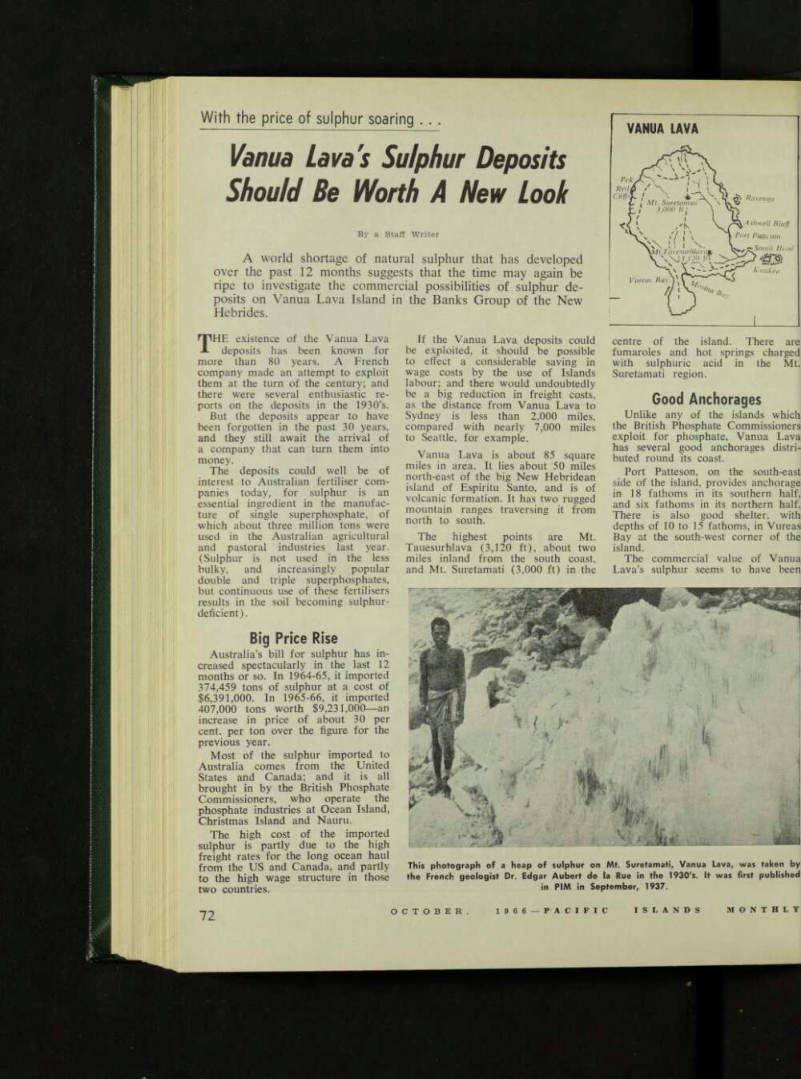
Vanua Lava is about 85 square miles in area. It lies about 50 miles north-east of the big New Hebridean island of Espiritu Santo, and is of volcanic formation. It has two rugged mountain ranges traversing it from north to south.
The highest points are Mt.
Tauesurhlava (3,120 ft), about two miles inland from the south coast, and Mt. Suretamati (3,000 ft) in the
centre of the island. There are fumaroles and hot springs charged with sulphuric acid in the Mt.
Suretamati region.
Good Anchorages
Unlike any of the islands which the British Phosphate Commissioners exploit for phosphate, Vanua Lava has several good anchorages distri buted round its coast.
Port Patteson, on the south-east side of the island, provides anchorage in 18 fathoms in its southern half, and six fathoms in its northern half.
There is also good shelter, with depths of 10 to 15 fathoms, in Vureas Bay at the south-west corner of the island.
The commercial value of Vanua Lava’s sulphur seems to have been
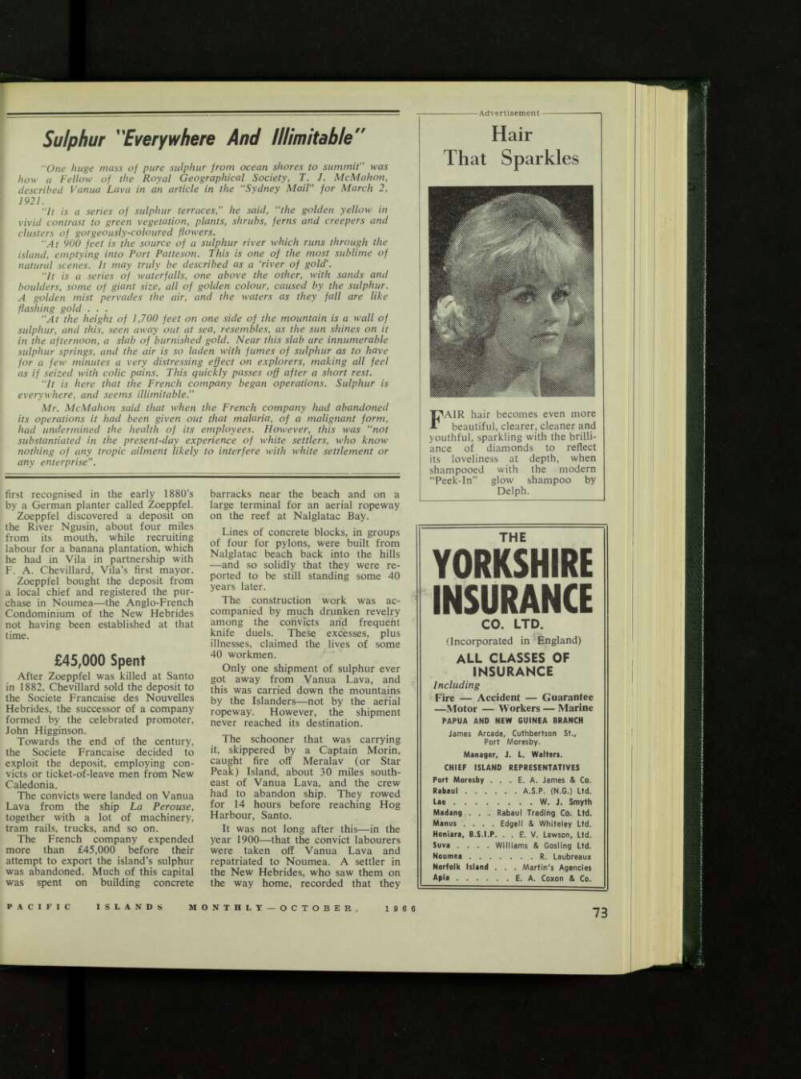
This photograph of a heap of sulphur on Mt. Suretamati, Vanua Lava, was taken by the French geologist Dr. Edgar Aubert de la Rue in the 1930's. It was first published in RIM in September, 1937.
first recognised in the early 1880’s by a German planter called Zoeppfel.
Zoeppfel discovered a deposit on the River Ngusin, about four miles from its mouth, while recruiting labour for a banana plantation, which he had in Vila in partnership with F. A. Chevillard, Vila’s first mayor.
Zoeppfel bought the deposit from a local chief and registered the pur chase in Noumea—the Anglo-French Condominium of the New Hebrides not having been established at that time.
£45,000 Spent
After Zoeppfel was killed at Santo in 1882, Chevillard sold the deposit to the Societe Francaise des Nouvelles Hebrides, the successor of a company formed by the celebrated promoter, John Higginson.
Towards the end of the century, the Societe Francaise decided to exploit the deposit, employing con victs or ticket-of-leave men from New Caledonia.
The convicts were landed on Vanua Lava from the ship La Perouse, together with a lot of machinery, tram rails, trucks, and so on.
The French company expended more than £45,000 before their attempt to export the island’s sulphur was abandoned. Much of this capital was spent on building concrete
barracks near the beach and on a large terminal for an aerial ropeway on the reef at Nalglatac Bay.
Lines of concrete blocks, in groups of four for pylons, were built from Nalglatac beach back into the hills —and so solidly that they were re ported to be still standing some 40 years later.
The construction work was ac companied by much drunken revelry among the convicts and frequent knife duels. These excesses, plus illnesses, claimed the lives of some 40 workmen.
Only one shipment of sulphur ever got away from Vanua Lava, and this was carried down the mountains by the Islanders—not by the aerial ropeway. However, the shipment never reached its destination.
The schooner that was carrying it, skippered by a Captain Morin, caught fire off Meralav (or Star Peak) Island, about 30 miles south east of Vanua Lava, and the crew had to abandon ship. They rowed for 14 hours before reaching Hog Harbour, Santo.
It was not long after this—in the year 1900—that the convict labourers were taken off Vanua Lava and repatriated to Noumea. A settler in the New Hebrides, who saw them on the way home, recorded that they
Sulphur Analysis Showed 97 p. c. Purity
looked as yellow as the sulphur they had been mining, and more like living corpses than humans.
Two years later, the Societe Francaise went into voluntary liquida tion, and much of the machinery and tram tracks were abandoned on Vanua Lava, although the aerial ropeway was taken to Paagoumene in New Caledonia, and was still in use many years later.
New Interest In 1930
No one seems to have thought again about exploiting the Vanua Lava sulphur deposits until 1930 when Mr. B. Dunstan, chief geologist with the Queensland Government, and Mr. F. C. Richards, a Brisbane metallurgist, surveyed them on behalf of Queensland mining interests.
On his return to Australia, Mr.
Dunstan was reported as saying that there were thousands of tons of pure sulphur on Vanua Lava; that he had investigated a deposit in the centre of a volcanic crater (presumably Suretamati); and that he had brought many samples back to Australia for further investigation.
Hot springs, forcing their way through the sulphur deposits, at an elevation of between 1,000 and 2,000 feet, formed a remarkable sight, he said.
Mr. Dunstan indicated that the terrain was pretty rugged, but he apparently did not think the sulphur deposits would be too difficult to exploit, as he said that Australian apathy in not developing the mineral resources of the area was “greatly to be regretted”.
About two years after Mr.
Dunstan’s visit, a party of Aus tralians. including Mr. Doug Askew, now of Papua, went to Vanua Lava and spent eight months investigating the sulphur deposits for the Pacific Mineral Development Company.
Transport Problems
Mr. Askew told PIM on his return that the deposits were extensive, and that analysis had proved them to be about 97 per cent. pure. About 15,000 tons of sulphur were lying on the surface, he said, but it was impossible to estimate what lay underground until a proper survey was made.
Difficult transport problems would have to be overcome before any of the sulphur could be shipped, as the deposits lay about three miles from the beach, and nearly 3,000 ft above
sea level, at the summit of a semi active volcano.
Between the summit and the beach was some of the roughest country Mr. Askew had ever seen. The deposits were still hot, and the atmosphere rusted tinned meats, rotted clothes, and discoloured silver money.
On the other hand, Mr. Askew described Vanua Lava as “a thermal wonderland”, and he said it could become “one of the great holiday resorts of the Pacific”.
Not long after the departure of Mr. Askew’s party from Vanua Lava, a French geologist, Dr. Edgar Aubert de la Rue, investigated the sulphur deposits and reported favourably on them, in the course of a geological survey of the New Hebrides for the French Government.
Nothing ever came of this survey nor of those of Dr. Aubert de la Rue’s predecessors—possibly because sulphur had become a drug on the market by the mid-thirties.
The market is certainly not glutted with it now. So why doesn’t some one in the sulphur business have a look at the Vanua Lava deposits again?