Jewellery Business
pp. 69-71 · Read in the full issue
A Papuan Craftsman Goes Into The Jewellery Business
From a Port Moresby Correspondent A Papuan craftsman of the old school, and an Australian woman —working as a business team —are producing Islands jewellery with a difference. They have stimulated enthusiastic local demand for jewellery made of tortoiseshell, silver, New Guinea stone and shells. Business is so good they can’t keep up the supply of some items.
Patricia Bryant Became
fascinated with the craftsman ship of Oala Reva last year when she saw some of his work at a local show. Oala is a former smallships’ engineer, who retired in 1941 and now lives in a tiny house over the water at Port Moresby’s Hanuabada village.
Oala has always worked local tortoiseshell, and during the war made a few shillings by selling to the troops such trinkets as carved hearts, inlaid with such words as, “Souvenir of Papua”.
In recent years he has been attempting to make financial ends meet by producing similar items, cutting up teaspoons to obtain silver for the inlays. He has also made bracelets, watch bands and rings, buying some of the raw materials needed at retail prices from Moresby shops. Often he had to hawk around the streets for sale the items he had just finished, to obtain enough money to go ahead with the next.
New Designs
Mrs, Bryant set Oala up with new equipment, including power tools, but more importantly she gave him new designs for his tortoiseshell ware.
He now produces go-go earings and bangles for the teenage set, and cuff links and tie tacks for mens-wear.
His necklaces, which have the same superb craftsmanship as before, now are better designed and threaded on silver chains. Drop earings of tortoiseshell are now set on rolled gold for pierced ears. Sterling silver
is now imported in sheets; teaspoons aren’t needed.
Oala, on a 50-50 deal with Mrs.
Bryant, does not now have to hawk his own wares because Mrs. Bryant has created a wholesale organisation which handles it all. New Guinea
Jewellery, as the company is called, supplies wholesale only to shops and hotels throughout the territory.
And as well as tortoiseshell, Mrs.
Bryant supplies a line of jewellery
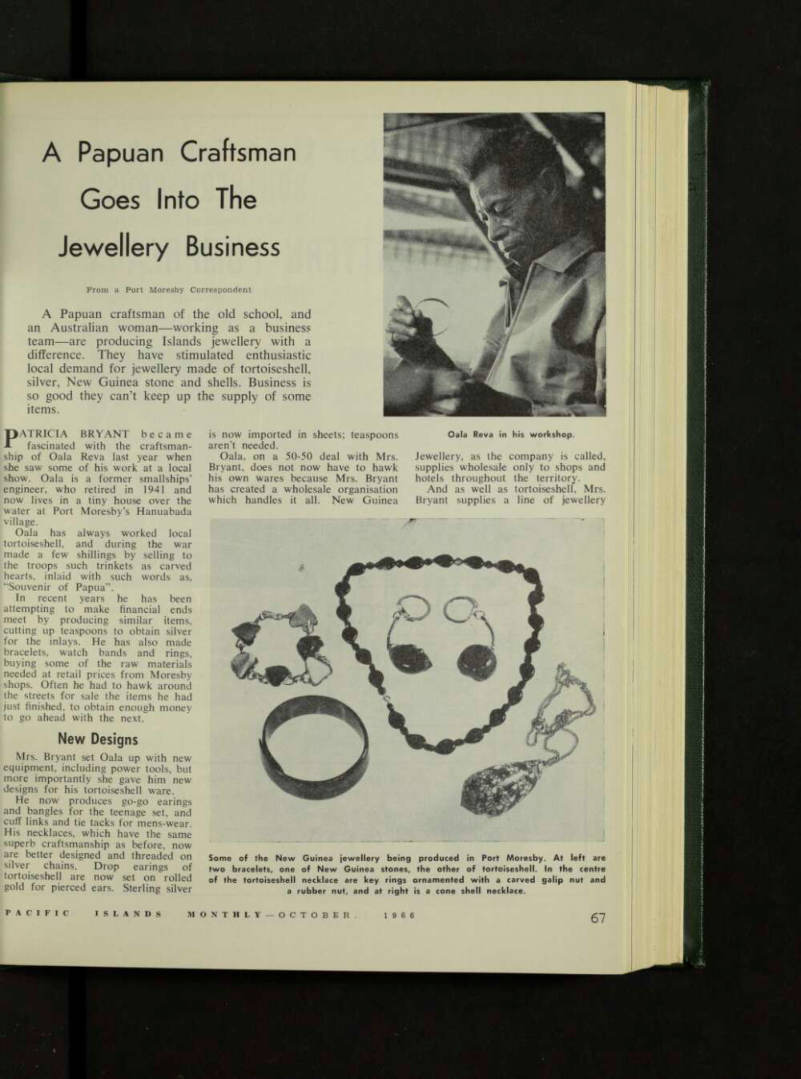
Oala Reva in his workshop.
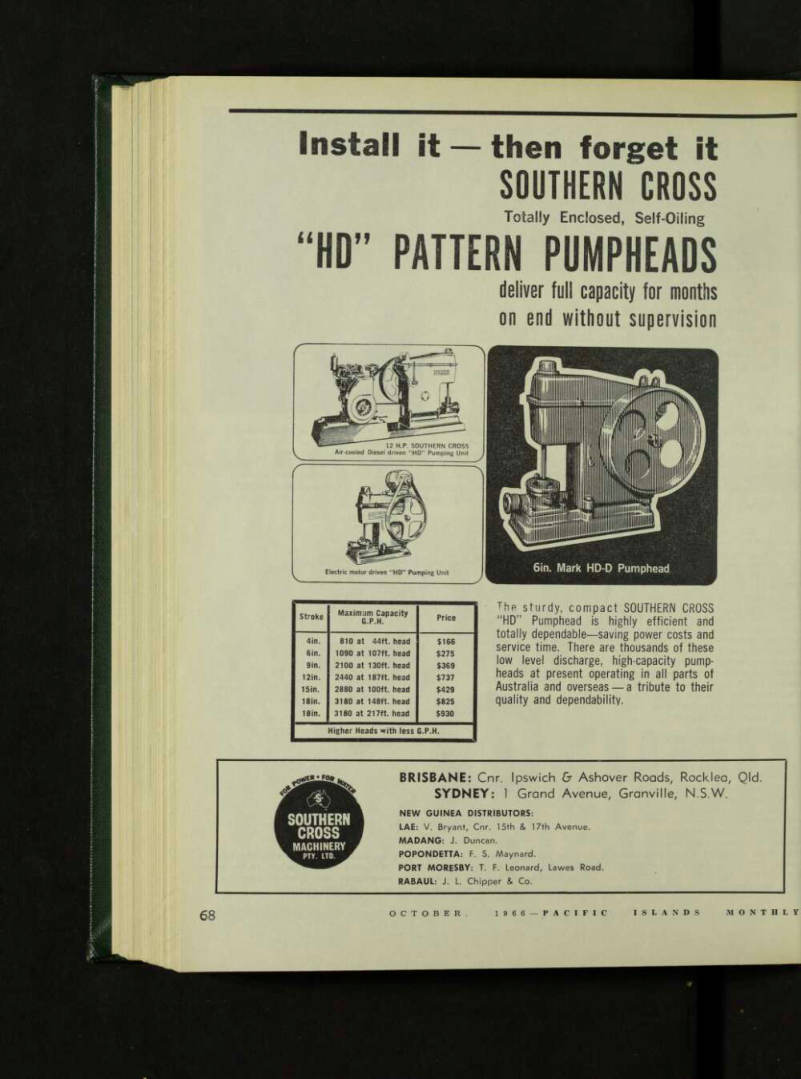
Some of the New Guinea jewellery being produced in Port Moresby. At left are two bracelets, one of New Guinea stones, the other of tortoiseshell. In the centre of the tortoiseshell necklace are key rings ornamented with a carved galip nut and a rubber nut, and at right is a cone shell necklace.
she herself has created from the hobby of her husband, New Guinea’s Chief Electoral Officer, Mr. Bob Bryant, who for years has been a confirmed rock-hound. Bob Bryant collects and polishes territory gem stones, which his wife now mounts is bracelets, necklaces, brooches, and jarrings.
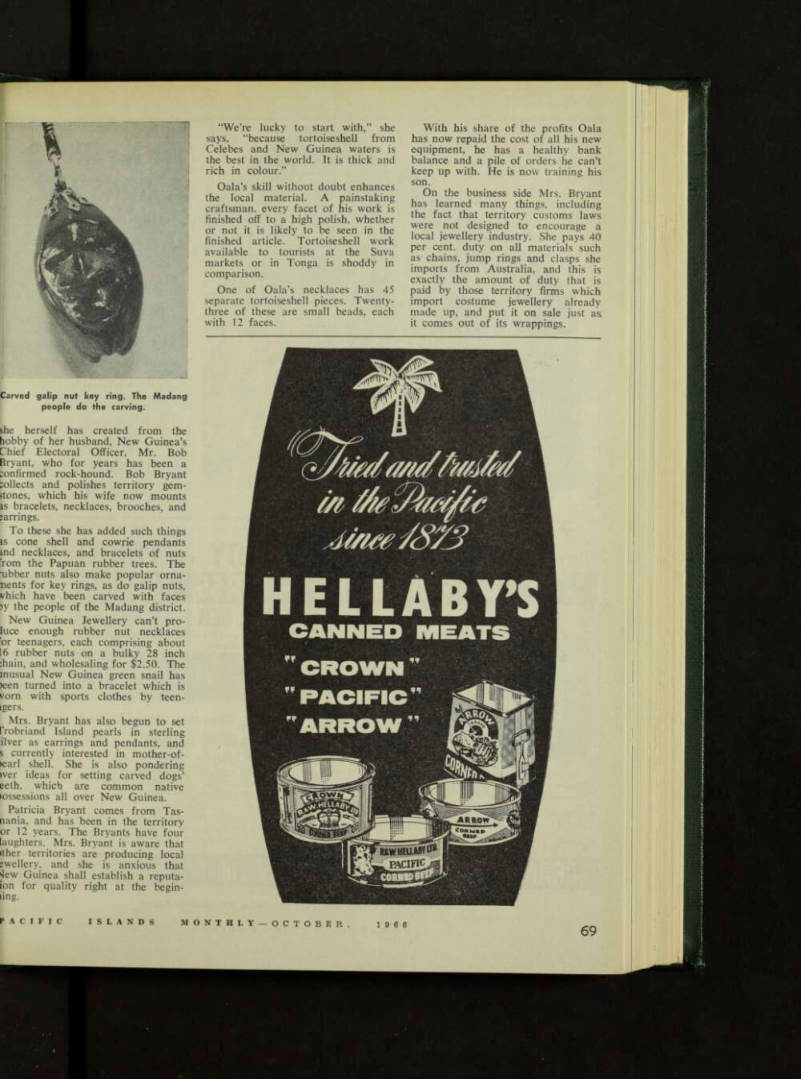
To these she has added such things is cone shell and cowrie pendants md necklaces, and bracelets of nuts Tom the Papuan rubber trees. The libber nuts also make popular orna nents for key rings, as do galip nuts, vhich have been carved with faces )y the people of the Madang district.
New Guinea Jewellery can’t pro luce enough rubber nut necklaces 'or teenagers, each comprising about [6 rubber nuts on a bulky 28 inch diain, and wholesaling for 52.50. The musual New Guinea green snail has >een turned into a bracelet which is vora with sports clothes by teen igers.
Mrs. Bryant has also begun to set frobriand Island pearls in sterling ilver as earrings and pendants, and s currently interested in mother-of ►earl shell. She is also pondering >ver ideas for setting carved dogs’ eeth, which are common native tossessions all over New Guinea.
Patricia Bryant comes from Tas nania, and has been in the territory or 12 years. The Bryants have four laughters. Mrs. Bryant is aware that ither territories are producing local swellery, and she is anxious that »Jew Guinea shall establish a reputa lon for quality right at the begin ling.
“We’re lucky to start with,” she says, “because tortoiseshell from Celebes and New Guinea waters is the best in the world. It is thick and rich in colour.”
Gala’s skill without doubt enhances the local material. A painstaking craftsman, every facet of his work is finished off to a high polish, whether or not it is likely to be seen in the finished article. Tortoiseshell work available to tourists at the Suva markets or in Tonga is shoddy in comparison.
One of Gala’s necklaces has 45 separate tortoiseshell pieces. Twenty three of these are small beads, each with 12 faces.
With his share of the profits Oala has now repaid the cost of all his new equipment, he has a healthy bank balance and a pile of orders he can’t keep up with. He is now training his son.
On the business side Mrs. Bryant has learned many things, including the fact that territory customs laws were not designed to encourage a local jewellery industry. She pays 40 per cent, duty on all materials such as chains, jump rings and clasps she imports from Australia, and this is exactly the amount of duty that is paid by those territory firms which import costume jewellery already made up, and put it on sale just as, it comes out of its wrappings.
Carved galip nut key ring. The Madang people do the carving.