Despite Differences, The New
pp. 59-62 · Read in the full issue
Hebrides Are On The Move
From a Special Correspondent Most people in the New Hebrides are agreed that, over the past five years, relations between the British and French Administrations have been much better than formerly, and that there has been more economic and social activity there than in any other similar period in the Condominium’s existence.
BUT it would be wrong to say that there are not differences—and this is particularly true in the fields Df health and education.
Unlike agriculture, mining, the post office, public works and Customs, svhich are administered by the joint Condominium Government, health and education continue to be the responsibilities of each national ad ministration although the various British and French religious bodies Jo a large part of the work. There are some unfortunate results.
The French Government has its own hospitals and gives medical supplies free to Roman Catholic missions throughout the group. They have done this for some years.
Some months ago, the British Gov ernment took over supplying and paying Presbyterian dressers.
The Condominium Government allocates about $140,000 for medical supplies, which makes up about 5 per cent, of what is required by the
other five missions scattered through out the group. For the remainder they do the best they can. This creates a most inequitable distribution of the available medical supplies.
The position is made worse by the fact that the two national govern ments and the Condominium find it necessary to distribute through the missions.
Two Reasons
A mission goes into an area for two reasons. It has been invited to do so by the New Hebrideans in the area or it wishes to extend its sphere of influence.
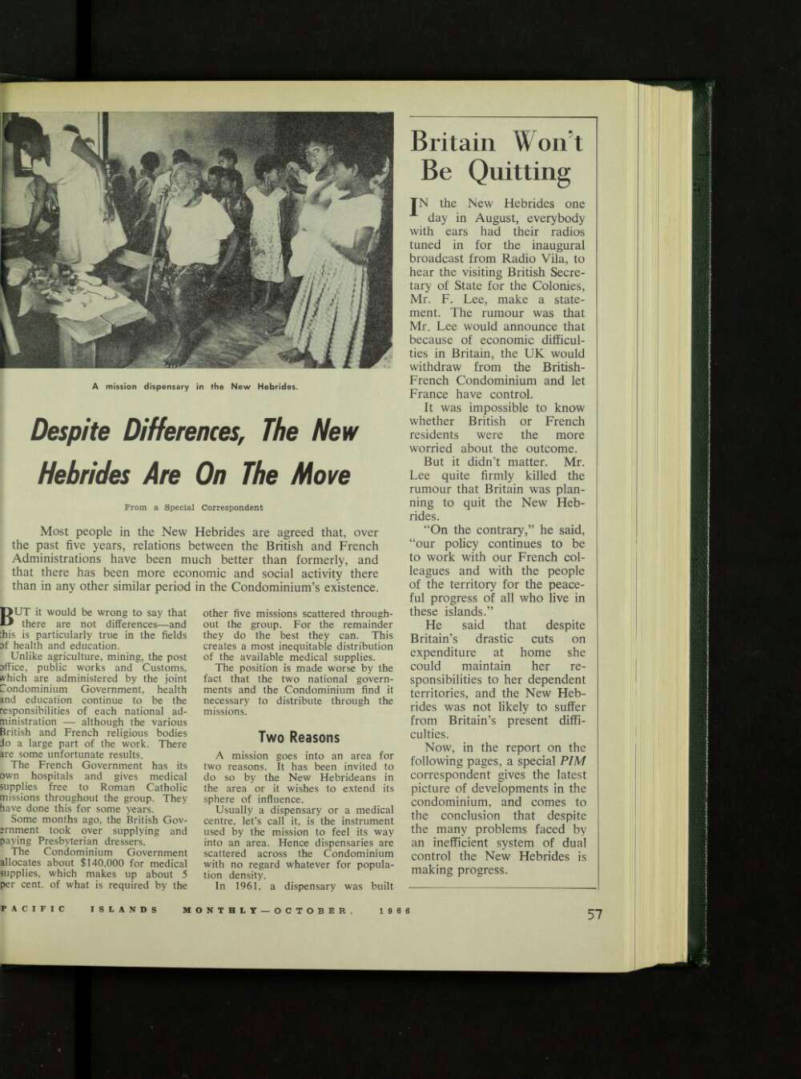
Usually a dispensary or a medical centre, let’s call it, is the instrument used by the mission to feel its way into an area. Hence dispensaries are scattered across the Condominium with no regard whatever for popula tion density.
In 1961, a dispensary was built
A mission dispensary in the New Hebrides.
of permanent materials on th rugged, inaccessible west coast c Malekula and manned by a Frenc Roman Catholic nurse. It was costly and, at first sight, commend able achievement.
Unfortunately, it was built betwee two villages which professed Presby terianism, which were not more tha 500 yards apart, and which alread received medical supplies regularl from the mission close by at Sout West Bay!
Five miles the other way wa Leviamp with 180 people and anothe dispensary. When Brenway, one c the two villages nudging the R( dispensary grew to 280 people, native dresser and his dispensary wer put there.
So now there are three dispensarie along five miles of Malekulan coa: serving only 610 people.
To complicate the problem furthe] the Roman Catholic dispensary wa built on land belonging to the astut Viahumbut, the chief of the Bi Nambus bush people.
Viahumbut, anxious to get th best of two worlds, agrees to certai proposals put to him by the differer missions and governments separately
No Permission For Church
I asked him about the dispensar on his land when I visited him in hi bush home in August. He though fully adjusted his nambus, scratche himself and looked at the new pi fence he had been building roun his vegetable garden. His seven wive sitting close by waited for him t answer.
It appears that he gave permissio for the dispensary on his land bi not the church which followec Nevertheless, the determined, ou spokenly anti-British Father Loupp< who had tenaciously kept the R< dispensary where it is, remair adamant.
Herein lies the problem. Missior are not primarily concerned with th equitable distribution of medics supplies. Nor are they concerne with the even distribution c dispensaries. Their dispensaries ai chiefly weapons with which to gai entry to an area where their fait is not represented.
The chaotic situation in the ac ministration of health services duplicated many times under th heading of education.
Here the French and Britisl mainly through the missions, are als locked in a struggle for influence with the French making the greate headway.
At the end of 1962, there wer
■ 274 British mission schools with 7,700 pupils and 38 French schools 1(23 run by missions) with 2,260 pupils.
Now there are 9,000 pupils in the British schools and about 5,000 at the French.
The trend towards French school ing is despite the British Admini stration’s increased interest in educa tion in the past five or six years.
This has resulted in the completion of Kawenu Teachers’ College at Vila which injects 35 new teachers each year into English-speaking schools.
Short refresher courses at Kawenu for teachers already in the English school system have relieved a serious shortage of qualified teachers.
A co-educational secondary school for 150 boarders started classes this year. The first stage cost $350,000.
The completed school is expected to cost double that amount.
The French Government entered the education field before the British.
They built schools and subsidised Roman Catholic building pro grammes, so long as the church con tinued to teach French.
Better Appearance
French schools have a better appearance generally speaking than the British and are built of permanent materials. Attendance at French schools is free. These factors, together with a population explosion, are the main reasons for the big increase in attendances at the French schools in the last few years.
Meanwhile, the haphazard distri bution of British and French schools is turning the New Hebrides into a multi-lingual community with few clear-cut divisions.
In the main centres English is taught in one school and French in the other. The British missions plan to make the best of this problem by inviting Roman Catholics to teach French at their schools.
This year, the British Administra tion sent 70 New Hebrideans abroad on various scholarships, A similar number went abroad last year.
Some French-speaking students are in New Caledonia, and the number is expected to increase as education standards improve.
One of the few joint efforts in education so far was the establish ment of a £35,000 agricultural train ing institute at Tagabe, outside Vila, last year.
Plans for technical education—a weakness everyone seems to recognise —are still being discussed.
Despite the divisive influences of education, the New Hebrides is buzz ing with progress in many ways.
During the last two years there has been a phenomenal growth in the number of co-operatives.
Thirty-six have now been estab lished and 34 are preparing for their opening day.
The co-operatives are coming into being on a wave of enthusiasm which is going from post to post.
But they are facing difficulties, too.
Their greatest opposition comes from those who are hurt most by them— the traders.
Questions were asked by the traders’ representative at a recent meeting of the Advisory Council.
And not without cause.
In 1965, the co-operatives did
business worth £65,713 which previously would have been put through the traders.
The annual report on co-operatives put out by the British Administration in 1965 on the co-operatives under its control said; “There are signs that commercial opposition to established [co-operative] societies is stiffening and it is too early yet to be certain whether membership loyalty and commonsense will continue to over come the temptation of immediate gains offered by competing traders”.
One factor limiting the growth of co-operatives at present is the lack of New Hebrideans with sufficient qualifications to take on the task of co-operatives secretary or supervising officers.
Also, many co-operatives have invested dividends on behalf of members unwisely. For example, some have purchased launches, spent up to £8 a week on overall running and depreciation costs, without getting a fraction of that amount back.
Some are heavily in debt on launch accounts.
Some co-operatives are badly sited.
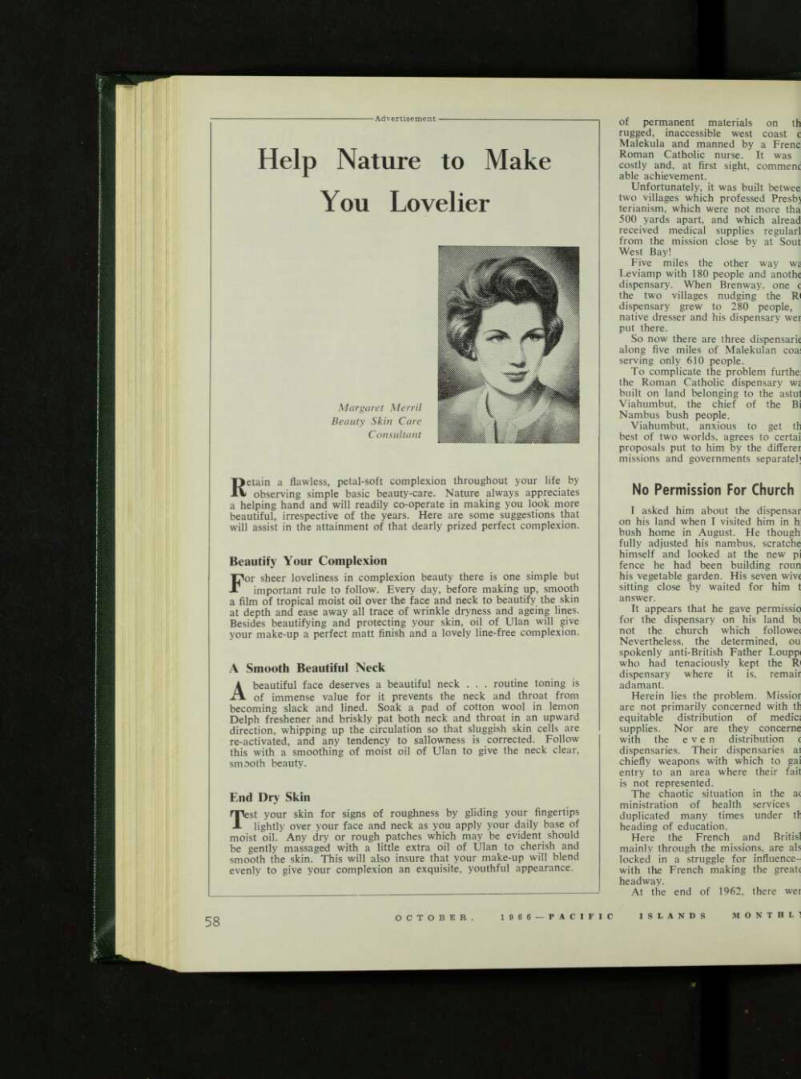
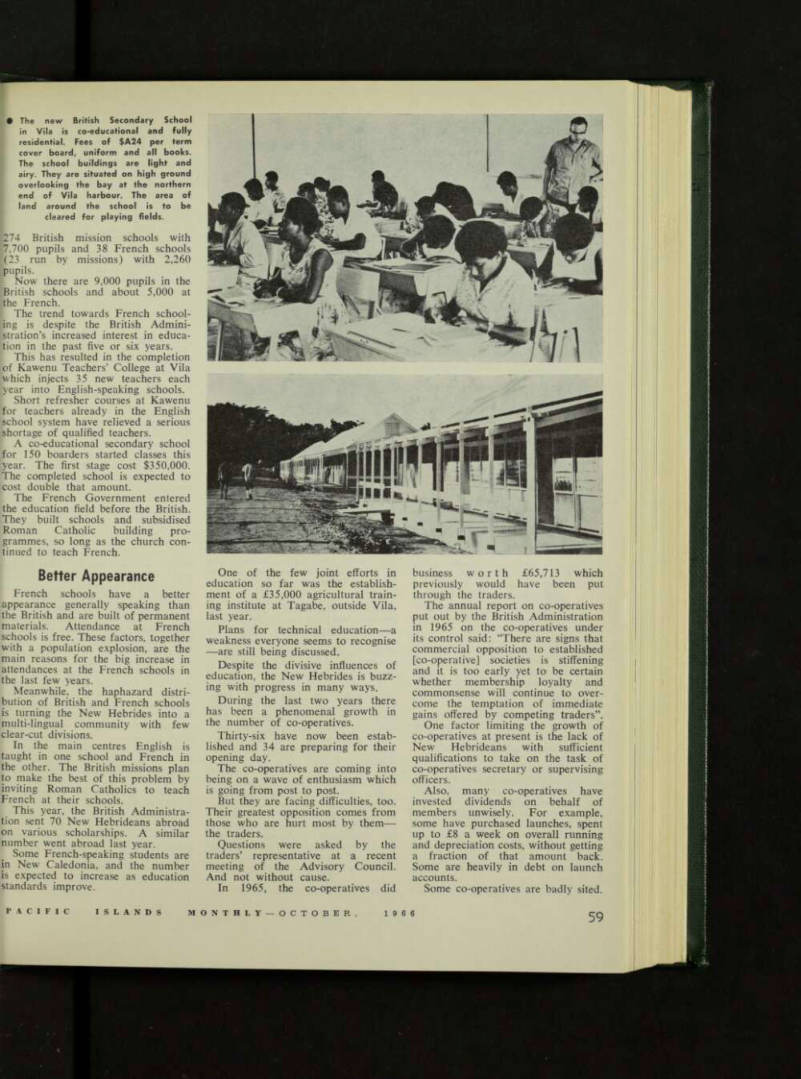
The new British Secondary School in Vila is co-educational and fully residential. Fees of $A204 per term cover board, uniform and all books.
The school buildings are light and airy. They are situated on high ground overlooking the bay at the northern end of Vila harbour. The area of land around the school is to be cleared for playing fields.
Others are poorly organised, have only a small range of goods, are poorly lit, display goods badly, employ primitive methods of account ing, and have virtually no security measures.
However, co-operatives have given the New Hebrideans a feeling of pride and achievement in many villages, and this is indicative of a new spirit being felt through the Condominium.
Meanwhile, there is a new sense of confidence throughout the New Hebrides that beef cattle may replace ailing copra as a money earner.
On Santo and Efate, beef has grown from an infant industry supplying only domestic needs into one earning significant export in come.
There are promising prospects for the future.
Both Vila and Santo have meat packing works. Vila’s works, opened earlier this year, are producing about 18,000 cans each month. The longer established works in Santo are pro ducing about 30,000 cans a month.
In 1965, their total production was worth £A211,468.
"Lawn Mowers"
Cattle were formerly used as lawn mowers on plantations. Now grazing areas are being opened up, and villages keep a herd of cows as well as pigs.
Beef breeding was stimulated by the fact that, under certain conditions, cattle in the New Hebrides can do entirely without drinking water.
On Tongoa there are 600 head of cattle without water. In 1964, despite a three-month drought, these cattle remained in good condition.
In an effort to get some homogenity into New Hebridean herds, the Condominium agricultural research stations have tried to arrive at a breed which will supply modern food requirements (more tender muscle, less separate fat).
To do this, the Agriculture Depart ment has decided to encourage Shorthorns through intensive selective breeding and to admix Charollais.
An order for three bulls and six heifers arrived from France earlier this year with funds supplied by the Joint Development Plan. Bulls suit able for serving cows will be avail able to growers at the beginning of 1968.
The department no doubt has strong arguments to support the selection of the Charollais, but it does not seem to have considered some other breeds too carefully.
The most successful beef cattle in
Australia in recent years, for example, has been the Australian-bred Aberdeen Angus. This animal has achieved the reputation of being one of the hardiest prime beef producers capable of withstanding extremes in climatic and soil conditions.
It is the choice of the Agriculture Departments of Japan and some South American countries, and ship ments of stud beasts are leaving Aus tralia for those countries regularly.
Yet a report of the Condominium Agriculture Department says the Aberdeen Angus “has never been tried in the New Hebrides which is a good reason for not considering it”.
The developments in the cattle industry have gone on side by side with advances in other directions.
Both Vila and Santo (Luganville), the two main settlements in the Group, have been putting on a new face, and have been attracting an increasing number of tourists.
The Polynesie and Tulagi are booked out months ahead, and the
number of air travellers has doubled since 1960.
In Vila, the modern Hotel Vate completed in 1964, provides first class accommodation, New Hebridean decor and fine French cuisine.
The waterfront has been cleanec up. Lawns replace rocky uneven ground, tin sheds are disappearing stores are putting on good displays.
Fountains, trees, beach umbrella! and typically French side-walk cafe: replace dingy shops.
Vila is currently providing £ sparkling night life for locals anc tourists alike with two new out-of town night clubs. One-day tours giv* visitors trips to local beaches, wit! food, custom dancing and native songs.
Another takes the more ad venturous by air right to the moutl of Yasur, the Tanna Island volcano
Clean-Up Campaign
Luganville, which elected its firsi local council in August, made up o: British, French and New Hebridear representatives, has embarked on ai intensive clean-up campaign.
At the beginning of 1966, forme] Flick representative, Mr. Ken Car penter, was invited to rid The Channe of its vicious mosquitoes, plan storrr water channels and wage war or those guilty of unhygienic practice: in the town.
The main street is to be kerbec and some of the old familiar land marks—wooden and tin sheds in th« main street—have five years to hi pulled down or replaced.
Some of the dynamic entrepreneur: of the post-war era have forsaker Luganville for new pastures, but the enterprising spirit remains. Business men are exploring ways by whict the empty freezers can be filled wit! beef for Japan when there is noi enough fish. Others are looking oui ways of making oil from copra locally.
A plan to harness the waterfal behind the town for hydro-electric power is still being discussed. There is also a move to have the existing beef freezer extended.
In short, the New Hebrides are on the move—and with a cleai declaration of policy and sound co operation between the two admini strations, there could be a period oi growth and prosperity as yet un known.
Members of the Advisory Council asked for such a declaration in Sep tember, 1965.
A year has now elapsed. It seems that Britain and France should now be able to give the council a reply.
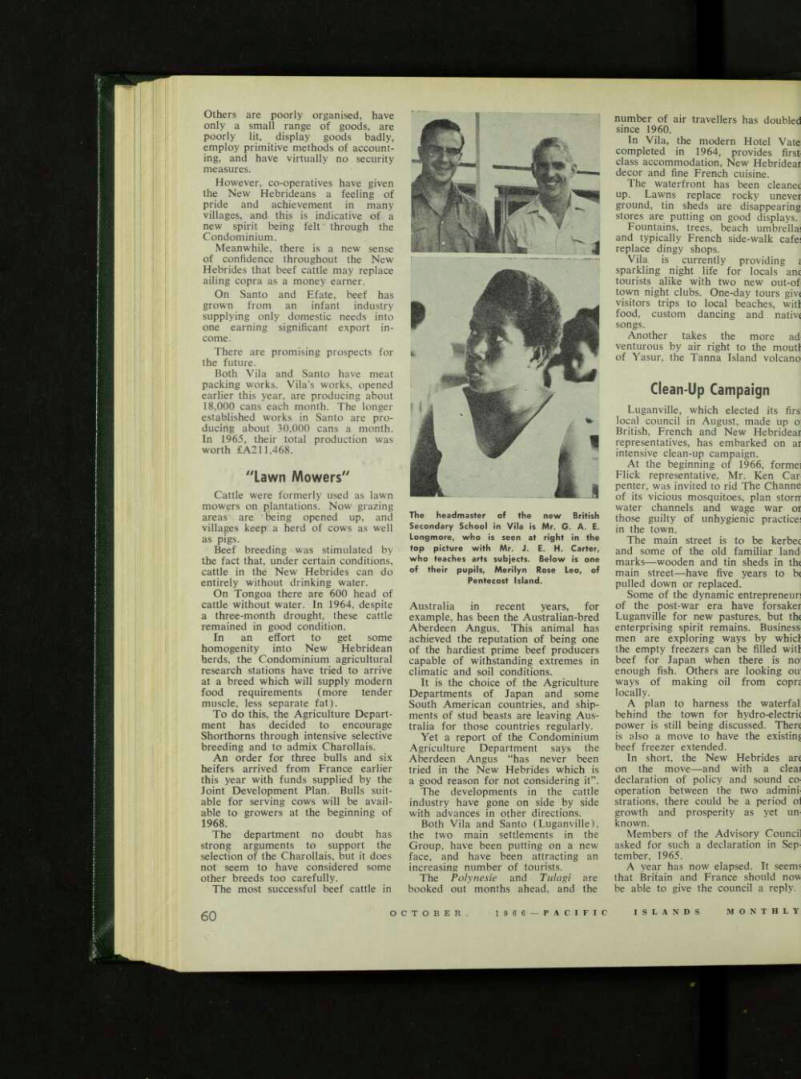
The headmaster of the new British Secondary School in Vila is Mr. G. A. E.
Longmore, who is seen at right in the top picture with Mr. J. E. H. Carter, who teaches arts subjects. Below is one of their pupils, Merilyn Rose Leo, of Pentecost Island.