To The Point
pp. 27-33 · Read in the full issue
With Percy Chatterton
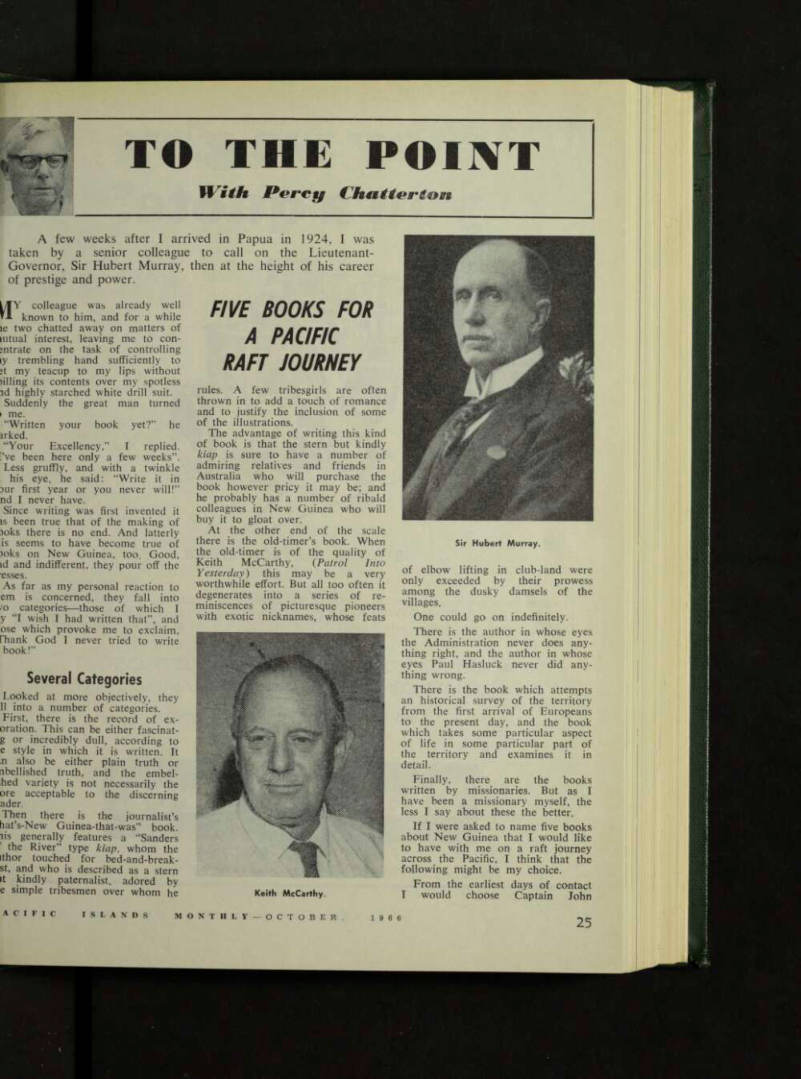
A few weeks after I arrived in Papua in 1924, I was taken by a senior colleague to call on the Lieutenant- Governor, Sir Hubert Murray, then at the height of his career of prestige and power.
LfY colleague was already well known to him, and for a while le two chatted away on matters of mtual interest, leaving me to con mtrate on the task of controlling ly trembling hand sufficiently to it my teacup to my lips without nlling its contents over my spotless id highly starched white drill suit.
Suddenly the great man turned » me.
“Written your book yet?” he irked.
“Your Excellency,” I replied, [’ve been here only a few weeks”.
Less gruffly, and with a twinkle his eye, he said: “Write it in iur first year or you never will!” nd I never have.
Since writing was first invented it is been true that of the making of ioks there is no end. And latterly is seems to have become true of )oks on New Guinea, too. Good, id and indifferent, they pour off the esses.
As far as my personal reaction to em is concerned, they fall into f o categories—those of which I y “I wish I had written that”, and ose which provoke me to exclaim, fhank God I never tried to write book!”
Several Categories
Looked at more objectively, they 11 into a number of categories.
First, there is the record of ex oration. This can be either fascinat g or incredibly dull, according to e style in which it is written. It n also be either plain truth or abellished truth, and the embel hed variety is not necessarily the ore acceptable to the discerning ader.
Then there is the journalist’s hat’s-New Guinea-that-was” book, lis generally features a “Sanders the River” type kiap, whom the ithor touched for bed-and-break st, and who is described as a stern it kindly paternalist, adored by e simple tribesmen over whom he
Five Books For
A Pacific
Raft Journey
rules. A few tribesgirls are often thrown in to add a touch of romance and to justify the inclusion of some of the illustrations.
The advantage of writing this kind of book is that the stern but kindly kiap is sure to have a number of admiring relatives and friends in Australia who will purchase the book however pricy it may be; and he probably has a number of ribald colleagues in New Guinea who will buy it to gloat over.
At the other end of the scale there is the old-timer’s book. When the old-timer is of the quality of Keith McCarthy, (Patrol Into Yesterday ) this may be a very worthwhile effort. But all too often it degenerates into a series of re miniscences of picturesque pioneers with exotic nicknames, whose feats
of elbow lifting in club-land were only exceeded by their prowess among the dusky damsels of the villages.
One could go on indefinitely.
There is the author in whose eyes the Administration never does any thing right, and the author in whose eyes Paul Hasluck never did any thing wrong.
There is the book which attempts an historical survey of the territory from the first arrival of Europeans to the present day, and the book which takes some particular aspect of life in some particular part of the territory and examines it in detail.
Finally, there are the books written by missionaries. But as I have been a missionary myself, the less I say about these the better.
If I were asked to name five books about New Guinea that I would like to have with me on a raft journey across the Pacific, I think that the following might be my choice.
From the earliest days of contact I would choose Captain John
Keith McCarthy.
Sir Hubert Murray.
loresby’s account of the voyage □ring which he discovered the reat land-locked harbour now amed after him. The passage irough the reef by which it is ap roached bears the name of his ship, [MS Basilisk.
Moresby’s lucid style places his discoveries and Surveys in New uinea and the D’Entrecasteaux lands on a level with A. R.
Wallace’s Malay Archipelago.
My second choice from the past ould be Romilly’s From my erandah in New Guinea.
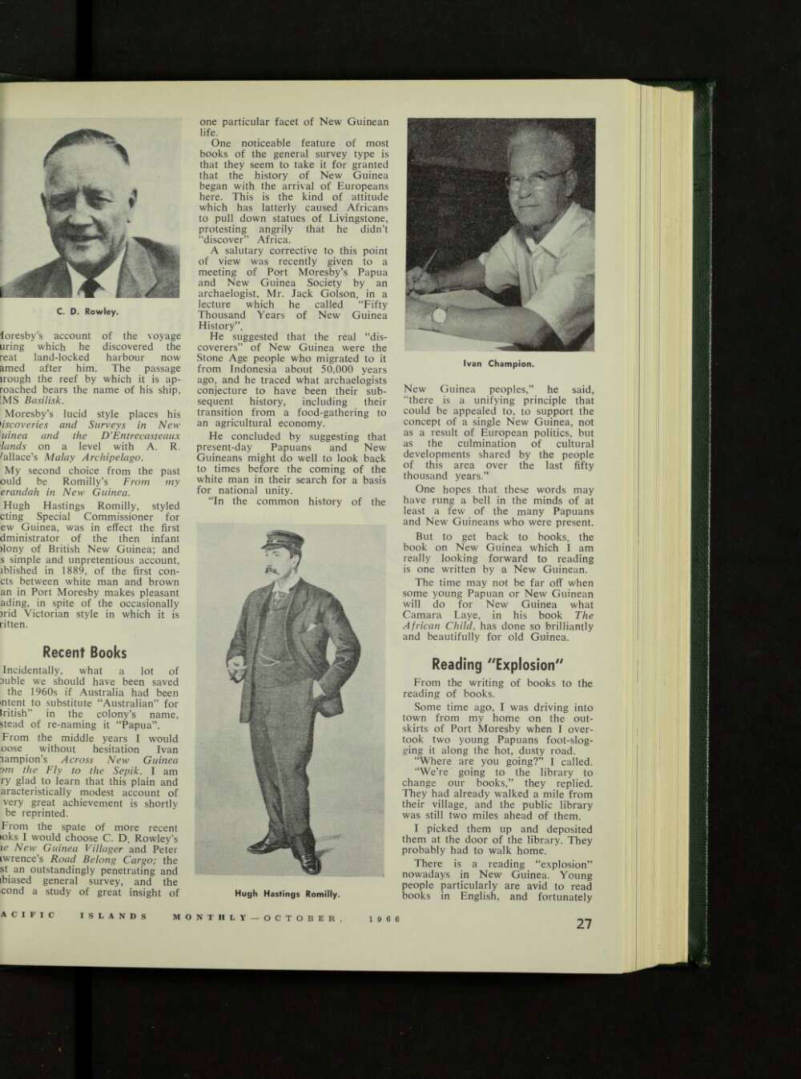
Hugh Hastings Romilly, styled cting Special Commissioner for ew Guinea, was in effect the first dministrator of the then infant >lony of British New Guinea; and s simple and unpretentious account, iblished in 1889, of the first con cts between white man and brown an in Port Moresby makes pleasant ading, in spite of the occasionally )rid Victorian style in which it is ritten.
Recent Books
Incidentally, what a lot of Duble we should have been saved the 1960 s if Australia had been •ntent to substitute “Australian” for British” in the colony’s name, stead of re-naming it “Papua”.
From the middle years I would oose without hesitation Ivan lampion’s Across New Guinea 9m the Fly to the Sepik. I am ry glad to learn that this plain and aracteristically modest account of very great achievement is shortly be reprinted.
From the spate of more recent »oks I would choose C. D. Rowley’s te New Guinea Villager and Peter iwrence’s Road Belong Cargo; the st an outstandingly penetrating and [biased general survey, and the cond a study of great insight of
one particular facet of New Guinean life.
One noticeable feature of most books of the general survey type is that they seem to take it for granted that the history of New Guinea began with the arrival of Europeans here. This is the kind of attitude which has latterly caused Africans to pull down statues of Livingstone, protesting angrily that he didn’t “discover” Africa.
A salutary corrective to this point of view was recently given to a meeting of Port Moresby’s Papua and New Guinea Society by an archaelogist, Mr. Jack Golson, in a lecture which he called “Fifty Thousand Years of New Guinea History”.
He suggested that the real “dis coverers” of New Guinea were the Stone Age people who migrated to it from Indonesia about 50,000 years ago, and he traced what archaelogists conjecture to have been their sub sequent history, including their transition from a food-gathering to an agricultural economy.
He concluded by suggesting that present-day Papuans and New Guineans might do well to look back to times before the coming of the white man in their search for a basis for national unity.
“In the common history of the
New Guinea peoples,” he said, “there is a unifying principle that could be appealed to, to support the concept of a single New Guinea, not as a result of European politics, but as the culmination of cultural developments shared by the people of this area over the last fifty thousand years.”
One hopes that these words may have rung a bell in the minds of at least a few of the many Papuans and New Guineans who were present.
But to get back to books, the book on New Guinea which I am really looking forward to reading is one written by a New Guinean.
The time may not be far off when some young Papuan or New Guinean will do for New Guinea what Camara Laye, in his book The African Child, has done so brilliantly and beautifully for old Guinea.
Reading "Explosion"
From the writing of books to the reading of books.
Some time ago, I was driving into town from my home on the out skirts of Port Moresby when I over took two young Papuans foot-slog ging it along the hot, dusty road.
“Where are you going?” I called.
“We’re going to the library to change our books,” they replied.
They had already walked a mile from their village, and the public library was still two miles ahead of them, I picked them up and deposited them at the door of the library. They probably had to walk home.
There is a reading “explosion” nowadays in New Guinea. Young people particularly are avid to read books in English, and fortunately
C. D. Rowley.
Hugh Hastings Romilly.
Ivan Champion.
here is an ever-increasing supply of yell-illustrated books in reasonably imple English for them to read.
This was not always so. In pre yar days, when I was engaged in caching young Papuans English, it yas very difficult indeed to find uitable reading matter for them yhen they had learned to read.
Books written in simple enough inglish were too childish in con ent; books with the right sort of ontent were in too difficult English, "his is no longer a problem.
In Port Moresby, at the low-cost ousing settlement of Hohola, there i now a cool, airy library built in con rete brick, which owes its existence lainly to the enthusiasm and hard rork of a District Administration fficer, Bill Driver, and its success ) the understanding and patience of Welfare Officer, Constance Fair all.
Here there is a good supply of ooks, most of them donated, in Inglish, suited to all ages and iterests. There are tables laden with lagazines, and there is a special orner for the 6 to 9-year-olds, ipprentices from the neighbouring apprentices’ Hostel find shelves evoted to technical and craft books.
Maps and brightly coloured travel posters decorate the walls. Between 100 and 150 people mainly children and young people—use this library daily on week days.
Older folk, whose ability to read English is limited or non-existent, read whatever is available in Pidgin, Police Motu or their mother tongue, as the case may be. The Department of Information and Extension Serv ices prints its fortnightly news sheet, Our News, in Pidgin and Police Motu editions as well as in English.
Die publisher of our two English language newspapers also publishes a weekly newspaper in Pidgin, Nu Gini Tok Tok, with a circulation of about 9,000.
During the first six months of this year, the British and Foreign Bible Society sold 24,000 vernacular scriptures, ranging from single Gospels to whole Bibles, in 40 different languages, as well as 12,000 in English.
This enthusiasm for the printed word offers a wonderful opportunity to educators, and an equally wonder ful one to propagandists, dissidents and cranks.
As a member of the House As sembly I periodically find my mail box stuffed up with free “literature”, ranging from the Communist Tribune at one end of the scale to a periodical sponsored by the Govern ment of Mr. lan Smith at the other. (Over)
[ believe that indigenous MHAs are treated with similar generosity; Fortunately only a minority of them :an read English!
The demand for and prestige value [>f English is enormous. Some of it is, to put it bluntly, snob value. [ Some of it, particularly among students who have received a secondary education and hope to go >n to tertiary education or vocational ;raining, is an intelligent apprecia ;ion of the unique value of English is a tool of learning.
Some of it, I’m afraid, has a con siderable flavour of cargo cult.
Somewhere, it is thought, amidst the ntricacies of the white man’s anguage are hidden the magic words >f power, the “open sesame”, which vill enable the brown man to achieve he white man’s prosperity without ictually working.
People whose mother tongue is inglish and who have never under gone the discipline of learning and ising another language often don’t ealise what a difficult language inglish is, and how many traps it sontains for those who are learning t as a foreign language.
Idiomatic Expressions
It is chock full of idiomatic ex iressions, like “What a pity”, the leanings of which cannot be deduced rom the meanings of the individual pords of which they are made up.
Then there are the words like get”, which can mean almost any hing.
One afternoon, away back in 1943, had just dismissed my class for the lay when I was approached by one if my pupils.
“Taubada,” she said, “Is the war inished?”
“I don’t think so,” I replied. “It ertainly wasn’t finished this morning yhen I listened to the news. But vhy do you ask?”
“Well,” she said, “look at this icncil I bought in the store this norning.”
I took the pencil from her. It was ertainly an austerity model—no •rightly coloured enamel. And on ts plain, unvarnished wood were uprinted the name of the manufac iirer and the words “Wartime ? inish”.