Tropicalities
pp. 19-21 · Read in the full issue
When Australia’s Commissioner in Fiji, Mr. Bob Hamilton spoke at a dinner at Vatukoula recently, was it Mr.
Hamilton speaking, or the Australian Government with its great big foot firmly stuffed into his mouth? A number of senior Fiji Government officials are wondering.
MR. HAMILTON, not noted for his verbal reticence, was in full flood about what Australia had done, and wanted to do, and couldn’t do for Fiji. With him as guests at the Emperor Goldmine dinner were Messrs. Dirona Abe and Tei Abal, : two members of the P-NG House of Assembly, en route home from a UN meeting in New York.
What Australian private invest ment had done to transform the barren hills of Vatukoula, said Mr.
Hamilton, so it had done in other sectors of Fiji’s economy, to the colony’s social and economic benefit.
“It is my firm belief that, while giving our investors a fair return on their capital, and on the risks they take, this overseas contribution will continue to enrich Fiji far more than it will enrich Australia,” said the Australian Commissioner. He added; “One might ponder how it is that it is sometimes argued that the existence of Australian private in vestment in Fiji itself gives rise to an obligation on the part of the Aus tralian Government to give major financial aid to Fiji,
Flow Of Investment
“I hope that this particular argu ment will not gain credence here or be taken too seriously elsewhere.
“Should this happen, it could perhaps prejudice the flow of over seas investment into this country, rather than procure a net enlarge ment of your international capital receipts.”
Then came the punch lines.
There was no doubt in Australia, said Mr. Hamilton, that Fiji was in need of additional capital for develop ment, but there were similar needs shared by others, and while Fiji might have preferred that Australia spare her “a million or so”, Australia had some profoundly difficult problems in allocating its resources.
But he was not, he said, implying any decisions on Australian aid to Fiji.
Then why say anything?
Because at the time Mr. Hamilton
Australia's Official View - Or Just Talk?
was speaking, Australia was still considering Fiji’s pressing request for a Government-to-Government loan of £F3.54 million to bridge an embarrassing gap in the colony’s new five-year development plan. By the end of September Fiji officials were still anxiously awaiting a decision.
In view of Mr, Hamilton’s critical timing, was he—despite his disclaimer —primed by the Australian Govern ment to let Fiji down lightly, or was he just talking? Who knows?
Friendly, Feudal
Tonga
A ND on the subject of Pacific bumble-footedness, the Tongan Government is awarded PlM’s Rasp berry Cluster for its handling of the six castaway youths after their return to Nukualofa on September 13.
The lads had “borrowed” a whale boat 15 months ago, and had drifted to isolated ’Ata Island where the boat broke up under them and they were lucky to reach the island after a swim of nearly 24 hours (see story p. 101).
They came back from the dead, to be greeted by their families on the wharf—and by the police, who arrested and charged them with the theft of the boat.
Tonga’s Government newspaper, the Chronicle, reported that after being charged “they were released
to join their families pending further inquiries by the police”—which is the least one would have expected for compassionate reasons.
But it didn’t happen that way. They weren’t released to their families They were held in custody for those inquiries, and released a full week later.
It all looked rather feudal in the overseas Press reports, alongside stories of the official opening of the Government’s new Dateline Hotel and of King Taufa’ahau’s hopes for a flow of tourists to the “Friendly Isles”.
Ingenious Guitar
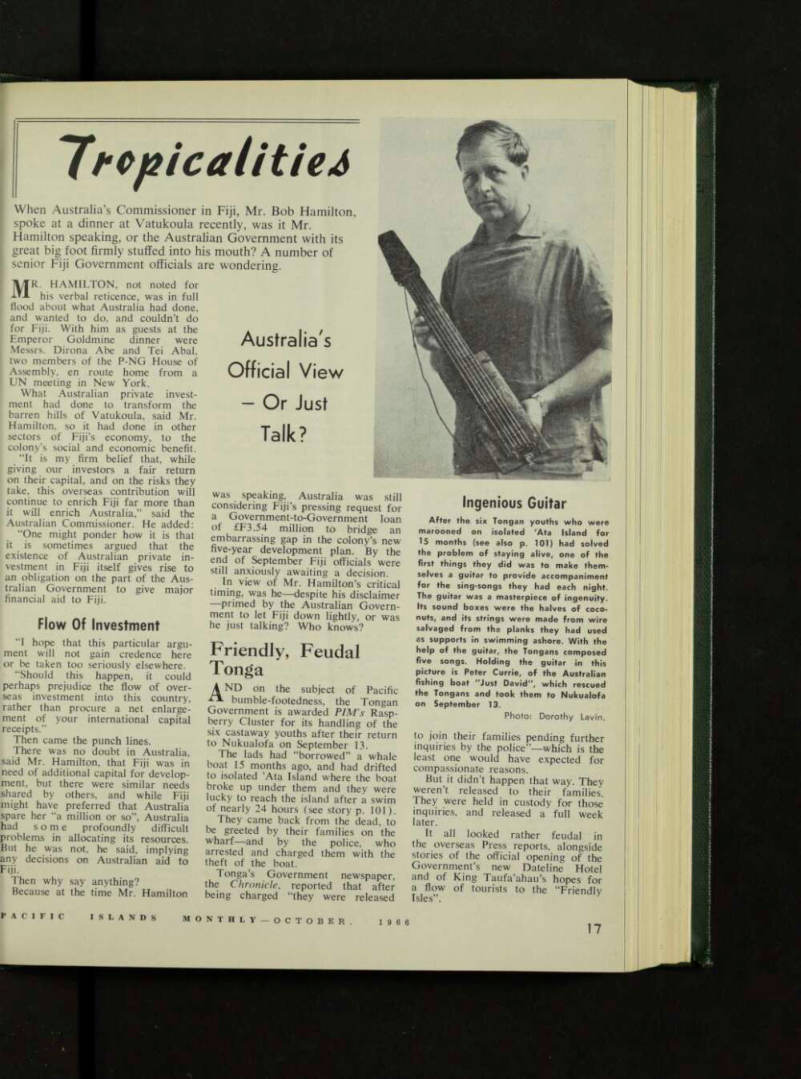
After the six Tongan youths who were marooned on isolated Ata Island for 15 months (see also p. 101) had solved the problem of staying alive, one of the first things they did was to make them selves a guitar to provide accompaniment for the sing-songs they had each night.
The guitar was a masterpiece of ingenuity.
Its sound boxes were the halves of coco nuts, and its strings were made from wire salvaged from the planks they had used as supports in swimming ashore. With the help of the guitar, the Tongans composed five songs. Holding the guitar in this picture is Peter Currie, of the Australian fishing boat "Just David", which rescued the Tongans and took them to Nukualofa on September 13.
Photo: Dorothy Lavin.
Pay Your Money,
Take Your Putt
RECENT Papua-New Guinea laws outlawing card games have not had much effect in parts of the Highlands. There they have their own gambling game. It’s called golf.
The New Guineans first began to take an interest in golf some years ago, but these days it has developed into a real craze in some areas.
Champions like Peter Thompson might not recognise the New Guinea version.
About eight to ten players make up a golf team, and there is only one hole on the course —a fish tank set in the green. Each player puts about 20c into kitty. Using “golf sticks” made of old pieces of iron, or carved from wood and looking rather like hockey sticks, each player has two putts from a distance of about 20 feet from the hole. The “ball” is made from the soft pith of a tree.
The golfer who sinks his ball in two putts claims the kitty. If by some miracle two players or more manage this feat then the kitty is divided.
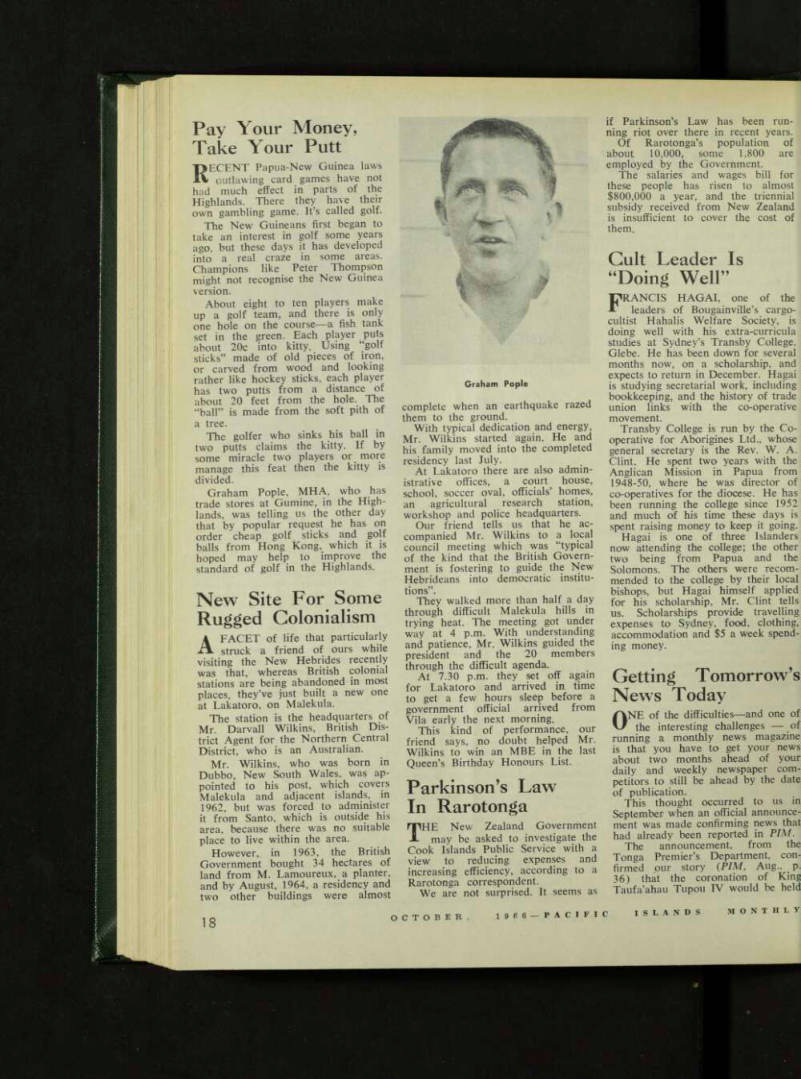
Graham Pople, MHA, who has trade stores at Gumine, in the High lands, was telling us the other day that by popular request he has on order cheap golf sticks and golf balls from Hong Kong, which it is hoped may help to improve the standard of golf in the Highlands.
New Site For Some
Rugged Colonialism
A FACET of life that particularly struck a friend of ours while visiting the New Hebrides recently was that, whereas British colonial stations are being abandoned in most places, they’ve just built a new one at Lakatoro, on Malekula.
The station is the headquarters of Mr. Darvall Wilkins, British Dis trict Agent for the Northern Central District, who is an Australian.
Mr. Wilkins, who was born in Dubbo, New South Wales, was ap pointed to his post, which covers Malekula and adjacent islands, m 1962, but was forced to administer it from Santo, which is outside his area, because there was no suitable place to live within the area.
However, in 1963, the British Government bought 34 hectares of land from M. Lamoureux, a planter, and by August, 1964, a residency and two other buildings were almost
complete when an earthquake razed them to the ground.
With typical dedication and energy, Mr. Wilkins started again. He and his family moved into the completed residency last July.
At Lakatoro there are also admin istrative offices, a court house, school, soccer oval, officials’ homes, an agricultural research station, workshop and police headquarters.
Our friend tells us that he ac companied Mr. Wilkins to a local council meeting which was “typical of the kind that the British Govern ment is fostering to guide the New Hebrideans into democratic institu tions”.
They walked more than half a day through difficult Malekula hills in trying heat. The meeting got under way at 4 p.m. With understanding and patience, Mr. Wilkins guided the president and the 20 members through the difficult agenda.
At 7.30 p.m. they set off again for Lakatoro and arrived in time to get a few hours sleep before a government official arrived from Vila early the next morning.
This kind of performance, our friend says, no doubt helped Mr.
Wilkins to win an MBE in the last Queen’s Birthday Honours List.
Parkinson’s Law
In Rarotonga
THE New Zealand Government may be asked to investigate the Cook Islands Public Service with a view to reducing expenses and increasing efficiency, according to a Rarotonga correspondent.
We are not surprised. It seems as
if Parkinson’s Law has been run ning riot over there in recent years.
Of Rarotonga’s population of about 10,000, some 1,800 are employed by the Government.
The salaries and wages bill for these people has risen to almost $BOO,OOO a year, and the triennial subsidy received from New Zealand is insufficient to cover the cost of them.
Cult Leader Is
“Doing Well”
Francis hagai, one of the leaders of Bougainville’s cargo cultist Hahalis Welfare Society, is doing well with his extra-curricula studies at Sydney’s Transby College, Glebe. He has been down for several months now, on a scholarship, and expects to return in December. Hagai is studying secretarial work, including bookkeeping, and the history of trade union links with the co-operative movement.
Transby College is run by the Co operative for Aborigines Ltd., whose general secretary is the Rev. W. A.
Clint. He spent two years with the Anglican Mission in Papua from 1948-50, where he was director of co-operatives for the diocese. He has been running the college since 1952 and much of his time these days is spent raising money to keep it going.
Hagai is one of three Islanders now attending the college; the other two being from Papua and the Solomons. The others were recom mended to the college by their local bishops, but Hagai himself applied for his scholarship, Mr. Clint tells us. Scholarships provide travelling expenses to Sydney, food, clothing, accommodation and $5 a week spend ing money.
Getting Tomorrow’s
News Today
ONE of the difficulties —and one of the interesting challenges of running a monthly news magazine is that you have to get your news about two months ahead of your daily and weekly newspaper com petitors to still be ahead by the date
of publication.
This thought occurred to us in September when an official announce ment was made confirming news that had already been reported in PIM.
The announcement, from the Tonga Premier’s Department, con firmed our story {PIM, Aug., _p. 36) that the coronation of King Taufa’ahau Tupou IV would be held
Graham Pople
on July 4, 1967, the king’s 49th birthday.
Two other notable examples of our clairvoyance that we remember from this year’s reporting are: • Dr. John Gunther’s resignation as Papua-New Guinea’s Assistant Administrator (Services) to become Vice-Chancellor of the territory’s new university. (We reported this in our issue for February, which was on sale in New Guinea at least two days before the official announcement). • The Roman Catholic Church’s decision to create a separate hierarchy for Oceania. (This was re ported in our issue for July, which was out for nearly a fortnight before the Vatican officially confirmed it).
Incidentally, in July we predicted that Sir Gawain Bell, a rank outsider, would become the next secretary general of the South Pacific Com mission, and we expect to have that one confirmed any day now.
Rotuma Was Never
Like This
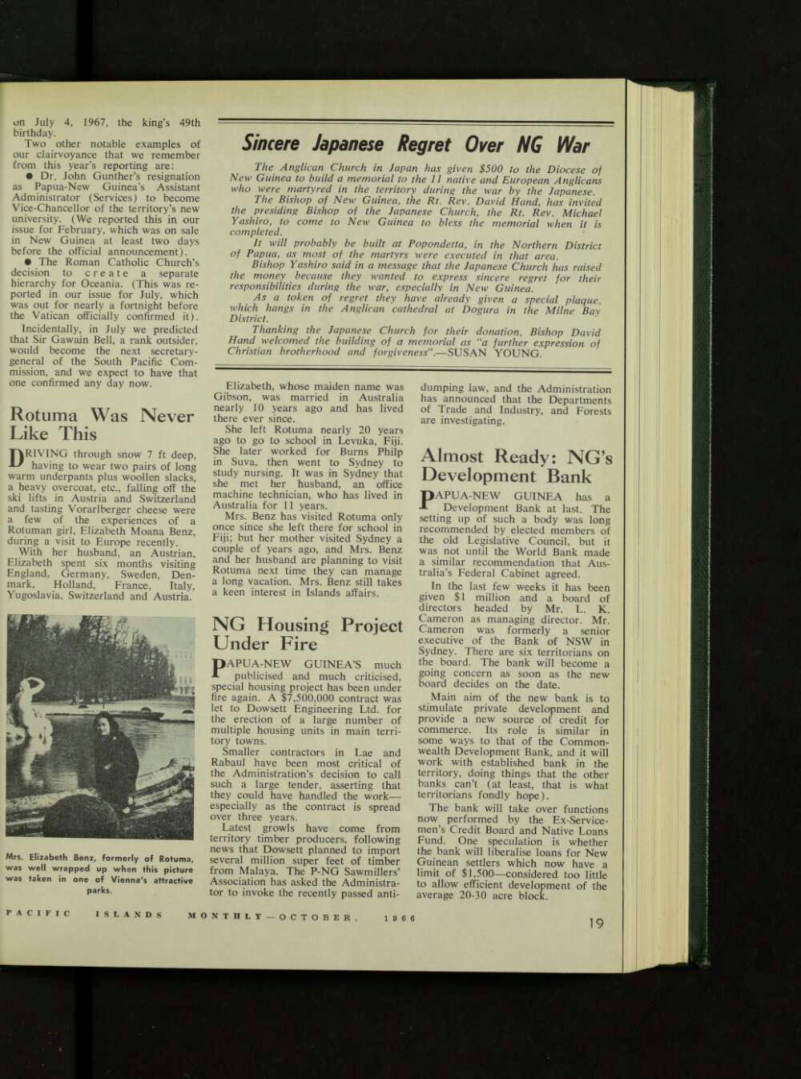
DRIVING through snow 7 ft deep, having to wear two pairs of long warm underpants plus woollen slacks, a heavy overcoat, etc., falling off the ski lifts in Austria and Switzerland and tasting Vorarlberger cheese were a few of the experiences of a Rotuman girl, Elizabeth Moana Benz, during a visit to Europe recently.
With her husband, an Austrian, Elizabeth spent six months visiting England, Germany, Sweden, Den mark, Holland, France, Italy, Yugoslavia, Switzerland and Austria.
Elizabeth, whose maiden name was Gibson, was married in Australia nearly 10 years ago and has lived there ever since.
She left Rotuma nearly 20 years ago to go to school in Levuka, Fiji.
She later worked for Burns Philp in Suva, then went to Sydney to study nursing. It was in Sydney that she met her husband, an office machine technician, who has lived in Australia for 11 years.
Mrs. Benz has visited Rotuma only once since she left there for school in Fiji; but her mother visited Sydney a couple of years ago, and Mrs. Benz and her husband are planning to visit Rotuma next time they can manage a long vacation. Mrs. Benz still takes a keen interest in Islands affairs.
NG Housing Project
Under Fire
Papua-new guinea’s much publicised and much criticised, special housing project has been under fire again. A $7,500,000 contract was let to Dow sett Engineering Ltd. for the erection of a large number of multiple housing units in main terri tory towns.
Smaller contractors in Lae and Rabaul have been most critical of the Administration’s decision to call such a large tender, asserting that they could have handled the work— especially as the contract is spread over three years.
Latest growls have come from territory timber producers, following news that Dowsett planned to import several million super feet of timber from Malaya. The P-NG Sawmillers’
Association has asked the Administra tor to invoke the recently passed anti
dumping law, and the Administration has announced that the Departments of Trade and Industry, and Forests are investigating.
Almost Ready: NG’s
Development Bank
Dapua-New Guinea Has A
Development Bank at last. The setting up of such a body was long recommended by elected members of the old Legislative Council, but it was not until the World Bank made a similar recommendation that Aus tralia’s Federal Cabinet agreed.
In the last few weeks it has been given $1 million and a board of directors headed by Mr. L. K.
Cameron as managing director. Mr.
Cameron was formerly a senior executive of the Bank of NSW in Sydney. There are six territorians on the board. The bank will become a going concern as soon as the new board decides on the date.
Main aim of the new bank is to stimulate private development and provide a new source of credit for commerce. Its role is similar in some ways to that of the Common wealth Development Bank, and it will work with established bank in the territory, doing things that the other banks can’t (at least, that is what territorians fondly hope).
The bank will take over functions now performed by the Ex-Service men’s Credit Board and Native Loans Fund. One speculation is whether the bank will liberalise loans for New Guinean settlers which now have a limit of sl,soo—considered too little to allow efficient development of the average 20-30 acre block.
Mrs. Elizabeth Benz, formerly of Rotuma, was well wrapped up when this picture was taken in one of Vienna's attractive parks.