From Kaindi
pp. 16-155 · Read in the full issue
The New Man From Kaindi
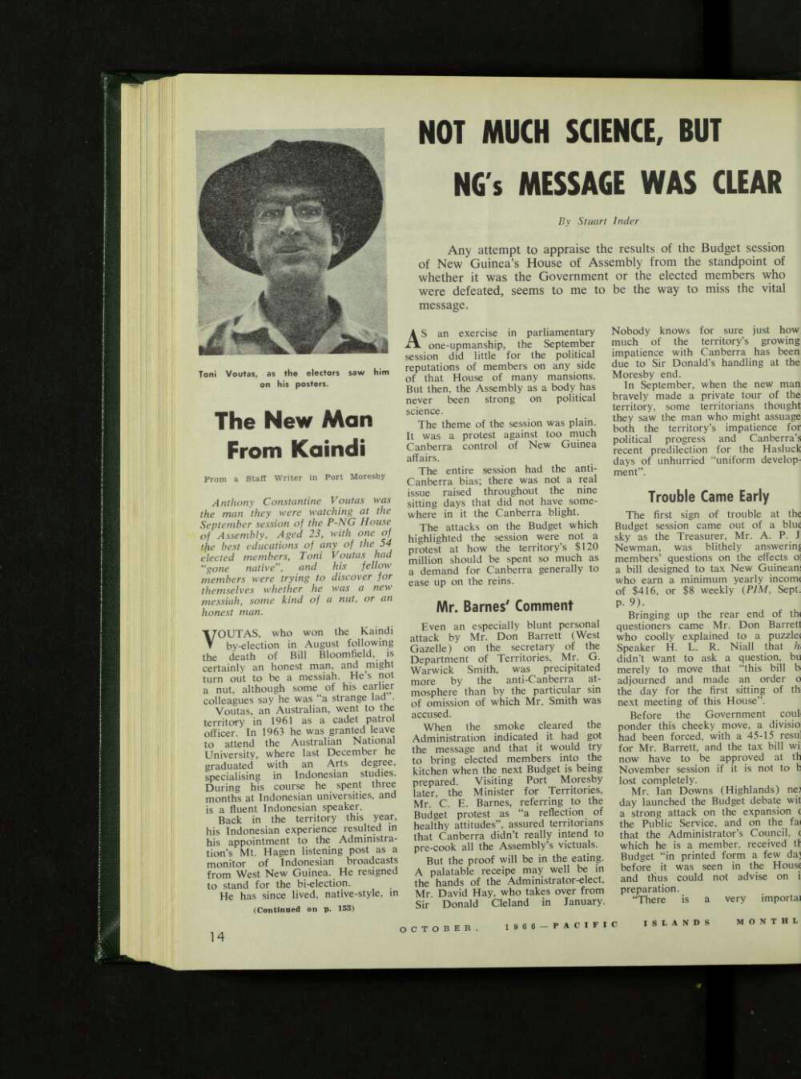
Prom a Staff Writer in Port Moresby Anthony Constantine Voutas was the man they were watching at the September session of the P-NG House of Assembly. Aged 23, with one of tjie best educations of any of the 54 elected members, Toni Voutas had “gone native ”, and his fellow members were trying to discover for themselves whether he was a new messiah, some kind of a nut, or an honest man.
VOUTAS, who won the Kaindi by-election in August following the death of Bill Bloomfield, is certainly an honest man, and might turn out to be a messiah. He’s not a nut, although some of his earlier colleagues say he was “a strange lad .
Voutas, an Australian, went to the territory in 1961 as a cadet patrol officer. In 1963 he was granted leave to attend the Australian National University, where last December he graduated with an Arts degree, specialising in Indonesian studies.
During his course he spent three months at Indonesian universities, and is a fluent Indonesian speaker.
Back in the territory this year, his Indonesian experience resulted in his appointment to the Administra tion’s Mt. Hagen listening post as a monitor of Indonesian broadcasts from West New Guinea. He resigned to stand for the bi-election.
He has since lived, native-style, m
(Continued on p. 153)
Toni Voutas, as the electors saw him on his posters.
his electorate which includes Wau, Bulolo and Menyamya—home town of the famed Kukukukuku tribesmen.
For his campaign he visited every one of 85 polling places in his rugged domain, distributing “Vote Toni” badges to his supporters. His election tactics were completely opposite to those of Bloomfield, who told the electors to vote first for the man of their choice and second for him —and won on preferences after the eighth count.
Voutas suspects that some electors still believe that both Bloomfield and “the man of their choice” got into parliament, and that this was dishonest of Bloomfield.
Voutas asked his electors for the number-one vote, and told them to vote for no other man—and thus he turned the election into a first-past the-post race. He got an outright majority, of 12,333, with a 70 per cent, poll on a roll of 28,588 electors.
His four native rivals divided the rest between them.
Voutas does not consider he is anti-European, as some Europeans have already claimed. He says that he tries to see things the native way, and that this is neither pro- nor anti- European.
“There is some anti-European feel ing in my electorate,” he says. “But you can’t ignore the fact that the New Guineans become submissive and feel inferior because the whites have so much. There is a way of getting people together, and this must be done, but you don’t do it by ignoring issues that hurt.”
Whether he is politically wet behind-the-ears remains to be seen.
He’s dedicated, and not afraid of work, and his speeches in the Budget session show he has no illusions that the House of Assembly has any power or that most of his work needs to be done outside the House.
The big problem ahead of him is whether, because of a forthcoming change in electoral laws, he will have the residential qualifications to enable him to stand for parliament in 1968.
Some elected members who already see in Toni Voutas a future threat to their leadership of the House are also interested in the outcome of his dilemma.