Militant Indians Active As
pp. 11-12 · Read in the full issue
Fiji Goes To The Polls
From a Suva Correspondent SUVA, Sept. 28 By air, land and sea; in bullock carts, launches, punts and rafts, Fiji’s electoral officers now are penetrating to every nook and cranny of the 300-odd islands which make up Fiji, to rattle the ballot boxes under the noses of 156,683 voters.
FIJI’S general elections are on— September 26 to October 8— and, in a last frenzy of activity, the 70-plus candidates are pleading their causes to the electorate.
Six candidates (all Alliance men) can sit back and take their ease.
They were elected unopposed—Ratu Edward Cakobau (Central cross-vot ing), Dr. W. L. I. Verrier (Northern and Eastern cross-voting), Jonati Mavoa (Fijian Lau-Rotuma), Solomoni Momoivalu (Lomaiviti- Kadavu), R. G. Kermode and R. H.
Yarrow (General, West Viti Levu).
In all the other constituencies (7 Fijian, 9 Indian, 3 General and 7 cross-voting constituencies) there are contests; but, although voting began on September 26, no results will be known until about October 10.
There have been no riots, no very exciting meetings, no large-scale demonstrations. But, allege the Alliance supporters, there has been some foul play.
Biggest talking point of the whole campaign has been the verbal lashing that Ratu K. K. T. Mara, Alliance president, gave A. D. Patel’s Federaion Party in the last election broadcast over the FBC, on September 23.
Anti-European
Mr. Patel and the other Federation andidates have urged Indian voters to ignore and “informalise” the ballot papers of the European candidates in the cross-voting.
This makes strange listening against the background of Patel’s campaign or an entente cordial among all races in Fiji.
At the opening of the campaign, all candidates were offered space in The Fiji Times for policy statements; and the Fiji Broadcasting Commission offered similar amenities. All responded except Federation candidates, they were ordered by the party leaders to boycott both The Fiji Times and the FBC.
They ignored The Fiji Times offer and demanded from FBC carte
blanche for their candidates. No one was to see the speeches in advance, and the tapes would be prepared by the party itself. The FBC refused the demand. Hence the boycott.
The non-Federation candidates made their speeches—all courteous and restrained—until the final one, that of Ratu Mara.
In all their meetings, the Federa tion candidates have had little to say on policy, or on how they would govern. But they attacked their opponents, the electoral system, the Europeans, the Civil Service and “colonialism”, and they demanded immediately —as did the United Nations Committee of 24—an elec tion based on a common roll (one man, one-vote).
Then, his patience exhausted, Ratu Mara hit back. For months, he has been pleading for racial unity.
“There is no place in Fiji for those who create discord and ill-will among our various communities, for those who substitute lies and abuse
for responsible leadership, for those who would sow seeds of resentment and violence in this peaceful land,”
Ratu Mara said.
He charged that the Federation Party had produced no semblance of a constructive policy for the future well-being of Fiji.
Instead, he alleged, they had said venomous things at their meetings.
He described the advice given to their supporters to invalidate the European and Fijian ballot-papers as “this disgraceful attempt to interfere with the expression of the wishes of the voters of Fiji, and to distort the results of the elections”.
It was an example of their irresponsibility and, unfortunately, was characteristic of the attitude they had displayed throughout the election campaign.
“They have concentrated on personal abuse and vilification of other candidates and their supporters and, worst of all. they have made racial hatred and ill-will a dominant feature of their campaign,” he said.
"Racial Hatred"
Was he exaggerating? Many who attended his meetings said he did not speak strongly enough. They declared there was incitement to racial hatred in many speeches at Federation Party meetings.
Even today there comes news of the election posters of the Alliance and of independent candidates being torn from walls and hoardings at Ba.
Organised gangs of hecklers, some of them threatening violence, have tried to break up meetings of anti- Federation Party candidates.
The party itself has been using old political tricks to give an impression of importance and wide support to meetings, by transporting in cars and buses large numbers of vociferous supporters and cheer-leaders.
Several car-owners, thought by the
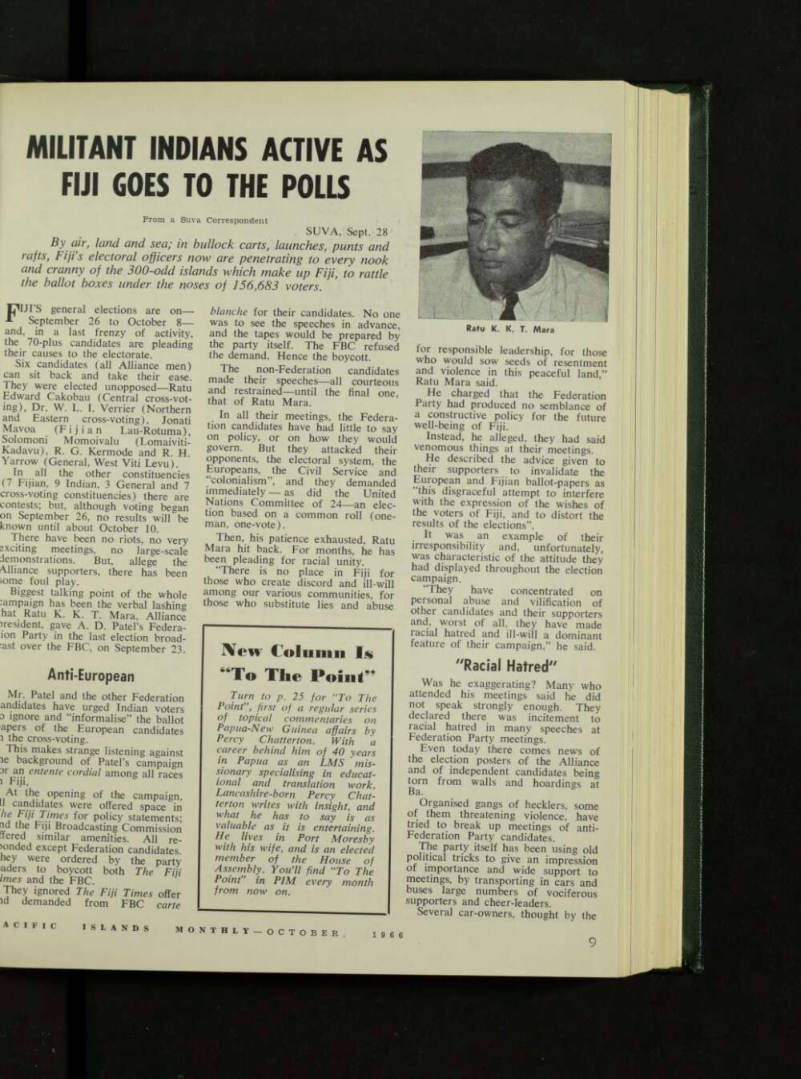
Ratu K. K. T. Mara
Federation to be their well-wishers, have been asked to bring their cars to meetings. When one pointed out that the meeting was only a few yards from his house, he was told: “Yes, but we want to get as many cars at the meeting as we can. It adds to the importance”.
The Government allowed a wide interpretation of the definition of “postal voter”. An elector who thought he would be more than 10 miles from the polling station on election day could have a postal vote.
Some candidates jumped at this, and at the electoral offices organised queues of people who said they would be many miles from home on polling day.
Some candidates, also, are “wit nessing officers”, who may help a voter to record his vote. It was noticed at Nausori, for instance, where more than 1,200 voters had been issued with postal ballot papers, that one Federation candidate, who was also a “witnessing officer”, was actively assisting his supporters. His opponents woke up to it, and they
also organised a similar service, and soon had large queues.
Then the Federation man suggested a compromise—that they should work together to render assistance to those who said they needed it.
The Fiji Times then pointed out the danger of allowing candidates to be “witnessing officers” in this way.
The Government replied that it didn’t think there was any danger— the officials were sure the candidates were too jolly decent to do anything unethical like that —or words to that effect.
Federation Prediction
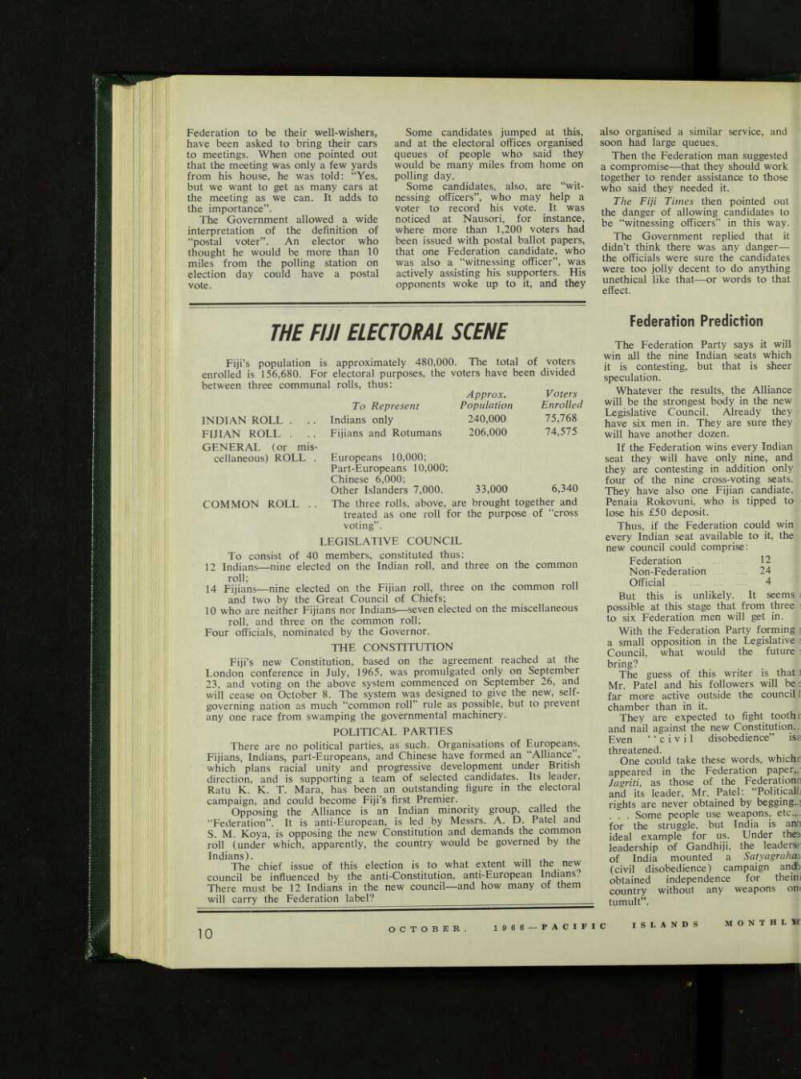
The Federation Party says it will win all the nine Indian seats which it is contesting, but that is sheer speculation.
Whatever the results, the Alliance will be the strongest body in the new Legislative Council. Already they have six men in. They are sure they will have another dozen.
If the Federation wins every Indian seat they will have only nine, and they are contesting in addition only four of the nine cross-voting seats.
They have also one Fijian candiate, Penaia Rokovuni, who is tipped to lose his £5O deposit.
Thus, if the Federation could win every Indian seat available to it, the new council could comprise; Federation 12 Non-Federation 24 Official 4 But this is unlikely. It seems possible at this stage that from three to six Federation men will get in.
With the Federation Party forming a small opposition in the Legislative Council, what would the future bring?
The guess of this writer is that Mr. Patel and his followers will be far more active outside the council chamber than in it.
They are expected to fight tooth and nail against the new Constitution.
Even “c i v i l disobedience” is threatened.
One could take these words, which appeared in the Federation paper, Jagriti, as those of the Federationn and its leader, Mr. Patel; “Political rights are never obtained by begging. . . Some people use weapons, etc... for the struggle, but India is an ideal example for us. Under the leadership of Gandhiji, the leaders of India mounted a Satyagraha (civil disobedience) campaign and obtained independence for their country without any weapons or tumult”.