Development
pp. 139-143 · Read in the full issue

Business and
Fiji Puts Pressure On
Australia For A Loan
By a Staff Writer
Shortly before Britain’s Secretary of State for the Colonies, Mr. Frederick Lee, was in Canberra in August, suggesting to Australia that it do more to help British interests in the Pacific, Fiji’s Financial Secretary, Mr. H. P. Ritchie, paid a visit to Canberra to propose the same thing.
MR. RITCHIE, however, had a specific request—that Australia grant Fiji a government-to-govern ment loan (with the usual interest) to cover an embarrassing financial gap in the colony’s new five-year plan.
The plan started in January and calls for a total expenditure of £F20.5 million over the next five years.
Fiji hopes to fund it with £3.6 million from local revenue over the period, £5.5 million from new loan raising, £7.7 million from CWD funds—leaving a gap of something like £3.65 million to be raised. This is where Australia comes in.
If Australia won’t come up with the money then it will probably mean a more expensive exchequer loan from Britain.
But Mr. Ritchie is “hopeful”, especially as Fiji got Britain to put in a word for her in Canberra be fore Mr. Ritchie arrived.
One of the difficulties is that Aus tralia hasn’t been offering govern ment-to-government loans to any body and new ideas naturally are hard to sell in Canberra.
While Mr. Ritchie was in Aus tralia he also arranged for a Mel bourne firm of stockbrokers to under write, as usual, the annual Fiji loan to be launched in September.
At a news conference Mr. Ritchie went to some pains to correct the general misapprehension in Australia that loan money comes from Aus tralia.
It doesn’t, he said. The Sep tember loan would be Fiji’s ninth since 1957, and only the first two or three had had Australian money in them—money that was in Fiji anyhow.
The Fiji loans are filled by banks, life-assuring societies, the Fiji Development Fund, and such organi sations as the Tonga Copra Board.
The September one will have, for the first time, three maturity dates— -6-7 years, 12-15 years and 17-20 years.
Radio Broadcast
Not long after Mr. Ritchie’s departure, and before the arrival of Mr. Lee in Canberra, PlM’s editor, Stuart Inder, commented on the situation in a national radio broad cast over the Australian Broadcasting Commission.
“Fiji in recent years,” Inder said, “has made constant requests to Aus tralia for help of various sorts, without any significant result, and Australia’s handling of the latest
request, especially at this particular time, with a vital election to be held next month in Fiji, is going to be watched very closely.
“It seems to many people in Fiji that we Australians are not un sympathetic to Fiji’s constant requests, so much as reluctant to give them proper consideration because of our preoccupation with New Guinea and South-East Asia.
“Mr. Ritchie told a news con ference in Suva the other day, after returning from Canberra, that he thought the Australian Government really was beginning to take more interest in Fiji, and that he was hopeful that something at last would come from the latest approaches.
“Australian business interests have always done very well in Fiji—the largest and most prosperous of busi nesses in the colony are Australian.
Yet there is a big imbalance of trade which has been an irritation for many years.
“Last year Australia sold to Fiji
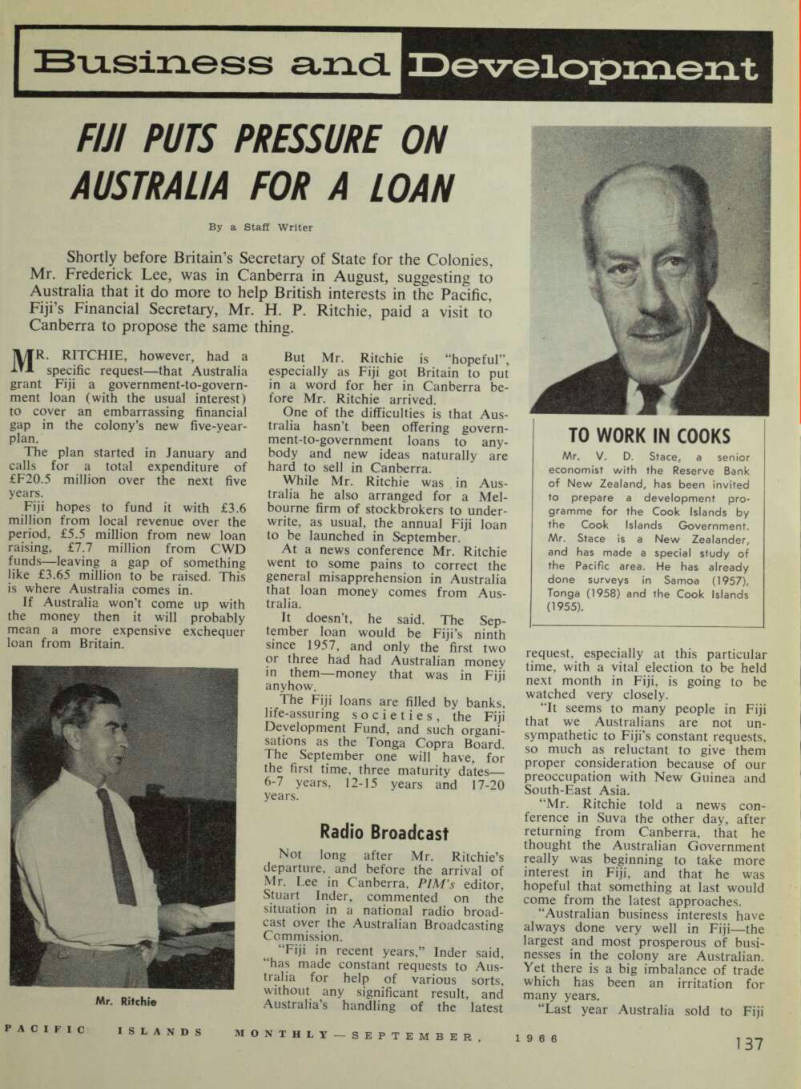
Mr. Ritchie
four times what it bought, and what it did buy was largely in the form of gold from the Australianestablished mines.
“There is also some Fiji irritation over the fact that Fiji gives Australia greater tariff concessions than Australia gives to Fiji. Attempts to alter this situation, so that Fiji may export to Australia goods that will help her economy and yet not damage Australia’s, haven’t met with any suecess , “In my view, Fiji Government leaders have been most patient and fairminded in pressing the colony’s claims upon Australia in recent years, and there are times when they
must have been at screaming point with frustration, “I’ve met these leaders as they have come and gone—cap in hand, as it were—attempting once again to sell the message that Fiji’s 500,000 people have economic problems that will be serious for Australia and for Austra lian investment if the colony can’t solve them.
“The colony has been working hard to solve them, but it can’t do the job without some help.
“The Fiji Government view is that help is needed before the colony gets into real trouble—not as a rescue operation afterwards, “What disturbs many observers,
me included, is how long Australia can afford to postpone real considera tion of Fiji’s problems before a change in the political situation in the colony makes it impossible for us to repair our broken image, “The new Fiji Legislative Council will have, for the first time, a majority of elected members, and no doubt we are going to get some plain speaking by Fiji politicians on Australia’s responsibility in this part of the world.
Australia is looked to for leader ship by the emerging territories of the South Seas, and the time is overdue for us to stop um-ing and ah-ing and to pitch in and lend a hand.”
US Oil Interests
In New Guinea
AMERICAN interests are seeking to expand oil operations in New Guinea.
Continental Oil Corporation of America, already exploring for oil at Lae, Madang, Central and West Papua, has made an application for a permit to extend its search to New Ireland and New Britain.
The company has specified an area of 10,000 square miles in its ap plication. The area covers the north ern half of New Ireland, the south and west coasts of New Britain and part of the northern end of the island.
The P-NG Petroleum Board is con sidering the application.
Slight Decline
In Copra Prices
PRESSURE from nearby supplies of Indonesian copra resulted in a slight decline in price for Philip pine FM copra during August.
Reporting this, Mr. lan McDonald, chairman of the P-NG Copra Marketing Board, said in Port Moresby on August 23: “The Philippine market has been ranging fairly steadily around £Stg.66/7/6 per ton this month, which has been slightly disappointing as the month opened at £Stg.67/15/per ton.
“Soyabeans, despite the fact of the growing price disparity in price relationships with other oilseeds, are still exercising the greatest influence on the market and as soyabean prices, c.i.f. Europe, have been declining somewhat over the last few weeks the rest of the market appears to have followed the same line.
“With the competitive position of soyabean oil somewhat unfavourable
at present the demand for more favourably priced competitive pro ducts such as the lauric oils, sun flower oil and groundnut oil should increase with prices at least holding firm, if not showing an increase.”
The P-NG Copra Marketing Board’s final price distribution for copra deliveries in 1965 will be more than 53.7 million or $32.90 per ton.
This will give producers a total price for 1965 copra of $175.90 for hot air copra, $172,90 for FMS copra and $170.90 for smoked copra.
New Fishing Industry
For Norfolk Island
THE Norfolk Island Council in July approved the establishment of a new fishing industry for the island.
The principals are two Sydney busi ness men, Mr. L. A. Semple and Mr.
R. Davis, who submitted their plans to the previous council in April.
The site then proposed for the fishing factory was on Crown land west of the Kingston Pier. Since then a site at Cascade has been considered, and it is understood that the area now favoured is the Cockpit, not far from the Cascade Pier. The factory is expected to cost about $24,000.
The Council has approved a quota of 400,000 lb of fish a year.
A large freezer will be installed, and surplus vegetables grown on the island will be processed for local consumption. The waste-products from the fish factory will be con verted into fertiliser which will be sold to the Islanders at wholesale rates. No nets or traps will be used in catching the fish—Council having limited fishing methods to hand-lines.
The labour force will be confined to local fishermen.
First Highlands Tea
Fetches Good Price
T*HE first commercially-grown tea to be shipped to London from the Western Highlands of New Guinea has been assayed at 58d Sterling a pound.
This was 16d more than the aver age price paid on the London market sarly in August.
The tea was grown in the Wahgi Valley by Kurumul Plantations Pty.
Ltd., a subsidiary of F. W. Williams Holdings Ltd., of Sydney.
It was processed in the company’s factory at Banz.
Mr, R, G. Bradshaw, of the London issayers, Wilson Smithett and Co., de
scribed the tea as “most impressive in quality”. It could be most closely compared with Kenya tea.
Mr. Bradshaw made an on-the-spot inspection of the young New Guinea tea industry in March.
Details Of Samoan
Timber Deal
NEGOTIATIONS on a deal that could have tremendous impact on Western Samoa’s economic development are nearing the final stages.
Executives of Potlatch Forests Inc., the third largest timber producer in the United States, are to have in formal discussions with the Samoan Parliament when they visit Apia in mid-October.
This will climax 18 months of investigation by Potlatch into the potential of the Samoan timber industry, and could lead to the investment by Potlatch of some SUSB milion on the island of Savaii over the next five years, PlM’s Apia correspondent R. F. Rankin reported in August.
Final proposals by Potlatch for discussion in October were made public in Apia in mid-August.
Plans envisage the setting up of a Forest Service, headed by a Director of Forests, and a high level inden pendent Land Use Board. The board would be responsible for the con trol, management and exploitation of all forest land through the Forest
Service. In this way, Potlatch, and any other timber firm, would deal with a Government body instead of with individual land-holders, thus avoiding the endless complications which would arise out of the tradi tional system of land tenure.
Potlatch states that it believes “Western Samoa’s timber resources are sufficient to justify a major ex penditure in plant and equipment, if mutually satisfactory conditions can be arranged”.
Potlatch wants: • The granting by the Government of Western Samoa of sufficient leases on timber lands to assure permanent operation. Leases of a minimum of 20 years with right of renewal would have to assure log supplies necessary to operate a mill of eventual capacity of 50 million board feet per year. • The granting by the government of adequate leases on property at seaports sufficient to cover plant needs as well as for neces sary and auxiliary needs of the operation. • Concessions permitting full use of the harbour facilities to be con structed for export purposes. (In this connection, as the largest user of the almost completed wharf at Asau, Potlatch has offered to consider a contract to manage the port facility). • Incentives such as those recently established by Parliament to encourage industrial develop ment. These include income tax moratorium; customs duty exemp
tion on plant, equipment and supplies necessary to operate a major milling plant; rights of repatriation of capital and profits with necessary foreign exchange privileges; freedom of entry and residence for overseas employees; and tax credits for reinvestment of earnings within the country.
In return Potlatch would agree to: O Prepare and make available to the government a detailed plan for forest management and utilisation based on sustained yield scien tific management, • Establish a programme for train ing Samoan personnel. • Enter into a basic timber con cession agreement of sufficient volume and length of time to support an eventual operation on the island of Savaii using 50 mil lion board feet of logs per year. • Establish an initial installation in Asau of a sawmill and logging facilities costing an estimated SUS2.S million with an expansion programme over the next few years at an estimated cost of from $4 million to $6 million additional, • In co-operation with Public Works Department develop power and water supplies for a proposed new city of Asau. • Develop a roading system in Savaii at an estimated cost of over 52.5 million.
Heavy Samoan
Demand For Loans
SINCE April, when New Zealand announced grants and loans total ling £lOO,OOO to be used for planta tion restoration following the hurri cane of January 29, more than 1,000 planters have applied to the Bank of Western Samoa for loans totalling £1 million.
The supervisor of the bank’s develop ment department, Mr. D. Phineas, said in August: “The applications, which have come from individual planters and village groups, include many feasible and ambitious schemes, but the bank does not have enough money to provide anywhere near enough of the finance needed.
“I believe that if the bank had £1 million available for agricultural de velopment loans, it could be profit ably used.”
The £lOO,OOO from New Zealand is restricted to rehabilitation projects; and the Development Branch is still struggling along with an insignificant capital of £lO,OOO.
There is a growing demand among the public and politicians that another
bank should be invited to set up busi ness in Western Samoa.
At the moment, the only one is the bank of Western Samoa owned by by the Bank of New Zealand (55 per cent.) and the Government of Western Samoa (45 per cent.).
Talks On New NG
Cargo Ship Link
NEWS reports in New Guinea and Australia in August linking the Bougainville Trading Company with proposals to start a new cargo ship ping link “as a challenge to the Burns Philp domination of the Aus tralia-New Guinea shipping trade”, seem to have caused some embar rassment in the Bougainville Com pany.
The company is not one of the promoters of the new plan, and its board has not discussed it.
Promoters include the Townsville Chamber of Commerce and other development organisations in Towns ville. They have been conducting a survey to see what support could be got for a monthly shipping service between P-NG and Northern Queensland, at freight rates cheaper than those being charged by Burns Philp between Australia and the ter ritory. They believe many products could be shipped to New Guinea more cheaply from Queensland than from the southern States, particularly produce.
There seems no doubt that there would be good support for such a service provided it could be done economically and cargo guaranteed.
Inquiries made by the promoters in Papua-New Guinea have shown this.
The Bougainville Company, which now operates three inter-island ships between Bougainville and Rabaul, was approached by the promoters during their inquiries, but the Bougainville board of directors, by late August, had not received or discussed any report on these talks and apparently were in the dark as to what they meant.
The company is currently looking for one new shipping run, and its present plans are to extend from Rabaul to Port Moresby, via Lae.
Lower Profit Likely
T»Ali Plantations Ltd. Ex
** pects the results for the last financial year to be lower than those for 1964-65, but reasonably satisfac tory in the circumstances.
The directors report that dry weather resulted in lower production of copra and cocoa for the half year to February 28.