Cruising Yachts
pp. 99-110 · Read in the full issue
Pacific Shipping And
Containerisation-It's On
The Way For The Pacific
Plans to establish containerisation (the ugliest word ever coined?) on the major shipping routes of the world are now well under way in the United Kingdom, Europe, Japan and North America. But shipping authorities say that, on a large scale, it is still a fair way off for the Pacific Islands, although it will eventually come. There is a limited service now.
CONTAINERISATION is a revolu tionary way of handling cargoes.
In its simplest form it means pack ing goods into a container, sealing the container, and transporting it to its destination.
Containers may be made of light gauge steel, aluminium, fibre glass or 5 or 7-ply timber with steel rein forcing.
The containers that are made of aluminum have steel corner posts and fittings. Preferably they are lined with plywood and have a timber floor.
Refrigerated containers have their own machinery attached. All that is necessary is to plug a lead into a power system. Cost of a 20 ft x 8 ft
x 8 ft container would be about $2,000 and double that for a refrigerated one. Two of these con tainers can be fitted together to make a 40 ft-long load for road transport.
In their ultimate form they have been described by a leading United States authority, Mr. Keith W.
Tantlinger, as “being used as mobile warehouses at the end of assembly lines to prevent the necessity of transferring the assembled com modity into a warehouse, and then being rehandled into other forms of transport vehicles. The contents of these mobile warehouses can be dis charged directly into the user’s facility at the exact point of use”.
Ideally, containerisation gives optimum results by the marriage of two or more transport services, rail, road, air or sea.
Too Expensive
The Pacific Islands in the present state of their economies cannot hope for the early establishment of large scale containerised services, similar to those which will operate elsewhere.
No Pacific Islands port has the facilities required for such a service, and no Pacific Islands government or administration has the money to provide them.
Apart from such essentials as huge marshalling areas and fleets of big trucks, better wharf facilities than most Pacific ports offer, are needed.
These facilities include adequate storage space and, if possible, cranes capable of lifting the containers.
When containerisation does come to the Pacific Islands, it will be on a small scale, with a number of
modifications compared with con tainer services in metropolitan countries.
Australian firms which operate shipping services to the Islands have been looking closely at the subject.
One or two other lines which service the Islands already have limited container services, while others are considering a start with wooden pallets.
Advantages
Some of the advantages of con tainerisation are: • Ships spend less time in port loading and unloading, so wharfage charges are reduced. • Insurance charges are reduced
because of the smaller likelihood of damage to cargo and pilferage. • Stevedore handling charges are reduced. • Less handling of cargo between consignor and consignee. • Less documentation of cargo.
All these advantages mean money saved, so that goods should eventu ally reach consumers at lower prices.
In Australia, work has already started on building berths to cater for specially-built container ships, the first of which is expected to arrive in 1968.
The cost of such berths would be well beyond the resources of most Islands group. For example, the special crane required to unload a container 20 ft by 8 ft by 8 ft costs 5A500,000.
Such cranes can load or unload a container every three or four minutes, and 20,000 tons of cargo in 24 hours or less.
At this stage the Pacific Islands could expect only small containers, carrying three to five tons of cargo, which could easily be handled by most ships’ cranes, and off loaded on to suitable trucks.
South Seas Situation
A PIM survey in Sydney in August of shipping companies which operate services in the Pacific showed that: CSR Co. Ltd., which operates the Rona between Australia and Fiji, is thinking about containerisation. The Rona’s derricks are capable of lifting containers and depositing them on wharves or trucks.
Messageries Maritimes has ordered seven small containers which may be carried in the Polynesie between Aus tralia and Noumea, Vila and Santo.
Present plans are to use them for valuable cargo to reduce pilferage.
P. and O-Orient have no immediate plans to carry containerised cargo in the Pacific.
Burns Philp, on the other hand, is investigating the possibility of carrying such cargo when storage space and wharf space facilities are improved in Papua-New Guinea and other Islands ports. Burns Philp operate services to P-NG and the BSIP with the Malekula, Bulolo, Moresby, Montoro, Braeside and Tulagi.
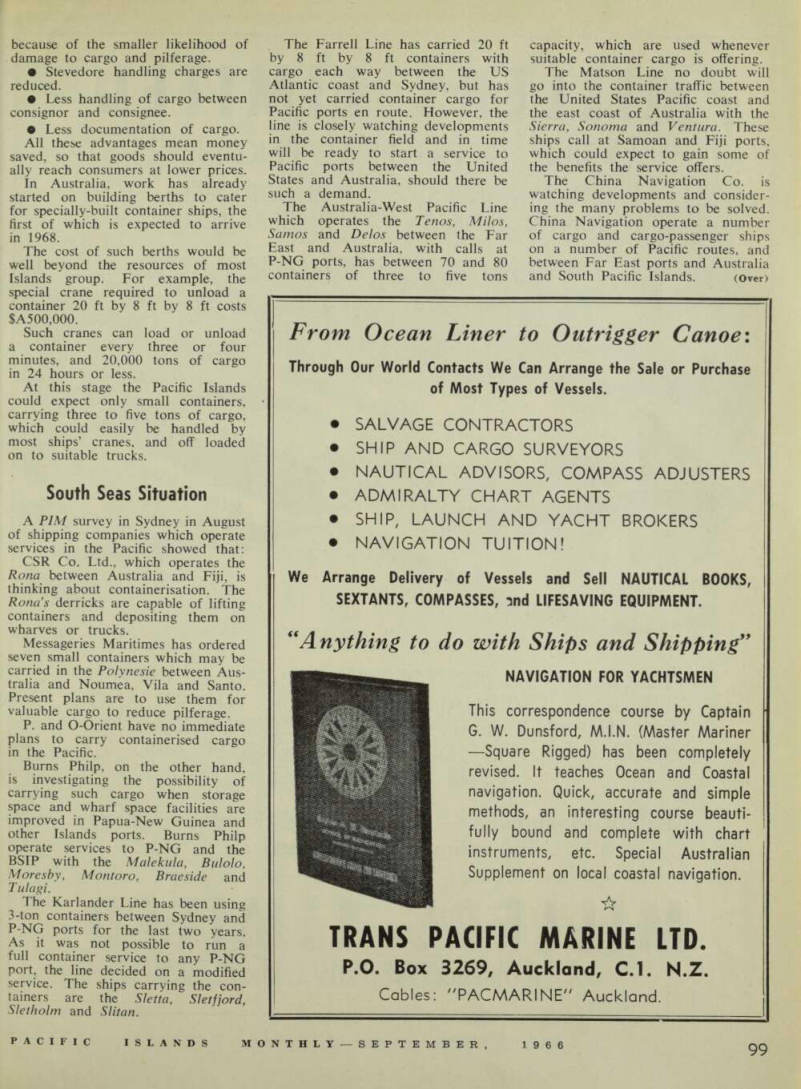
The Karlander Line has been using 3-ton containers between Sydney and P-NG ports for the last two years.
As it was not possible to run a full container service to any P-NG port, the line decided on a modified service. The ships carrying the con tainers are the Sletta, Sletfjord, Sletholm and Slitan.
The Farrell Line has carried 20 ft by 8 ft by 8 ft containers with cargo each way between the US Atlantic coast and Sydney, but has not yet carried container cargo for Pacific ports en route. However, the line is closely watching developments in the container field and in time will be ready to start a service to Pacific ports between the United States and Australia, should there be such a demand.
The Australia-West Pacific Line which operates the Tenos, Milos, Samos and Delos between the Far East and Australia, with calls at P-NG ports, has between 70 and 80 containers of three to five tons
capacity, which are used whenever suitable container cargo is offering.
The Matson Line no doubt will go into the container traffic between the United States Pacific coast and the east coast of Australia with the Sierra, Sonoma and Ventura. These ships call at Samoan and Fiji ports, which could expect to gain some of the benefits the service offers.
The China Navigation Co. is watching developments and consider ing the many problems to be solved.
China Navigation operate a number of cargo and cargo-passenger ships on a number of Pacific routes, and between Far East ports and Australia and South Pacific Islands. (Over)
The Austasia Line, whose ships call at New Guinea ports, has made no decision about containerisation.
The Dutch line, Royal Interocean, will not use containers in the Pacific for the time being, but is going into the container traffic in Europe.
The Union Steam Ship Co., which operates between New Zealand and Tonga, Western Samoa and Fiji, is understood to be making prepara tions for containerisation.
The company operates the Matua (to be replaced soon) and the Tofua from New Zealand to Fiji, Tonga, Niue and Samoa, and return. Other USS Co. services in the Pacific are operated with the Waimate, from Sydney to Fiji, Samoa and Tonga, and the Moana Roa (for the NZ Government) from Auckland to the Cook Islands.
Much of the cargo carried by these ships is perishable, and would require special containers—mesh con tainers for the carriage of bananas, for example.
Direct Service From
Uk To Rarotonga
The Shaw Savill ship Persic was due in Rarotonga on August 15 from the United Kingdom with a consign ment of tin plate for the Islands Foods factory and other cargoes.
The Persic’s voyage is the first direct one between the UK and Raro tonga for many years, apart from that of the Government-owned ship Moana Roa on her maiden voyage in 1960.
Three New Ships For
Gilbert And Ellice Islands
The GEIC Resident Commissioner, Mr. V. J. Andersen, has approved names for three new vessels which are expected to join the Colony fleet late this year or early 1967. The names are Tabuariki, Tautunu and Te Ebaeba.
The Gilbert Islands District touring vessel will be named Tabuariki , after the ancient Gilbertese god of thunder and lightning. Tautunu, the son of the sun and a great fisherman in Ellice Islands mythology, will be the name for the Ellice Islands District touring vessel.
Te Ebaeba will be the name of a landing craft, which will be used for cargo in Tarawa lagoon and for transporting heavy equipment for
development work in the outer islands.
The name Te Ebaeba was widely used for landing barges in the Gilbert Islands during the Pacific War.
The craft is being built in the United Kingdom and is expected to arrive at Tarawa later this year.
The two new touring vessels are being built in Singapore.
New Guinea Trading
Ship Lost On Reef
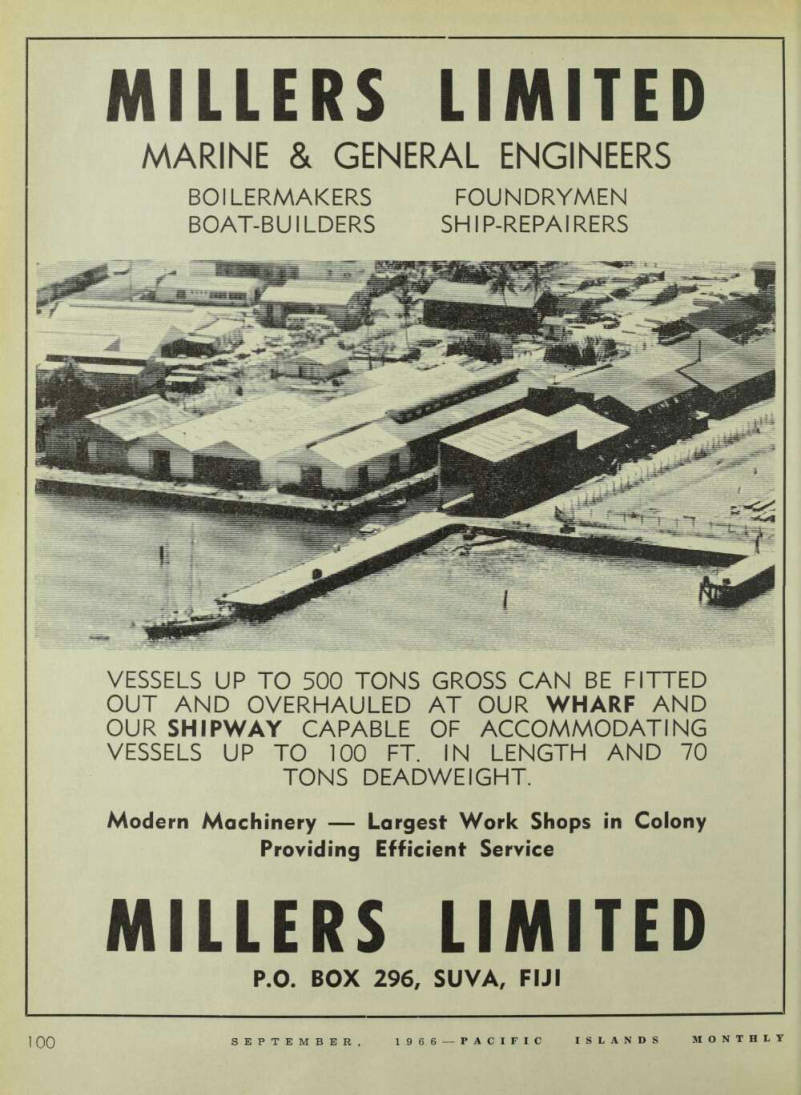
The 85 ft motor vessel Mainiro became a total loss after she struck a reef off Cape Metlik, New Ireland, on July 27. The ship was skippered by Captain Martin Kappu, and was carrying 10 passengers, including six small children.
A part-owner, Mr. Alan Tong, of Rabaul, said early in August that her cargo of cocoa and copra from plantations in New Ireland was also expected to be a total loss.
A passenger said in Rabaul that he woke up to find huge breakers rolling over the ship and the master calling out that the ship had struck a rock.
Captain Kappu rigged a searchlight and a rope, and with the help of two of the crew lowered himself over the bow to inspect the damage.
A huge wave carried the captain away, but he got a handhold on the rock and pulled himself out of the water.
He grabbed the rope again and climbed over the rock, lashed all the time by the waves, and used his life line to make a monkey bridge from a clump of trees on a cliff face to the Mainiro.
The passengers and crew, with the crew carrying the six children, made
One of the ships already using con tainers in the Pacific is the Karlander Line's "Sletholm", which carries 3-ton containers between Sydney and P-NG ports.
The ill-fated "Mainiro", which was lost off New Ireland in July (see this page).
their way through heavy surf along the rope to the cliff face and then down to the beach.
They stayed at a plantation for a week before a rescue boat was able to make its way through heavy seas to take them to Rabaul. No personal possessions were saved from the wreck.
An assessor’s party made an un successful attempt to board the Mainiro.
Formosan Master Fined
For Illegal Entry
The Formosan captain of the fish ing vessel Gin Shin Yik, which entered the Fead Islands illegally on July 15 (PIM, Aug., p. 107) was fined $lOO in the District Court at Sohano on August 2.
Captain Shar Tsu was fined $lOO on each of 11 counts of permitting members of the crew to land on the Feads, 100 miles north-east of Rabaul, NG.
In default of payment, the captain could go to gaol for four months.
The crew members have been gaoled for three weeks each.
The Stipendiary Magistrate, Mr.
Anthony Germaine, was flown to Sohano from Rabaul specially for the trial.
Japanese Fishing Master
For Tongan Ship
A Japanese fishing master for the Tongan fishing boat Pakeina was due to arrive in Nukualofa in August on a three-year contract. The boat ar rived in Suva in late July for slipping.
The Tongan Government hopes she will become the nucleus for a deep-sea fishing fleet.
The ship is commanded by Captain George Walkers, who has a crew of seven other Tongans, all previously trained as fishermen in Japanese ships.
The Pakeina will fish mainly for tuna for Tonga’s domestic market.
Any surplus catch will be exported.
She has a deep freeze capacity for 25 tons of fish and a normal range of about 2,000 miles.
The Pakeina is 74 feet long.
Two Mishaps Narrowly
Averted At Port Moresby
Two ships narrowly avoided crash ing into the wharf at Port Moresby early in August while the Harbour Master, Captain W. Gibson, was at the helm.
In one instance the ship’s telegraph failed to operate, and in the second the engine failed.
Captain Gibson, describing the incidents later, said he was piloting the Australasia, 10,800 tons, into the
outer berth when the ship failed to respond to a signal to reverse engines.
He immediately gave the order to drop the starboard anchor, which pulled the liner up 100 feet from the wharf.
An hour later Captain Gibson was piloting the Komei Maru, a 3,200ton Japanese freighter, into the inner berth when the engines failed.
As the ship headed straight for the access bridge between the wharf and cargo sheds, Captain Gibson dropped the port anchor, and then the starboard anchor as an added
precaution.
The Komei Maru was only 20 feet from the wharf as the anchors held.
Hope For Noumea
Port Improvements
Something may finally be done about the lamentable port situation in Noumea, according to a letter from the Secretary-General of the Administration addressed to the Chamber of Commerce.
The letter says a plan for improve ments has beeen sent to the Ministry of Overseas Territories, who will submit it to the European Develop ment Fund (six Common Market countries). It is hoped the plan will be financed by that organisation.
The main point of the plan is the construction of a berthing quay in deep water. The new quay would
be built at right angles to the present waterfront quay. It would provide berthing space for two 40,000-ton vessels with water depths of 33 ft.
Construction of such a quay would necessitate the acquisition of one or two powerful tugs to handle big vessels.
Completion of the plan would be of enormous benefit to Noumea.
Tourist ships would be able to berth in the middle harbour, instead of remaining anchored in the roadstead with consequent inconvenience for tourists going ashore.
Noumea newspapers have attacked the existing port situation for years, without much result until now.
Marshall Islands
Ship For Sale
The MIECO Queen, which belongs to the Marshall Islands Import- Export Co., arrived in Suva in July for overhaul, and has tentatively been offered for sale. The MIECO Queen, of 228 tons, is too small for the company’s work.
The company is looking for a ship of 800 to 1,200 tons as a re placement.
The MIECO Queen was built for the company in Hong Kong in 1956. In 1964 she underwent a refit in Japan, when her engine was re placed by a new 280 hp Yanmar motor.
Port Moresby Seamen
Seek Award
The Port Moresby Workers’ As sociation has submitted a log of claims to the Employers’ Federation on behalf of seamen on ships work ing out of Port Moresby.
At present there is no agreement regulating the terms and conditions of employment of Port Moresby seamen.
The log covers pay, annual and sick leave, notice of dismissal, the issue of bedding and other materials, first aid kits and refrigerators for crew men.
Another New Ship
For The New Hebrides
New Hebrides ship owner Captain Athol Rusden has bought the New Zealand coaster Holmbrae from the Holm Shipping Co. Ltd. of Welling ton.
Captain Rusden sent a crew of 11 to Auckland in his 48-ton trader Darnley early in August to man the new ship, which will carry copra, fuel and general cargo between the New Hebrides and Fiji.
Captain Rusden has renamed the ship Paulmarkson. This was the name he gave to a former Japanese
fishing boat, Asahi Maru No. 8, which he bought from a salvage syndicate in Fiji in 1964 and sold to Conzinc Rio Tinto last year at a handsome profit ( PIM , May, 1965, p. 107).
The Paulmarkson sailed from Auckland on August 7. The Darnley will remain there for about 2i months for an extensive refit.
Blasting Tests For
Channel At Asau
Royal New Zealand Navy divers recently carried out trials to blast a channel to a new wharf at Asau in Savaii, Western Samoa.
The wharf is nearly finished, but the channel is not deep enough for ships to get to it.
The channel is 4,000 ft long, and 200 ft wide. It may eventually be deepened to 40 ft.
The RNZN divers estimated that it would take about 10 months to blast the channel.
"Thorsisle" Withdrawn
From Pacific
The Pacific Islands Transport Line’s Thorsisle, which has been operating bulk cargo services in the Pacific for several years has been withdrawn and replaced by a bigger ship, the Thorsgaard.
The Thorsgaard was previously used on a service between Singapore and Australia.
The Thorsgaard and the Thor I maintain services from the west coast of North America to Papeete, Pago Pago. Apia, Suva, Lautoka, Noumea, occasionally New Guinea, and the Australian east coast.
The main cargo carried on the outward journeys from America is timber.
Progress On Bsip,
Tonga Wharves
Work is progressing on the con struction of two new South Seas wharves —at Tulagi, BSIP, and Nukualofa, Tonga.
Two hundred tons of sheet piles recently arrived in Tonga for the Queen Salote wharf at Nukualofa.
The piles, in 50 foot lengths, are to be driven along the face of the reef to eliminate the possibility of sections of the reef crumbling in bad weather. The piles to carry the wharf will be driven in front of these.
Dew and Co. of Oldham, England, are building the wharf.
Meanwhile, at Tulagi, work is nearing completion on 150 feet of the $BO,OOO wharf.
The final length of the wharf will be decided when it is determined how deep new steel piles on order from Japan will have to be driven.
When the new wharf is completed several vessels at a time will be able to berth. The present wharf is made of timber and is in a poor condition.
New Ireland Co-Operatives
To Buy $Loo,Ooo Ship
A New Ireland transport society, being formed by co-operatives, plans
Captain Rusden.
to buy a ship for $lOO,OOO to carry copra from outlying islands.
The directors have decided on a 100-ton trading ship, 70 ft long, with a 22 ft beam. Delivery is expected by February, 1967.
After delivery it will be equipped with bulk fuel tanks to supply fuel and kerosene to consumers round the New Ireland coast.
The directors consider the present commercial shipping services are un reliable, and have caused unnecessary losses.
New "Ajax" To Show
The Flag In Fiji
A Royal Navy warship bearing a famous name is expected to spend five days in Fiji in September on a showing-the-flag cruise. She is HMS Ajax, a general purpose frigate.
The latest Ajax was commissioned in 1962, and has a complement of about 200 officers and men.
Her predecessor, a cruiser, took part in the battle of the River Plate in December, 1939, when, with
HMNZS Achilles and HMS Exeter, she took on the German pocket battleship, Graf Spec.
Although the three British ships were outgunned they forced the Graf Spec into the river estuary, where she was scuttled.
Japanese Student
Fishermen In Suva
A visitor to Suva late in July was the Shonan Maru, a Japanese research and training ship, which had been at sea since May 16. She carried 50 students who were learning how to fish.
The students and crew caught between four and five sharks a day on their way to Fiji, and 90 tons of tuna.
The Shonan Maru, 399 tons, has a cruising speed of lOi knots and carries a crew of 24.
Societe Ie Nickel
Sells Ore Carrier
The New Caledonian nickel com pany, Societe le Nickel, has sold the ore carrier Tayo. The vessel left New Caledonia to return to France in late June. The crew of the Tayo is expected to go to Japan from France to take delivery of a new ore carrier of about 15,000 tons.
A second carrier is also on order from Japan and is to be delivered in 1967.
The Tayo was constructed in Britain. She took up service in New Caledonia in 1952, and until this year was constantly engaged in carrying nickel ore from the coastal mining sites to the smelters in Noumea.
Science To The Aid
Of Fishermen
The United States fishing research ship, Townsend Cromwell, left Hawaii recently carrying scientists and technicians who were to study newly-installed equipment designed to track sub-surface schools of tuna.
It was the second cruise the ship had made to the Pacific.
Scientists agree that one of the major tuna resources consists of skipjack tuna (aku) which are not caught by standard methods, and which probably cannot be located by surface signs.
On the first cruise observers worked primarily with surface aku schools as the chief purpose was to train them to recognise schools on the ship’s sonar equipment.
One aku school was located by sonar 150 ft beneath the ship and tracked for 56 minutes as it rose to the surface, sounded, rose, and sounded again.