through Indonesia
pp. 94-96 · Read in the full issue

And a thoughtful journey through Indonesia
Politically Maslyn Williams’ new book, Five Journeys from Jakarta, is already out of date. Fundamentally the book is probably of even more importance now, in this period of kiss-and-make-up, than when he wrote it.
Maslyn williams, by his public utterances, is anti-in volment-in-Vietnam. Perhaps, in the larger sphere, he is even a pacifist.
I don’t know. But he is certainly a Western-hands-off-Asia man. In his new book he says . . the West can achieve nothing in Asia and Africa unless it locks up its weapons and approaches the coloured world with love and justice.
“There is, for instance, no way for America to win the war in Viet nam (whatever the morality or the politics of the matter). There is simply no way for a Western power to win an Asian war except by be coming an occupying power—by con tinuing colonisation . . .”, etc.
Colonial Period a "Sin"
He does not apparently count Japan as Asian and there are plenty of people who would disagree with him on the love-justice-no-weapons approach. Moreover, he obviously believes that the colonial period everywhere was a sin in its own right and not, as historians 500 years from now might well class it, a phase of development. He seems over-in clined to allow the Indonesians to mesmerise him into the same frame of mind as themselves—that all their
troubles stem from 300 years of Dutch rule.
But even for those who might disagree with Mr. Williams pretty nearly all along the line on the above subjects, there is much to learn from this very excellent account of his several months in Indonesia. There is much also to entertain.
The author, a fastidious man and timid, according to himself, is determined to live “among the people” and, indeed, except in the international Hotel Indonesia in Djakarta (our spelling), there is virtually no other way to do it.
The bed-bugs, the squalor, the inefficiency, the waiting around for officialdom to put stamps on documents, the run-down state of public utilities, all hit him like a blow in the face and he reacts like any other Westerner. It all repels and horrifies him—just as he is ir ritated to the point of despair at the everlasting clap-trap of propa ganda.
Although, in a sense, he is an apologist for Asia and his desire is to be sympathetic to Indonesians in particular, he is always honest in his reactions whatever they might be.
His five journeys from Djakarta were to Sulawesi (which we still call Celebes); Bali; Sumatra; Java (out side Djakarta) and, finally, to West New Guinea (Irian).
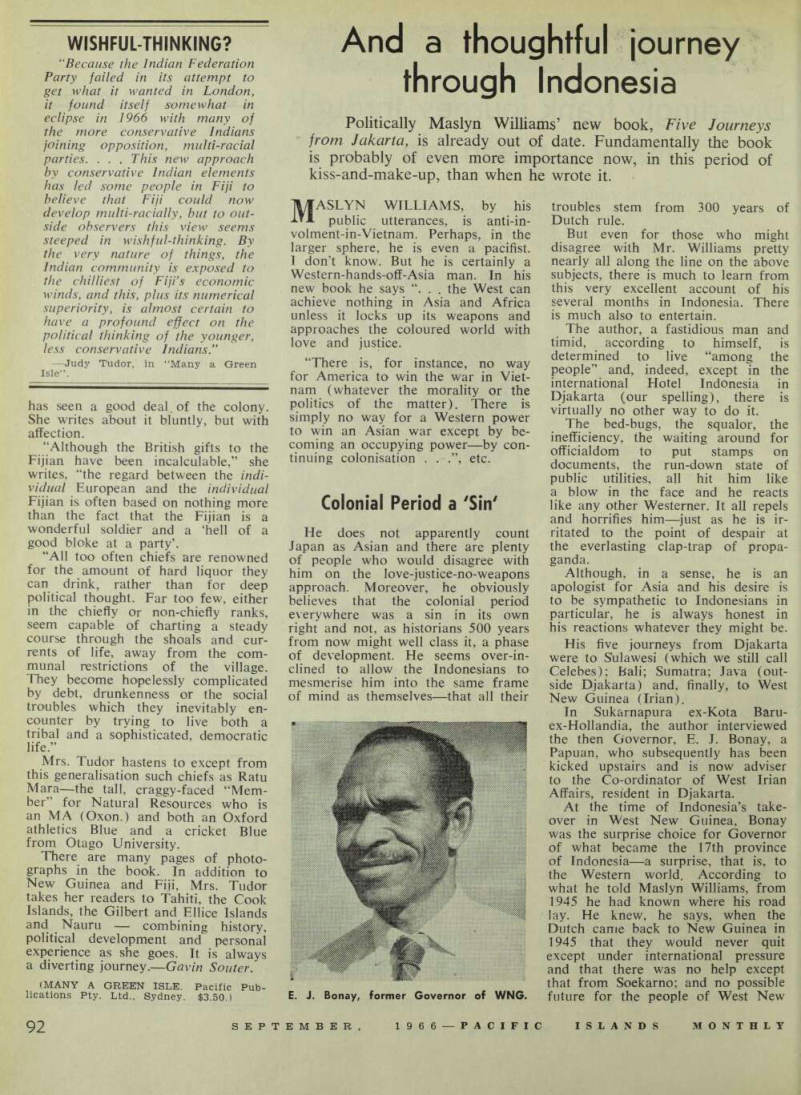
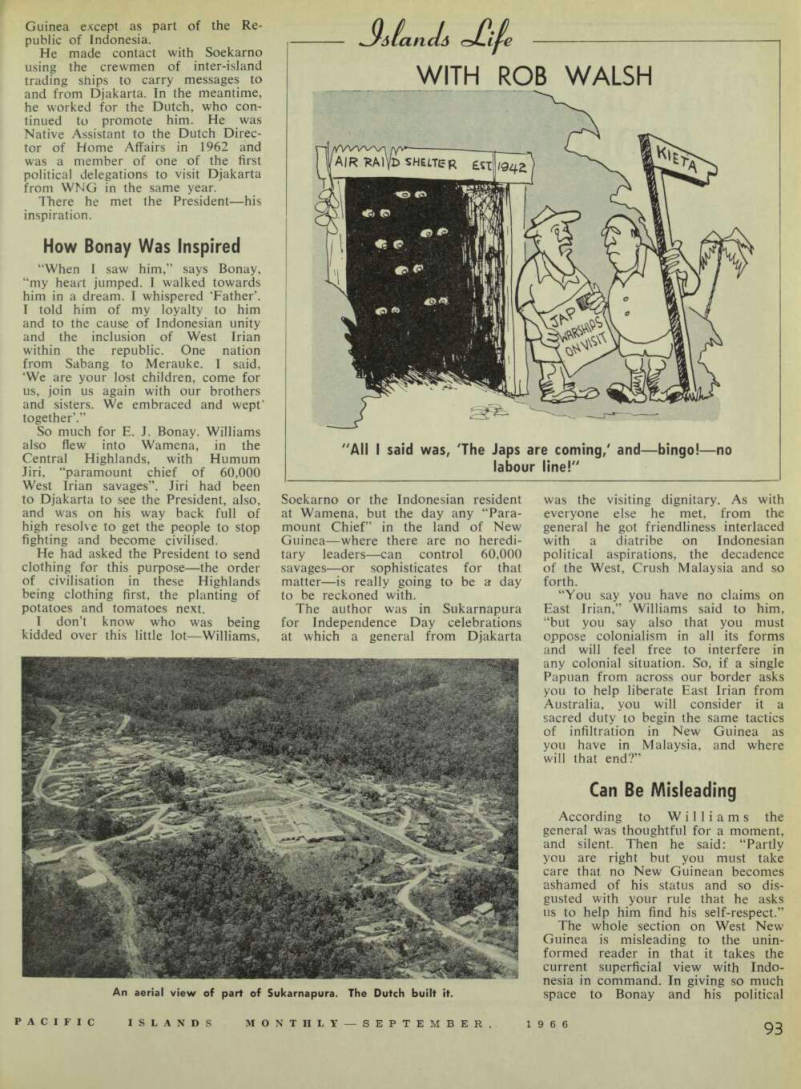
In Sukarnapura ex-Kota Baru ex-Hollandia, the author interviewed the then Governor, E. J. Bonay, a Papuan, who subsequently has been kicked upstairs and is now adviser to the Co-ordinator of West Irian Affairs, resident in Djakarta.
At the time of Indonesia’s take over in West New Guinea, Bonay was the surprise choice for Governor of what became the 17th province of Indonesia—a surprise, that is, to the Western world. According to what he told Maslyn Williams, from 1945 he had known where his road lay. He knew, he says, when the Dutch came back to New Guinea in 1945 that they would never quit except under international pressure and that there was no help except that from Soekarno; and no possible future for the people of West New
E. J. Bonay, former Governor of WNG.
Guinea except as part of the Re public of Indonesia.
He made contact with Soekarno using the crewmen of inter-island trading ships to carry messages to and from Djakarta. In the meantime, he worked for the Dutch, who con tinued to promote him. He was Native Assistant to the Dutch Direc tor of Home Affairs in 1962 and was a member of one of the first political delegations to visit Djakarta from WNG in the same year.
There he met the President—his inspiration.
How Bonay Was Inspired
“When I saw him,” says Bonay, “my heart jumped. I walked towards him in a dream. I whispered ‘Father’.
I told him of my loyalty to him and to the cause of Indonesian unity and the inclusion of West Irian within the republic. One nation from Sabang to Merauke. I said, ‘We are your lost children, come for us, join us again with our brothers and sisters. We embraced and wept' together’.”
So much for E. J. Bonay. Williams also flew into Wamena, in the Central Highlands, with Humum Jiri, “paramount chief of 60,000 West Irian savages”. Jiri had been to Djakarta to see the President, also, and was on his way back full of high resolve to get the people to stop fighting and become civilised.
He had asked the President to send clothing for this purpose—the order of civilisation in these Highlands being clothing first, the planting of potatoes and tomatoes next.
I don’t know who was being kidded over this little lot—Williams,
Soekarno or the Indonesian resident at Wamena, but the day any “Para mount Chief” in the land of New Guinea—where there are no heredi tary leaders—can control 60,000 savages—or sophisticates for that matter—is really going to be a day to be reckoned with.
The author was in Sukarnapura for Independence Day celebrations at which a general from Djakarta
was the visiting dignitary. As with everyone else he met, from the general he got friendliness interlaced with a diatribe on Indonesian political aspirations, the decadence of the West, Crush Malaysia and so forth.
“You say you have no claims on East Irian,” Williams said to him, “but you say also that you must oppose colonialism in all its forms and will feel free to interfere in any colonial situation. So, if a single Papuan from across our border asks you to help liberate East Irian from Australia, you will consider it a sacred duty to begin the same tactics of infiltration in New Guinea as you have in Malaysia, and where will that end?”
Can Be Misleading
According to Williams the general was thoughtful for a moment, and silent. Then he said: “Partly you are right but you must take care that no New Guinean becomes ashamed of his status and so dis gusted with your rule that he asks us to help him find his self-respect.”
The whole section on West New Guinea is misleading to the unin formed reader in that it takes the current superficial view with Indo nesia in command. In giving so much space to Bonay and his political
An aerial view of part of Sukarnapura. The Dutch built it.
background and thinking, the casual reader could scarcely escape the im pression that all West Papuans were pro-Indonesian before the Dutch were forced out.
This is far from the truth. The Bonays were in the minority, as Williams knows himself, and I think, in leaving his story in the way that he does, he does less than justice to the other Papuan nationalists who were extremely anti-Indonesian; and no justice at all to the Dutch whose motives were pretty far removed from those that come out of Bonay’s mouth.
However, West New Guinea is only a very small part of this story of a colourful, exasperating and interesting people whose shadow must be cast over the SW Pacific.
The book was written at the height of Indonesia’s Crush Malaysia hysteria—the Communist plot of September 30, 1965 is brought in only at the end of the book. It is, there fore, a very interesting exercise to read Williams’ story at this time, only short months afterwards, when Malaysia and Indonesia have made a peace pact, when Soekarno is pushed into the background and the Western world, with Australia to the fore, is trying to forgive and forget.
Which is the true Indonesia, readers will ask themselves?. And perhaps they will read again the passage in the book which describes an occasion when Soekarno makes an unexpected visit by helicopter into a small town where Williams happens to be. Accompanied by his beautiful second wife, the Bung gathers 10,000 worshipping people around him in minutes. He makes no political speeches, sets them to folk singing instead. It appears that he has just dropped in to inquire whether a few Chinese storekeepers who had had their premises ransacked in the course of one of the periodic campaigns against them, had been recompensed.
Maslyn Williams sometimes has a slightly mannered way of writing but he writes very well. He likes the people and sees their point of view, while at the same time being very much prone to the irritations of Western man at the irrational Asian.
Although one may not share his basic concepts of the Indonesian or the South East Asian situation, there is a great deal of thought-provoking material in his book; and finally, there is the pleasure of reading it for its prose alone—unusual in a
political-travel book.-
JT.
(Five Journeys Prom Djakarta.
Collins; $4.50).