A Closer Look
pp. 73-75 · Read in the full issue
At New Guinea's Primitive Hewas
From a Mt. Hagen Correspondent An Administration patrol which recently entered the last restricted area in the Western Highlands of New Guinea was forced to undergo a rather chilly experience on its first contact with the primitive people of the
region.
EACH member of the patrol was washed (all over!) by the local people, who used branches of a tree, dipped in the waters of the Lagaip River. This ritual was to ward off evil spirits and malaria in this “dangerous” country north of the river.
Although the Administration has been in touch with these primitive hill people—the Hewas—for the past 15 years, this was the first time a proper patrol had entered their country.
This “contact and influence” patrol, led by ADO Ross Henderson, left Porgera, in the Lagaip sub-district of the Western Highlands, on July 1.
The party entered Hewa country on July 7 by crossing the Lagaip River over a 90-yard cane suspension bridge from the Paiela area, south of the river.
Ritual Washing
This was a difficult operation, as most of the carriers were not water men and required considerable help with the crossing. After getting across, the patrol felt it somewhat ironic that they had to be ritually washed with the same dirty water they had tried hard not to fall into!
Up to the time of reporting, the party has contacted about 200 of the Hewa people, who live in sparse and widely scattered extended family groups. The reception of the govern ment party by these people has been, on the whole, friendly but wary.
This wary attitude is only natural, when it is considered that fighting is still prevalent among many groups.
This is evident in the construction of the houses, which are built on stilts at least 15 ft above the ground, and often up to 25 ft. The locals live on the top floor, which is loop holed to facilitate the firing of arrows
at would-be attackers. The bottom part of the construction, which is enclosed, houses the family livestock.
On the centre post inside the living quarters the Hewa people hang a skull decorated in yellow and black, surrounded by the bones of pig, cassowary and other game. The skull is that of an ancestor revered for his hunting skill, and its function is to ensure good hunting for his descendants.
The Hewas seem to have a well balanced diet. In addition to the plentiful supply of game, each group has about three gardens in various stages of development. These gardens produce sweet potato, taro, bananas and sugar-cane.
As a result of the friendly relations established with the local people, the patrol has so far been able to buy enough food for one meal a day. The rest of the patrol’s supplies have had to be airdropped from a Cessna aircraft. There has been an approximate 75 per cent, recovery, which is good in this rug ged country.
Amazed By Helicopter
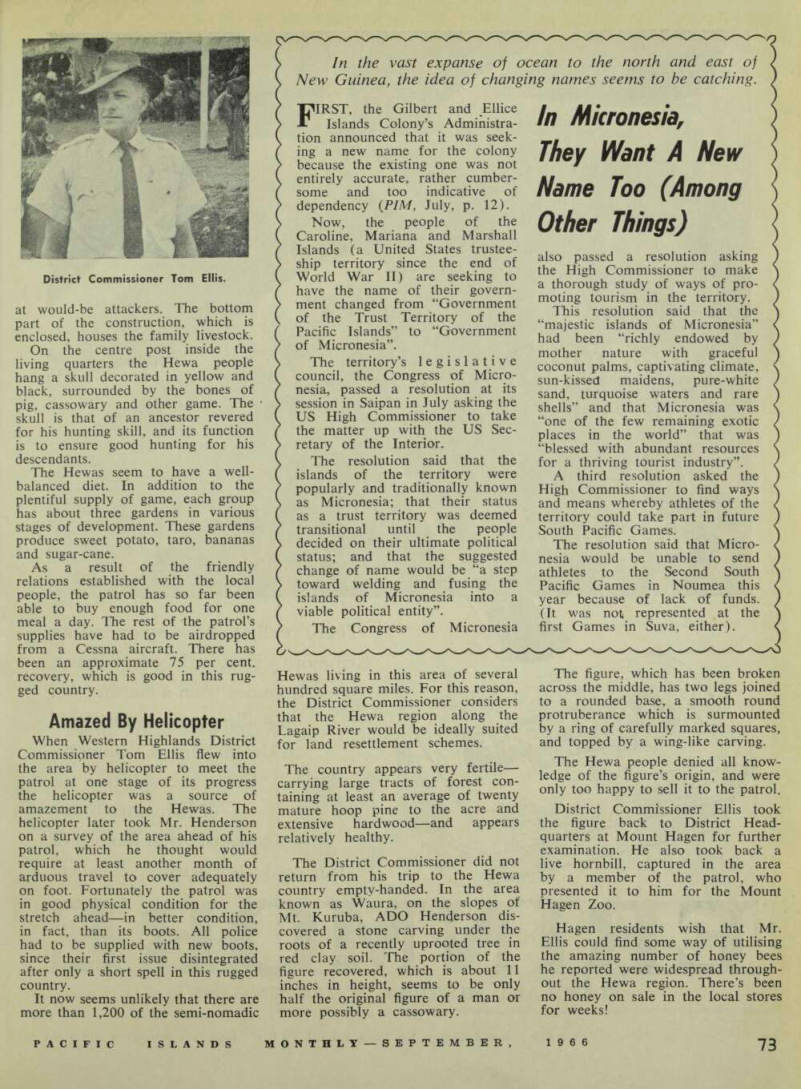
When Western Highlands District Commissioner Tom Ellis flew into the area by helicopter to meet the patrol at one stage of its progress the helicopter was a source of amazement to the Hewas. The helicopter later took Mr. Henderson on a survey of the area ahead of his patrol, which he thought would require at least another month of arduous travel to cover adequately on foot. Fortunately the patrol was in good physical condition for the stretch ahead—in better condition, in fact, than its boots. All police had to be supplied with new boots, since their first issue disintegrated after only a short spell in this rugged country.
It now seems unlikely that there are more than 1,200 of the semi-nomadic
Hewas living in this area of several hundred square miles. For this reason, the District Commissioner considers that the Hewa region along the Lagaip River would be ideally suited for land resettlement schemes.
The country appears very fertile— carrying large tracts of forest con taining at least an average of twenty mature hoop pine to the acre and extensive hardwood—and appears relatively healthy.
The District Commissioner did not return from his trip to the Hewa country empty-handed. In the area known as Waura, on the slopes of Mt. Kuruba, ADO Henderson dis covered a stone carving under the roots of a recently uprooted tree in red clay soil. The portion of the figure recovered, which is about 11 inches in height, seems to be only half the original figure of a man or more possibly a cassowary.
The figure, which has been broken across the middle, has two legs joined to a rounded base, a smooth round protruberance which is surmounted by a ring of carefully marked squares, and topped by a wing-like carving.
The Hewa people denied all know ledge of the figure’s origin, and were only too happy to sell it to the patrol.
District Commissioner Ellis took the figure back to District Head quarters at Mount Hagen for further examination. He also took back a live hornbill, captured in the area by a member of the patrol, who presented it to him for the Mount Hagen Zoo.
Hagen residents wish that Mr.
Ellis could find some way of utilising the amazing number of honey bees he reported were widespread through out the Hewa region. There’s been no honey on sale in the local stores for weeks!
District Commissioner Tom Ellis.