Winds Of Change Blow
pp. 69-71 · Read in the full issue
"The Taro Law Hinders A
Man's Freedom Of Thought"
Across Little Niue
From a Niue Correspondent Most mornings on Niue, except Sundays of course, people in the island’s main town of Alofi are awakened around dawn by the roar of outboard motors echoing off the cliffs of the steep island. These outboard motors are attached to canoes or boats and some people complain because they are so noisy.
But the sight of a speeding outrigger canoe driven by an out board motor is a symbol of the changes in life that have occurred on Niue Island in recent years.
THE petrol engine is everywhere, so much so that a bulk storage depot, is being built to hold enough fuel for all the trucks, cars, motor cycles and outboards on the island.
There are so many cars on the island now that on Fridays it’s hard to find a place to park a car close to the stores in Alofi, Comparatively speaking, of course!
There are still just as many bicycles, for Niue is famous for its bikes. But trucks now bring Public Works labourers to work from the villages, many ride their own motor cycles, and senior public servants who have been doing training courses in New Zealand have invariably brought back a second-hand car with them, and they drive proudly to work.
No Parking!
Buses pound ponderously down the roads; there are speed limit signs— even “no parking” signs—and there is talk of sealing the dusty coral roads!
There are other changes, too, on this tiny island that Captain Cook discovered. There’s more and more mail on “boat days”.
At one time, just a few short years ago, all the letters and newspapers were sorted for delivery the morning the monthly ship arrived and all the parcels were sorted in the afternoon.
Nowadays we are lucky to get our letters before the ship departs in the late afternoon and parcels take two days to sort because there are so many of them.
Many of the changes have hardly been noticed. Government offices are staying open during the lunch hours now to cater for people who can’t get in at any other time. A few years ago everything closed firmly for
the lunch hour. Housing has changed, mainly as the result of the 1959 and 1960 hurricanes. There are hardly any punga walled houses with rusty corrugated iron roofs left standing, they are all new neat concrete and fibrous cement buildings.
At one time, everybody in the European community knew everybody else, and on the monthly boat day a new arrival met just about everybody else. But now it’s not uncommon, weeks after the boat, to see a strange white face on the island, and wonder who he is.
There are two children’s play centres, an expanded public library, a film society.
It’s possible to buy fresh meat in the stores, whereas only a few years ago, unless you ordered it specially from New Zealand, you lived on bully beef. Sales of tinned butter have slumped because you can now buy fresh butter without having to order it.
The Niuean people look better dressed than they used to be, probably
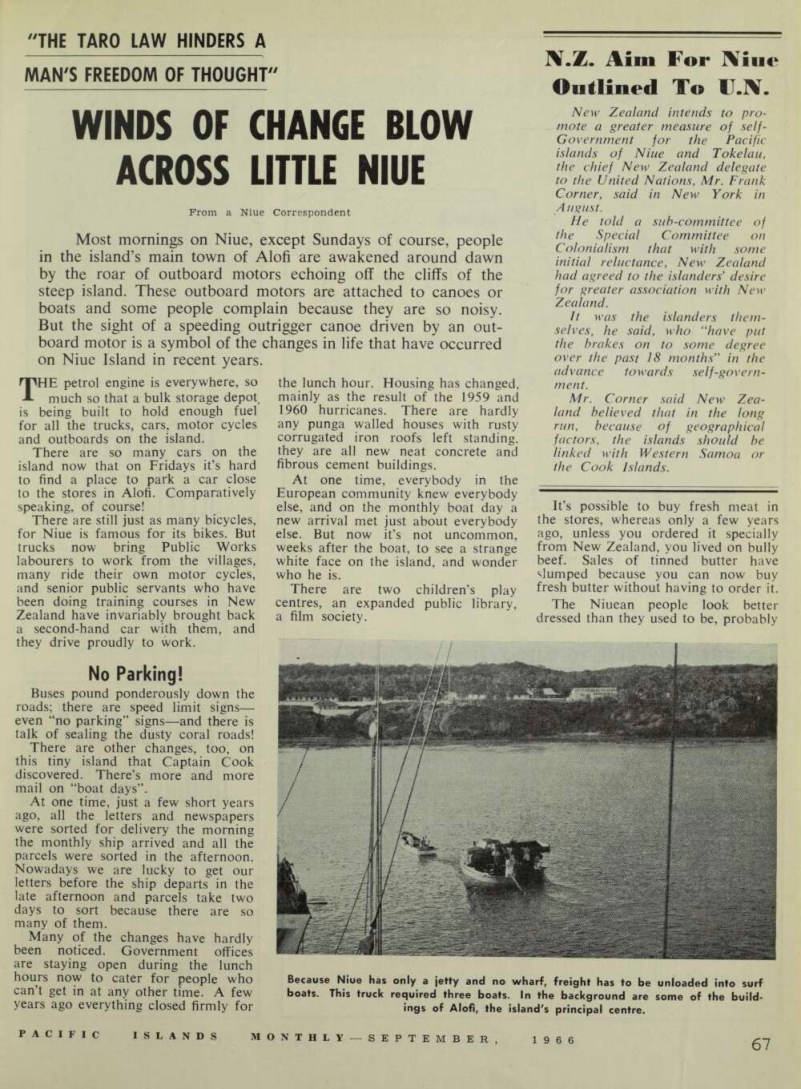
Because Niue has only a jetty and no wharf, freight has to be unloaded into surf boats. This truck required three boats. In the background are some of the build ings of Alofi, the island's principal centre.
because there is more money around and because the stores sell a far greater range of materials and ready made clothes than they once did. At one time, about all that could be bought were khaki shorts and white shirts for men, and lengths of faded material for the women. Now the latest men’s shirts are available.
Although none of the stores sells ready-made dresses as yet, it probably won’t be long before they do. We have a Leader of Government Busi ness and an elected Assembly, so that the local people have more power over their own affairs.
More publicity is being given to the Niuean’s way of thinking. This has been speeded up by the con version of the Niue Daily News— which was a sheet of New Zealand and world news issued by the radio station—into a local paper called Tohi Tala Niue and published by the recently-established Community Development Office.
I
Freedom To Plant
Among one of the recent letters to the editor was one about the Planting of Land Ordinance. This came into force nearly 40 years ago to make sure that every head of a family planted sufficient food crops to feed his family and, indirectly, to stop theft of food crops and to in crease banana and copra exports.
Under this ordinance taro plots are inspected regularly and those who have not planted enough of it are prosecuted.
A Niuean, writing to the editor, wanted to know if this ordinance was
now justified. He wondered if a Niuean was not entitled to the free dom to plant what he felt was suf ficient for the good of his family, and not be forced to plant what some body else wanted.
He made the points that times have changed, that people nowadays eat a lot of bread and other types of imported foodstuffs.
He said that while it was true that taro is the staple vegetable, that people ate bananas, breadfruit, tapioca, yams and kumaras, and these did not, in law, have to be planted.
There was no law compelling a man to catch so many fish in a week or
raise so many fowls and pigs in a year, so why a law compelling a man to plant taro?
The correspondent ended by say ing that personally he felt the law should be abolished, because it hindered a man’s freedom of thought and action; it prevented him from feeling completely responsible for the welfare of his family; and because in the eyes of the outside world it implied that the Niuean was lazy and had to be pushed to feed himself.
A few years ago such a letter would never have been written, and certainly not published. Niue has changed.
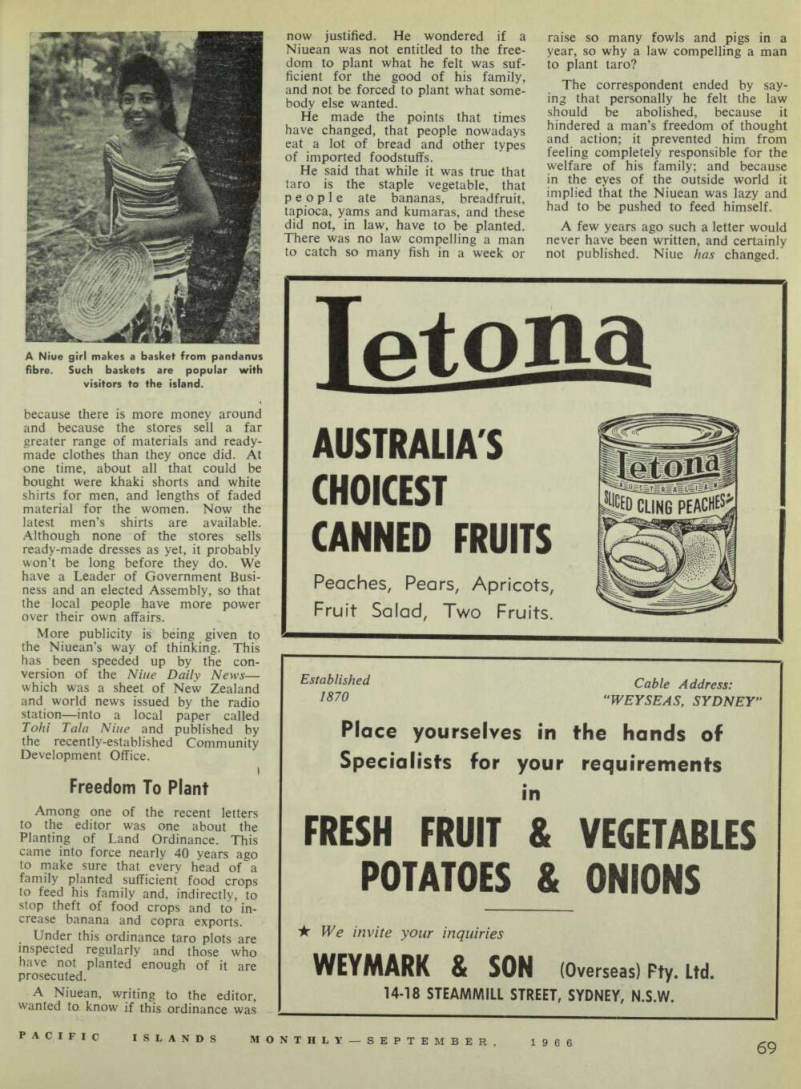
A Niue girl makes a basket from pandanus fibre. Such baskets are popular with visitors to the island.