Conspiracy Claim
pp. 63-67 · Read in the full issue
Repercussions Over Stolen Documents
N.Z. Prime Minister
Denies Cook Islands
Conspiracy Claim
The New Zealand Prime Minister, Mr. Holyoake, denied in the New Zealand Parliament in August that New Zealand public servants, employed in the Cook Islands, had been in volved in a conspiracy to unseat the Cook Islands Government.
MR. HOLYOAKE was replying to a charge made by members of the Opposition. They had alleged that a number of Europeans had been involved in a plot to distribute copies of a stolen document which would discredit the Cook Islands Government, and that the copies had been made on a photostat machine in the office of the New Zealand High Commissioner in the Cook Islands, Mr. L. J. Davies.
The document in question was a letter allegedly written by a former Cook Islands Cabinet Minister, Mr.
Julian Dash wood. The letter was stolen from Dashwood’s room at the Hotel Rarotonga, and photostatic copies of it were subsequently dis tributed on Rarotonga.
The distribution of these copies led to Dashwood being charged in May with corruptly attempting to obtain a bribe of £l,OOO “on account of undertaking to advise Cabinet to accept an offer from an Australian firm for the issue of a comme morative crown coin”.
Fined £5O
In the Cook Islands High Court on June 2, Dashwood pleaded guilty to the charge and was fined £5O.
Later that month, Albert C. Dawson, who had been suspended as manager of the Hotel Rarotonga, was acquit ted in the High Court of a charge of stealing various documents belong ing to Dashwood, or, alternatively, of receiving stolen documents.
Dawson later left the Cooks.
Following Dawson’s acquittal, the Cook Islands Government asked the New Zealand Government to appoint a commission to inquire into the operation of the High Court, and to make “such recommendations as are deemed necessary to ensure an im partial course of justice” (PIM, July, P- 15).
The stolen document case was raised in the New Zealand Parlia ment on August 2 by a member of
the Labour Opposition, Mr. N. J.
King, during discussion on the Estimates for the Department of Island Territories.
Mr. King, quoted from an article in the July issue of the New Zea land Monthly Review, which stated that about 20 photostat copies of the document had been distributed; that these copies had not been made in New Zealand; and that a copying machine capable of producing the photostats was in the New Zealand High Commissioner’s Office in Raro tonga.
The High Commissioner had stated, according to the article, that the work was done without his know ledge.
“It seems pretty clear that the whole plot to distribute the stolen document involved quite a number of Europeans,” the Monthly Review article added.
Mr. King said that the Minister of Island Territories, Mr. J. R. Hanan, had stated on May 31 that he could not comment on affairs in the Cook Islands until he received a report from the High Commissioner.
He asked if the report was avail able yet, and said there should be a full commission of inquiry if the Government could not satisfy the House.
The Under-Secretary for Finance, Mr. Muldoon, branded the Monthly Review, from which Mr. King had quoted, as “violently Left-wing” and “unreliable”; while the Minister for Internal Affairs, Mr. Seath, who was temporarily in charge of the Islands Territories portfolio in the absence of Mr. Hanan, said the House “should not get too excited” over the Cook Islands affair.
Questions Unexplained
Referring to the photostated document, Mr. Seath said it was pos sible the High Commissioner did not know the letter had been copied.
“I understand that the copies were made by photographers visiting the islands,” he added.
At this point, the Leader of the Opposition, Mr. Kirk, claimed that several questions had not been ex plained.
“It is true that two photographers were asked to photograph the documents,” he said, “but the photo
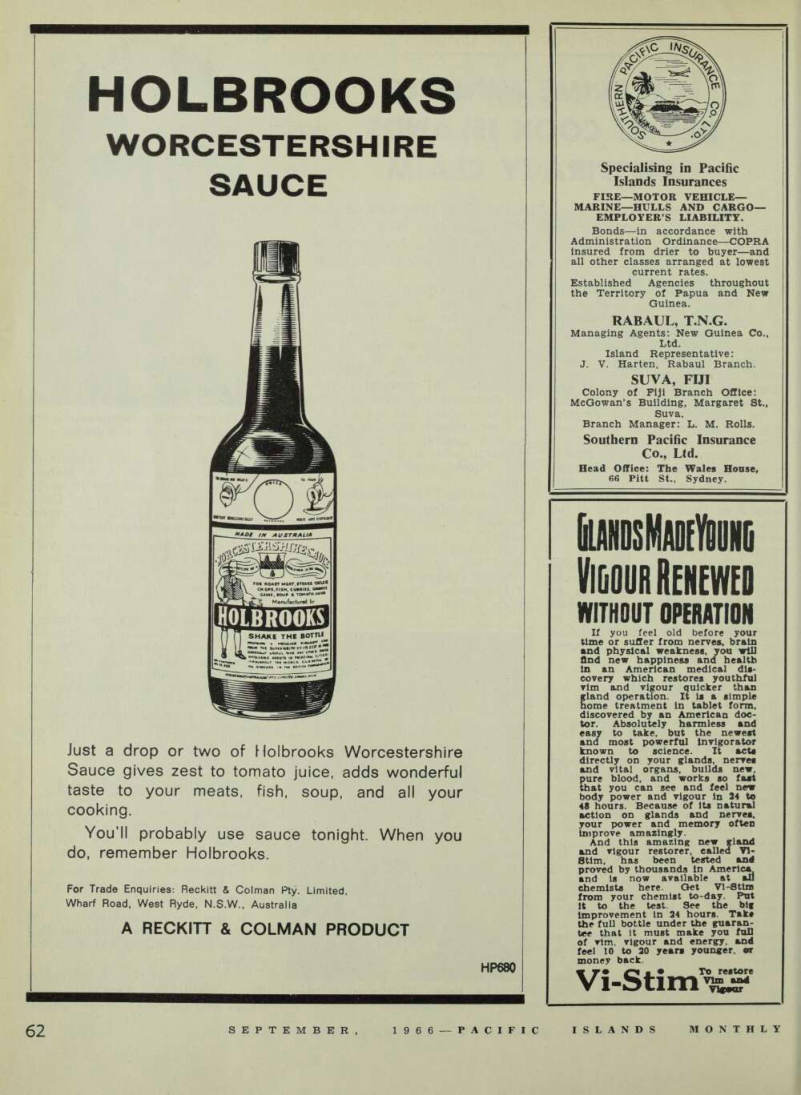
Mr. J. R. Hanan, NZ Minister of island Territories.
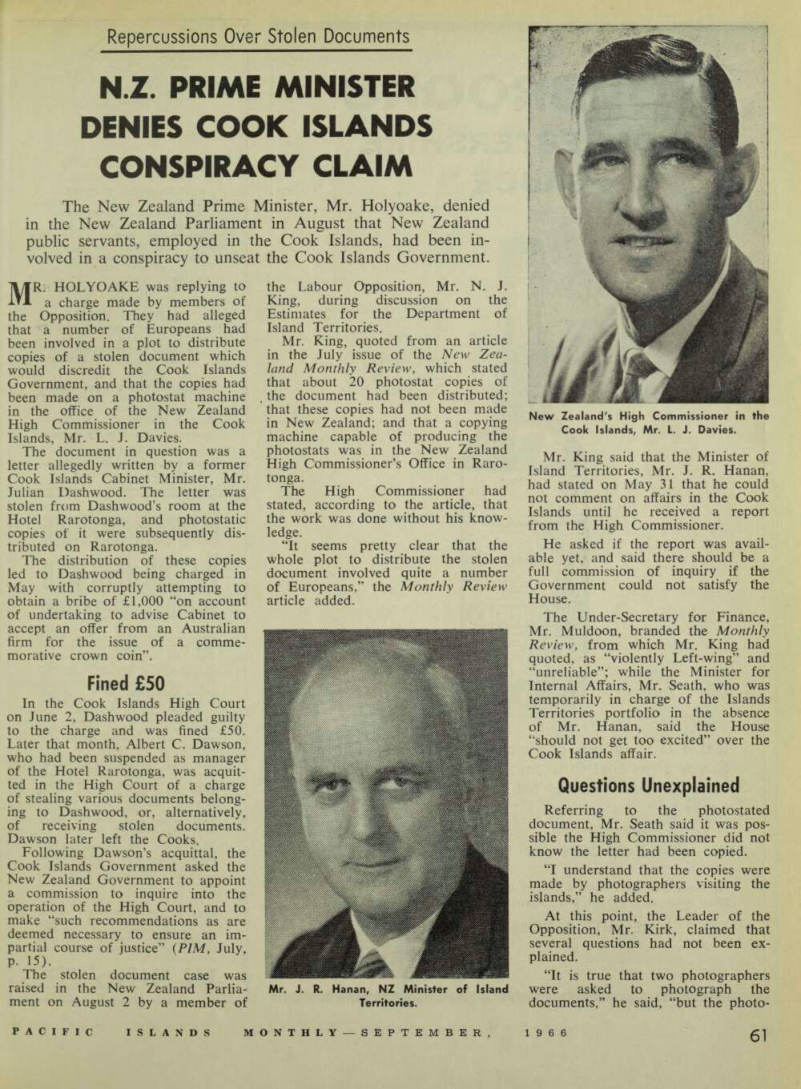
New Zealand's High Commissioner in the Cook Islands, Mr. L. J. Davies.
graphs are again separate from the photostats.
“The Commissioner has gone so far as to say that if these copies were made in his office, they were done without his knowledge.
“Another unexplained aspect of this is that the Cook Islands Prime Minister said there were nine people in a conspiracy and that these nine had access to officials, some of whom were seconded from New Zealand [see panel].
“One can scarcely accept that the Prime Minister or his Government was satisfied with that when two [Cook Islands] Government Ministers resigned and there is a possibility of another resignation.”
Mr. Kirk said that if there was any suggestion of a conspiracy by any seconded officer he should be brought home.
“How can a government survive if it does not have complete con fidence in the officers who serve it?” he asked.
Replying to the Opposition charges, Mr. Holyoake said he did not have
the “vaguest idea why the question has been raised”.
He said the Cook Islands Premier had not written to him of any con spiracy. and he knew of no New Zealand Government officer who was working against him.
“The whole question hinges on the Opposition’s completely lunatic sug gestion that an officer sent out from New Zealand has involved himself in a conspiracy,” he said. “I would have thought Mr. Hanan would have told me about it if he had heard of it.”
Mr. Holyoake added that New Zealand’s High Commissioner would have told him if there had been
something which could disrupt re lations between New Zealand and the Cook Islands.
Mr. Muldoon claimed that the Op position had raised a “mare’s nest”.
“All it is about,” he said, “is that there has been an alleged use of a photo-copying machine in the High Commissioner’s office. We could deal with it by repatriating the photostat machine. This is about all the charge is worth.”
Two days later, Mr. Holyoake interrupted proceedings in Parlia ment to tell the House of an exchange of cables between himself and the Cook Islands Premier.
He said that because of the
seriousness of the Opposition charge, he had cabled Mr. Henry asking if he would care to comment on it, Mr. Henry had replied, saying:' “Good relations with the people of New Zealand are and always will be of paramount importance for the people of the Cook Islands. Most certainly any matter capable of affecting relations between our res pective Governments would have been brought to your attention.
“My relationship with the High Commissioner is harmonious and I know of no conspiracy among seconded officers, or reason to suspect one.”
Mr. Holyoake said that Mr.
Henry’s cable had “completely con firmed” statements he had made to the House two days earlier.
In a letter to the Christchurch Star on August 6, the chairman of the New Zealand Monthly Review Society, Mr. R. A. Hill, said that the Government had been unable to deny any of the charges made in the New Zealand Monthly Review on the illegal use of the photostat machine in the New Zealand High Commissioner’s office.
Mr. Hill added; “Whether or not the behaviour of expatriate New Zealand civil servants has been tactless or even hostile to the new self-government of the Cook Islands may be brought out by an inquiry which the Cook Islands Government has requested from the New Zealand Government. The fact is, however, that amongst the people of the Cook Islands, a growing feeling of hostility is being reported towards those who believe that the pre-independence conditions of New Zealand pater nalism can continue after inde pendence.”
Mr. Albert Henry.