America's South Seas 'Showplaee '
pp. 33-42 · Read in the full issue

All That Glitters Isn't Gold In America's South Seas 'Showplaee '
BY ROBERT LANGDON, Assistant Editor, “Pacific Islands Monthly”
When you arrive in American Samoa for the first time, it is easy for you to get the im pression that—thanks to the territory’s tireless, dynamic, much-publicised Governor H. Rex Lee— the place has been converted from a Pacific slum to a Polynesian paradise in the past five years.
AGAINST a backdrop of romantic, jagged mountains, your aircraft touches down on an up-to-the-minute airport at Tafuna, on the main island of Tutuila.
Your passport is “processed” in a modern terminal building, construeted to resemble a group of Samoan fales.
A fleet of modern taxis and reasonably contemporary buses awaits without to whisk you from the airport to your hotel The road you ’ travel on, which hugs the coast for the most part, is new, smooth and bitumenised, with a line down the middle. , , , . , The houses along the way, mainly Western-style, have electricity laid on, and none of the unsightly over-water toilets that are a feature of the coastline in neighbouring Western a i?, oa ' , 4l n °r V ant * Jhen, you Pass a , jf, 8 “T)i Um tbe roadside * P „ Keep American moa Clean . You look around you, an e place is clean.
At the “village” of Utulei, you pass the modern, two-storey, Michael J. Kirwan Educational Television Center, which is the hub of American Samoa’s much-publicised TV system.
A little further along, dominating
Pago Pago’s celebrated harbour, you see the transmission towers for the TV system, perched astonishingly on the top of what appears to be an almost perpendicular mountain.
Then your bus drops you off at the vast > modern, 100-room Pago Pago Intercontinental Hotel, and you un pack your bags in handsomely furnished, air-conditioned comfort, ° n th e surface, everything seems to be pretty much as Clarence W.
Hall, a senior editor of the Reader’s D ‘ ges '.’ described a recent issue bls ourna ‘ , be . SLlrdac 2’ 5? moa , does . se f m ,° V 6 A in the South with bursting new life and prosperity .
No StTlllGS
But after you begin to move about a bit more? talk to people, and inspect a few of the expensive things in the shops, you start asking yourself whether American Samoa is as much like paradise as Hall told the world it was j n a magazine with the world’s largest circulation of more than 26 million copies, One of the first things you notice is that the Samoans, unlike Poly nesians elsewhere, never seem to laugh or smile very much.
You can hardly help noticing that
when you go for a drive, boys in the villages are apt to pick up stones and hurl them at you!
If you happen to go into the Government Executive Office and Courthouse, you see that the court room is always full of unhappy looking people. In the local news paper, Samoa Times, there are an unusually large number of stories of violent crime for such a small place.
Conversations with the local people often seem to turn into solemn, head shaking affairs, in which the same subjects—the dizzying speed of change and the de-Samonisation of American Samoa—continually crop up.
I got involved in a number of such conversations during a visit to American Samoa in July.
One man, a part-Samoan, who was visiting Samoa for the first time in 20 years, said angrily: “This place will just be another Hawaii in another 10 years.”
Another, an American, said: “Un
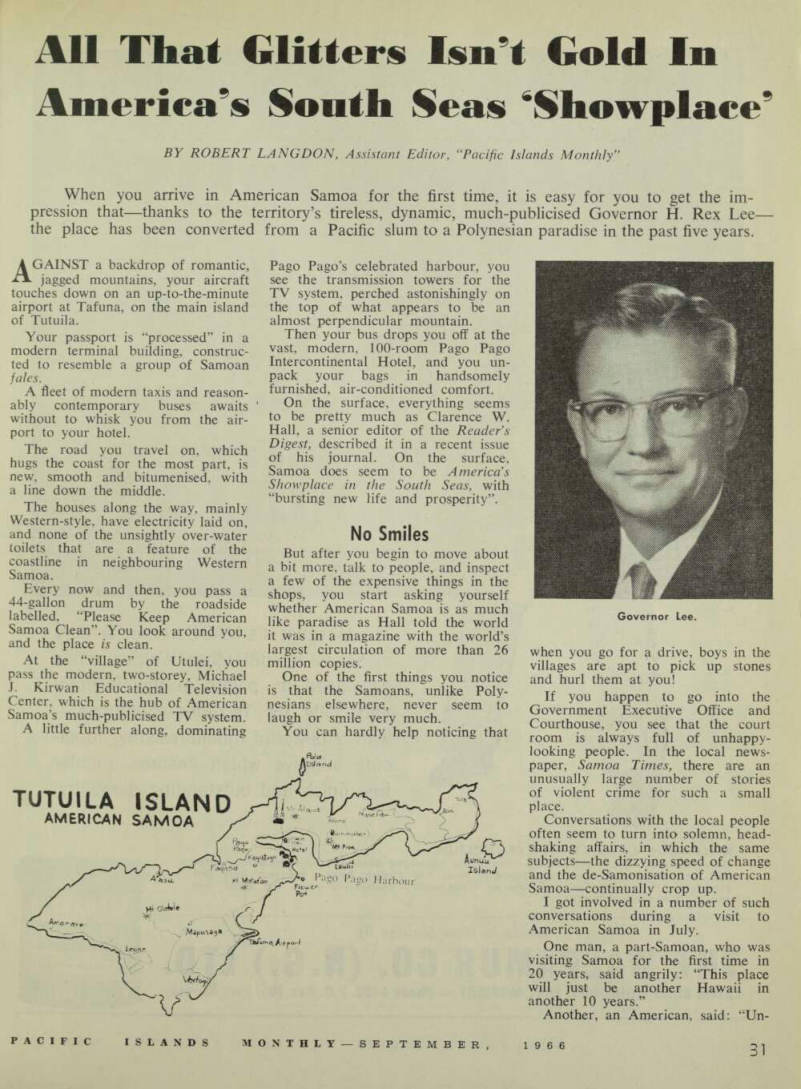
Governor Lee.
less something is done soon to record all the old songs, chants and traditions, it will be too late. The Samoans are losing their own culture so fast that there will soon be no one left who knows them”.
A third person, a Samoan woman, said: “The way things are going, we’ll soon have to employ experts from the Bishop Museum to teach us our own language—just like the Hawaiians have done in Hawaii. I hope not, though”.
Remarks of this kind set me probing even deeper. And by the time I had spent a few days in Samoa, I had come to the conclusion that the explosive development that Governor Lee had brought to Samoa over the last five years had certainly not created the Polynesian paradise that the Reader’s Digest article claimed.
This opinion was confirmed and reinforced after I returned to Sydney and made a close study of Govern ment reports, bulletins, newspaper articles, newspapers and books on American Samoa of recent years, and discussed matters with RIM colleagues who had visited Samoa over the years, pre-Lee and cum- Lee, in the course of their regular Pacific beat.
In brief, my findings were that the explosive development of the past five years has caused a violent break down in the archaic, but efficient social system that has served the Samoans for centuries. It has also played havoc with the primitive, communal economic system.
As a result, many of the finer
aspects of the Samoan way of life and culture are being destroyed, and the people are being confused and irritated by the many changes that are continually forced upon them.
Because of the many millions of dollars that the US Government has poured into American Samoa since the advent of Governor Lee, the people have developed a taste for many amenities of Western civilisa tion that their own limited resources can never allow them to afford.
They have developed an irrespon sible attitude towards money—that others will pay their bills.
Side by side with all this, there is galloping inflation, increasing in debtedness, unprecedented adult and juvenile delinquency, a soaring crime rate, and a bulging prison.
SPC Conference
Governor Lee’s schemes to give American Samoans a better life originated in May, 1961, when he was sent to American Samoa as Governor, to clean the place up for the Fifth South Pacific Conference.
During the 60 preceding years of US control, little had been done in the way of development. The place was shabby, dirty and unkempt.
Governor Lee had a large grant from Congress to build accommoda tion and put a new face on the terri tory for the benefit of the Conference delegates.
Having done that, he wanted to do more; and he was able to convince Congress of the desirability of open ing its purse-strings for a whole series of projects aimed at improving health, education, public works, and the economy generally.
Governor Lee seems to have been
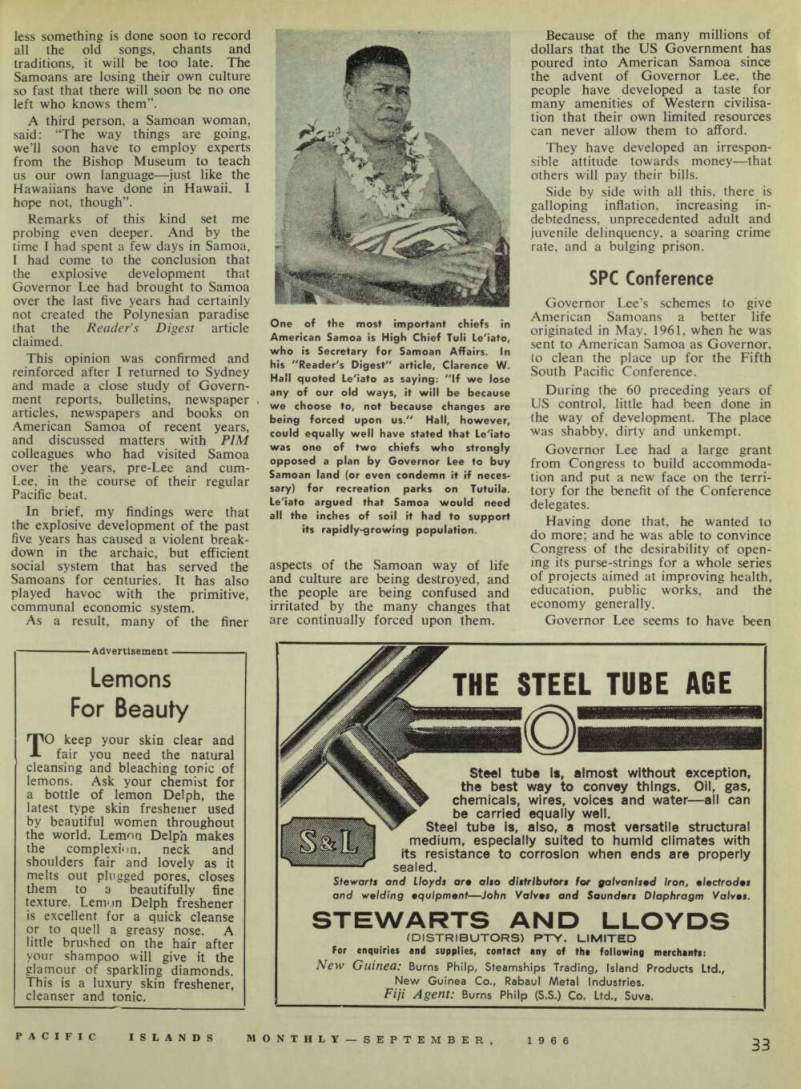
One of the most important chiefs in American Samoa is High Chief Tuli Le'iato, who is Secretary for Samoan Affairs. In his "Reader's Digest" article, Clarence W.
Hall quoted Le'iato as saying: "If we lose any of our old ways, it will be because we choose to, not because changes are being forced upon us." Hall, however, could equally well have stated that Le'iato was one of two chiefs who strongly opposed a plan by Governor Lee to buy Samoan land (or even condemn it if neces sary) for recreation parks on Tutuila.
Le'iato argued that Samoa would need all the inches of soil it had to support its rapidly-growing population.
genuinely anxious that the Samoans should be encouraged to build up confidence to do things for them selves. But he appears to have taken no heed of a warning from his part-Samoan predecessor, Governor Peter Coleman, that, in Samoa, it was necessary for the Administration to be “constantly on the alert to pace political and social growth with economic growth”.
He also seems to have given little thought to what would happen if changes were brought too quickly to an intensely conservative people, with an archaic social system, little formal education, and extremely limited natural resources.
Having decided what he thought was good for American Samoa, he got things moving at full blast.
For centuries before the advent of
One of the few American public servants in American Samoa with more than a year or two of service in the territory is the Territorial Secretary, Mr. Owen S. Aspinall, seen here with a Samoan chief. Mr.
Aspinall, who is 38, went to American Samoa nearly five years ago as Attorney- General. He has occupied his present post since late 1962. The fact that most State siders in Samoa are just "trippers" on short-term contracts means that they have little time or inclination to study Samoan customs and see things the Samoans' way.
Governor Lee, the Samoans had a subsistence economy and a system of government known as the matai system.
The unit of society under this system is the aiga or family group (perhaps 200 people) who acknow ledge allegiance to a matai, or chief.
All land belongs to the aiga in common, and is worked under the direction of the matai, who is elected by the adult members of the clan.
The matai allots tasks to his sub ordinates, collects the fruits of their labours (fruit, fish, vegetables) and divides them among the families.
The matai also maintains order and discipline; and adjudicates in inter family disputes.
Each aiga lives in a village; and the villages are grouped into counties and districts, over which high chiefs and talking chiefs have higher authority. Ceremonial and oratory forms an important part of life, and nothing is ever done in a hurry.
Perfect System
In a subsistence economy, the matai system is probably as perfect as any that can be devised. It ensures fair shares for all; and care for the aged and sick.
Even if some members of the aiga work for wages (as some did when the US Navy controlled American Samoa), the matai system still works, provided the wage earners hand their earnings over to the matai for distribution.
However, things begin to get out of hand when whole aigas, including the matai, begin working for wages, and there is no one left to catch Hsh and work in the plantations.
This is what began to happen when the numerous projects initiated by Governor Lee got under way, and, in addition, the American canning company, Star Kist, joined Van Camp in canning tuna in Pago Pago caught by Asian fishermen.
As the Samoans moved out of the plantations, local foodstuffs got scarcer and dearer. Eventually the stage was reached when American Samoa was not even self-sufficient in local foods.
So long as the money kept rolling in, no one cared. And once it started, it seemed as if it would never stop.
In the four financial years, 1961- 1964, Congressional grants to
American Samoa totalled more than $37 million, or about $440 per head per year for the territory’s 20,000-odd people.
These figures compare with only s6i million, or an annual average per head of $67, for the five preced ing years.
Needless to say that, with un precedented wealth flowing into their country, the Samoans developed tastes for amenities of civilisation which they cannot continue to afford without the continuance of Con gressional munificence, of the dis covery of some startling new ways of making money.
While the boom was on, they bought cameras, television sets, radios and indoor toilets. They took holi days in Hawaii. Some even installed two cars in the garage.
In the full flush of their prosperity, they also became investors.
Anxious that they (and not out siders) should share the profits of a tourist industry, which he saw as their best hope for the future, Governor Lee persuaded them to form the American Samoan Develop ment Corporation, and put in $350,000 in payroll deductions to build a new hotel. (The existing hotel at that time was small and primitive).
In any other South Seas territory, $350,000 would probably have been enough to give tourism a trial run.
But not in American Samoa.
American Samoa’s hotel must needs be the biggest and most luxurious in the whole of the South Seas.
Huge Loan
So the Samoans, who, five years ago, had little more than a few fish and coconuts to bless themselves with, were talked into taking on a 20-year loan of $1,500,000 at 5 per cent, interest or thereabouts, repayable from 1968.
The hotel was opened last December and has been operating at a loss ever since, even though its tariffs are much higher than travellers will find anywhere else in the South Seas, French Polynesia excepted.
I, personally, cannot see how such a massive hotel is ever likely to pay for itself, far less be made sufficiently profitable for its shareholders to make money out of it. My reasons for this view are: • The Samoans know nothing about hotel management, and have had to put the running of the hotel in the hands of Intercontinental Hotels Ltd., which presumably collects a handsome commission for its services, ® Intercontinental Hotels has had
• It would be hard to find a better picture than this to illustrate the point that the Samoans are built for comfort and not for speed. It is hardly sur prising that they find the pace of development in their country be wildering.
to import expensive expatriate man agers, but so far it has not been able to keep them for long. Two have so far come and gone; a third is now in office, • Tourists, including Americans, have shown that they are not pre pared to pay exorbitant prices to see even Tahiti, the most glamorous island in the Pacific (see p. 129). • The hotel is so big that the cost of its upkeep, even with no one in it, will be enormous. ® American Samoa is not suffi ciently well known to attract a con tinuous stream of visitors; and its main island, Tutuila, is so small and has so few attractions —apart from spectacular scenery—that those who do come are unlikely to stay much longer than two days.
The failure of the hotel to return handsome profits right from the start has surprised many of the un sophisticated Samoan shareholders, and they are already impatient for dividends.
Meanwhile, most of Governor Lee’s major construction jobs have petered out; and the huge flood of money that was flowing in from Uncle Sam’s coffers has shrunk to a much smaller stream.
There have been several ominous signs of recession in recent weeks. ® On July 12, 60 out of the 89 men in the territory’s police force went on strike for more pay (among other things), but 160 young men immediately applied to replace them and so get on the Government pay roll. • In June, the Government cracked down on some 30 businesses which owed it about $48,000 in un
paid bills. It denied any further credit to some of the firms, and announced that from October 1, it would give credit only to businesses and individuals who had filed an acceptable “application for credit” with the Department of Administra tive Services.
O In late July, the Government announced that between 150 and 200 individuals and businesses had failed to pay their electricity bills since February, despite several warnings to do so, and said that their electricity would be cut off unless they paid up within three days. Early in August, people who had not paid their bills to the end of June were given similar warnings.
It would appear from all this that the Samoans are constantly finding it harder and harder to keep paying for the magnificent amenities that Governor Lee has brought them.
Meanwhile, the dense jungle that grows so quickly on an island with 200 inches of rain a year has over run many of the village plantations; the labour force that once looked after them has been dispersed; and even those who no longer have jobs are reluctant to return to them.
The exodus from the plantations
The man with overall responsibility for the administration of American Samoa is the US Secretary of the Interior, Mr.
Stewart L. Udall.
that occurred while things were really booming has weakened the sway that the matais previously had in their villages and parents had over their children.
This has been further weakened by the advent of TV education, which has resulted in Samoan teachers being taught how to teach by imported teachers from the United States who have no know ledge of the Samoan language and little time to interest themselves in Samoan customs.
The loss of authority of the matais and of parents has resulted in a startling upsurge in social problems.
Crime Figures
Official figures for the last two years are not available, but a com parison of those published in the annual reports for the year ended June 30, 1960 (the last full year before the advent of Governor Lee) and June 30, 1964, gives some idea of the trend.
In 1960, the number of people convicted of crimes was 294. In 1964, it was more than twice that figure—7o9.
In 1960, 30 people were sentenced to prison by the courts. In 1964, the number was 83; but in addition, 673 people were detained in prison for a period of not more than 24 hours either for their own safety or that of the public.
There has been a corresponding
increase in the juvenile delinquency rate. By November, 1964, this had become so bad that the Government had to impose a curfew on all children under 16 unaccompanied by adults after 9 p.m.
The curfew is still in force, but there are complaints from time to time that it is not strictly enough policed.
One of the worst aspects of American Samoa’s brand of juvenile delinquency is that children and teenagers hurl stones at passing cars.
This is bad enough when done in broad daylight (it happened to me twice in two days), as the motorists have some chance of dodging or shielding themselves. They have no chance of such evasive action at night when the stones are flung by teen agers hiding in dark corners.
The high incidence of juvenile delinquency in American Samoa is a sad commentary on the real value of the TV educational system which Governor Lee introduced to the terri tory with much fanfare on October 5, 1964.
This system now covers all but three or four schools in the whole territory, so that more than 5,000 children are receiving their lessons by TV.
The total capital cost of the system to the end of January this year was $2,3 81,000, but this figure does not include the cost of new school build ings, or school buses and jeeps. The operating cost of the system for
the 1966 fiscal year was about $1,200,000.
The idea of introducing the TV education system occurred to Governor Lee soon after his arrival in Samoa, when he found difficulty in understanding the English spoken by the local Samoan teachers.
He was also shocked by the teachers’ low academic standards, and decided that “an explosive upgrading” was necessary.
It does not seem to have been put to Governor Lee that it would have been more reasonable for him to address the Samoans in Samoan.
Nor, apparently, did he pause to consider that when you live on a small island in the midst of a vast ocean, academic education may not be the be-all and end-all of every thing.
He decided that an “explosive up grading” was necessary, and that the use of TV was the way to obtain it.
Before six months were out, he had persuaded Congress to grant him $40,000 for a feasibility study.
A four-man study team from the National Association of Educational Broadcasters went to Samoa in late 1961. returned to Washington a month later, and reported that educa tional TV was the answer to Samoa’s problems regardless of the fact that such a system had never been tried anywhere else.
The ETV system, as it now operates, provides only about two hours of television teaching over five
channels on each school day. But all instruction revolves around the TV lessons.
The lessons are prepared at the TV studios by Stateside teachers (who are imported on two-year contracts) and are sent to the Samoan classroom teachers several days be fore being telecast.
Mainly English
Stateside principals, who live at each school, advise the classroom teachers on how to prepare for tele casts, what to watch for, and how to follow up the telecast lessons.
Except in the lowest grades, where some Samoan lessons are given, all lessons are in English—i.e., a foreign language.
Thus the Samoan children are not only being subjected to a method of education whose efficacy has never been proved elsewhere; they are being weaned away from their own language which is the very enshrine ment of their culture.
After nearly two years of such
teaching, there is some evidence that the knowledge of English among the Samoans is somewhat better than it used to be. But it is still far from certain that the Samoans will not grow up to be only semi-literate in both English and Samoan.
Certainly, the alienation of the young Samoans from their own language (and therefore their own culture) has already caused a rift between them and their elders, and this, in turn, has created some of the social problems already mentioned.
Meanwhile, it is interesting to note that while American Samoa has be come beset with social problems aris ing out of the “explosive upgrading” of its education system and the millions of dollars pumped into its economy, political developments in the territory have been almost non existent.
A constitutional review committee composed of Samoan leaders, which began considering revisions to the 1960 Constitution last year, has thrown out virtually every proposal to change the existing set-up.
It rejected, for example, a proposal that Senators should be required to be able to read and write Samoan or English; it rejected a proposal (suggested by Governor Lee) that a move should be made towards an elected Senate.
Neither the committee nor the Legislature has done anything to try to overhaul the archaic system of land ownership, even though land owner ship was described by the Samoa News last year as “the number one dispute among families in American Samoa today” and the cause of a “daily schedule of cases” in the Office of Samoan Affairs.
It is obvious that Samoa’s leaders have become afraid to make even minor changes in the constitution for
• The Post Office of American Samoa still looks the same as it did when this picture was taken several years ago. But the dress of the people is different. Nowadays barefootedness is most unusual except among children; trousers are worn by almost all men except chiefs and oldsters; and the dress of the women is apt to be more modern —even toreador pants and "mini" skirts being some times seen.
The terminal buildings at American Samoa's Tafuna jet airport have been constructed to give the impression of a complex of Samoan "fales". They are of concrete pre-cast beam construction with shingle roofs —the shingles being imported from the US.
fear of making things even more chaotic than they are now.
High Talking Chief Fofo I. F.
Sunia explained this outlook in an article in the Samoa News last year when he said: “American Samoa is going through a period of change like it has never seen before. Conditions are beginning to change in most things even before you begin to get used to them. . . . When one is not certain, it is always best to hold on to at least a part of what he has”.
There is no doubt that because of their confusion over the goings on around them, the Samoans are less capable of governing themselves now than they used to be.
They are certainly a long way behind their brethren in Western Samoa, who have adhered to traditional Samoan ways, and who became independent in 1962.
This, incidentally, brings up a matter that is a sore point with the Samoans in both Samoas —that Gov ernor Lee has introduced immigra tion laws and travel restrictions that have cut off the American Samoans from their Western neighbours, who are related to them by blood, history and tradition.
The restrictions came into effect in June, 1964. The Samoa Times said recently that they seemed to “heap contempt on all Samoans”, that they were “not in the public or national interest of the territory”, and that they were “splitting the two Samoas further and further apart”.
All in all, it is pretty plain that, although Governor Lee has brought much material progress to American Samoa, the place is not exactly a “Polynesian paradise”, to use the Readers Digest’s phrase.
Governor Lee’s programmes have undoubtedly originated from the best of motives; and it is a tribute to his enormous capacity for work, his organising ability, and his per suasiveness that he has been able to accomplish so much so quickly.
But material progress is not every thing. There was material progress on Mangareva, French Polynesia, a century or so ago, when an over zealous band of missionaries pushed, prodded and persuaded the local Polynesians into building massive churches, schools, roads, fish traps, etc., for what they thought was the Mangare vans’ own good—and destroyed the Mangare vans’ own culture in the process.
Mangareva’s buildings are all in ruins today, and the once thriving Mangarevans are a broken remnant of their former selves. The moral is, I think, that you can push the Poly nesians too far too fast, and in a direction they don’t really want to go.