The Editors' Mailbag
p. 29 · Read in the full issue
Jobs In The G.E.I.C.
Sir, —The article entitled “Life Has Its Problems—Even In The GEIC” (PIM, July, p. 45) intrigued me.
Last year I applied for a job in the Gilbert and Ellice Islands Colony.
The position was widely advertised and drew many applicants. I was among the half-dozen finalists who emerged after some two months of form-filling and interviews. Then followed a two-month wait, during which I was offered two good jobs in New Guinea. As I was particularly keen on going to the GEIC, I decided to wait, and let those go.
A letter advising that the job had gone to another applicant, thank you for your interest, etc., finally arrived, and I left for New Guinea where I was able to secure employment.
During the next six months I was advised on no less than three oc casions that a change of decision had been made and that I was again being considered for the position. Was I still interested?
Although still keen on the GEIC, I was loth to make another move so soon after returning to New Guinea.
However, after the third letter arrived, stating that the position was still open and that the employer con cerned was most interested in me, I wrote saying that I was available subject to serving a satisfactory period of notice and provided the cost of the move was borne by the prospective employer.
Two months later, a fourth and final letter arrived announcing that as I seemed well settled in New Guinea it would be a pity to uproot me, and the job had been given to someone else.
My friends say I am callous be cause I refer to the GEIC as the “Gilbert and Sullivans”. Are they right?
John Fowke.
Mamai Estate, Port Glasgow, Papua.
Vila's Bauer Field
Sir,—As a frequent traveller to the South Pacific Islands of World War II, I find it a dismaying com mentary on the durability of history to read (PIM, June, p. 129) that Bauer Field, Vila, is being corrupted to Bauerfield Airport.
Bauer Field was built by US forces and named for Marine Major Harold
W. “Joe” Bauer who was killed in the air battle over Guadalcanal in 1942. Major Bauer earned the Con gressional Medal of Honour for his part in turning back the Japanese enemy’s drive to conquer still other South Pacific Islands.
If Vila’s prestige will be enhanced by calling it an “airport” instead of a “field”, let’s call it Bauer Airport.
Joe wouldn’t mind. But, please, not Bauerfield Airport. (Honiara please note: When the 25th anniversary of the Guadalcanal landing is observed next August, let’s have someone defile the memory of Marine Major Lofton R. Henderson and rename it Hendersonfield Air port.)
Robert C. Hayes,
Lieut-Col., US Marines (Retired). 2414 West Mercer Way, Mercer Island, Washington, USA.
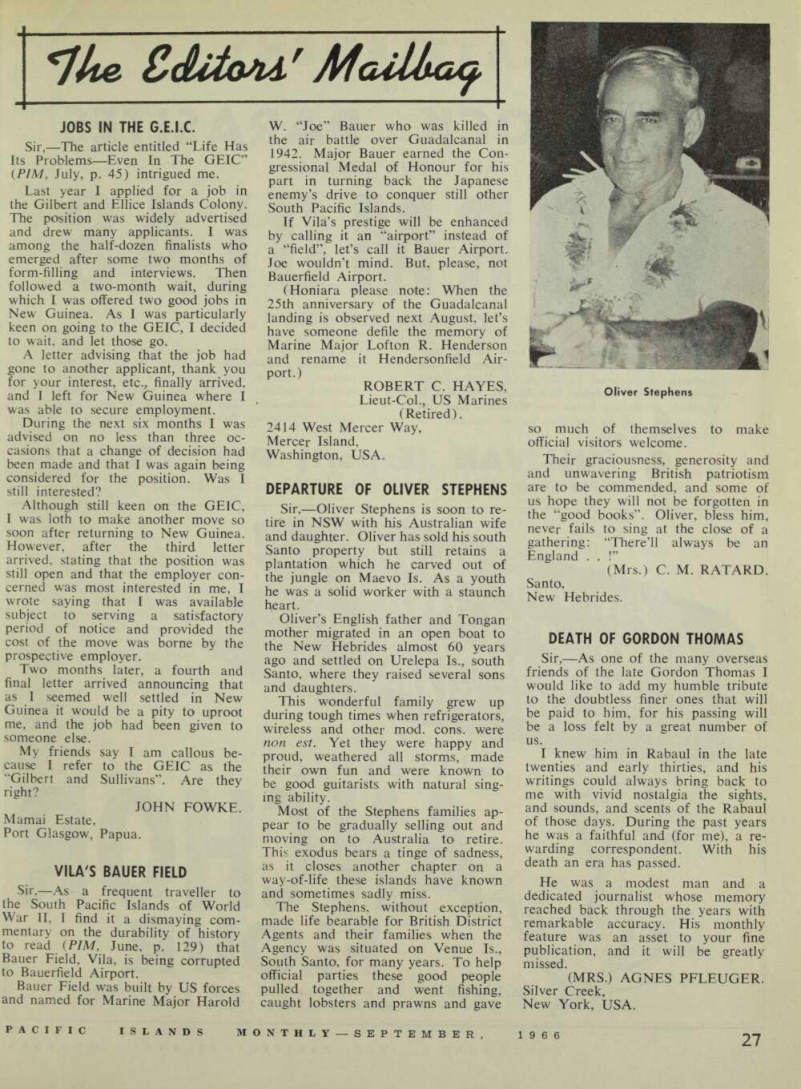
Departure Of Oliver Stephens
Sir, —Oliver Stephens is soon to re tire in NSW with his Australian wife and daughter. Oliver has sold his south Santo property but still retains a plantation which he carved out of the jungle on Maevo Is. As a youth he was a solid worker with a staunch heart.
Oliver’s English father and Tongan mother migrated in an open boat to the New Hebrides almost 60 years ago and settled on Urelepa Is., south Santo, where they raised several sons and daughters.
This wonderful family grew up during tough times when refrigerators, wireless and other mod. cons, were non est. Yet they were happy and proud, weathered all storms, made their own fun and were known to be good guitarists with natural sing ing ability.
Most of the Stephens families ap pear to be gradually selling out and moving on to Australia to retire.
This exodus bears a tinge of sadness, as it closes another chapter on a way-of-life these islands have known and sometimes sadly miss.
The Stephens, without exception, made life bearable for British District Agents and their families when the Agency was situated on Venue Is., South Santo, for many years. To help official parties these good people pulled together and went fishing, caught lobsters and prawns and gave
so much of themselves to make official visitors welcome.
Their graciousness, generosity and and unwavering British patriotism are to be commended, and some of us hope they will not be forgotten in the “good books”. Oliver, bless him, never fails to sing at the close of a gathering: “There’ll always be an England . . !”
(Mrs.) C. M. Ratard.
Santo, New Hebrides.
Death Of Gordon Thomas
Sir, —As one of the many overseas friends of the late Gordon Thomas I would like to add my humble tribute to the doubtless finer ones that will be paid to him, for his passing will be a loss felt by a great number of us.
I knew him in Rabaul in the late twenties and early thirties, and his writings could always bring back to me with vivid nostalgia the sights, and sounds, and scents of the Rabaul of those days. During the past years he was a faithful and (for me), a re warding correspondent. With his death an era has passed.
He was a modest man and a dedicated journalist whose memory reached back through the years with remarkable accuracy. His monthly feature was an asset to your fine publication, and it will be greatly missed.
(Mrs.) Agnes Pfleuger.
Silver Creek, New York, USA.
Oliver Stephens