Japan Takes The Long
pp. 143-150 · Read in the full issue

Business and
Development
Japan Takes The Long View In New Guinea
By Judy Tudor
“If you can’t lick ’em,” said Tom Briggs when he was showing me over the Briggs and McLean store in Kasagten St., Madang, New Guinea, “join ’em”. Briggs and McLean are furniture-makers, but what he was referring to was the fact that their store was full of imported Japanese furniture— modem, elegant, about half the price of similar articles imported from Australia and considerably less than anything manufactured in the territory.
TOM BRIGGS’ interest was in his company’s line of products but the sentiments he expressed about the Japanese are pretty generally held in the territory today.
This is not to say that the years 1941-45 and all the misery that went with them are forgotten. But most people are realists when it comes to trade, and accept the fact that Australia’s trading partnership with Japan is one of the most important economic developments of recent years and that if it is good for Aus tralia it could be good for Papua- New Guinea.
Small At Present
Trade between P-NG and Japan at present is small judged at the inter national level. Exports from P-NG to Japan in the years 1960-65 averaged about £BOO,OOO in annual value. Imports from Japan into P NG have increased, however, from a value of £1,749,573 in 1960-61 to £3,701,794 in 1964-65.
P-NG has exported its traditional raw materials—timber, cocoa beans, coffee, crocodile skins, trochus; and imported from Japan motor vehicles, machinery, electrical goods, radios, cameras, textiles, etc.
The arrival of Japanese furniture on the scene is a comparatively recent development. It is of the type gener ally known as “Swedish” design.
Some of it is made from New Guinea timber and all of it is so attractive that it is likely to revolutionise terri tory interior decorating in the next few years.
To date, trade between Papua-New Guinea and Japan has been a hap
hazard development but there are in dications that certain people are now prepared to take a long-term view of it and plan accordingly. As the Japanese see it, P-NG could be the source of many needed raw materials but, at present, much of P-NG production is committed else where. To this extent Japanese in terests are anxious to get into de velopment projects in the territory that would supply these materials.
On the New Guinea side, there is an ever-increasing demand for manu factured goods and as there is no
protective tariff barrier as there is in Australia, and no preferential duties for any one country, Japan can de liver quality goods at more than com petitive prices. Under these circum stances few territorians are prepared to demand “Australian made” for purely patriotic reasons.
There have recently been moves in New Guinea—from Rabaul mostly— to formalise the P-NG-Japan trading partnership by having a New Guinea branch of the Japan-Australia Busi ness Co-operation Committee, the fourth meeting of which was held in Canberra with much publicity and goodwill in mid-April.
Hostility
To the end of June, the NG sector hadn’t got off the ground. A number of people I spoke to about it were sceptical, a few hostile. Most of the hostility was due to the development side of the committee’s proposals.
These people see a subtle difference between fostering trade between P NG and Japan, and Japan coming in to help develop P-NG on any large scale. Many of these, no doubt, would be prepared to turn a blind eye to what Japan might do, so long as they do not have to publicly en dorse it.
The Japanese themselves are acutely aware of this hang-over from
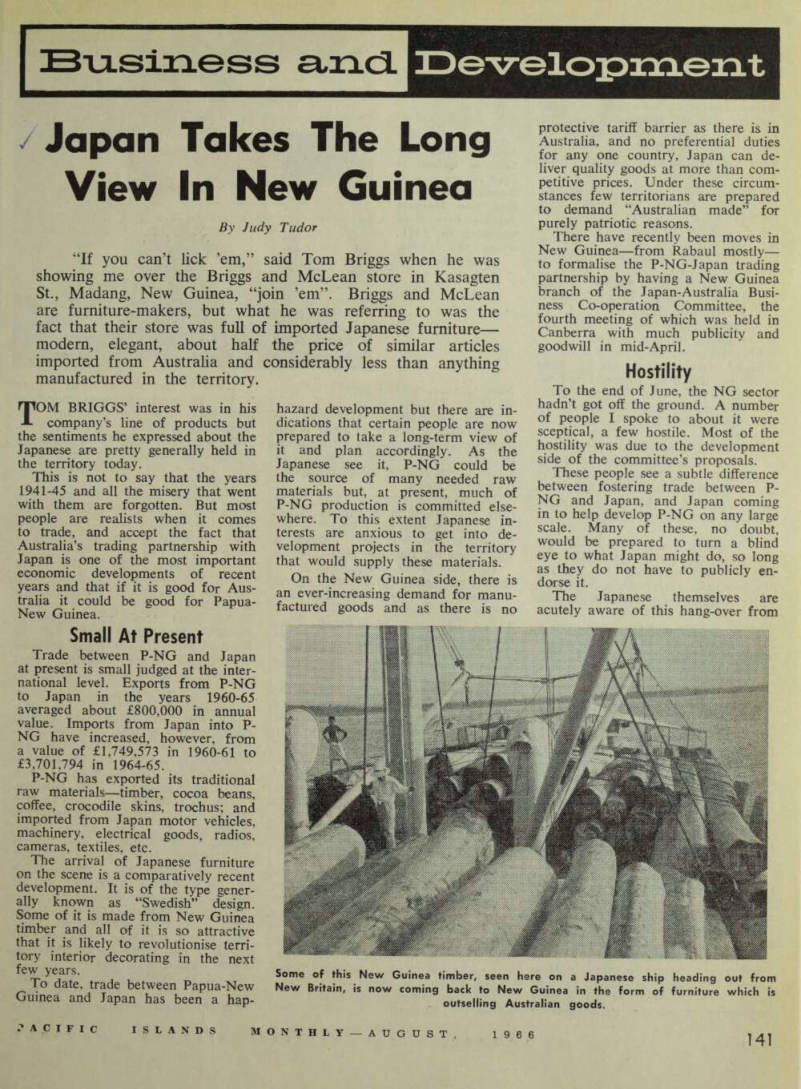
Some of this New Guinea timber, seen here on a Japanese ship heading out from New Britain, is now coming back to New Guinea in the form of furniture which is outselling Australian goods.
wartime animosity and are not likely to crowd their luck by pushing things too hard or too fast.
Meantime two enterprises have quietly put their own form of New- Guinea-Japanese co-operation into practice and are already in business.
The New Guinea end of the enter prise is the South Pacific Develop ment Co. Pty. Ltd. of Rabaul; at the Tokyo end is the South Pacific De velopment Co. Although the two companies have the same name—for the sake of convenience according to the shareholders—and each will act for the other in their respective countries, there is no financial tie-up between the two.
One-third of the shares of the Rabaul SPD Co. are held by Mr. J.
A. Thurston; one-third by Mr. C. E.
Holland; and one-third are described as “floating”, for the present.
Mr. Thurston is a territorian of over 30 years standing. He has large plantation and other interests and be fore the Pacific War was one of the first and most successful miners on the Sepik goldfields. He served in both wars.
Mr. Holland is a post-war resident of New Guinea and until recently was a director of the Rabaul Trading Co.
Pty. Ltd. He has resigned from this post to take over the active manage ment of the SPD Co. Pty. Ltd. in Rabaul.
The largest shareholder in the Japanese SPD Co. is the Nissho Co.
Ltd. C. Itoh and Co. Ltd., another big industrial undertaking, is also a major shareholder. Managing-director of the Japanese SPD is Mr. T. Ogawa who is already a well-known visitor to New Guinea as a director of Southern Trade and Industry Co.
Ltd. of Tokyo.
Ramifications
Southern Trade handles the mar keting arrangements in Japan of New Guinea Lumber, and New Guinea Lumber is the result of the Clarke Bros. Holdings take-over of Thompson and Wright, Cape Hoskins sawmillers, a few years ago and Clarke Bros.
Holdings subsequently joining forces with Japanese interests for the large scale exploitation of Cape Hoskins timber, particularly in relation to exports to Japan.
On paper, the new set-up between the two South Pacific Development companies seems even more compli cated than the ramifications of New Guinea Lumber. However, what it boPs down to is co-operation.
When the Japanese company has development money to invest in New Guinea, or when it wants to buy from New Guinea or to supply equipment, goods or know-how to
New Guinea, it will do so through NGD in Rabaul.
When the Rabaul NGD wants to sell in Japan or buy from Japan it will have ready-made access through the Japanese NGD, which is linked with some of the biggest industrial under takings in Japan.
The Rabaul company has taken over a building in Malaguna Road.
This will be the head office of the company and will also provide a showroom for Japanese agency lines.
The two NGD companies, acting from their respective spheres, expect to foster the production of cocoa, coffee and timber in the territory with a view to export to Japan. They are interested in putting in a plant for the preparation of coir from coconut husks, which at present are wasted or burnt in copra dryers.
They will also try to interest the New Guineans in growing maize for the Japanese market, Japan at the present time importing 2i million tons from Thailand. [lf the past history of trying to interest P-NG natives in large-scale production of annual crops is anything to go on, the Japanese might do better buying their maize from Australia or else where.]
Japanese Workmen
In a slightly different sphere, the companies will be agents for the Kanbarra Ship Building Co. which wants to supply the technicians and the component parts for a New Guinea-owned venture in Rabaul, the NG Shipbuilding Co. Ltd. The com pany, in which the present Toboi Shipbuilding Co. will be a maior shareholder, plans to build steel ships of up to 700 tons.
There is no trouble about getting in the necessary Japanese equipment and parts but the company was having some difficulty in getting two year visas for the 15-20 Japanese technicians that are required until local people can be trained. ( PIM, July, p. 19.) The Rabaul SPD Co. may also eventually have a quarter share in the new New Guinea South Pacific Line vessel that went into intra-territory service at end of July.
This vessel, formerly the Eisho Maru, but renamed the River Dagi after a river in the Cape Hoskins area, is of 500 tons and is manned by a local crew and Australian officers. Her home port will be Rabaul but she will trade between there and Cape Hoskins, Port Moresby, Samarai, Lae, Madang, etc.
The Future
She will carry timber and general cargo, including fuel. She will thus overcome some of the difficulties ex perienced in the past by NG Lumber when fuel for their machinery did not arrive on schedule at Cape Hoskins.
The shareholders in the New Guinea South Pacific Line are Hetherington Kingsbury Pty. Ltd. of 4 Bridge Street, Sydney (who are also manag ing agents); New Guinea Lumber; and Thompson and Wright, each company holding a quarter of the shares. The remaining quarter was held by the Rabaul Trading Co. but they have now withdrawn. Their shares had not been reallocated in mid-July but South Pacific Develop ment, Rabaul, was interested.
Looking further into the future, the two NGD companies have “thought about” fish-canning and the
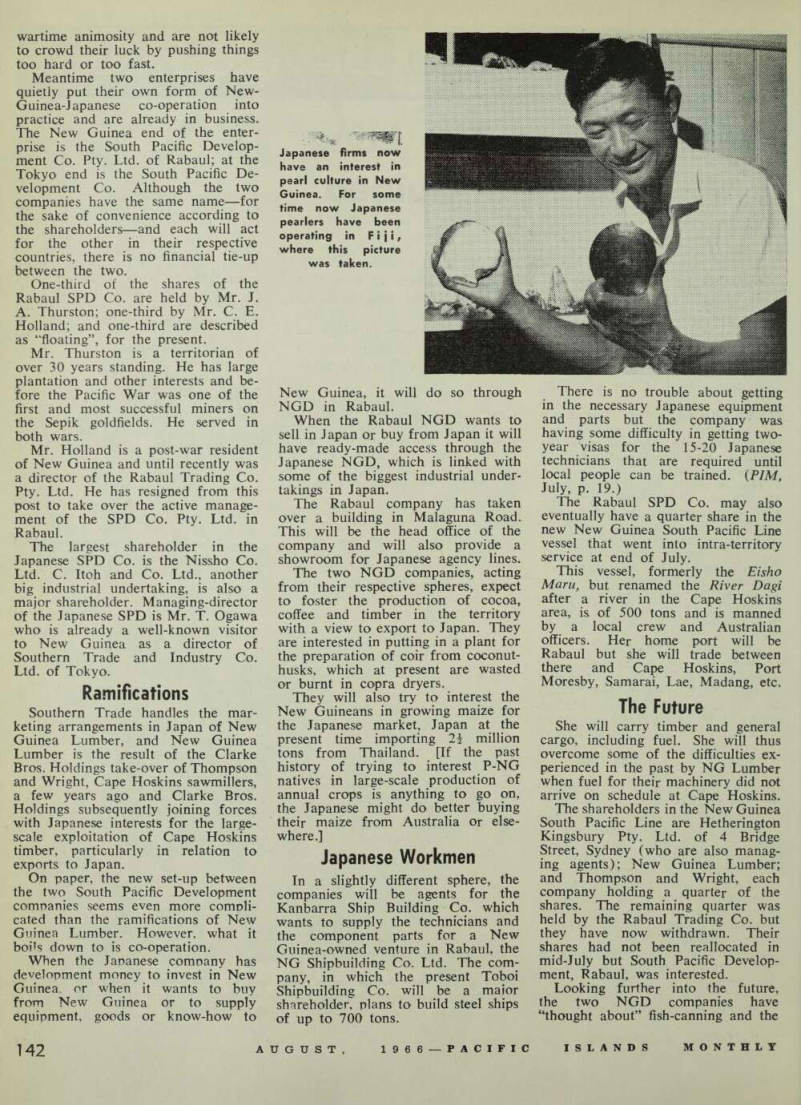
Japanese firms now have an interest in pearl culture in New Guinea. For some time now Japanese pearlers have been operating in Fiji, where this picture was taken.
exploitation of gold-lip pearl-shell for the cultured pearl industry; and, at the Japanese end, the manufacture of pre-fabricated houses from New Guinea timber.
Whatever doubts some Territorians might have about the appearance of the Japanese on the P-NG develop ment scene, at the very least it can be taken as a pretty shrewd Japanese assessment of the economic future of the territory.
As Mr. Ogawa points out, the Japanese Government does not sponsor private foreign investment just for the sake of getting a leg in.
There is still strict currency-control in Japan, so the fact that the Japanese Government Overseas Economic Co operation Fund has made a long-term advance of about $A500,000 for New Guinea, is regarded as significant.
Besides the programme mapped out by the South Pacific Development Company, other Japanese interests are already engaged in oil exploration and pearl culture in the territory.
Pearl Culture
Pearls Pty. Ltd., which is already producing cultured pearls at Kuri Bay, Thursday Island, has had a lease for experimental purposes inside Fairfax Harbour, Port Moresby, since last year. The lease is just across from Tatana Island and access is at present by water. The company has, however, applied for a lease to put up a laboratory on the foreshores.
A few Japanese experts are em ployed there and their efforts already look as though they are going to be very successful. A PIM representa tive in June saw one of their pearls that had been produced in only six months. It was almost half an inch in diameter, perfectly round and of excellent lustre. Even the Japanese seemed surprised at the rate of growth.
They said that Fairfax Harbour seemed a natural for pearl culture but that they had had some difficul ties when floods in the area earlier in the year had reduced the salinity of the harbour water temporarily.
All the pearls are grown in shell brought from Thursday Island.
Pearls Pty. Ltd. is 49 per cent.
Japanese owned; Brown and Dureau and associates own the rest of the shares. Mr. Neville E. Barnes is their Port Moresby agent.
Australia Aquitane Petroleum Pty.
Ltd. has commenced geological in vestigations in the Sepik, operating out of Maprik. (This area was one of the first areas of oil search back in the 1930’5, although Oil Search operated out of Maimai (west of Maprik) and Green River.)
Expansion For Fiji
Times And Herald
'Y'HE FIJI TIMES, the newspaper that boldly carries the claim that it is “the first newspaper published in the world each day”, is expanding.
In July work began on a big new two-storey building to cost about £F50,000, and when it is finished at the end of the year Fiji Times and Herald Ltd. will become the biggest and best-equipped printing and publishing organisation in the South Seas.
The Fiji Times carries its unusual claim in its heading because it is published each morning, except Sunday, in Suva, which is immedi ately westward of the 180th degree of longitude, where the new day begins. The newspaper was estab lished in 1869, and thus will shortly be 100 years old.
The new building, being erected by Reddy Construction Ltd., of Fiji, is immediately behind the present build ing in Gordon St., Suva.
The company was bought in 1956 from the late Sir Alport Barker by Mr, R. W. Robson on behalf of Pacific Publications Pty. Ltd. The owners since then have followed a policy of ploughing back the profits.
Within the last 10 years, the printing-works have been completely re-equipped with modern plant; The Fiji Times, has quadrupled circulation to an average near to 10,000 per day; the Indian weekly, Shanti Dut, has doubled its circulation; the circulation of a Fijian weekly news paper, Nai Lalakai, established four years ago, has been growing steadily; and, under the stimulus of modern plant, most of the colony’s com mercial printing now goes to the Times office.
Construction of an additional building was forced upon the com pany because the present building could not accommodate any more plant or staff, although the demand for both is acute.
In 1965 the company bought the whole of the central block behind The Fiji Times building, owned by the estate of the late Mrs. J. H.
Millett. It runs from Victoria Parade through to Butt Street, and includes the Well-known Millett Building. The new 'Fiji Times building will occupy most of the vacant land behind the Millett Building.
Much of the printing plant in the Gordon Street building will be moved into the new building, thus providing adequate room in the Gordon St. building for general, advertising and editorial offices. Commercial print ing will have a section of the new
building to itself, with an additional entrance from Butt Street.
A feature of this growth and development is that more than 90 per cent, of the company’s staff of 140 are Fiji-born, and nearly all the technicians have been trained there by the company. The management praises the quality of work done by the technicians. The printing staff is composed entirely of part- Europeans, Indians and Fijians.
Islands Newspaper
To Change Hands
The Samoa Bulletin, one of Western Samoa’s two weekly news papers, will probably be in new hands by the time this issue of PIM is published.
The Bulletin, which was founded 16 years ago, has been published by Samoa Printing and Publishing Company, headed by one of Western Samoa’s biggest businessmen, Mr.
Eugene Paul.
Mr. Paul said in mid-July that arrangements had almost been com pleted to sell the Samoa Printing and Publishing Company to Messrs.
Aitken Fruean and Rudi Ott.
Messrs. Fruean and Ott recently resigned from the positions of Gov ernment Printer and Deputy Gov ernment Printer respectively. Both have studied printing work in New Zealand and Australia, but have had no experience in the production of a newspaper.
Mr. Paul said they intended to develop the printing side of the com pany’s business, and to hire an editor to bring out the newspaper.
He added that with his many
enterprises (these include Polynesian Airlines, the Gold Star Transport Co. and a new Coca-Cola bottling company) he did not have sufficient time to devote to the printing and newspaper business.
Mr, Fruean recently denied a re port that the sale price for the Samoa Printing and Publishing Company was £WSIS,OOO. He indicated that the figure was lower than that.
Meanwhile, there is still doubt about the future of Western Samoa’s other weekly newspaper, Samoana, published by Samoa Newspapers Ltd.
In a court action earlier this year, Apia businessmen K. von Reiche and E. Annandale, and their wives, asked the court to wind up Samoa Newspapers Ltd., on the ground that a deadlock had been reached among shareholders.
The two couples hold 50 per cent, of the £6,000 paid up capital of Samoa Newspapers Ltd. The rest is held by the editor and managing director, R. F. Rankin, and by his mother-in-law, Mrs. P. Forsgren.
They opposed the petition on the grounds that it would be against the public interest to wind up the com pany, and they offered to buy out dissident shareholders at a price fixed by independent arbitration.
The court ruled that the two shareholding groups should try to come to an agreement between them selves, and that if no agreement was reached by August 1, the company should be wound up.
No agreement had been reached by July 27 when Samoana said in an editorial that its voice was near to being silenced.
It added: “If Samoana does dis appear or lose its familiar freedom, its tradition will continue in yet another paper with the same staff and familiar features, similar in everything but name.”
Some of the staff, directors and associates of the Fiji Times and Herald Ltd., photo graphed in Suva. Most of the staff members in the picture have long records of service.
Copra Report:
Outlook Bright
AFTER remaining steadily around the £Stg66 level for several weeks, copra prices moved upward quite smartly to £Stg6B, in mid-July.
Mr. lan McDonald, chairman of the P-NG Copra Marketing Board, said in Port Moresby on July 23; “Most edible oil-seeds also showed an upward trend, probably because of a growing resistance on the part of consumers against the abnormally high soyabean prices that have been having such an effect on the market over the last few months.
“However, as a result of recent adverse weather reports mainly affecting the Argentine groundnut crop and Philippine copra, coupled with the forecast that the 1966/67 soyabean crop will not greatly exceed that of 1965/66, it is likely that soyabean prices will again advance.
“Should this occur it is felt that both copra and coconut oil will be placed in a fairly favourable com petitive position, and consequently, with the drop in Philippine pro duction, the outlook for copra ap pears to be fairly bright.
“A further important factor affecting the market for edible oils and fats is the increasing demand for stock meals.
“Soyabean meal and cottonseed meal between them account for about 96 per cent, of the US supply, and with the heavy increase in live stock numbers in the US it is quite likely that US crushers will be com peting strongly with European crushers for these oilseeds during the coming season. Although most of the price rise will be related to meal, oilseeds, including copra, should share in a general price recovery.”
US Trust Territory
Copra Prices Down
fPHE Copra Stabilisation Board of the US Trust Territory lowered copra prices by SUSIO per short ton for all grades from July 1.
New prices are: Grade I $U5122.50; grade II $U5112.50; grade 111 $U5102.50; per short ton, delivered at district centre ware houses. Field prices are SUSIIO, SUSIOO and SUS9O, respectively for the three grades.
Following a meeting of the board on June 20, Mr. E. Rechucher, the acting chairman, said the action was necessary because copra prices in Japan markets had dropped sharply during the last three quarters. Con
sequently the stabilisation fund had suffered a loss of over SUS9O,OOO, and by the end of the quarter to June 30, expected to incur further losses of about SUS 23 6,000 as a result of stabilising prices paid to producers.
Mr. Rechucher said that a further drop in the prices paid to producers may be necessary if copra prices remain at the same level or drop lower during the next quarter.
CSR Chairman Issues
Sugar Warning
AN enormous number of people were being hurt by the present “deplorably low price” of sugar, the chairman of the CSR Co. Ltd., Mr.
J. W. Dunlop, said in his address to the annual meeting of shareholders in Sydney on July 20.
The economies of whole regions and countries depended heavily on sugar and largely on the world price, and Fiji, where sugar was the largest industry, was among the hard hit territories. If there was no inter national sugar agreement, a serious situation would rise there this season for both millers and growers.
The world price of sugar, when Mr. Dunlop gave his address, was £stg.l?/15/- a ton, having risen by £l/15/- a ton from the lowest price of the season.
Mr. Dunlop did not mention that Fiji, although likely to be hard hit, is fortunate at having assured sales of 140,000 tons (out of a record 311,000 tons produced in 1965) under the Commonwealth Sugar Agreement at about £FSO a ton; plus sales of about 40.000 tons to the US at un stated prices (but much better than
the world price); and a contract to supply a certain tonnage to Malaysia.
Mr. Dunlop said the difficulties of achieving an international agreement included the differing political atti tudes and policies of East and West, the intentions of Cuba, and the less-than-deep concern of several countries which exported only small proportions of their total production.
CSR was extremely active in seek ing ways to better the situation, and both by itself and with others it had made sure that all governments con cerned were fully informed of the seriousness of the problem.
The company’s profit for the 12 months ended March 31 was $12,913,130, a drop of $132,592 compared to the previous year. The dividend was steady at 12± per cent, (including a final of 6£ per cent.).
Two New Factories
For Tonga
Riechelmann Bros., Of Nuku
alofa, have enlarged their busi ness ventures with a biscuit factory, the first to be built in Tonga. The factory began producing cabin biscuits in July.
Future plans include the making of various types of sweet and fancy biscuits to supply the whole king dom.
The kingdom currently spends more than £19,000 annually in importing biscuits.
A recent newcomer to the Tonga Copra Board, Mr. Charles Bax, has formed the Hygienic Butchery, which aims to produce enough pro cessed pigmeats, including bacon, hams, pickled pork and smallgoods,
to supply Tongan demand and later for export.
With guidance from the Agriculture Department, farmers will be instructed in modern methods of feeding and pig husbandry, which should result in an increase in quality as well as quantity. Hygienic Butchery is using the brine and sugar method followed by smoking.
Islands Market For
Tongan Vegetables
and vegetables produced in A Tonga are now being exported regularly each month to American Samoa, and the earnings from these shipments in overseas funds are close to those from a single shipment of bananas to New Zealand.
Tonga’s King Taufa’ahau stated this when he officially opened Tonga’s Legislative Assembly in Nukualofa in late June.
“If we could do the same with Fiji, which has recently lifted some of her restrictions on produce enter ing the Colony, this could become another source of overseas revenue,” he added.
A trial shipment of Tongan vege tables was taken to Suva by Fiji Airways in late July. The vegetables were grown by Mr. W. P. Wight who has a 20-year lease of 135 acres of land on Tongatapu and has 20 Tongans working for him, Mr. Wight began growing vege tables last July, and shipped 600 cases of tomatoes to New Zealand late last year. He is the only large scale grower in Tonga at present.
Oil Palm Venture
For New Britain
AN oil palm scheme for New Britain, reported in PIM in July (p. 140) was officially confirmed in Canberra on July 8. The P-NG Ad ministration is advertising for lease a block of about 5,000 acres for grow ing of oil palms in the Cape Hoskins area.
The Minister for Territories, Mr.
Barnes, said it was suggested that oil palm could be grown in the territory on a system involving a main plant ation, processing factory and associ ated native smallholdings. A large capital outlay would be required for the initial plantation establishment, and the government “would consider a measure of financial participation in the project.”
Mr. Barnes added that the Govern ment had already received a proposal from Harrisons and Crosfield (ANZ) Ltd.