travel
pp. 129-131 · Read in the full issue
American Samoa's Tourist Era Begins On A Pricy Note
From Robert Langdon, PlM’s Assistant Editor, in Pago Pago Here in Pago Pago, they tell the story of a young American who got so angry at the high prices, poor service and indifferent food at the new Pago Pago Intercontinental Hotel that, with the permission of a chief, he pitched a tent in the district of Tafuna and lived in it for the rest of his stay in American Samoa.
THE event is said to have occurred early this year when the hotel, which was officially opened last De cember, was only a few weeks old.
It could conceivably happen again now, for many American tourists visit ing Pago Pago become furious at the poor value they get for their money at the Intercontinental.
A tourist from Ohio described the hotel to me as “a disgrace”. Another said it was a “blot on the American image.” And a third said: “Why come all the way down here when in Hawaii you can get all that this place has to offer, and more, for much less?”
American residents of Pago Pago call the hotel the “Luxury Club,” and sound rather sorry for you when you tell them you are staying there.
But the fact is that, short of pitch ing a tent, sleeping on a mat in a Samoan fale, or finding a local State sider to take you in, there is nowhere else you can stay. You are equally at the hotel’s mercy when it comes to food, as Pago Pago as no restau rants worth mentioning.
As prices now stand, by Australian and New Zealand standards, the Inter continental is strictly for millionaires
travel
and absconding oil company account ants.
Single rooms cost from SUSIS to $22 a day (without food), and doubl; rooms are $lB to $25, at base rates.
In addition, there is a service charge of 10 per cent. So single rooms actually cost from $16.50 to $24.40 a day; and doubles are from $19.80 to $27.50.
The rooms are large, well furnished, light, cool, and pleasantly decorated. They have elegant bath room and toilet facilities, “piped”
Hawaiian music playing day and night, and telephones.
You can turn on the Hawaiian music without paying for it.
But it is typical of the hotel’s “slug em-for-everything, and slug-em-hard” approach that every time you pick up your telephone to make a local call, a charge of 20 cents (US) rings up on your bill.
No information is available in the rooms to warn unwary guests of
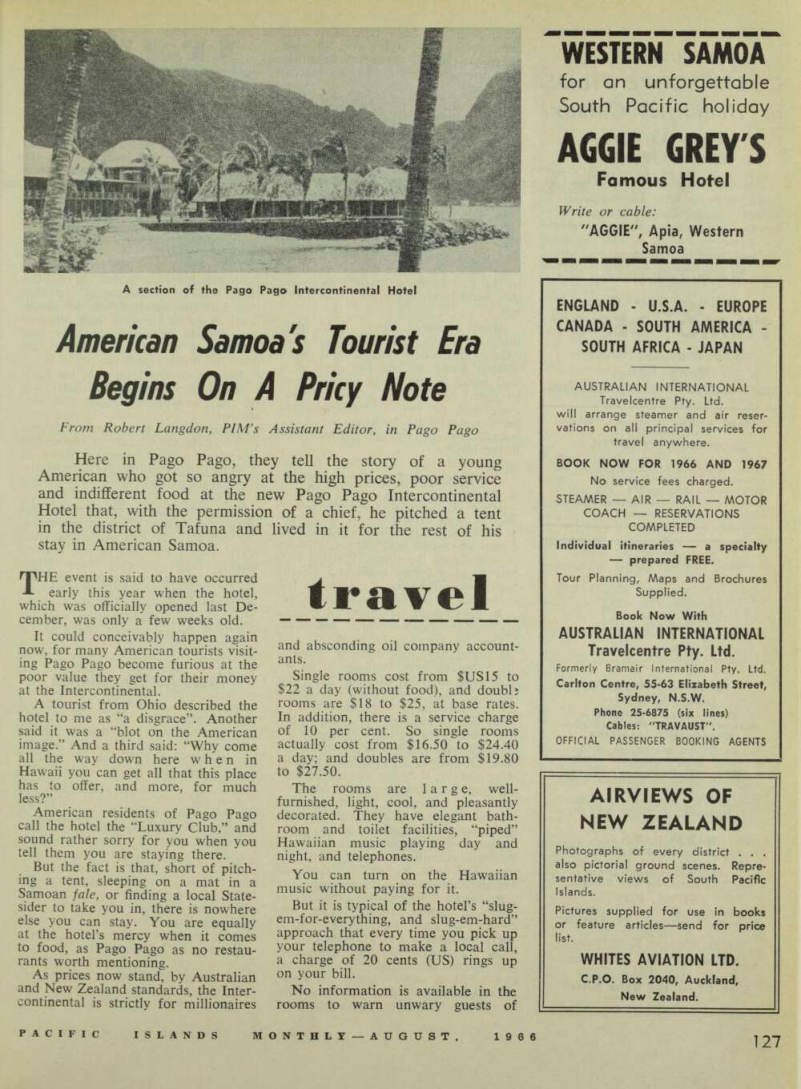
A section of the Pago Pago Intercontinental Hotel
these high telephone charges (which are twice as high as Stateside charges). Nor is there any informa tion on room tariffs, laundry prices, etc.
It is virtually impossible even to sit down at the hotel’s snack bar with out running up a bill for at least $2, for even a toasted sandwich can cost as much as that, and there is always a 10 per cent, service charge to be added. More often than not your snack is cold by the time it reaches you.
The Samoan waitresses, although pleasant to look at in their bright red and white puletasis, are not swift on their feet. The snack bar is half-open to the ever-blowing Trade winds, and this wind is no respecter of anything hot.
Many guests, I found, lived spar ingly on snack bar hamburgers, fish cakes, and chow mien, and were seldom game to add the cost of a real meal in the hotel dining room to their bill. They avoided liquor after one or two frighteningly ex pensive sorties to the hotel bar. They bought no souvenirs from the stall in the lobby.
Reasons For Prices
There are apparently several reasons for the high prices: • Intercontinental Hotels (the Pan American-owned operating company) is working on the theory that the first patrons at any new hotel in a distant place are well-heeled members of the jet set for whom money is no object. • Because of the enormous sums of money poured into American Samoa by the US Government and the many new jobs created thereby, the Samoans have virtually given up tilling the soil and catching fish. The result is that even local foodstuffs for the hotel have to be imported. • The Samoans, through the American Samoan Development Cor poration, put up $300,000 to build the hotel. Being unaccustomed to long term planing, they are already becom ing impatient for dividends on their investment. However, beginning in a couple of years, the Samoans must also start paying back a loan to build the hotel of $1,500,000 from the Small Business Administration in Washing ton. The loan is for 20 years and carries interest of 5 per cent, or thereabouts. Therefore, the hotel must be made profitable, on two counts, as soon as possible. It is operating in the red at present. • There are far too many em ployees at the hotel. The total is about 200, or one employee for every potential guest. However, as the occupancy rate has only been about
35 per cent, since the hotel opened, there are really three employees for every guest. The over-staffing is often painfully obvious. One morning, for example, I counted eight guests in the snack bar for breakfast and 11 cooks, waitresses and cashiers to look after them.
As the minimum hourly wage in the territory is 49 cents, and as the working week is 40 hours, the mini mum weekly wage bill for the hotel is at least 53,920.
The reason for the large staff is probably more a matter of politics than one of management, in that the Samoan shareholders no doubt want to see as many of their relatives and friends employed there as pos sible. Most of these have never had previous hotel experience.
Despite all the foregoing, the local tourist authorities say the hotel will be fully booked in August and Sep tember.
From then on they expect a 50 per cent, occupancy rate or better as American Samoa becomes known as a tourist resort through an advertis ing campaign now under way in the US Press.
The authorities have no misgivings about the future. They see encourag ing portents in Pan American Air ways’ recent decision to put a third weekly flight through Pago Pago; BOAC’s expressed interest in Pago as a stopping place; and Air New Zealand’s continually full planes from Auckland and Nadi, which may re sult in a second weekly flight before long.
More Accommodation
So rosily, indeed, do the tourist authorities see the future that plans have already been announced to build additional accommodation at a cost of about $500,000. Work is expected to start on this at the end of this year.
The additions will be in the form of two “long houses”, containing a total of 60 double rooms. This will bring the number of beds available to 322.
The Public Works Department is also to build a sandy beach near the hotel by overlaying the coastal reef with sand dredged from other parts of Pago Pago Harbour. The beach will be more than half a mile long.
Work will begin on this as soon as a current job of reclamation in Pago Pago Harbour is completed, probably in August The current job, which is being
carried out with a dredge hired from the Western Samoan Government, is to create a national park at the innermost end of the harbour. This is being done by filling in four or five acres of shallows with sand and mud sucked from the harbour bed nearby.
When the land for the national park has been created, each chief in nearby Pago Pago village will be asked to build and maintain a guest fale (Samoan-style house) in the park. All these fates together will form a model village, which will be open for inspection by tourists.
If the present rapid trend towards Western-style houses continues, as it almost certainly will, they will probably be the only fates in all Tutuila (American Samoa’s main island) within two years or so.
It is also proposed to build sports facilities in the national park and facilities for picnics. A Samoan museum might also be built there eventually.
Other plans for the development of tourism in the territory include: • A second hotel, possibly on re claimed land at Tafananai in Pago Pago harbour. • A coffee and souvenir stall, and a garden of tropical flowers on the top of Mt. Alava, where the transmission towers for American Samoa’s educational television system are situated. (Mt. Alava, 1,809 ft high, is on the opposite side of Pago Harbour to the hotel. It is reached by an aerial tramway which takes
you to the top in 6i breathtaking minutes for $2.50 return). • A golf course at Aoloau, a dozen or so miles from Pago Pago.
Aoloau is about 1,000 ft above sea level. Sufficient US Federal funds have been allocated for a survey of the golf course site, and a well known golf course designer, Mr.
Robert T. Jones, of New Jersey, has been asked to do the survey. • The commissioning of two deep sea fishing boats, which will take tourists out to the prolific fishing grounds two or three miles off the coast of Tutuila. One of the boats arrived early in July, The other was expected in a few weeks.
American Samoa’s Director of Tourism, Fofo I. F. (Joe) Sunia, told me: “We believe that tourism will be American Samoa’s basic industry in the future.”
Certainly, American Samoa has the scenery—if few other attractions at present—to bring the tourists.
But it is foolish to charge them exorbitant prices if an industry is to be built up.
Footnote: Non-American visitors to Pago Pago should make sure they have enough US currency to pay their bills, otherwise they are likely to lose heavily on exchange. The Intercontinental Hotel accepts Aus tralian currency dollar-for-dollar with the US variety. This means that Australian travellers lose about 11 cents on each Australian dollar.