travel
pp. 123-127 · Read in the full issue
The Trouble With New Guinea Tourism Is That It Isn't Necessary
From Judy Tudor, in Port Moresby The 12-member Papua-New Guinea Tourist Board that is soon to be appointed is going to have a 12-man-sized job moulding what passes for travel in the territory into anything re sembling a tourist industry. They will have to begin right here at the point of entry—the so called international airport at Port Moresby.
RECENTLY when I landed at 6 a.m. after the usual midnight-to dawn flight from Sydney about 50 people disembarked to pass through the inadequate facilities. Two officers dealt with entry requirements, which took approximately half an hour. As each pasenger got through check point one he retrieved his luggage from the wagon and stood with it until the small area was packed with sweating bodies and baggage.
Then and only then did two Customs officers start the second phase of processing. After that was over the passengers had again to shoulder their gear and drag it out into the milling reception area of the terminal, a place from which the most conspicuous missing article is the reception.
This is standard procedure for ar rival in the territory. Of course, over 90 per cent, of the people who pass through those Customs-hall doors into the bright exotic air of Papua-New Guinea are not strangers in the strict sense of the term, and these are swiftly picked up and removed in private cars by friends, relatives or business contacts.
No Welcome
Only a handful will have eventually to go into town “in the company coach” and for these there is no wel come. On them P-NG turns an in different back because to be new not to belong, not to know what gives —are still unforgiveable sins in the territory. These strangers at the air port could, you feel, drop dead and no one could care very much.
To be sure, the age of tourism hasnt yet begun. This is something that will happen in some magical way, soon, because the World Bank report said that it would be a good thing. Then, perhaps, there may be a welcoming smile to lighten the bleakness of a visitor’s first impact with Jackson’s Airport, Port Moresby.
In the meantime things are very much as they have always been.
travel
Fundamentally white Territorians— including some hotel employees—still dislike tourists and this attitude now seems to be rubbing off on the New Guineans. Except in the Highlands, where you still get a cheery smile and a greeting from natives, I’ve seen no indication in recent years that Lowlanders are in the slightest degree interested in having tourism.
They are too preoccupied with emancipation at the present phase of their development and probably need much more time before anything else is foisted on them.
Hotels Are Busy
But even while this apathetic atti tude prevails over so much of the community, travel services and hotels have never been so extended as at present. Planes are almost always full and hotels in the main centres
must have pretty nearly a 100 per cent, occupancy rate.
This is partly accounted for by the peregrinations of local public ser vants and short-term imported ex perts who are forever on the move; partly by the large influx of people on big building projects such as those now being undertaken for the army and air force; and partly by the fact that Australian business has at last discovered the territory and sends a never-ending stream of people there to sell or to gather information.
More Needed Yet
Up to quite recently nothing had been done to cater for this growing traffic and although quite a few pro jects are now in the works they will not, to my mind, do more than cope with the normal growth of this pro fessional and business clientele, Large-scale hotel and motel building for a large-scale tourist industry ia still far away.
The hotel owners of the territory cannot be blamed too much for this.
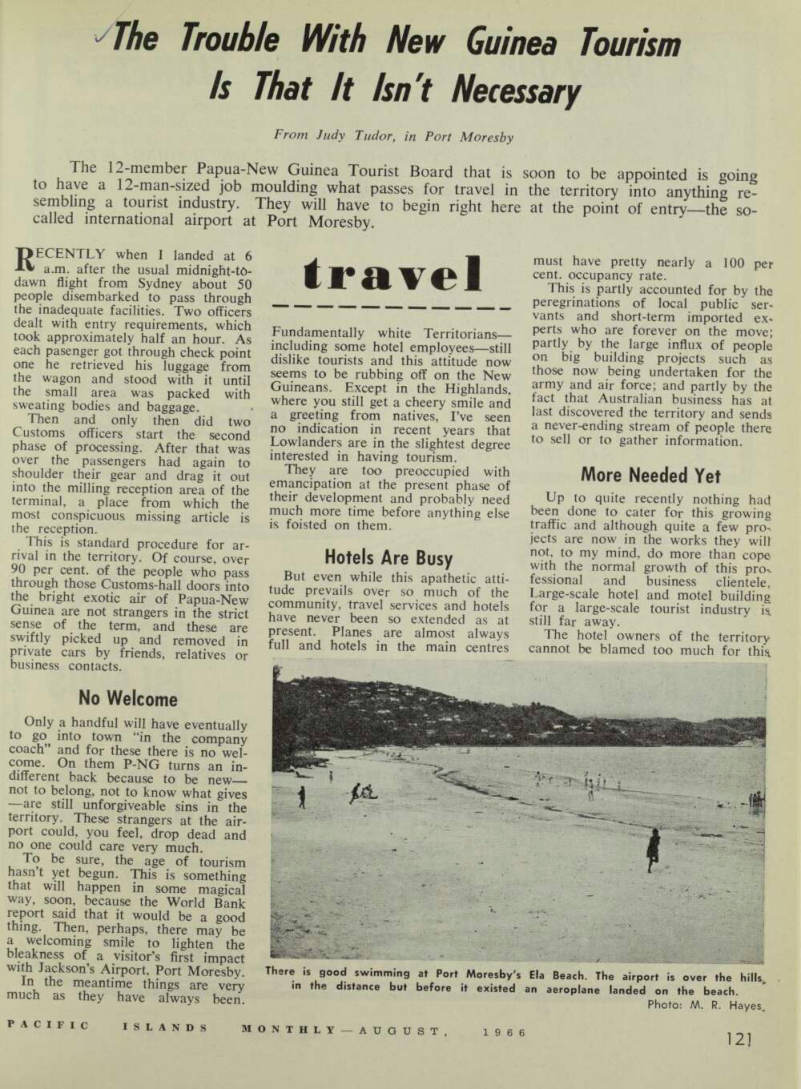
There is good swimming at Port Moresby's Ela Beach. The airport is over the hills in the distance but before it existed an aeroplane landed on the beach.
Photo: M. R. Hayes.
state of affairs. Up to now there has been no official encouragement of tourism—to the contrary; and no assistance with long term credits or financing. Building of any sort is very expensive in P-NG, depreciation and deterioration are about twice the rate you can expect in Australia; trained staff difficult to come by.
In 1962 when prohibition on native drinking was lifted the hotels certainly had an abrupt increase in revenue but the new customers created a space problem for which proprietors had not prepared and which they are be ginning to solve only now.
Under all the circumstances per haps one should be surprised not that so little has been done in the territory to make hotels more civilised, but that a few people are now actually engaged in doing something.
Moresby Plans
In Port Moresby work is pro gressing with The Gateway Hotel, owned by a Patair subsidiary. The location is right at Jackson’s Airport, seven miles from the centre of the town and although the management intends to provide some sort of bus service the hotel will not be very convenient for business visitors.
It will serve conducted tourist parties well and probably will be a boon when jets begin to operate between Sydney and Port Moresby, and feeder services to the rest of
Madang has not long added a block of about 10 luxury suites right down on the harbour front. Each is air conditioned and equipped with phone, small refrigerator and private bath room. The furnishings are modern and the rooms are much in demand.
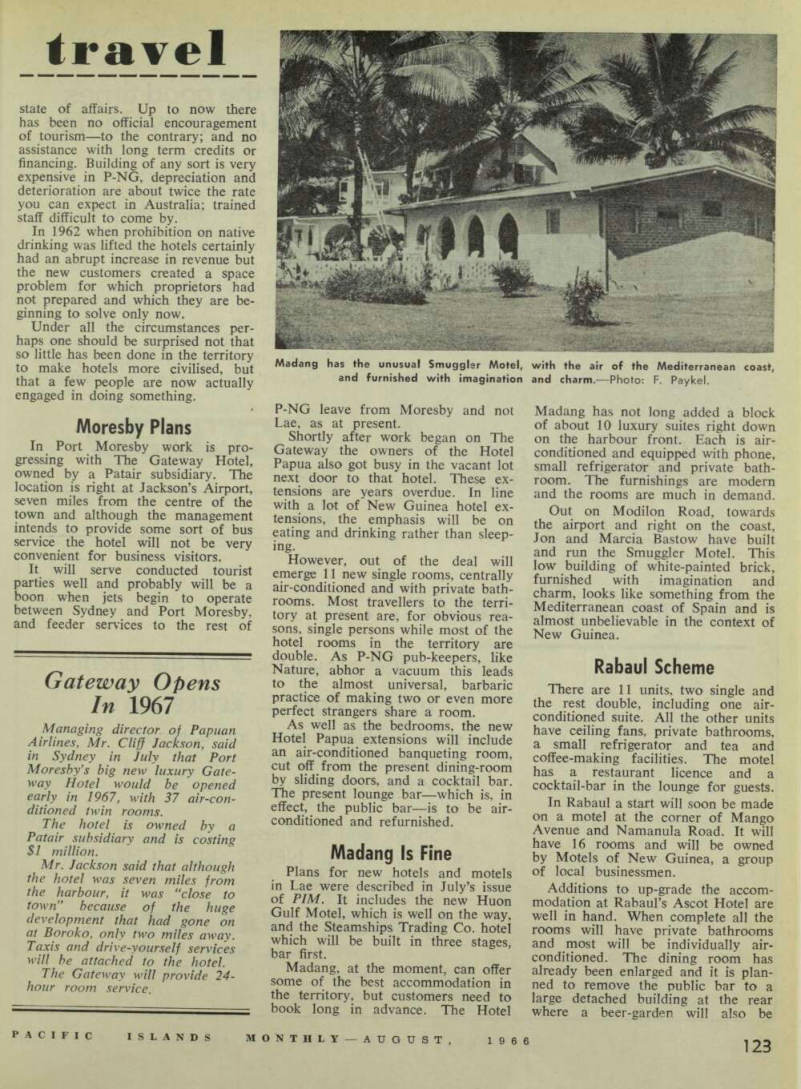
Out on Modilon Road, towards the airport and right on the coast, Jon and Marcia Bastow have built and run the Smuggler Motel. This low building of white-painted brick, furnished with imagination and charm, looks like something from the Mediterranean coast of Spain and is almost unbelievable in the context of New Guinea.
Rabaul Scheme
There are 11 units, two single and the rest double, including one air conditioned suite. All the other units have ceiling fans, private bathrooms, a small refrigerator and tea and coffee-making facilities. The motel has a restaurant licence and a cocktail-bar in the lounge for guests.
In Rabaul a start will soon be made on a motel at the corner of Mango Avenue and Namanula Road. It will have 16 rooms and will be owned by Motels of New Guinea, a group of local businessmen.
Additions to up-grade the accom modation at Rabaul’s Ascot Hotel are well in hand. When complete all the rooms will have private bathrooms and most will be individually air conditioned. The dining room has already been enlarged and it is plan ned to remove the public bar to a large detached building at the rear where a beer-garden will also be
P-NG leave from Moresby and not Lae, as at present.
Shortly after work began on The Gateway the owners of the Hotel Papua also got busy in the vacant lot next door to that hotel. These extensions are years overdue. In line a < lot ,. of New Guinea hotel ex- L W ,u be , 0n eating and dnnkmg rather than sleep- ID u . ~, , , °^ e yf r ’ out . the ea * ne * sm ® e . r ,? oms ’ cent ‘ a * y 7™°”' dlt M°“ t d . and Y f nV .t n^°l, tr a av ? rs K • ory at present are, tor obvious reasons, single persons while most of the hotel rooms in the territory are double. As P-NG pub-keepers, like Nature, abhor a vacuum this leads to the almost universal, barbaric a BrtW° 8 r tW ° ° r eTCn m ° re p A Ir anS kT a rOOl Y' hAt p“, * h t bedrooms l, the , ne . w Hotel Papua extensions will include an air-conditioned banqueting room, u , he pre ent dl 7!‘^ r0 u Om by sliding doors, and a cocktail bar.
The present lounge bar—which is, m effect, the public bar—is to be airconditioned and refurnished.
Ail r* lYidudnQ IS rme Plans for new hotels and motels in Lae were described in July’s issue of PIM. It includes the new Huon Gulf Motel, which is well on the way, and the Steamships Trading Co. hotel which will be built in three stages, k a £ir^j St ' Madang, at the moment, can offer some of the best accommodation in the territory, but customers need to book long in advance. The Hotel
Madang has the unusual Smuggler Motel, with the air of the Mediterranean coast, and furnished with imagination and charm.— Photo: F. Paykel.
built. This will allow alterations to the present lounge-bar.
When a tourist industry finally gets going in the territory there will be scope for the provision of ancilliary services. At present it is a wide-open field with only a few people provid ing bus excursions and boat and reef trips. Most people going to the terri tory on business now hire a drive yourself vehicle which almost doubles their daily expenditure. Car-hire works out roughly at about $lO a day, although in the Highlands I have paid as much as $l5 per day for a VW car. The rate does not vary much whether you hire a recent model from one of the well-known rental firms or a beat-up old job from some of the less well known.
Most of the towns have taxis, some of them radio-equipped. But by and large the supply is inadequate for present demand and could not hope to cope with a regular influx of tourists.
Disgraceful Taxis
Some of the vehicles used for taxis are a disgrace—dirty, beaten up, with doors that won’t open, no handles, split upholstery, an engine that sounds as though it could drop out on the road at any moment. Presumably there is some sort of check before registration, but it is hard to believe it.
Making entry relatively painless, providing that welcome smile, boost ing new hotel building, organising sightseeing, taxis and transport—these are just some of the things that the Tourist Board will have to deal with before Papua-New Guinea can get into the same tourist league as Fiji, Tahiti or New Caledonia.
Evidently authority thinks that it is worth the effort; and that to pre sent P-NG with a ready-made tourist industry “at the time of self government” would be a good thing.
Although, as an individual, I am glad of any progress that will make visits there anything less like plain hell, as an onlooker I am far from convinced that the territory at present needs tourism as a national project.
The place is rolling in money. It is largely unearned, give-away money but it provides a climate in which it is difficult to see manufactured tourism as an urgent necessity. Be cause it is not urgent it becomes just twice as difficult to get it off the ground.