Yesterday
p. 95 · Read in the full issue
As the issue of PIM for August, 1946, went to press Papua and New Guinea planters and traders were indignant about the Australian Government's handling of war surplus disposals. Earlier in the year, Canberra had given assurances that the Administration and returning territorians would have first choice of goods sold by Commonwealth Disposals but a meeting of ex-servicemen in Rabaul, on August 6, protested that the Government had not kept its promise, and that large quantities of goods had been sold to outside buyers.
OTHER items from that issue of 20 years ago were: — TRANS-PACIFIC air transport was still having teething troubles 10 months after the end of the Pacific war. The American and Australian Governments had been negotiating for some months on reciprocal landing rights but still had not reached agreement.
Pan American Airways com menced San Francisco to Auck land flights in early June but these were later dropped when all Constellation aircraft were grounded due to a series of ac cidents with these planes in the United States. In Fiji the relative merits of Nadi and Nausori as an international airport were still being discussed. Air services from New Zealand to Fiji, Western Samoa, Tonga and the Cook Islands were being operated by the Royal New Zealand Air Force.
THERE were proposals for Australian National Airways to use the big wartime airfield at Nadzab, in NG’s Markham Valley, as a stop-over on a planned Sydney - Manila air service. It was understood that this service would later be operated by BOAC—as a joint venture for Britain, Australia and New Zealand. (Nadzab has only recently been reconstructed as an RAAF staging strip).
AS far as PIM was concerned a most important piece of news in August was that Mrs.
Judy Tudor, of the editorial staff, had received a permit from the Australian Department of Ex ternal Territories to visit Papua and New Guinea in September.
No PIM representative had been permitted to visit the Australian territories since the war. They had always been refused because Mr.
Ward, Minister at the time, had objected to PlM’s outspoken views on his approach to New Guinea affairs.
A LIMITED number of Japan ese workers had been per mitted to return to Angaur Island in the Palau Group to mine phosphate rock for fertiliser for Japan. The Palau Group was formerly part of the Japanese mandated territory of the Marshalls and Carolines.
PROPOSALS to undertake the manufacture of plaster and cement sheets, makita nut board and makita nut “wood flour” in Suva, Fiji, had been put forward by an Australian, Mr. J. T. Col lins. There was a steady overseas demand for “wood flour” as a base in the manufacture of plastics and it was thought that Fii would have a valuable new export—if the makita nuts proved suitable for the purpose.
CALIFORNIAN business
interests, had been agitating in Washington for the State Department to seek fishing bases in the South Pacific so that Ame rican fisheries could exploit the untapped tuna resources of the area. One of the leaders of the movement to secure fishing bases, Dr. W. Chapman, of the Califor nian Academy of Sciences, pointed out that the seas surrounding the Gilberts, Masquesas, Fii, Tonga, Cooks, Samoa and Tuamotus, had never been touched as far as tuna fishing was concerned. (A large tuna fishing and canning industry is now based in Pago Pago, Ame rican Samoa, using Japanese fisher men).
THREE young Fijian chiefs were to go Oxford to com plete their studies. They were Ratu Edward Cakobau, Ratu Penaia Ganilau and Ratu Mara. The first two had been selected for special training for appointment
in the Colonial Administrative Service and Ratu Mara was to read for a degree in economics.
The three were to go into residence at Wadham College, where Ratu Sir Lala Sukuna had been an undergraduate 30 years previously.
MAIN topic of interest in the Solomons was the acquittal of a part-European trader, John McDonald, of charges of col laborating with the Japanese, recruiting native labour for them and being instrumental in the handing over of grounded Ame rican pilots to the Japanese in the Shortland Islands group, northern Solomons. McDonald’s main defence lay in the production of documents proving that in the eyes of the Government he was regarded as a native and not as a European.
Employees of the British Phosphate Commission on Nauru were having a difficult task in the reconstruction of phosphate workings and equip ment after the Japanese occupa tion of the island. The Japanese had taken all the good steel from the cableways buildings, bins and cantilever and incorporated it in their pill-boxes and underground fortifications. Rehabilitation was further hampered by lack of skilled labour. The Gilbertese labourers on Nauru were soon to depart for home and 800 Chinese workers were to replace them.
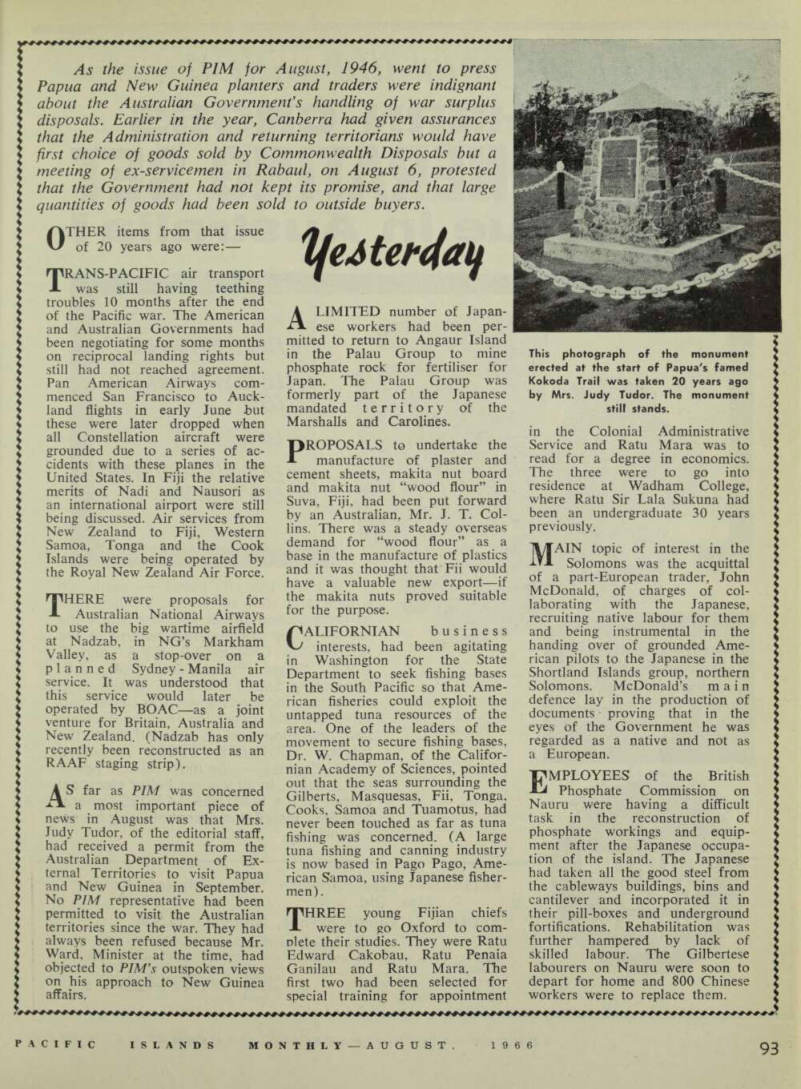
This photograph of the monument erected at the start of Papua's famed Kokoda Trail was taken 20 years ago by Mrs. Judy Tudor. The monument still stands.