Blueprint For A
pp. 73-75 · Read in the full issue

Fijian Paradise
From a Suva Correspondent It all began with the Bolsheviks after the great famine, which killed millions of Russians. The millions who survived were restive and the Reds had a problem on their hands. So, they produced the first Five-Year Plan—and ifs been a favourite pursuit of Governments ever since.
NOW Fiji’s Government has pro duced a new Five-Year Plan of development, which will cover the period between now and 1970. Un like many others of its ilk, it is pretty well down-to-earth. That is, if one bears in mind the wise words of Robbie Burns anent mice and men, Fiji’s planners are cautious, how ever. None of their previous plans bore out the promise contained in their pages.
And this one has a very formidable hurdle to clear—a self-governing Fiji.
Perhaps that’s one reason for the timing of the plan, a kind of gesture to the people of Fiji from the Colonial Office: “Here’s a blueprint for paradise and you’re on your own”. ' The plan was published on July 1 in five blue-backed volumes. One is a review of the whole scheme, probably for those mildly interested in the mechanics of the thing; and there are four others—education and health, agriculture and forestry, com munications and public utilities, and public expenditure.
Over To Tourism, Timber
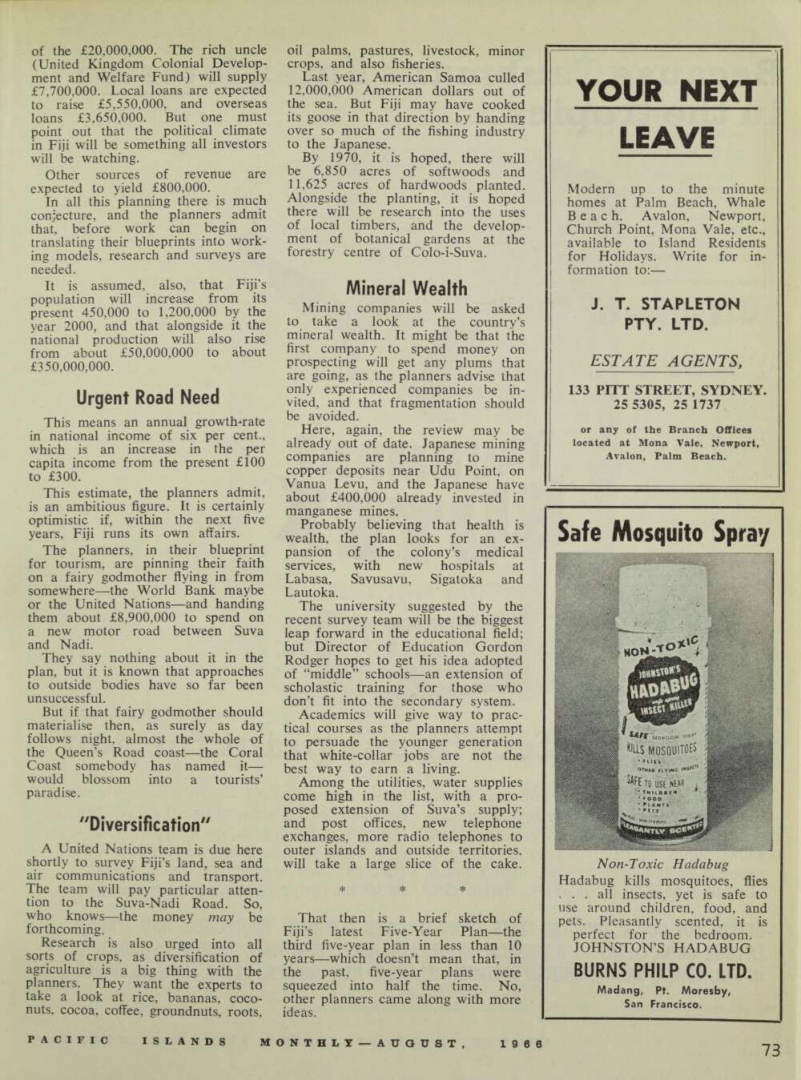
For the first time—and it’s the most striking thing about the plan— emphasis has been shifted from the colony’s two traditional main sources of income, sugar and copra, to tourism and forestry.
That is one indication of some realistic thinking. Sugar, which is these days often a plaything of politics, occupies a lower place at the planners’ table and, perhaps, the inexorable flight of the rhinoceros beetle towards Fiji’s main copra areas has coloured thinking more than somewhat.
The exploitation of Fiji’s forestry potential has hardly begun, say the planners, and the same goes for tourism. The planners, looking into their crystal, see, in the year 2000, tourists bringing £35,000,000 into the
colony and lumberjacks transmuting Fiji’s wood into £100,000,000-worth of gold.
Sugar, estimated to be worth £20,000,000 by then, lags far behind.
The coconut industry is expected to yield only £4,600,000 over the next 12 to 15 years. Bananas, attended by a crop of “ifs”, are expected to yield an income of £50,000 a year.
A Rich Uncle!
It has taken two years to prepare the plan and, as has been pointed out already, it is based on estimates of cost which are already out of date.
There was a government wage award in March which will have affected the position more than a little, and soon the colony’s Provident Fund will dip into the pockets of the people.
The plan proposes capital expendi-
ture of £20,000,000 in the next five years; and this will be increased by £1,800,000 —if the rich uncle abroad can afford it.
Here is where most of the money will go: Agriculture £580,000; agricultural subsidies £1,343,000; land develop ment £690,000; education £2,068,000; medical services £2,523,000; roads £3,396,000; postal and telegraph services £2,395,000; water supplies £1,259,000, and government build ings £1,567,000.
The details of what Fiji is to do with the money, and what it may expect the money to produce, are contained in three of the blue books.
And who foots the bill? The tax payers of Fiji will find £2,800,000
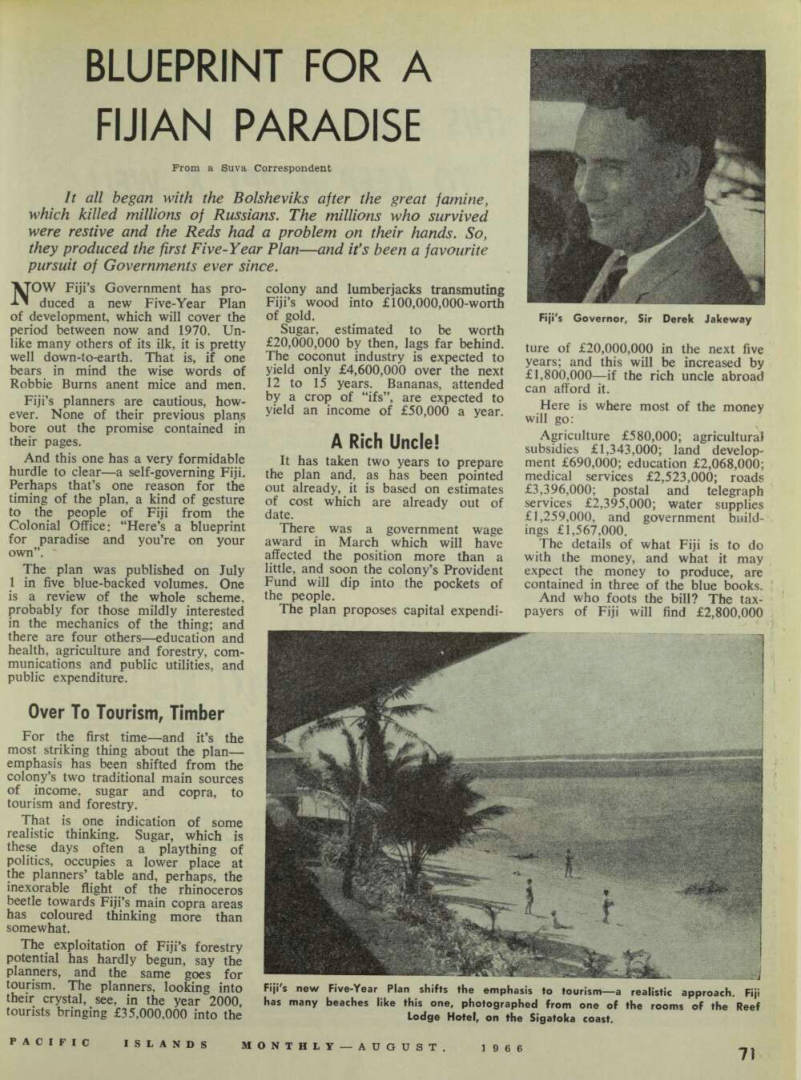
Fiji's Governor, Sir Derek Jakeway
Fiji's new Five-Year Plan shifts the emphasis to tourism—a realistic approach. Fiji has many beaches like this one, photographed from one of the rooms of the Reef Lodge Hotel, on the Sigatoka coast.
of the £20,000,000. The rich uncle (United Kingdom Colonial Develop ment and Welfare Fund) will supply £7,700,000. Local loans are expected to raise £5,550,000, and overseas loans £3,650,000. But one must point out that the political climate in Fiji will be something all investors will be watching.
Other sources of revenue are expected to yield £BOO,OOO.
In all this planning there is much conjecture, and the planners admit that, before work can begin on translating their blueprints into work ing models, research and surveys are needed.
It is assumed, also, that Fiji’s population will increase from its present 450,000 to 1,200,000 by the year 2000, and that alongside it the national production will also rise from about £50,000,000 to about £350,000,000.
Urgent Road Need
This means an annual in national income of six per cent., which is an increase in the per capita income from the present £lOO to £3OO.
This estimate, the planners admit, is an ambitious figure. It is certainly optimistic if, within the next five years, Fiji runs its own affairs.
The planners, in their blueprint for tourism, are pinning their faith on a fairy godmother flying in from somewhere —the World Bank maybe or the United Nations—and handing them about £8,900,000 to spend on a new motor road between Suva and Nadi.
They say nothing about it in the plan, but it is known that approaches to outside bodies have so far been unsuccessful.
But if that fairy godmother should materialise then, as surely as day follows night, almost the whole of the Queen’s Road coast—the Coral Coast somebody has named it— would blossom into a tourists’ paradise.
"Diversification"
A United Nations team is due here shortly to survey Fiji’s land, sea and air communications and transport.
The team will pay particular atten tion to the Suva-Nadi Road. So, who knows—the money may be forthcoming.
Research is also urged into all sorts of crops, as diversification of agriculture is a big thing with the planners. They want the experts to take a look at rice, bananas, coco nuts, cocoa, coffee, groundnuts, roots,
oil palms, pastures, livestock, minor crops, and also fisheries.
Last year, American Samoa culled 12,000,000 American dollars out of the sea. But Fiji may have cooked its goose in that direction by handing over so much of the fishing industry to the Japanese.
By 1970, it is hoped, there will be 6,850 acres of softwoods and 11,625 acres of hardwoods planted.
Alongside the planting, it is hoped there will be research into the uses of local timbers, and the develop ment of botanical gardens at the forestry centre of Colo-i-Suva.
Mineral Wealth
Mining companies will be asked to take a look at the country’s mineral wealth. It might be that the first company to spend money on prospecting will get any plums that are going, as the planners advise that only experienced companies be in vited, and that fragmentation should be avoided.
Here, again, the review may be already out of date. Japanese mining companies are planning to mine copper deposits near Udu Point, on Vanua Levu, and the Japanese have about £400,000 already invested in manganese mines.
Probably believing that health is wealth, the plan looks for an ex pansion of the colony’s medical services, with new hospitals at Labasa, Savusavu, Sigatoka and Lautoka.
The university suggested by the recent survey team will be the biggest leap forward in the educational field; but Director of Education Gordon Rodger hopes to get his idea adopted of “middle” schools—an extension of scholastic training for those who don’t fit into the secondary system.
Academics will give way to prac tical courses as the planners attempt to persuade the younger generation that white-collar jobs are not the best way to earn a living.
Among the utilities, water supplies come high in the list, with a pro posed extension of Suva’s supply; and post offices, new telephone exchanges, more radio telephones to outer islands and outside territories, will take a large slice of the cake. * * * That then is a brief sketch of Fiji’s latest Five-Year Plan—the third five-year plan in less than 10 years—which doesn’t mean that, in the past, five-year plans were squeezed into half the time. No, other planners came along with more ideas.