Airlines Fail To
pp. 49-53 · Read in the full issue

Meet The Challenge
In Ng Highlands
Prom a Highlands Correspondent Even with the impending in troduction of a jet service be tween Australia and Lae, and with turbo-prop internal services but a few months off, Terri torians feel that air services in the New Guinea Highlands leave much to be desired.
MOST regular air services remain over-booked, and there is little chance of relief from the turbo-props because of the lack of radio naviga tion aids throughout the territory.
The public have been getting a “take-it-or-leave-it” attitude from airline staffs, and nobody is interested in passenger welfare. Although Mendi, in the Southern Highlands, has now had a regular air service for almost three years, the Mendi air port has no terminal building of any description, and passengers sit around and wait out the inevitable delays in dust or rain. There are no toilet facilities and women with child ren must rely on the hospitality of the locals.
At Goroka airport, in the Eastern Highlands, only one airline provides toilets for its passengers and neither offers refreshments.
We still have our quota of our old “side-saddle” DC3s—unlined,
without sound-proofing, with the remains of the previous cargo con signment on the floor. They are cold beyond belief on the clear mornings of the Highlands, with draughts and every other conceivable discomfort.
We don’t like the side-saddle, but we love the dependable DC3’s.
Gone are the friendly days when one could ask an urgent favour of a pilot. It’s considered bad form these days to talk to the paying customers.
The main airlines, TAA and Ansett-MAL, are largely under the thumb of the Federation of Air Pilots, an Australian body which at present has a new log of claims before the airlines for consideration.
The log seeks $6,000 a year for first officers and up to $lO,OOO for DC3 captains, plus fringe benefits, including free accommodation, elec tricity, transport, meals when on duty (you name it). And eight trips per day would be the limit. Thus a pilot flying from Goroka or Mt.
Hagen could have his eight landings over by, say, 10 a.m. daily, for a productive flying day of one hour and 15 minutes.
Pilots are continually moving to have the already much-reduced gross weight of the DC3s reduced even further, so the days of the DC3 are growing shorter and she will probably be priced out of business.
Collaborating with the pilots in pricing out the DC3s is the Depart ment of Civil Aviation, which has all but closed Wau airstrip to DC3
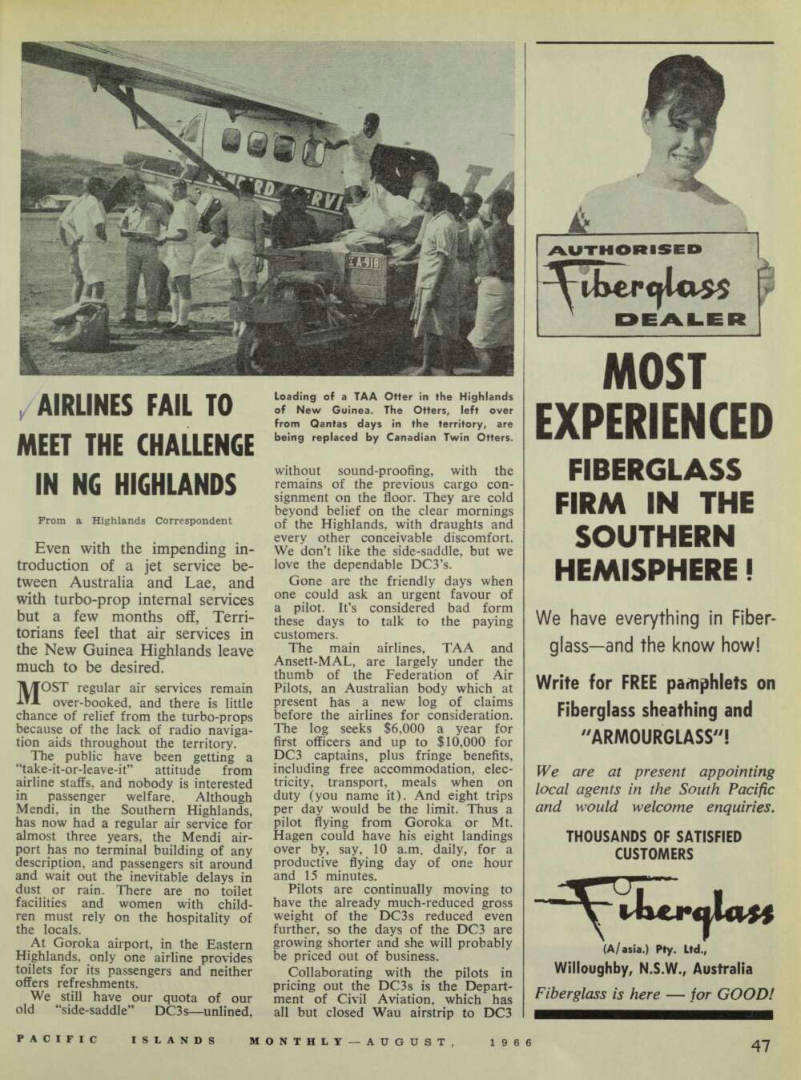
Loading of a TAA Otter in the Highlands of New Guinea. The Otters, left over from Qantas days in the territory, are being replaced by Canadian Twin Otters.
movements. Wapenamunda and Wabag must come next.
The big bogey is the much exaggerated “single engine perfor mance” stipulation. That is, should an engine fail below a certain speed during the take-off can the aircraft make a safe landing on the remain ing engine?
At Wau it seems unlikely due to the slope of the airfield, but then only a mathematical giant could calculate the chances of an engine failing during those critical 15 seconds, and the safety record of the DCB’s in New Guinea is as high as anywhere else.
The modern turbo-props, such as the envisaged Fokkers, suffer from the same complaint—thin air—and presumably they will also be restricted in their gross weights from the outset.
Skyvans
Ansett-MAL has bought the Short Skyvan to replace the present much used but uneconomical Piaggio and some other light aircraft. Another turbo-prop, short haul, short strip aircraft, the Skyvan will have to prove itself in the territory. Reported to carry about 3,800 lbs of cargo, or up to 19 passengers, the first three aircraft are expected in New Guinea toward the end of the year.
TAA have placed their faith in the de Havilland Canadian Twin Otter, of similar size and performance to the British Skyvan, to replace their aged normally aspirated Otters, a left-over from Qantas days. Both types priced at over $120,000 will have to be utilised a lot more than the present Piaggios and Otters to do justice to balance sheet and public alike.
But perhaps there is hope for the Highlanders yet. There have been recent voices raised in the House of Assembly calling for a local air licensing authority which could take
into account local conditions in the granting of airline and charter licences, instead of having all this decided in Melbourne.
And the new Directorate of Trans port will take an interest in airlines.
In June the Administration was calling for applications for a Co ordinator of Transport, who is to be appointed to head this new directorate.
The co-ordinator, who will be responsible to the Administrator, will establish a separate Department of Transport. This department was re commended by the World Bank
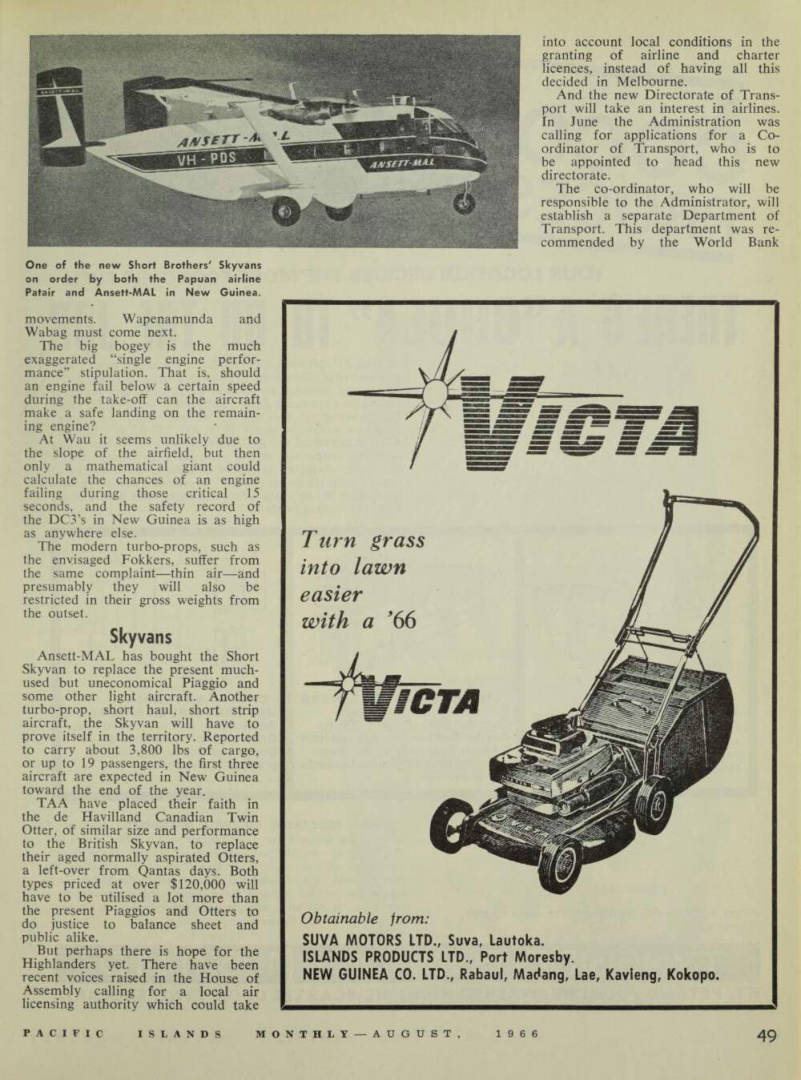
One of the new Short Brothers' Skyvans on order by both the Papuan airline Patair and Ansett-MAL in New Guinea.
Report, which pointed out that it is important at this stage of the ter ritory’s development that the problems of road and air transport, ports and shipping be considered as a whole.
The report said the Department of Transport would have the job of preparing programmes to meet the transport requirements of shippers, consumers and government departments; the administration of legislation relating to transport in dustries which are subject to the authority of the P-NG Administration; liaison with Commonwealth depart ments (including, obviously, DCA); and provision of advisory services to transport users and carriers.
It is not suggested that the new Transport Department be involved in operations but it could be the nucleus of a local airline licensing authority taking into account local conditions, and it will have an air transport officer concerned with civil aviation.
It is worth pointing out that the World Bank Report felt there was a shortage of small aircraft in the territory and that the control of independent operators of small air craft may have been too restrictive.
Small Aircraft Important
The report said, “By its low initial cost and operational flexibility the small aircraft has an important role under territory conditions; it is often the only medium of communication with isolated posts; it is the only air transport medium which can assure any degree of service frequency of points of low traffic volume; It provides a useful supplement to
scheduled services, especially where only indirect routings exist; and, it provides a rapid means of visiting a number of points for an admini stration officer or a businessman who cannot be tied to a fixed schedule.
“While recognising that schedule services require a degree of pro tection, the mission recommends that the position of the light aircraft operators should be reviewed; the independent carriers should be given more expansion opportunities; and the introduction of new aircraft and the establishment of subsidiary bases should be encouraged.”
Highlanders especially are await ing this brave new aviation world.
Mr. Levestam For Nz
• H. A. Levestam, one of the few surviving public servants of the New Zealand regime in Western Samoa, will leave the country in August to go into private business in New Zealand. Mr. Levestam joined the New Zealand Public Ser vice 33 years ago. He went to Western Samoa in 1952 and has been Secre tary to the Government for the past eight years. His successor as Secre tary is Lauofo Meti, who has been his understudy for several years.
Lauofo is Western Samoa’s com missioner on the South Pacific Com mission.