Report Exposes Weaknesses
pp. 47-48 · Read in the full issue
In Solomons Education
A report on the development of technical education in the British Solomon Islands Protectorate caused so much em barrassment to the protectorate government recently that it hesitated for some time before reluctantly making the report public in June.
THE report is one of the first to be made under the Australian South Pacific Technical Assistance Plan, which was launched last November as a South Seas Colombo Plan (PIM, April, p. 61).
It was prepared by Mr. J. M.
Carswell, Senior Assistant Director of the New South Wales Department of Technical Education, who visited the Solomons several months ago.
The gist of the report is that technical education is desperately needed in the Solomons, but that the present standard of general education is so low that few students are equipped for it.
As a result, the general level of workmanship in the protectorate is low; economic development is being retarded by a shortage of competent technical personnel; and there are insufficient qualified people to fill positions in Government departments and industry.
Mr. Carswell recommended that a residential technical college be established at Honiara for both full and part-time students.
This college would; • Accept primary school leavers for pre-vocational courses to equip them for trade training.
O Teach trade training.
O Groom a small number of the brighter students for study at uni versities and institutions overseas.
Overseas Courses
It could also take over some existing training courses, teach some subjects for other training schools, and carry out adult vocational train ing.
Mr. Carswell said the BSIP would have to make use of courses in over seas countries for many years to obtain qualified engineers, tech nicians, graduate teachers for secondary and technical education and other highly qualified clerical and administrative staff.
It would also have to send students
overseas for training in trades where the annual intake was too small to warrant a local course.
However, there was a big demand for basic courses in the building, electrical and mechanical trades.
Mr. Carswell said the present low standard of workmanship was “a direct result of existing conditions”.
Limited Education
“Most of those now in the trades entered with only a limited primary school education and there are very few with any secondary education at all,” he said.
“The primary school system has many deficiencies, not the least of which is the fact that the teachers themselves have had little education and no training whatsoever in scientific principles.
“Science and technology are of another world, and a lad with five.
six, or seven years of primary educa tion has not even started to think in terms of cause and effect.
“There is nothing in his home environment to help him, and he is
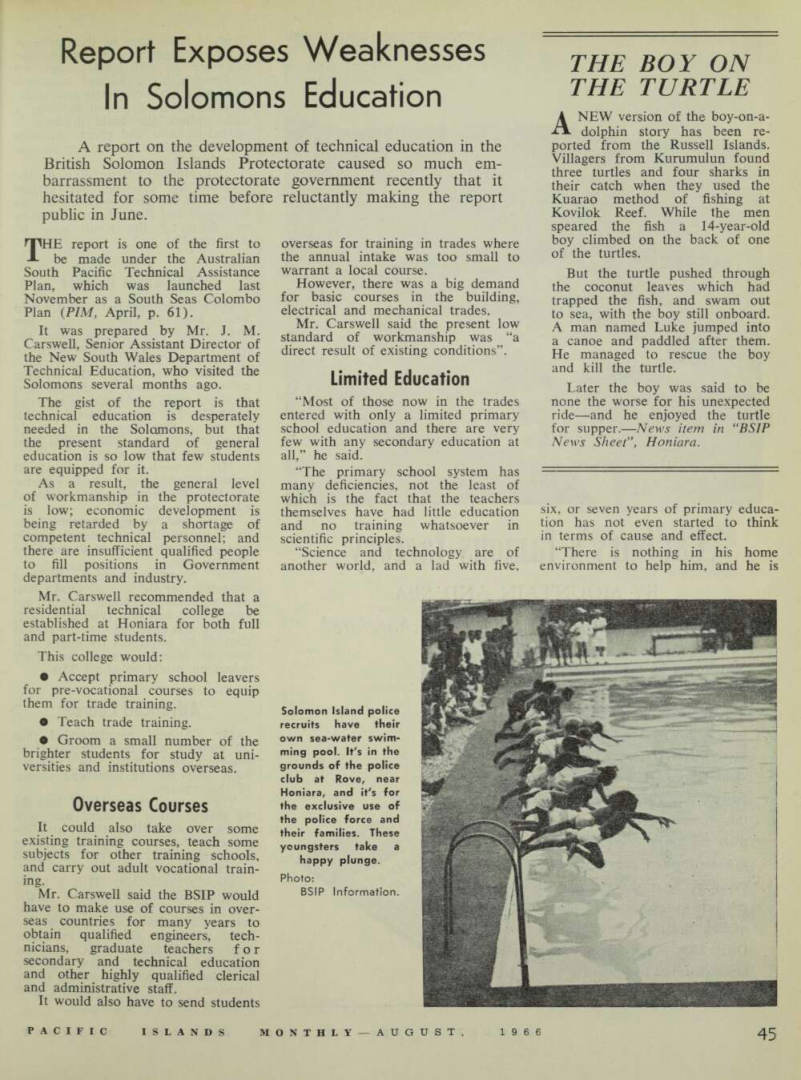
Solomon Island police recruits have their own sea-water swim ming pool. It's in the grounds of the police club at Rove, near Honiara, and it's for the exclusive use of the police force and their families. These youngsters take a happy plunge.
Photo: BSIP Information.
divorced from most of the problems of a mechanical age, which are commonplace with boys brought up * n „ more highly developed countries.
“It would be completely unrealistic to expect such a person to enter a trade, where the basic thinking is related to cause and effect, and with little or no formal training to become a tradesman.
“With little understanding of the reasons for carrying out certain operations, he tends to do exactly as he is told and if the communications are faulty the result may be disastrous.”
Long-Term Project
Mr. Carswell warned that it would be a long-term project, with few short cuts available, to raise the general level of competence to a desirable standard.
In the initial stages the training college would have to do the best it could with the human material available, but steps should be taken to ensure that there was a steady improvement in the educational level of entrants to the courses.
Mr. Carswell said he considered secondary education was a key factor in the development of technical education in the BSIP.
But it had become apparent early in the survey that not enough people had secondary education to meet the requirements.
On present planning it was expected that the annual intake into the secondary schools would not exceed 265 between 1966 and 1972.
But it was expected that the annual demand by employers for pupils with two or more years of secondary schooling would be about 350.
Advanced Course
Mr. Carswell recommended that 20 students who had completed the pre-vocational course be selected each year for an advanced course of three years.
These students would be brought to matriculation standard and sent overseas for further study, particu larly in degree or diploma courses in engineering, or on shortened apprenticeship courses.
Mr, Carswell said: “If it is to be accepted that the protectorate should not allow a situation to continue where all positions above tradesman level are either filled by expatriate staff or not filled at all, then the proposed advanced course assumes considerable importance as one of the necessary stages in an overall plan to remedy the position.”