Notable South Seas Era
pp. 43-46 · Read in the full issue

R. W. Robson Looks Back
Over 50 Years
Notable South Seas Era Ends With Joseph Mitchell's Retirement
The retirement in July of Joseph Mitchell from the general managership of Burns Philp & Co. Ltd—on his 92nd birthday and after 75 years of service with “the Big Firm” — goes close to marking the end of a South Pacific Islands era, and a unique bit of colonial history.
r began about 80 years ago, and it is ending in this turbulent period of international politics, which followed World War 11. Joseph Mitchell has seen nearly all of it.
It was an era in which strong men, equipped with little beyond enterprise and imagination, went into the undeveloped islands and created for themselves active organisations of trading and planting, shipping and finance; and, while thus creating riches, brought a number of tropical South Seas groups under the Union Jack.
When first I saw the Islands they were all—except for the bits held by French and German imperialists— marked red on the maps, as part of “the Empire on which the sun never sets”.
After that, —more than 50 years ago—l met many of the trader pioneers, Here are some I especially remember: • Joseph Mitchell and P. T. W.
Black (who most fittingly has taken the place of Mr. Mitchell) —both of whom, with “young James Burns”, were the trusted lieutenants of BP’s founder, Sir James Burns. • Sir Maynard Hedstrom, founder of Morris Hedstrom Ltd., a square built Scandinavian who never ceased planning and creating. • Sir Walter Carpenter, a hawk nosed Australian who ranged all over the South Pacific, and established W. R. Carpenter & Co. Ltd., now directed by his sons as a multi-million
dollar concern, with multi-hundred interests. • Ivan Nelson, another Scandi navian sea-rover who established Nelson & Robertson Ltd. as an all purpose development corporation, • “Tibby” Hagen, a big French man with a big blond beard, who operated from New Caledonia, but whose interests were so widely spread that once a cablegram lodged in London, addressed simply “Tibby, South Pacific”, found him within a few hours. • O. F. Nelson, still another Scandinavian pioneer, who created a trading empire in Samoa in the German days, and subsequently fought military bureaucrats with such vigour that the New Zealanders
deported him, while his clever daughters kept the big corporation going in Polynesia. • “Cappy” A. S. Fitch, who took the leaking old Queenscliff from Tasmania to found in Papua a coastal trading station—that today is Steamships Trading Co. Ltd., another million-dollar concern with stores and plantations and ships.
Other names from that memorable period come crowding to mind—the doughty Bunting Brothers, of Papua; H. E. Snell and red-headed Vivian Crisp, able lieutenants respectively to Hedstrom and Fitch; the New Zealanders Donald and Groves, who pioneered big trading in Eastern Polynesia; W, S. Tait, who cut a big swath in his day in the Melane sian traffic.
No Holds Barred
Most of them are dead—Mitchell, Fitch and Crisp are in retirement— but all, without exception, left behind memorial corporations which keep their memories green and respected.
Joseph Mitchell knew them all.
Probably, at one time or another, he fought with most of them.
Competition was keen—the famous “BP tentacles” were on every South Seas island, and on many north of the equator—and no holds were barred.
Much pioneering had been done in the South Seas by individual planters and traders before BP’s led
(Continued on p. 44)
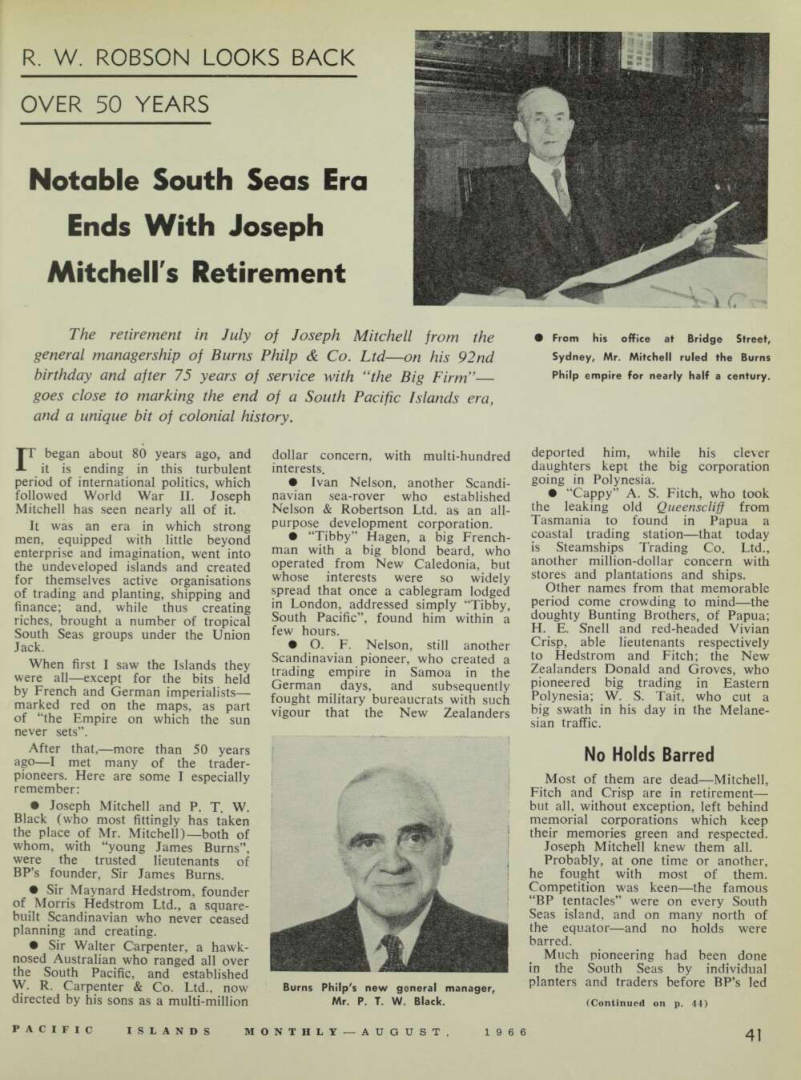
• From his office at Bridge Street, Sydney, Mr. Mitchell ruled the Burns Philp empire for nearly half a century.
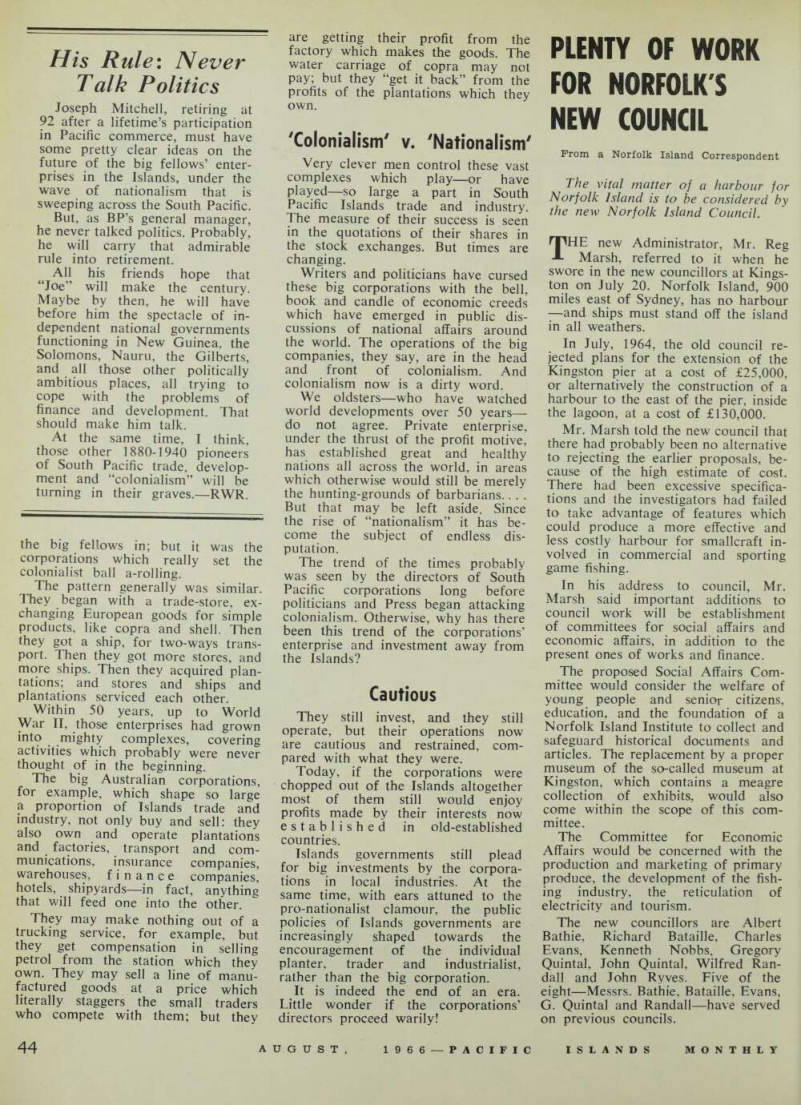
Burns Philp's new general manager, Mr. P. T. W. Black.
the big fellows in; but it was the corporations which really set the colonialist ball a-rolling.
The pattern generally was similar.
They began with a trade-store, ex changing European goods for simple products, like copra and shell. Then they got a ship, for two-ways trans port. Then they got more stores, and more ships. Then they acquired plan tations; and stores and ships and plantations serviced each other.
Within 50 years, up to World War 11, those enterprises had grown into mighty complexes, covering activities which probably were never thought of in the beginning.
The big Australian corporations, for example, which shape so large a proportion of Islands trade and industry, not only buy and sell: they also own and operate plantations and factories, transport and com munications, insurance companies, warehouses, finance companies, hotels, shipyards—in fact, anything that will feed one into the other.
They may make nothing out of a trucking service, for example, but they get compensation in selling petrol from the station which they own. They may sell a line of manu factured goods at a price which literally staggers the small traders who compete with them; but they
are getting their profit from the factory which makes the goods. The water carriage of copra may not pay; but they “get it back” from the profits of the plantations which they own.
'Colonialism' v. 'Nationalism'
Very clever men control these vast complexes which play—or have played—so large a part in South Pacific Islands trade and industry.
The measure of their success is seen in the quotations of their shares in the stock exchanges. But times are changing.
Writers and politicians have cursed these big corporations with the bell, book and candle of economic creeds which have emerged in public dis cussions of national affairs around the world. The operations of the big companies, they say, are in the head and front of colonialism. And colonialism now is a dirty word.
We oldsters—who have watched world developments over 50 years— do not agree. Private enterprise, under the thrust of the profit motive, has established great and healthy nations all across the world, in areas which otherwise would still be merely the hunting-grounds of barbarians.. . .
But that may be left aside. Since the rise of “nationalism” it has be come the subject of endless dis putation.
The trend of the times probably was seen by the directors of South Pacific corporations long before politicians and Press began attacking colonialism. Otherwise, why has there been this trend of the corporations’ enterprise and investment away from the Islands?
Cautious
They still invest, and they still operate, but their operations now are cautious and restrained, com pared with what they were.
Today, if the corporations were chopped out of the Islands altogether most of them still would enjoy profits made by their interests now established in old-established countries.
Islands governments still plead for big investments by the corpora tions in local industries. At the same time, with ears attuned to the pro-nationalist clamour, the public policies of Islands governments are increasingly shaped towards the encouragement of the individual planter, trader and industrialist, rather than the big corporation.
It is indeed the end of an era.
Little wonder if the corporations’ directors proceed warily!