Tongan Coronation
pp. 38-39 · Read in the full issue
Next July Tipped As Date For Tongan Coronation
From Robert Langdon in Nukualofa.
The coronation of King Taufa’ahau Tupou IV of Tonga will probably be held on July 4 next year—the king’s 49th birthday, according to well-informed sources in Nukualofa.
THE coronation ceremony will take place in either the Royal Chapel or the Centennial Church in Nuku alofa.
The crowning will be performed by the president of the Free Wesleyan (Methodist) Church in Tonga, the Rev. G. C. Harris, MA.
Ceremonies and festivities as sociated with the coronation will probably last a week. These will include an installation ceremony with elements of Tongan, Samoan and Fijian tradition dating back to the 16th century.
It is not yet known whether the installation ceremony will precede or succeed the actual coronation.
King Taufa’ahau Tupou IV will be the third Tongan sovereign to be crowned by a papalangi Methodist minister. The other monarchs were the king’s mother, Queen Salote Tupou 111, and his grandfather, King George Tupou 11.
If July 4 proves to be the date for the coronation, it will mean that the ceremony will take place more than 19 months after the death of Queen Salote on December 16 last year.
By contrast, Queen Salote’s corona ton, which was held on October 11, 1918, was only seven months after the previous sovereign’s death.
The reason for the long delay in the present case is said to be the king’s wish to visit England before the coronation. He is also said to want to avoid having separate cele brations for his coronation and birth day.
Tongan Lore
A committee is expected to be formed soon to make arrangements for the coronation. This committee will no doubt include the Hon.
Ve’ehala, Keeper of the Palace Records since 1944, who is an expert on Tongan lore.
Ve’ehala recently submitted a 180page report on coronation procedures to the Premier, Prince Tuipelehake.
He has been gathering informa tion on the subject since the 1950’5, as it was then realised that when the next coronation took place few people would be alive who would remember the previous one.
The late Queen Salote, herself, provided Ve’ehala with numerous details; others were gathered from old people who had witnessed the 1918 ceremony.
Much of Ve’ehala’s report con cerns the installation ceremony.
In the case of Queen Salote, this took place on the lawn beside the Royal Palace two days before the coronation was held in the Royal Chapel.
J. S. Neill says in his book Ten
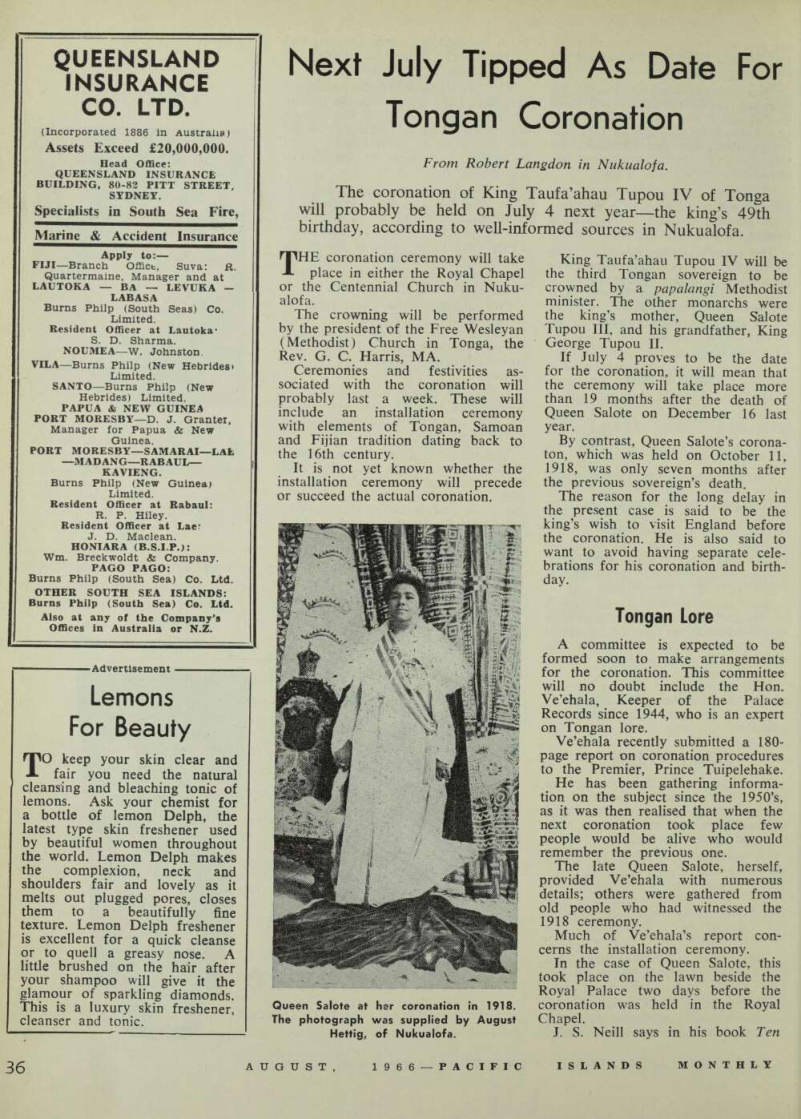
Queen Salote at her coronation in 1918.
The photograph was supplied by August Hettig, of Nukualofa.
Years in Tonga that in the installa tion ceremony, the Queen sat on a specially prepared dais under a canopy decorated with palms and garlands. A food offering was made, the kava root was presented, and kava was made in the traditional manner.
“After the kava had been drunk and the food distributed, speeches were made acknowledging the right of Queen Salote to rule over her people,” Neill said.
A feature of the installation ceremony is that the sovereign makes three affirmations: • To give the best of the products of the reef to the Tuitonga (ancient sacred king of Tonga) and to the Tui Kanokupolu (ancient temporal king). • To give the best of the pro ducts of the land to the Tuitonga and the Tui Kanokupolu. • To divide the land among the people and work it for the benefit of all Tonga.
The first two affirmations are now purely symbolic as the present king is a descendant of the Tui Kanoku polu line of temporal kings; and his great-great-great-grandfather, King George Tupou I, who founded the present dynasty in 1845, was invested with the dignities of the old sacred king on the death of Laufilitonga in 1865.
On the other hand, the third affirmation on the distribution and working of land is considered by the Tongans of immense importance.
This is scarcely surprising in a country which has only 259 square miles of land, all of which is owned by the Crown, although large estates are divided among the country’s 33 hereditary nobles.
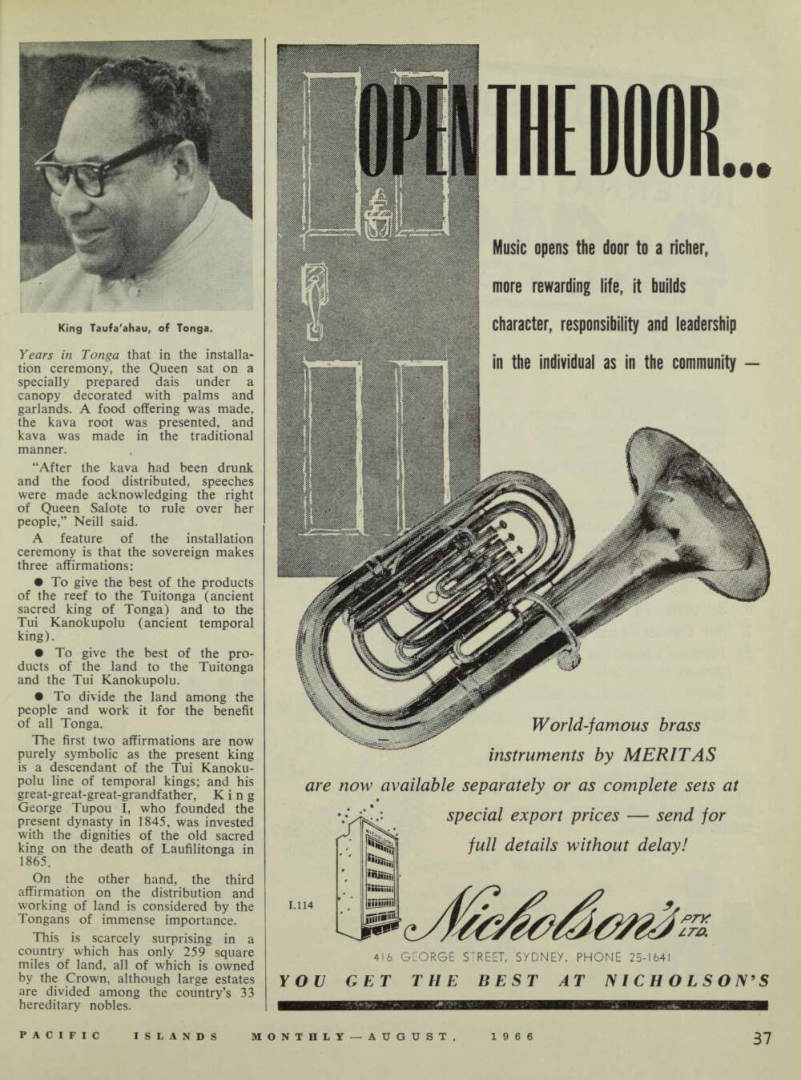
King Taufa'ahau, of Tonga.