Causes Loss
pp. 33-35 · Read in the full issue
Fivepenny Stamp
Of Face
From a Tarawa Correspondent There is a fuss over the five penny Gilbert and Ellice Islands stamp. A GEIC man living in Fiji says he is embarrassed be cause the stamp makes the islanders appear to be backward, and he wants it redesigned.
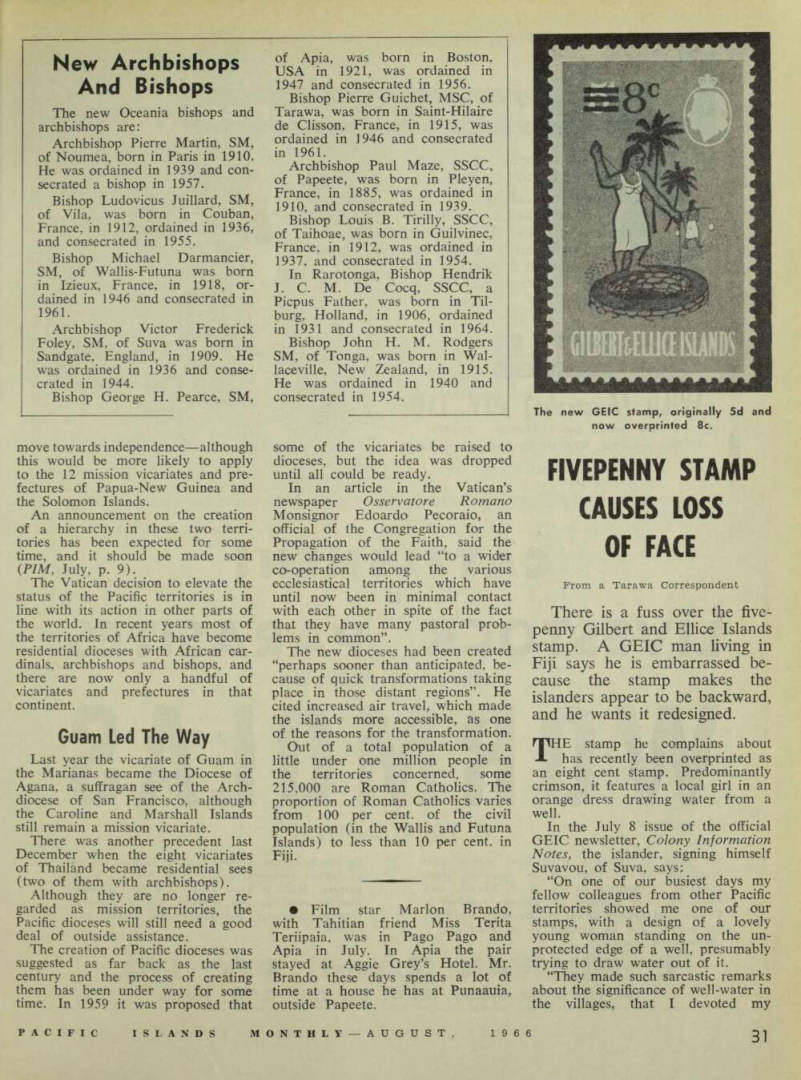
THE stamp he complains about has recently been overprinted as an eight cent stamp. Predominantly crimson, it features a local girl in an orange dress drawing water from a well.
In the July 8 issue of the official GEIC newsletter, Colony Information Notes, the islander, signing himself Suvavou, of Suva, says: “On one of our busiest days my fellow colleagues from other Pacific territories showed me one of our stamps, with a design of a lovely young woman standing on the un protected edge of a well, presumably trying to draw water out of it.
“lliey made such sarcastic remarks about the significance of well-water in the villages, that I devoted my
The new GEIC stamp, originally 5d and now overprinted 8c.
precious time to express my opinion on this stamp.
“The simple drawing on our stamp reflects the standard of living in our islands. A glance at that particular stamp leaves no doubt in the minds of people of hygienic places as to our ways of living. It shows that we are still backward as far as village hygiene is concerned.
“The well has no cover and its surrounding wall is only a few inches above the ground. It has no sloping away drainage. This type of well structure is against the rules of health.
“How can we expect to live happily in healthy conditions, if one of the basic needs of man, i.e., water, is not well provided, protected and dis tributed to our homes?
“Undoubtedly, the designer of this particular stamp draws this simple and attractive design according to his or her understanding of how we obtain our water, and as an on-the spot eye-witness of the whole affair.
I don’t intend to criticise the designer (because he or she may be right in his or her motive in designing this), and I don’t blame the ignorant villager. But I, am just wondering what the Medical Department has done to improve village hygiene. Has the department concerned taken any active measures to promote and main tain good health in our villages?
“Do the doctors and assistant health inspectors visit the villages and ad vise the local authority and/or the indigenous population on how to pro tect themselves from disease? Or are they too busy to leave their hos pitals and dispensaries to visit the villages, for a few hours in a week or a month? Are the village people too lazy to keep up with health measures which the doctors instruct them to do?
“No wonder the South Pacific Commission statistics on infant mor tality rate show a shockingly high figure in the Colony; and no doubt, water is one of the predisposing or precipitating factors, if not the main factor. Prevention is better than cure.
“I don’t intend to disgrace the Medical Department on its public health measures, but to ask a few questions which are consciously in the minds of so many keen observers.
“I would be very grateful if the authority concerned with stamp de signing would reconsider its design.”
Samoa Handles Its Own
WESTERN Samoa has decided to continue handling its postage stamp sales and not hand them over to outside agents. American business men Messrs. Finbar Kenny and Burt Todd had discussions with Samoan
officials in Apia recently, and an Apia correspondent says they offered the Samoan Government a lucrative contract if they could handle the issue of Samoan stamps.
In view of Western Samoa’s need of ready cash there was strong sup port for the American proposals among some local officials, but Western Samoa’s Director of Post Office, Mr. Ernest Betham, said he was confident Samoa could develop its own stamp business.
Sales of Samoan stamps have shown a steady increase since the country became the first independent Poly nesian nation, in 1962. Sales over the last four years have been £5tg.24,000 (1963) £32,500 (1964), £33,000 (1965), and an expected £40,000 this year “We are working to a long-term stamp policy, aiming at annual sales of £100,000,” said Mr, Betham.
New Issues
THE New Hebrides Condominium will issue a new definitive series on August 15, four World Health Organisation stamps on September 20, and six UNESCO stamps on December 1. There will be First Day Covers for each series.
The six definitives (three British and three French), are five gold cents (showing manganese loading), 25 gold cents (a fish), and one gold franc (a bird). The WHO stamps (two British and two French) are 25 gold cents and 60 gold cents, and show the WHO headquarters building; the
UNESCO stamps (three British and three French) are 15 gold cents, 30 gold cents and 45 gold cents. They show three aspects of the organisation.
Western Samoa, in September, plans to release a special hurricane relief stamp. The current independence 8d stamp will be overprinted “Hurricane Relief 6d”. Portion of the revenue will go towards rehabilitating planta tions devastated during the January 29 hurricane.
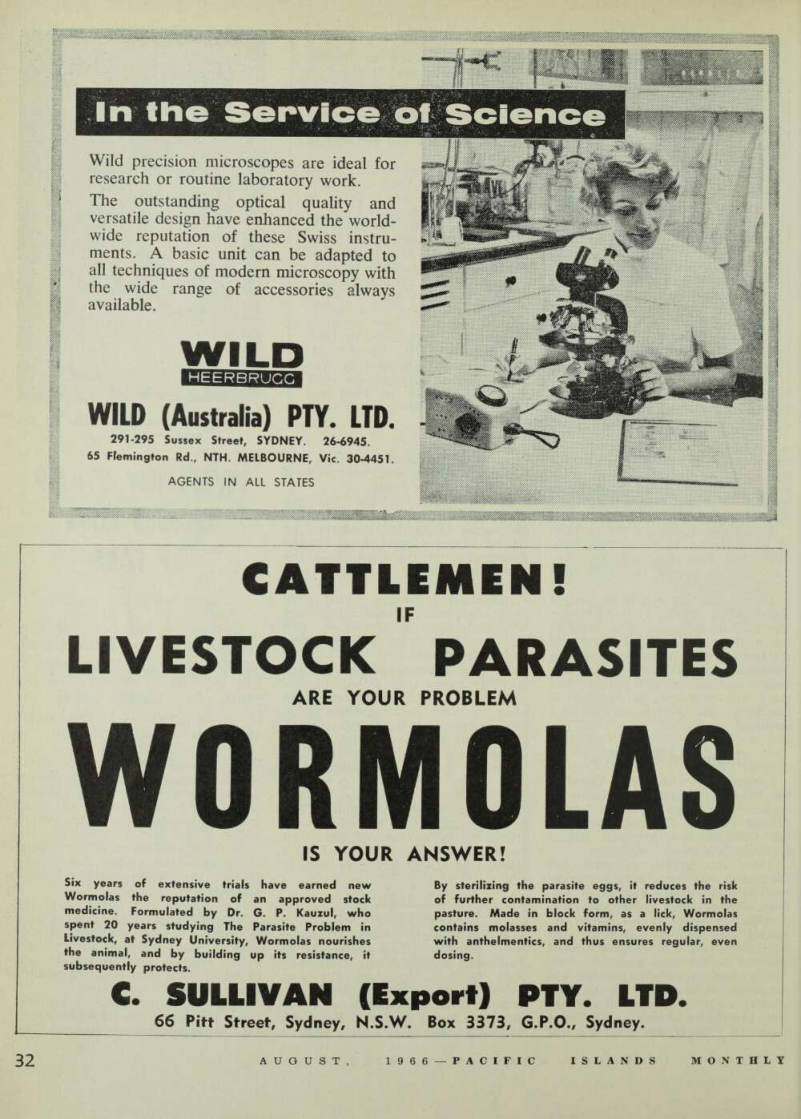
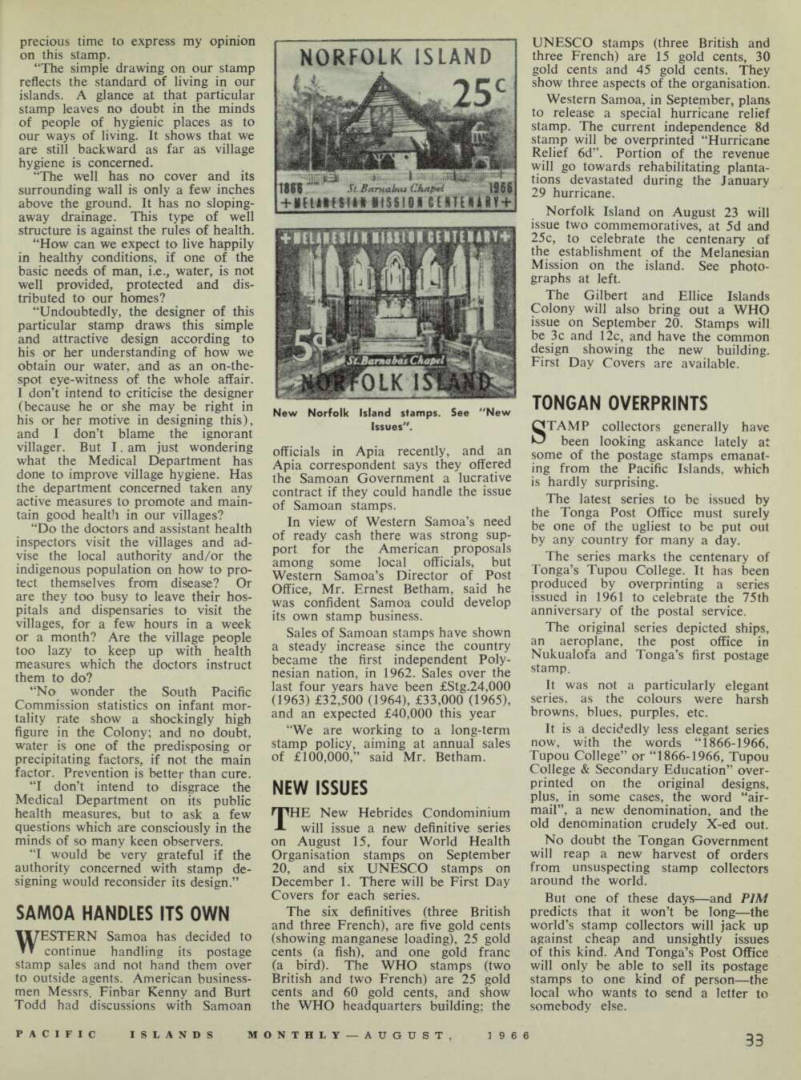
Norfolk Island on August 23 will issue two commemoratives, at 5d and 25c, to celebrate the centenary of the establishment of the Melanesian Mission on the island. See photo graphs at left.
The Gilbert and Ellice Islands Colony will also bring out a WHO issue on September 20. Stamps will be 3 c and 12c, and have the common design showing the new building.
First Day Covers are available.
Tongan Overprints
STAMP collectors generally have been looking askance lately at some of the postage stamps emanat ing from the Pacific Islands, which is hardly surprising.
The latest series to be issued by the Tonga Post Office must surely be one of the ugliest to be put out by any country for many a day.
The series marks the centenary of Tonga’s Tupou College. It has been produced by overprinting a series issued in 1961 to celebrate the 75th anniversary of the postal service.
The original series depicted ships, an aeroplane, the post office in Nukualofa and Tonga’s first postage stamp.
It was not a particularly elegant series, as the colours were harsh browns, blues, purples, etc.
It is a decidedly less elegant series now, with the words “1866-1966, Tupou College” or “1866-1966, Tupou College & Secondary Education” over printed on the original designs, plus, in some cases, the word “air mail”, a new denomination, and the old denomination crudely X-ed out.
No doubt the Tongan Government will reap a new harvest of orders from unsuspecting stamp collectors around the world.
But one of these days—and PIM predicts that it won’t be long—the world’s stamp collectors will jack up against cheap and unsightly issues of this kind. And Tonga’s Post Office will only be able to sell its postage stamps to one kind of person—the local who wants to send a letter to somebody else.
New Norfolk Island stamps. See "New Issues".