Church Moves Are
pp. 32-33 · Read in the full issue

'Preparations For
Independence'
By Kevin Hilferty, Editor of “The Catholic Weekly”, Sydney.
The creation in July of an in
dependent hierarchy of arch
bishops and bishops in the South Pacific is a major development for the Roman Catholic Church in this part of the world.
TEN former mission vicariates apostolic have become dioceses in their own right and three have been elevated to archdioceses—Suva, Noumea and Papeete.
Pope Paul created three new ecclesiastical provinces, each includ ing suffragan dioceses, and at the same time promoted the incumbent Vicars-Apostolic to archbishops, in three instances, and to bishops.
The new Archbishops are Arch bishop Foley, SM, Suva; Archbishop Maze, SSCC, Papeete; and Arch bishop Pierre Martin, SM, Noumea.
The new ecclesiastical provinces are: SUVA: The Archdiocese of Suva (formerly the Vicariate of Fiji); the Dioceses of Apia (formerly the Vicariate of Samoa and Tokelau);
Tarawa (formerly the Vicariate of the Gilbert Islands).
NOUMEA: The Archdiocese of Noumea (formerly the Vicariate of New Caledonia); Diocese of Vila (formerly the Vicariate of the New Hebrides); Diocese of Wallis-Futuna (formerly the Vicariate of the Wallis and Futuna Islands).
PAPEETE: The Archdiocese of Papeete (formerly the Vicariate of the Tahiti Islands); Diocese of Taiohae (formerly the Vicariate of the Marquesas Islands).
The new Diocese of Tonga (for merly the Vicariate of Tonga and Niue) is to be immediately subject to the Holy See.
The new Diocese of Rarotonga (formerly the Vicariate of the Cook Islands) is to be a suffragan diocese of Wellington, New Zealand.
The territories of Southern Oceania formerly were vicariates apostolic— the bishops who administered them were regarded as vicars for the Holy See in Rome, and all were subject to the jurisdiction of the Vatican’s congregation for the Propagation of the Faith.
Now they are bishops and arch bishops in their own right, and their new titles are, in effect, a declaration by the Church that the territory is no longer considered “missionary”, in the old sense. The bishops will now have a greater degree of autonomy.
In time they and the European clergy will be replaced by local leaders.
The new arrangement is also re garded as a preparation for the time when more of the Island territories
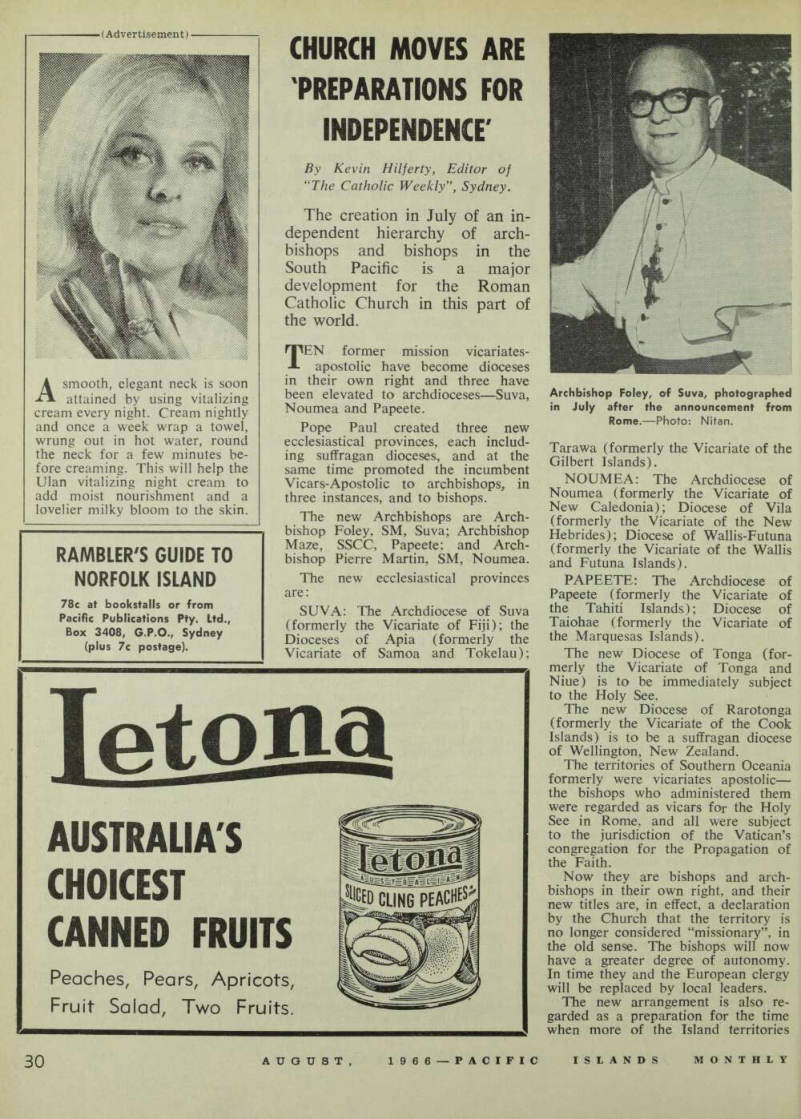
Archbishop Foley, of Suva, photographed in July after the announcement from Rome. — Photo: Nitan.
move towards independence—although this would be more likely to apply to the 12 mission vicariates and pre fectures of Papua-New Guinea and the Solomon Islands.
An announcement on the creation of a hierarchy in these two terri tories has been expected for some time, and it should be made soon (PIM, July, p. 9).
The Vatican decision to elevate the status of the Pacific territories is in line with its action in other parts of the world. In recent years most of the territories of Africa have become residential dioceses with African car dinals, archbishops and bishops, and there are now only a handful of vicariates and prefectures in that continent.
Guam Led The Way
Last year the vicariate of Guam in the Marianas became the Diocese of Agana, a suffragan see of the Arch diocese of San Francisco, although the Caroline and Marshall Islands still remain a mission vicariate.
There was another precedent last December when the eight vicariates of Thailand became residential sees (two of them with archbishops).
Although they are no longer re garded as mission territories, the Pacific dioceses will still need a good deal of outside assistance.
The creation of Pacific dioceses was suggested as far back as the last century and the process of creating them has been under way for some time. In 1959 it was proposed that
some of the vicariates be raised to dioceses, but the idea was dropped until all could be ready.
In an article in the Vatican’s newspaper Osservatore Romano Monsignor Edoardo Pecoraio, an official of the Congregation for the Propagation of the Faith, said the new changes would lead “to a wider co-operation among the various ecclesiastical territories which have until now been in minimal contact with each other in spite of the fact that they have many pastoral prob lems in common”.
The new dioceses had been created “perhaps sooner than anticipated, be cause of quick transformations taking place in those distant regions”. He cited increased air travel, which made the islands more accessible, as one of the reasons for the transformation.
Out of a total population of a little under one million people in the territories concerned, some 215,000 are Roman Catholics. The proportion of Roman Catholics varies from 100 per cent, of the civil population (in the Wallis and Futuna Islands) to less than 10 per cent, in Fiji. • Film star Marlon Brando, with Tahitian friend Miss Terita Teriipaia, was in Pago Pago and Apia in July, In Apia the pair stayed at Aggie Grey’s Hotel. Mr.
Brando these days spends a lot of time at a house he has at Punaauia, outside Papeete.