Tropicalities
pp. 27-31 · Read in the full issue


One of the silliest pieces of legislation ever passed in Papua-New Guinea, or in any other country, will come into effect on August 18. This is the Gaming (Playing Cards) Ordinance of 1965.
UNDER this ordinance no one in the territory will be able to im port playing-cards without the per mission of the Commissioner of Police.
The manufacture of playing-cards or anything that can be substituted for them is also unlawful.
Nor can anyone lawfully play cards on public premises that have not been licensed for playing by the Com missioner of Police at an annual fee of $5. Cards can be played on pri vate premises providing that the pack itself has been hired or borrowed from a place that has been licensed.
This half-baked piece of legislation was introduced as a private member’s bill by a New Guinean member of the House of Assembly last year be
cause he was of the opinion that the love of gambling was the root of all evil in native communities. Although it was at first regarded by most Terri torians as something of a joke, he got sufficient support from other native members and a few European mem bers to have it passed. A later at tempt to have the legislation repealed in the House was not successful.
All legislation passed by the House has to receive the assent of the Ad ministrator, or, in certain circum stances, the Governor-General of Aus tralia. It was expected by many people that this assent would not be given, as it has not been given to other much more important and sane legislation. But it was assented to in July and thus in August will become law.
Many Territorians now believe that it will be one of those laws that lie unused in the statute books—some thing like the New South Wales law that existed until recently to insist on neck-to-knee bathing suits on public beaches.
But this remains to be seen. In any event, while it is law, even if largely unhonoured, it can be invoked at any time now or in the distant future, perhaps under circumstances not con templated by the member who framed the legislation in 1965.
He Remembered
The Old Fiji
WHEN Mr. John Francis Byrne died in Fiji in late June at the age of 96, he was believed to be the oldest part-European in the colony.
He lived all his life on the Koro togo coast, between Sovi Bay and Sigatoka. His neighbours referred to him affectionately as “Mr. Stay- Put”. He lived in a little house hidden in the bush on Mosala Point, near the old cemetery, overlooking the mouth of the Sigatoka River.
Mr. Byrne’s father, James Byrne, born in Newark, New Jersey, was a sailor on an American whaler. While the ship lay in Sovi Bay one day in
1863, he had a blazing row with the mate, and that night he slipped ashore, and hid in the bush until the whaler left. The village chief took a liking to the lad and he settled into the village. He married a Fijian woman from Namosi, and their son was named John Francis.
The Byrnes, father and son, re mained all their lives on that coast, planting cotton, trading, running cattle and running cargo boats, and always closely associated with the coastal Fijians. The son in 1902 married another part - European, Sophie Pucell, daughter of Alfred Pucell, a well-educated Englishman who had settled in Viti Levu; and they had two very good-looking children—John Byrne, who is now a departmental manager in the Morris Hedstrom store in Sigatoka, and Amy who married Herbert Murray.
Mrs. Amy Murray, now nearly 60, and a widow, is still a handsome woman. The Byrnes once owned a lot of land, but sold it cheaply.
Mr. J. F. Byrne did not go seeking adventure—it came to him.
In those early days, the Fijians in the mountains behind the coast were cannibals and raiders, and dangerous, Mr. Byrne’s father on one occasion led the United States consul from Levuka (the old capital) up into a hill village. He overheard the vil lagers deciding that the consul should provide a good meal, and they plotted to capture him. Mr.
Byrne’s father got the official away after a lively fracas.
On another occasion, when Mr.
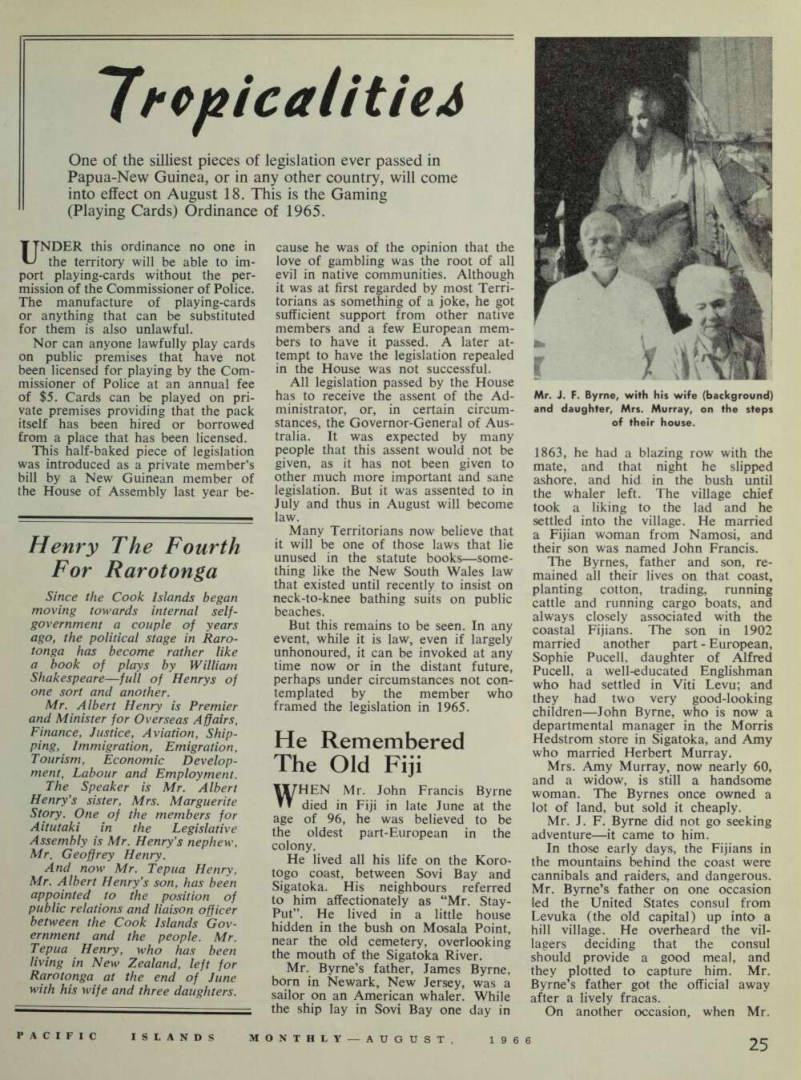
Mr. J. F. Byrne, with his wife (background) and daughter, Mrs. Murray, on the steps of their house.
Byrne lived on his farm at Mosala Point, the hill-men came down in force and carried off all his livestock as the family escaped along the beach to Sigatoka.
Mrs. Murray, while we were talk ing to her the other day, walked to the garden’s edge and pointed down at a large pond beneath a cliff.
“That’s where they threw their pots and dishes and other household goods before they ran,” she said.
Mrs. Byrne is now 84, sick and blind. She has many memories of the long years she has spent on the Sigatoka coast with “Mr. Stay-Put”.
New Guinea Sells
A Wider View
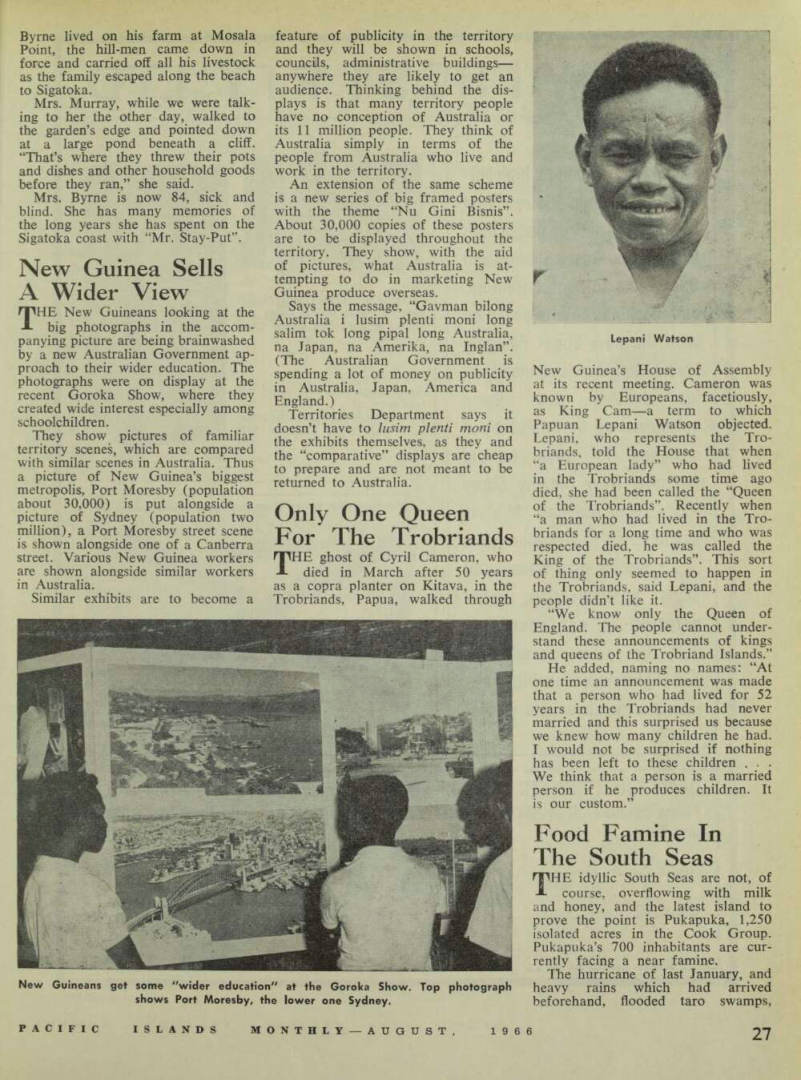
THE New Guineans looking at the big photographs in the accom panying picture are being brainwashed by a new Australian Government ap proach to their wider education. The photographs were on display at the recent Goroka Show, where they created wide interest especially among schoolchildren.
They show pictures of familiar territory scenes, which are compared with similar scenes in Australia. Thus a picture of New Guinea’s biggest metropolis, Port Moresby (population about 30,000) is put alongside a picture of Sydney (population two million), a Port Moresby street scene is shown alongside one of a Canberra street. Various New Guinea workers are shown alongside similar workers in Australia.
Similar exhibits are to become a
feature of publicity in the territory and they will be shown in schools, councils, administrative buildings— anywhere they are likely to get an audience. Thinking behind the dis plays is that many territory people have no conception of Australia or its 11 million people. They think of Australia simply in terms of the people from Australia who live and work in the territory.
An extension of the same scheme is a new series of big framed posters with the theme “Nu Gini Bisnis”.
About 30,000 copies of these posters are to be displayed throughout the territory. They show, with the aid of pictures, what Australia is at tempting to do in marketing New Guinea produce overseas.
Says the message, “Gavman bilong Australia i lusim plenti moni long salim tok long pipal long Australia, na Japan, na Amerika, na Inglan”. (The Australian Government is spending a lot of money on publicity in Australia, Japan, America and England.) Territories Department says it doesn’t have to lusim plenti moni on the exhibits themselves, as they and the “comparative” displays are cheap to prepare and are not meant to be returned to Australia.
Only One Queen
For The Trobriands
THE ghost of Cyril Cameron, who died in March after 50 years as a copra planter on Kitava, in the Trobriands, Papua, walked through
New Guinea’s House of Assembly at its recent meeting. Cameron was known by Europeans, facetiously, as King Cam—a term to which Papuan Lepani Watson objected.
Lepani, who represents the Tro briands, told the House that when “a European lady” who had lived in the Trobriands some time ago died, she had been called the “Queen of the Trobriands”. Recently when “a man who had lived in the Tro briands for a long time and who was respected died, he was called the King of the Trobriands”. This sort of thing only seemed to happen in the Trobriands, said Lepani, and the people didn’t like it.
“We know only the Queen of England. The people cannot under stand these announcements of kings and queens of the Trobriand Islands.”
He added, naming no names: “At one time an announcement was made that a person who had lived for 52 years in the Trobriands had never married and this surprised us because we knew how many children he had.
I would not be surprised if nothing has been left to these children . . .
We think that a person is a married person if he produces children. It is our custom.”
Food Famine In
The South Seas
THE idyllic South Seas are not, of course, overflowing with milk and honey, and the latest island to prove the point is Pukapuka, 1,250 isolated acres in the Cook Group.
Pukapuka’s 700 inhabitants are cur rently facing a near famine.
The hurricane of last January, and heavy rains which had arrived beforehand, flooded taro swamps,
New Guineans get some "wider education" at the Goroka Show. Top photograph shows Port Moresby, the lower one Sydney.
Lepani Watson
and what taro had not already rotted in the ground was swept away. More than 2,000 taro roots reached the island on March 1, but taro takes up to 14 months to mature so part of the population moved to food reserve lands on the islets of Motu Kotawa and Motu Ko. The islets are normally uninhabited. Pukapuka school was closed.
Although fish has been plentiful, in July the people were compelled to eat coconuts which had been reserved for next season’s copra production.
The Moana Roa reached the atoll on July 7 and found the islanders without flour, rice, sugar, or taro, and meanwhile a radio appeal made by Premier Albert Henry to the Rarotongan public resulted in the formation of the Pukapuka Relief Fund, with money and food publicly subscribed.
Donations for the fund came in even from little Niue, a New Zealand territory 300 miles east of Tonga, which has also donated generously in recent times to Western Samoa and the Tokelaus.
The fund was to buy flour, rice and sugar. It \vas to have been put aboard the trading vessel Abatere for Pukapuka before the end of July.
Samoa, Too
While the Cook Islands were closing the food gap, the people of Western Samoa in July were also engaged in the same activity. Distri bution of emergency food supplies from the New Zealand Red Cross and the World Food Programme, following the same January hurricane, were well under way and the whole procedure has been going more smoothy than had been expected earlier.
Handling by committees in Samoa had caused complaints about unfair distribution, but these diminished when distribution came directly under the control of Prime Minister Mataafa, and the secretary of the Relief Committee, Mr. R. F. Betham.
By mid-July enough food had been distributed to give every man, woman and child in the territory 2i lb of rice, 5f lb of flour, one tin of meat and three tins of milk, and there was more food yet to be dis tributed.
By September it is expected that Samoa’s main cash income crop of bananas will be once more producing and the need for emergency aid will be passed. However the World Food Programme is now considering a scheme of continuing aid, aimed at rehabilitating the plantations. Food will be supplied in lieu of wages for plantation owners and workers.