Rabi Spokesman
pp. 20-21 · Read in the full issue
Speaks Out
By a Staff Writer
In Sydney in July to discus the best way of obtaining a large share of the phosphate cake, th Rev. Tebuke Rotan gave Aus tralians some fascinating fact about life on the island of Rab
in the Fiji Group.
RABI is owned and occupied b the Banabans, the people o Ocean Island, who resettled there e masse in 1945.
Tebuke is manager of the Rat Island Council and replaces an officia called a Banaban Adviser, the last o whom left last year when the Bana bans told the Fiji Government tha he must go. In Sydney, Tebuke an< Rabi’s legal adviser, Mr. M. Saunders of Suva, had talks with a Sydney firn of economic consultants,, Philij Shrapnel and Co. The consultant have prepared the case which th< Banabans will advance when the thre< British Phosphate Commissior partners, the GEIC Government anc the Banabans get together at a con ference in Wellington in late Augusi to discuss phosphate royalties.
Press Conference
Tebuke said at a Sydney news con ference arranged by public relations consultants, Eric White and Associ ates, that the Banabans received only 5/- a ton royalty for Ocean Island phosphate, while the GEIC Govern ment received a tax of 29/- a ton, The Banabans were thus taxed at a rate of 17/- in the £.
He said the GEIC Government had amassed nearly £BOO,OOO from the phosphate royalties, and would use it to provide income after the phosphate deposits were exhausted in about 15 years. The Banabans would get none of it. The Banabans, “the real owners of the phosphate”, had accumulated only £70,000, and this was in the period before the war.
“The Banaban people have been forced to live in conditions bordering on poverty,” said Tebuke. ‘They are not in‘ a position *to develop the island, educate their children, or plan for the future.”
Tebuke said the Banabans thought they were old enough to run their own affairs but the Fiji Government wanted “to keep ruling”.
“Banabans want to retain their
identity as Banabans and that is why we decided a few months ago not to register on the Fiji electoral roils for the new elections,” he said. “We are in the Fiji Colony now and we can’t run away, but we hope we can run everything ourselves eventually.”
Tebuke said that when the Bana bans got a proper share of the phos phate money—as they hoped to do following the Wellington conference —there would be a meeting of Banaban landowners to decide how to invest it. Their economic advisers would examine the island’s resources and determine what form develop ment should take to create a viable economy.
Tebuke said neither the GEIC Gov ernment nor the Fiji Government had ever told the Banabans the facts they were entitled to know as landowners of Ocean Island. What the Banabans had learned over the years had come from the pages of PIM and the Banabans had become fed-up with this official neglect.
"Sacked The Adviser"
The news conference really sparkled when Tebuke got on to the subject of the Rabi people’s annoyance with the Banaban Adviser and with the Fiji Government.
He gave in detail his story of the troubles of March last year, when police had to be called to Rabi. When PIM reported the event last September (p. 16) the Fiji Government put out a statement denying it.
This time the Sydney newspapers gleefully reported the events under such headings as “Island Revolt!”
“We sacked the adviser,” said Tebuke. “He told us he had to do a job for the government as well as for us (although we paid his salary) so we said we would have to chase him out.
“We got together with our spears, 500 strong. I was appointed to be the leader although I didn’t want to do this. But I got my spear, too.”
Tebuke said the meeting decided to tie up the adviser, Paul Laxton, and put him in a boat for the main land, as the people didn’t want any more advisers (“Mr. Laxton, though, was a very nice man. We had no quarrel with him,” said Tebuke).
The meeting decided (“having clapped hands three times, as is the custom”) to “kill all those Bana bans who supported Mr. Laxton.”
“About 50 men sided with Mr.
Laxton, but 20 went into the bush.
Thirty had to decide whether to stay with Mr. Laxton or be killed. All but one decided to side with us.”
Tebuke told how the meeting then
decided to kill the one man supporting the adviser, and how at this stage he had stepped in and forbidden any kill ing. ‘They nearly speared me then, be cause I had disobeyed their custom,” explained Tebuke. “We had all clapped three times to agree with the decision, you see. But I was a mem ber of the church and there wasn’t to be any killing. They said they would agree, so long as we got rid of the adviser.”
Tebuke said a District Officer and police had come from Savusavu while the meeting was going on (the meeting had lasted from 10 a.m. to 7 p.m.). But the police took no action when they realised there was only a few of them against 500 islanders.
"No More Advisers"
Tebuke said the adviser had left some weeks later and that he himself was now in fact filling that post.
There would be no more outside ad visers.
The Banabans felt there was good hope of achieving their aim of a fair phosphate deal.
Said Tebuke: “The conference in Wellington will be the first time we Banabans have been invited to take part in discussions about our own share of the money from our own land.”
Added a questioner; “But what did your church say when they heard about your leadership of this army on Rabi?”
Tebuke: “Oh, they did not like it very much. They sacked me for a week!”
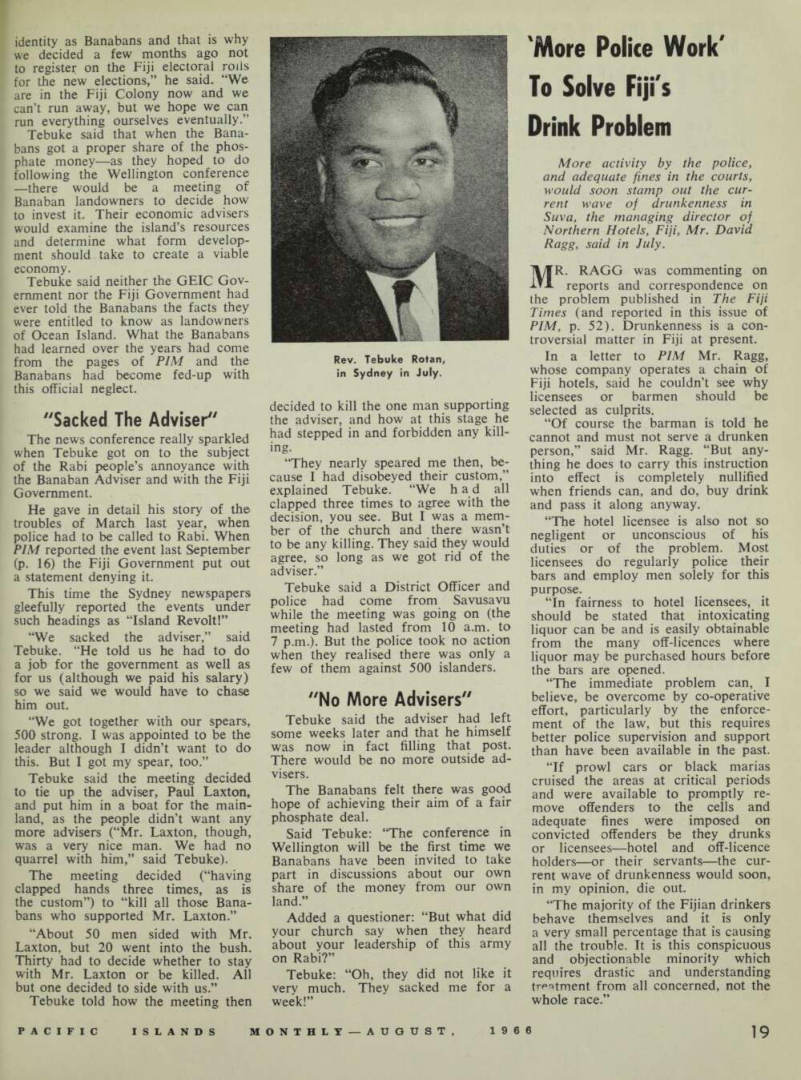
Rev. Tebuke Rotan, in Sydney in July.