Gordon Thomas,
pp. 11-12 · Read in the full issue
Ng's Veteran
Talk-Talker,
Passes On
In the early hours of August 1, at Concord Repatriation Hos pital, Sydney, death at last claimed Edward Llewllyn Gordon Thomas —Tolala. PIM thereby lost a long-time contri butor and a valued friend. The South-west Pacific lost its fore-' most chronicler of pre-1914 history. He was 76.
HE had been in hospital for the previous month, but had, in fact, been in increasingly poor health since September, 1945, when he emerged from three years’ internment by the Japanese in Rabaul. He had lived in semi-retirement at Campbelltown, NSW, since then.
In this last decade his physical contact with the world around him constantly diminished, but he had crowded sufficient variety into his early years to cover a whole life span. In his latter years he was able to live on these memories better than most and through his “Talk-Talk” column in PIM, he created new friends, new interests and his own
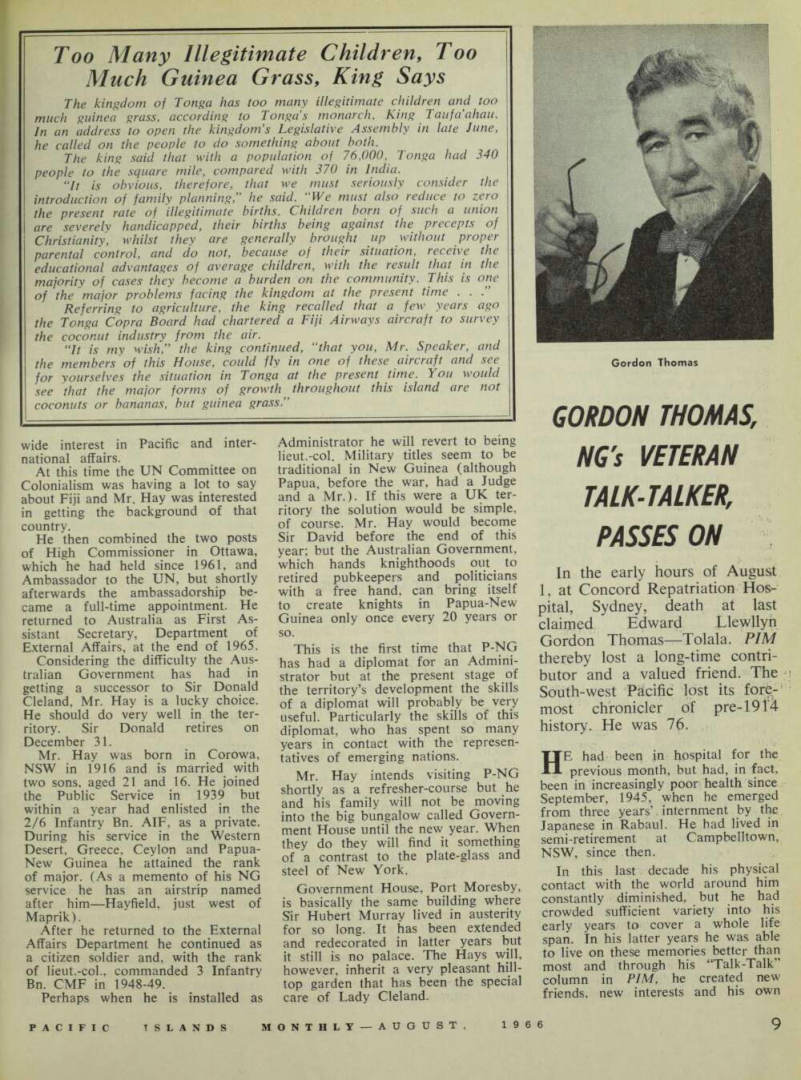
Gordon Thomas
niche in the continuing pageant of New Guinea affairs.
He was an American by birth— born in Chicago on January 5, 1890.
His father was an Army man, but the family seems to have had its roots in Canada rather than the United States.
The young Gordon Thomas, after he had completed his education in London, Wiesbaden (Germany), and Switzerland, began a newspaper career on the family newspaper The Camrose Mail, in Alberta. He’later worked on the Vancouver Mail, but by the time he was 20 he was off to Australia.
In 1911, he took a job as printer for the Methodist Mission that then had its New Guinea headquarters in the Duke of York Islands.
New Guinea was then a German possession, and it was at this period that he formed contacts with German officials and colonists, many of which he retained to the end.
What little has been recorded, in English, of this German period in New Guinea has come mainly from Gordon Thomas, especially through his “Talk-Talk” column in PIM.
He left the mission in 1912 and went trading for the German firm of HASAG, one of the three big firms of German New Guinea. At that time, HASAG was an amalgamation of H. R. Wahlen interests and those of Queen Emma.
In 1913, Gordon changed com panies again, going to Bougainville or the Australian company, Choiseul Plantations Ltd.
He served in the ATF in France during World War I. When he re turned to the territory, he was editor of the Rabaul Times, the local weekly.
for two periods, 1925-27 and 1933-42.
The rest of his years in the territory were spent in trading, plantation management, overseeing, and as an assistant oil driller at Matapau, in the Sepik District, when NG oil-search was centred there.
When the Japanese invaded Rabaul m January, 1942, over 300 civilians were trapped there. They were eventually shipped away to Japan on the Montevideo Maru which was sunk with all hands before she reached her destination.
Prisoner Of Japanese
For reasons of their own the Japanese retained half-a-dozen of the civilians in Rabaul to work as rouse abouts at the freezer and power station. Gordon Thomas was one of these and therefore escaped the fate of his friends, although the mental and physical effects of this internment he was to carry to the end of his life.
He has left a long, unpublished manu script about this period that is one of the more unusual records of the war in New Guinea.
Between the wars, under the pseudonym of Don Gordon, he wrote innumerable magazine articles, a book of verse (Echoes of the South Seas), and a novel (Tropic Equa tions).
He married in 1912. Mrs. Thomas died in Sydney in 1961.
Gordon Thomas will be mourned by friends all over the world and by constant readers of his PIM “Talk- Talk”. PIM, without Tolala’s memoirs of the “German times”, his occasional lapses into Victorian senti mentality and his mild arguments with the post-World War II genera tion of experts, won’t be the same.