Cruising Yachts
pp. 101-110 · Read in the full issue
Pacific Shipping And Cruising Yachts
Two New Ships
For Islands
Service
Two new ships—or at least two old ships with new names— have just begun careers in the South Pacific Islands. They are
the Sarang (formerly Kopara)
and the Ai Sokula (formerly
Boezemsingel).
Sarang, a freighter of 679 tons gross, built in 1938, has bee acquired from New Zealand by the Karlander Line for a monthly service out of Sydney to Brisbane, Honiara, Kieta and Rabaul.
The Sarang was due to begin her first trip on June 29, returning to Sydney on July 19.
Among her cargo will be supplies for the Conzinc-Rio Tinto copper mining operations at Kieta.
Cargo will be unloaded at Kieta on to barges built in Sydney for Kar lander. The P-NG Administration is building an overseas wharf at Kieta.
The Sarang, which has a cargo capacity of 1,400 tons, will be under
the command of Captain C. Mc- Donald, of Sydney.
She replaces the Sletta which has been operated by Karlander under charter. The Sletta has been returned to her owners, Skibs Karlander, of Norway.
The Ai Sokula is the third ship of that name to go into service in the Fiji inter-island trade. Her name was changed from the Dutch Boezemsingel at a ceremony at Prince’s Wharf, S'uva, on June 4.
She is owned by Island Industries Ltd. and is operated under charter by Island Transport Ltd., both of which are subsidiaries of W. R.
Carpenter and Co. (Fiji) Ltd.
Her new name, chosen by the Tui Cakau, Ratu Josefa Lalabalavu, the paramount chief of Cakaudrove, was bestowed by his daughter, Adi Elenoa, when she poured a bowl of yaqona over the bow.
The Ai Sokula is under the com mand of Captain Frank Mitchell, of Qamea. She will operate between Suva and Cakaudrove ports.
The first Ai Sokula was a Japanese wartime tug, which was later re named Oliver Mac and sold. The second, also renamed, was sold to American interests in the Marshalls.
“Ai Sokula”, according to Hazel wood’s Fijian dictionary, is the name of the Cakaudrove tribe.
When the first Ai Sokula went into service the owners had to get special
permission from the high chiefs of Cakaudrove to use the name.
Presumably, the owners had to secure similar permission for the second and third ships to bear that name.
The Ai Sokula was built in Hol land in 1961 ( PIM, March, p. 101).
Crayfish Export Plan
For Solomons
An American firm, Woodward and Dickerson, of Philadelphia, is to form a new company called Solomon Is lands Fisheries Ltd., through which it hopes to develop a crayfish export industry in the Solomons.
If the venture is a success, many Solomon Islanders could find employ ment in the new industry, according to an official BSIP news release.
The secretary of the firm behind the venture, Mr. David Zogbaum, be lieves that the crayfish industry could grow to be the BSIP’s second most valuable export market. At present copra is the most valuable.
The local variety of crayfish is re puted to be delicious.
Matson Goes Back
To Noumea
The Matson Pacific cruise liners, Monterey and Mariposa, resumed calling at Noumea in June. They had been by-passing Noumea since December, 1965, pending a review by the US Department of Justice of the
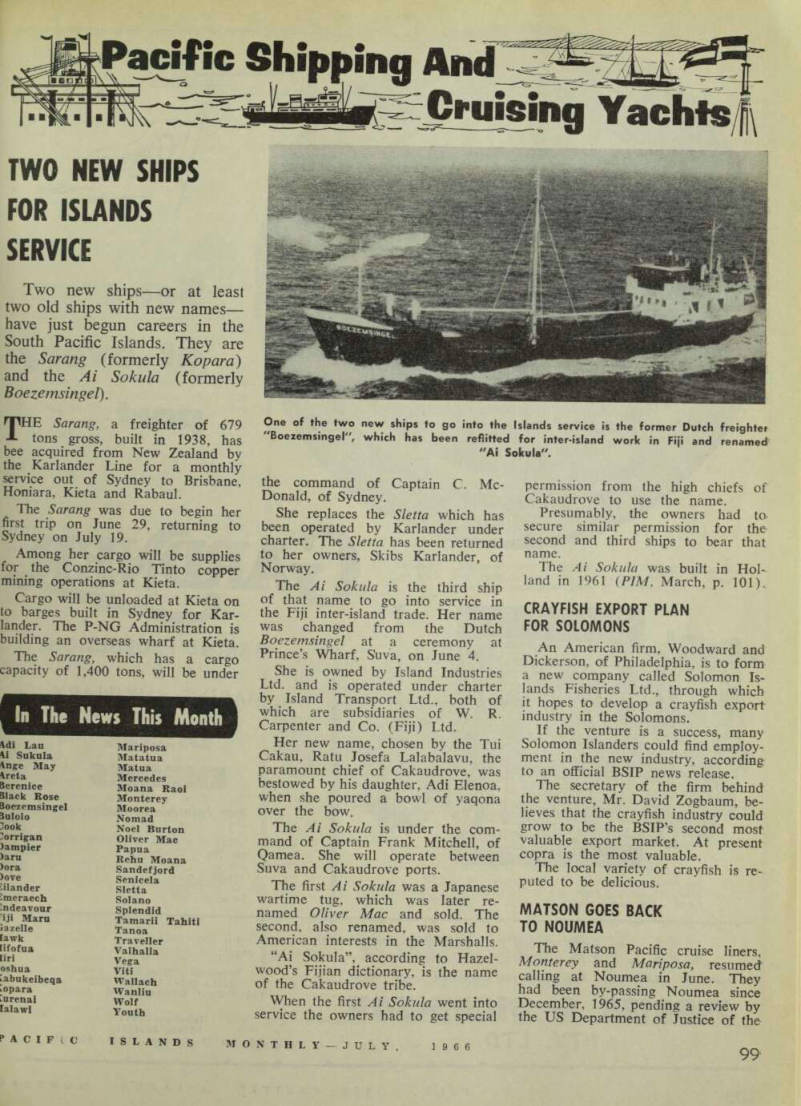
One of the two new ships to go into the Islands service is the former Dutch freighter "Boezemsingel", which has been remitted for inter-island work in Fiji and renamed "Ai Sokula".
US meat inspection and quarantine regulations.
Under the new regulations meat from countries free of foot-and-mouth disease and rinderpest may enter the US in ships that have called at ports which have not been named as free of those diseases.
Ships’ holds or compartments con taining meat for the US must be sealed in the country of origin by an appropriate official of that country with approved seals.
Cutter Pulled Off
Fiji Reef
The Fiji auxiliary cutter, Adi Lau, which went aground on a reef off Moala, Fiji, on May 13 (PIM, June, p. 107) was pulled off by the Tongan tug, Hifofua.
Temporary repairs were made to holes in her hull, and she was then towed to Suva by the Malawi.
Director Of Marine
A British master mariner, Captain Alan Newport, 38, arrived in Fiji m early June with his wife and family, to take up the new post of Director of Marine. He has been seconded by the British Board of Trade, where he served with the Marine Survey Department for five years.
His post was created in a new ordinance, based on recommendations from the Safety at Sea Commission which followed the Kadavulevu disaster.
New Forwarding Company
In Solomons
A new company has been formed in Honiara, British Solomon Islands Protectorate, to ship cargo and undertake Customs clearance.
Called the Melan-Chine Shipping
and Forwarding Agency Ltd., the new company will handle goods for for warding to outstations and vice versa.
Mrs. M. E. Hunter, the general manager, said recently that Melan- Chine will soon build a public bonded warehouse, a general warehouse and offices.
The company owns the trading vessel, MV Hawk.
Nickel Loading
Resumes At Noumea
In recent weeks, for the first time in many years, a ship has been load ing nickel ore at Noumea’s wharf.
Years ago it was a familiar sight
to see heaps of nickel ore on the wharf waiting to be shipped. Gener ally it came from mines on Noumea’s threshold.
However, with the cessation of mining around Noumea, the spectacle became rare, and ships went to the mining centres on the coast for load ing.
The opening recently of the rich Yo-Yo mine, 15 miles from Noumea, operated by Mr. Sylvestre Laconte, has brought the loading gear out of mothballs and big buckets were swinging over the side of the Fiji Maru in June carrying nickel ore from trucks alongside.
The vessel loaded 8,000 tons of ore
and then moved out into the stream to load a further 1,000 tons.
Lack of depth at the wharf pre vented the Fiji Maru from loading the full 9,000 tons.
Survey Ship Resumes
Work In Fiji
The Royal Navy survey ship HMS Dampier arrived in Fiji in early June after completing a survey in the New Hebrides.
Dampier is to complete the ocean survey work carried out by HMS Cook, which was badly damaged in October, 1963, when she struck a coral reef off Ellington, Fiji.
Commander P. G. N. Cardno, captain of the Dampier, said on arrival in Fiji that the survey started by the Cook off the north coast of Vanua Levu would be continued and ex tended to the south-west as far as possible before the ship left for Singapore in the second week of July.
It was also hoped to complete a survey of Bligh Water, north of Viti Levu.
The series of surveys by Cook and Dampier will be published on a scale three times larger than that of exist ing charts.
Mariners Not Happy
About Levuka's New Lights
The new leading lights brought into use at Levuka, Fiji, in April, 1965, have aroused much criticism among local mariners, according to Captain Stan Brown, of Suva, who wrote an article about the lights they superseded in PIM for April, (p. 91).
“All agree that the new lights are much inferior to those in the positions sited by Lt. George Woods RN in 1871,” Captain Brown says.
“The front light, when first in stalled, was so difficult to identify hat a string of ordinary light globes, mcased in watertight covers, was ffaced in a line under the light, “These globes now plainly indicate he position, but are so strong that t is even more difficult to see the ight.
“There is general agreement that Voods in 1871 did a far better job han the Public Works Department n 1965.”
Iecond Ship For
>-Ng Federation
A 70 ft ship is being built in Aus raha for the Federation of Native locieties Ltd., of Papua-New Guinea, "he federation already owns one hip, the Hiri.
The hull of the new ship, to be ailed Papua, has been planned so tiat she will go over sand bars at
Kerema and Toaripi. The ship, will cost about $130,000.
The federation hopes to begin using the new ship m Territory waters m August.
Elusive Sun A I In
r iD Dtc cccu
Gilberts Seen Again
A dangerous Gilbert Islands reef, which was first reported 167 years ago, but whose position has ever since been in doubt, was sighted again recently by the Gilbert and Ellice Islands ship Moana Raoi.
The reef is Nautilus Shoal, first seen by Captain Charles Bishop of the British trading vessel Nautilus en route from Sydney to China in 1799.
In 1835, the whaler Corsair was wrecked on what was thought to be Nautilus Shoal.
In 1872 USS Narrangansett reported that the reef was 12 miles southward of Tabiteuea.
However, in 1916 Captain Kettle of the SS John Wiliams IV reported that the reef was six miles WSW of the position reported by the Narran gansett; and this was confirmed by Mr - . Corrie ’ a trader, who gave the position as nine miles south-west by south of the southern extremity of Ta biteuea.
In 1921, HMS Veronica reported that the approach to Tabiteuea was very dangerous, and in 1953 Captain W. Schutz, of the auxiliary ketch Kia Kia reported having seen breakers in the area - But when ships of the Royal Navy, particularly the survey vessel HMS Cook, searched the area to the south ward a nd westward of South Tabi teuea between 1959 and 1963, they found it clear of shoals beyond the main sea reef, The recent sighting of Nautilus Shoal was described by Captain E. V.
HMS "Dampier" which will be surveying in Fiji waters until mid-July.
Ward in Colony Information Notes, issued by the GEIC Information Department. He said: “On the recent occasion, from the upper bridge of Moana Raoi, shoal water and breakers were sighted ex tending across the bow about five miles away in a position some 12 miles south of Tabiteuea. The breakers and shallows, which ap peared realistically dangerous by eye and through binoculars, disappeared when approached at about one mile.
“These phenomena are known as ‘vigias’ and are common in the tropical Pacific. Many, since dis proved. were reported by whalers and sailing ships, and it is probable that uncertain reckoning and strong cur rents accounted for reefs and shoals being inaccurately charted.
“Large shoals of fish often appear as breakers whilst confervoid algae sometimes discolours the sea so that it appears like a shoal. On occasions ‘vigias’ have appeared so realistic that ships, warships, and even survey ships, have lowered boats to investi gate them.
“It is surmised that many ‘vigias’ come out of gin bottles, but not this one. Not at seven in the morning.”
New Ship For P-Ng
Lighthouse Service
A new ship, the Noel Burton, is replacing the Papua-New Guinea lighthouse ship, Wallach, which has made regular inspections for many years of the 59 lighthouses in P-NG and the 65 beacons along the south coast of Papua.
The Wallach, in future, will operate from Thursday Island.
Explosives Delivered For
Mangaia Reef-Blasting
The New Zealand naval vessel En deavour unloaded 500 out-dated anti submarine projectiles (each weighing 450 lb) and four tons of TNT at Mangaia, Cook Islands, early in June.
The ship had to lie off the reef while the explosives were unloaded into small island craft, as she could neither berth nor anchor at the island.
The explosives will be used in reef blasting to develop a harbour at the island.
Lack of a good harbour has seriously hampered the export of Mangaia’s pineapples in recent years.
The Endeavour left Auckland in late May and acted as escort ship in the Auckland-Suva yacht race.
She spent several days in Fiji when the race was over unloading ammunition, mainly blanks for salutes, for the Fiji military forces.
Explosives for reef-blasting at Niue
and Rarotonga were also among her cargo.
On her way home, the Endeavour was to call at Raoul Island in the Kermadecs with mail and supplies for the meteorological station.
Customs Checks On
Ships On N.G. Run
The Burns Philp passenger-freighter Bulolo was under close scrutiny by Customs officials in Sydney during the Queen’s Birthday holiday week end.
They started their search after a man had been stopped carrying three radios.
Concentrating their search on crew cabins they seized transistor radios, cigarettes and liquor. The search ex tended over three days.
A few days earlier at Lae and Madang, Customs officers seized thousands of cigarettes from the Wanliu, which was on the way from Australia to Hong Kong.
At Lae they found about 20,000 undeclared cigarettes in the crew quarters.
At Madang they saw boxes floating in the water while the Wanliu was in harbour. They found the boxes con tained cigarettes which had been damaged by water.
The Wanliu carries a Chinese crew.
Inquiry Into Fire
In Fiji Cutter
A Fiji auxiliary cutter, the Ange May, caught fire because of a leaking fuel line which ran near the engine.
The Fiji Marine Board on June 7 came to that conclusion after a pre liminary inquiry into the loss of the
Ange May , which caught fire and sank while on the way from Levuka to Batiki on May 5.
The board decided that a formal inquiry was unnecessary, The engineer, Josef a Are, said that on P re Y ious tri P s the fuel pipe near tbe en gi n e had burst. The engine had twice caught fire while the fuel tank on the auxiliary engine was being filled.
When the fire broke out he took charge of the only extinguisher on board, and tried to put the fire out.
He managed to stop the engine, but could not close the fuel valves
because the flames had spread. The fire got out of control and several explosions followed.
The captain, Luke Mocewai, said one explosion had blown the top off the engineroom.
All on board later went into a life boat, and when they were a short distance away there was a further violent explosion in the fiercely burn ing cutter.
Tuna Boat Launched
In Micronesia
A 75-ft tuna boat, christened Emeraech (Morning Star), eased into the water at a boatyard at Palau (Micronesia) early in June before a crowd of several hundred, including the United States Trust Territory’s new Acting High Commissioner, Mr.
William R. Norwood, and Mrs. Nor wood.
The launching of the Emeraech signals the beginning of a new period of commercial fishing in Micronesia.
She is the first Hawaiian-style tuna boat to be built for work in the area.
The boat has a larger bait and catch capacity than traditional Okinawan-style boats and requires half as many crew, Mr. Norwood said at the launching ceremony that the new boat would be of “deep significance” in the economic future of Micronesia.
"Viti" To Become
Pleasure Yacht
The Viti, formerly the Fiji Gover nor’s yacht, has been sold to a British businessman, and will be con verted into a pleasure yacht and float ing business headquarters.
The Viti, of 701 tons, has been lying idle at Auckland since 1961.
Her new owner, Mr. M. J. Batty, plans to have her refitted at Hong Kong.
During World War II the Viti was pressed into service, and was manned by members of the FRNVR.
Strong Criticism
From Bench
A Fiji magistrate, Mr. T. L. von Pokorny, found much to criticise when he gave his findings recently after an inquiry into the deaths of two children aged eight and six, who were drowned on December 16, 1964.
The two children were among 16 passengers in a launch, the Kabukei beqa, which capsized and sank while on the way to Beqa Island from Suva.
The evidence revealed that: O The Kabukeibeqa was un registered, and the captain and en gineer had no certificates. • The engineer, in name only, knew nothing about engines.
• The accurate dimension and displacement of the launch were something of a mystery. • When the Kabukeibeqa was converted from a sailing cutter into a launch, a Suva marine engineer warned that she was very “tender”, with a tendency to capsize. • The Kabukeibeqa carried no life saving equipment. • There was no provision to meet disaster if it came.
Mr. von Pokorny said that when the Kabukeibeqa was converted local timber was used. The work was done at Beqa.
The engineer who installed the engine warned that the launch would be top-heavy because of the height of her upper deck and the weight
of the Beqa timber used, and would have a tendency to capsize.
The launch was in open sea and rolling heavily when three waves struck her on the port side and she capsized without warning.
Mr, von Pokorny said that evidence revealed that the seamanship of the captain and the other two members of the crew could not be criticised.
“However, the people having effec tive control of the launch are very much to blame for not having the launch registered and licensed, and for not having provided any life saving equipment for that launch whatsoever,” Mr. von Pokorny said.
Maritime Mishaps In
New Caledonia
Early June was a season of mari time mishaps in New Caledonia. The 27 ft motor cruiser Berenice was wrecked on the barrier reef south of Noumea; and a motor boat got into trouble when she went looking for the Berenice.
The Berenice , owned by Mr. Max Varin, of Noumea, had been carry ing supplies to men working on the wrecked Japanese tuna boat Kurenai, which Mr. Varin bought after she went aground on the southern reef of couple of years ago. The Berenice apparently went on to the reef when her engines failed. It was late even ing at the time.
An air search for the boat began when she became overdue in Noumea.
When found, the seven men on board were up to their waists in water.
The pilot vessel Gazelle was then sent to the scene of the wreck and the men were safely taken off. The Berenice, which was insured, is thought to be a total loss.
Meanwhile, another boat searching for the Berenice went aground on Snark Reef near the Amadee Light house, after her motor failed. The lighthouse keepers alerted the authori ties in Noumea and a boat came out which rescued the crew, dragged the boat from the reef and towed her back to Noumea.
Replacement For "Matua"
A ship to replace the Pacific Islands passenger-freighter Matua is being designed in Wellington, according to New Zealand reports.
The Matua, built in Britain in 1936, will probably make a last voyage round the Islands early next year and then be sold for scrap.
Tenders for the new ship may be called late this year.